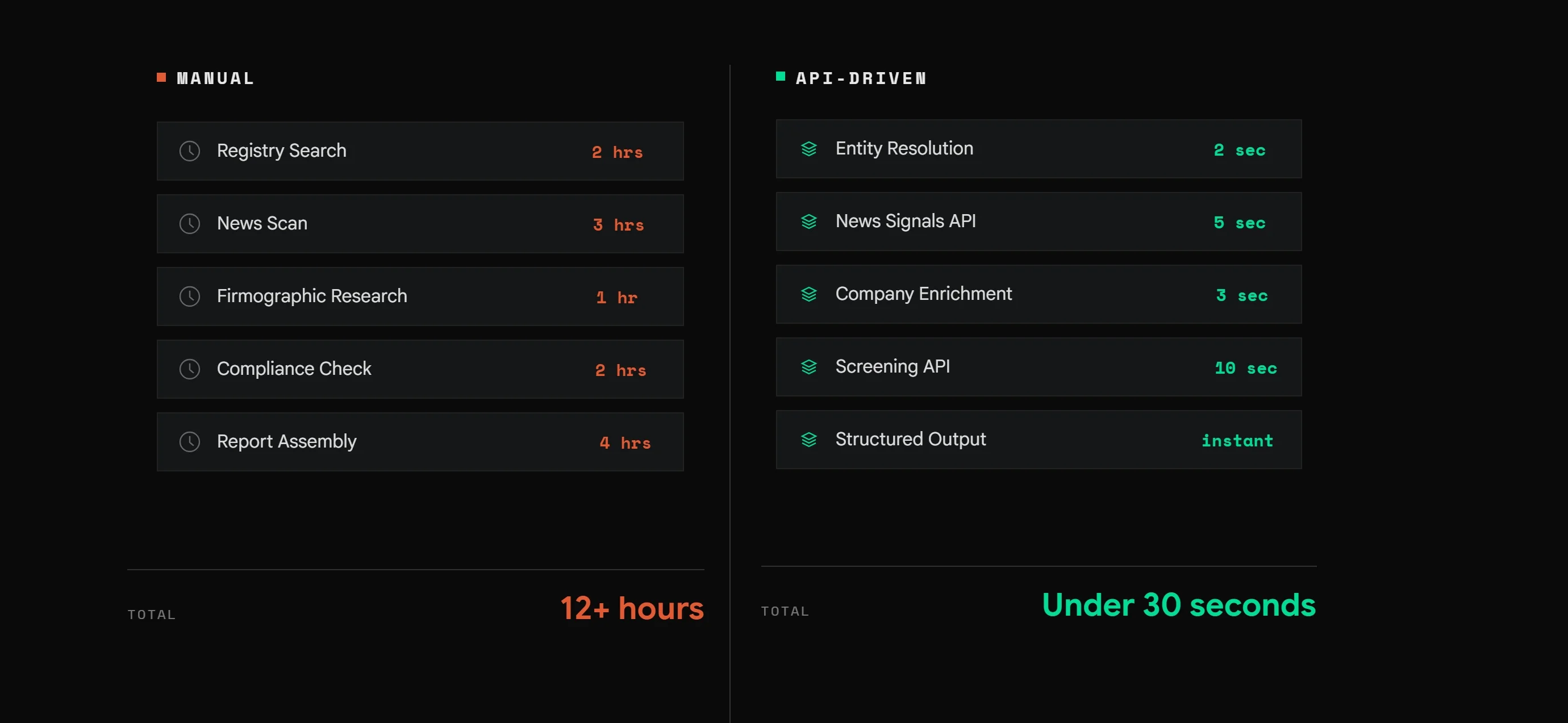
Private company due diligence consumes roughly 120 hours per completed deal. Factor in deals that never close and the number climbs past 250 hours per investment. Automating company due diligence means replacing that manual assembly work, financial verification, ownership mapping, legal exposure, competitive positioning, management background checks, with structured API calls. Deal teams, risk analysts, and corporate development groups increasingly use private company data APIs to automate the time-consuming layers, cutting days of manual research into minutes. What can't be automated is judgment: reading what a headcount drop means for a specific deal, or deciding whether a founder is the right operator.
This blog covers which parts of due diligence can be automated through APIs, how to architect the pipeline, and where human judgment stays irreplaceable.
Why Private Company Due Diligence Still Runs on Manual Workflows
Private companies leave fragmented trails. Unlike public companies, which file quarterly and disclose ownership to exchanges, private firms operate with limited visibility, financials may sit behind a single jurisdiction's statutory filings, ownership behind holding entities, and operational metrics rarely get published at all.
The difficulty, is rarely knowing what to review. It's assembling reliable information fast enough to support a decision.
That assembly cost is measurable. McKinsey's 2025 survey found generative AI cutting M&A deal timelines by 10-30% and costs by roughly 20%, with 41% of corporate development teams now using it in at least one diligence workstream, up from 9% in 2023. The shift is real. The question is what sits underneath the AI layer, and the answer is data APIs.
What a Private Company Data API Actually Returns
A private company data API takes a name, domain, or identifier and returns structured firmographic, financial, and signal data instead of a PDF report. Depth varies by provider, some return basic firmographics, others 75+ data points per entity.
Here is what a typical enrichment call returns, using akta.pro's company data API as an example:
- Entity resolution: Matches a company name or website to a unique, globally resolved entity across 20M+ companies
- Firmographics: Headquarters, founding year, employee count, revenue estimates, operating status
- Business model and product offering: What the company sells, its go-to-market structure, competitive differentiation
- Management and leadership: Key executives with titles and backgrounds
- Technology stack: Tools and platforms the company uses internally
- Industry codes: NAICS, SIC, and proprietary sub-sector classifications
- Funding and M&A history (enterprise tier): Investment rounds, acquirers, transaction values
A separate news signals endpoint adds entity-resolved company mentions across 80 event categories, with sentiment scoring and deduplication.
POST /v1/company_search
{
  "query": "acme logistics",
  "match_type": "name_or_domain"
}

Response:
{
  "entity_id": "ent_4f8a2b9c",
  "name": "Acme Logistics Inc.",
  "domain": "acmelogistics.com",
  "confidence": 0.97
}
That entity_id is what every subsequent enrichment or signal call references, which is why entity resolution runs first in the pipeline below.
For context on how this compares to the broader AI-due-diligence landscape: platforms like Hebbia, Kira Systems, and Luminance apply AI to document review inside data rooms (contracts, filings, disclosures), while Datasite and Intralinks manage the data room itself. A company data API like akta.pro's sits underneath all of them, supplying the structured firmographic and signal layer that feeds into whichever document-review or data-room tool a deal team already uses. It's infrastructure, not a replacement for those platforms.
Five Due Diligence Layers You Can Automate with APIs
| Layer | How automatable | Typical providers |
|---|---|---|
| Entity resolution | Fully | akta.pro and comparable entity graphs |
| Firmographic enrichment | Fully | akta.pro, Crunchbase-type sources |
| News & signal monitoring | Fully | akta.pro news signals |
| Ownership / corporate structure | Partially, jurisdiction-dependent | Dun & Bradstreet, Moody's Orbis, OpenCorporates |
| Sanctions / PEP / watchlist screening | Fully | OpenSanctions, Middesk, Persona, ComplyAdvantage |
Entity resolution anchors everything downstream. Private companies share names, sit inside holding structures, and operate under DBAs, so every subsequent call depends on getting this match right first.
Firmographic enrichment replaces what used to be 30-60 minutes of manually pulling from LinkedIn and registries, then normalizing it into a spreadsheet.
News and signal monitoring is where APIs add the most leverage. A single call can return months of categorized, entity-resolved company news, filtering out roughly 80% of the noise a raw Google News search returns, classified across categories like legal actions, leadership changes, funding events, and workforce shifts.
Ownership mapping is the hardest to fully automate since registry quality varies by jurisdiction. Gaps tend to show up with offshore entities and complex fund structures.
Compliance screening against sanctions, PEP, and adverse media lists is the most mature category and is effectively fully automatable for standard diligence.
Building an API-Based Due Diligence Pipeline: Architecture and Sequence
Step 1: Ingest and resolve. The pipeline starts with a list of target companies, a single company name from a deal team, or a trigger from a CRM or deal pipeline tool. The first API call resolves each company to a canonical entity ID. This is non-negotiable. Every subsequent enrichment call references this ID.
Step 2: Firmographic qualification. Run the enrichment API to pull structured firmographics. Apply your filters: industry fit, geography, size range, operating status. Companies that fail qualification criteria get flagged and deprioritized without any analyst time spent.
Step 3: Signal scan. For companies that pass qualification, pull 90 to 180 days of historical company news and signals. Filter for material event types: legal actions, leadership changes, funding events, workforce shifts. Flag companies with adverse signals for escalated review.
Step 4: Deep enrichment. For the shortlisted targets, pull the full data profile: business model, technology stack, management team, competitive landscape, and (where available) financial estimates and funding history. This is the dataset that feeds your investment memo or risk assessment.
Step 5: Compliance screening. Run the target and its key principals through sanctions, PEP, and adverse media APIs. This runs in parallel with step 4 and produces a structured pass/fail/escalate output.
Step 6: Human review. The output of steps 2 through 5 is a structured dossier, not a decision. An analyst reviews the compiled profile, identifies gaps, formulates questions for management, and drafts the sections of the diligence report that require judgment: competitive moat assessment, management quality, market timing.
This sequence compresses 60-70% of the workload, identification, enrichment, monitoring, screening, into API calls that run in minutes. The remaining 30-40%, interpretation and negotiation context, stays with humans.
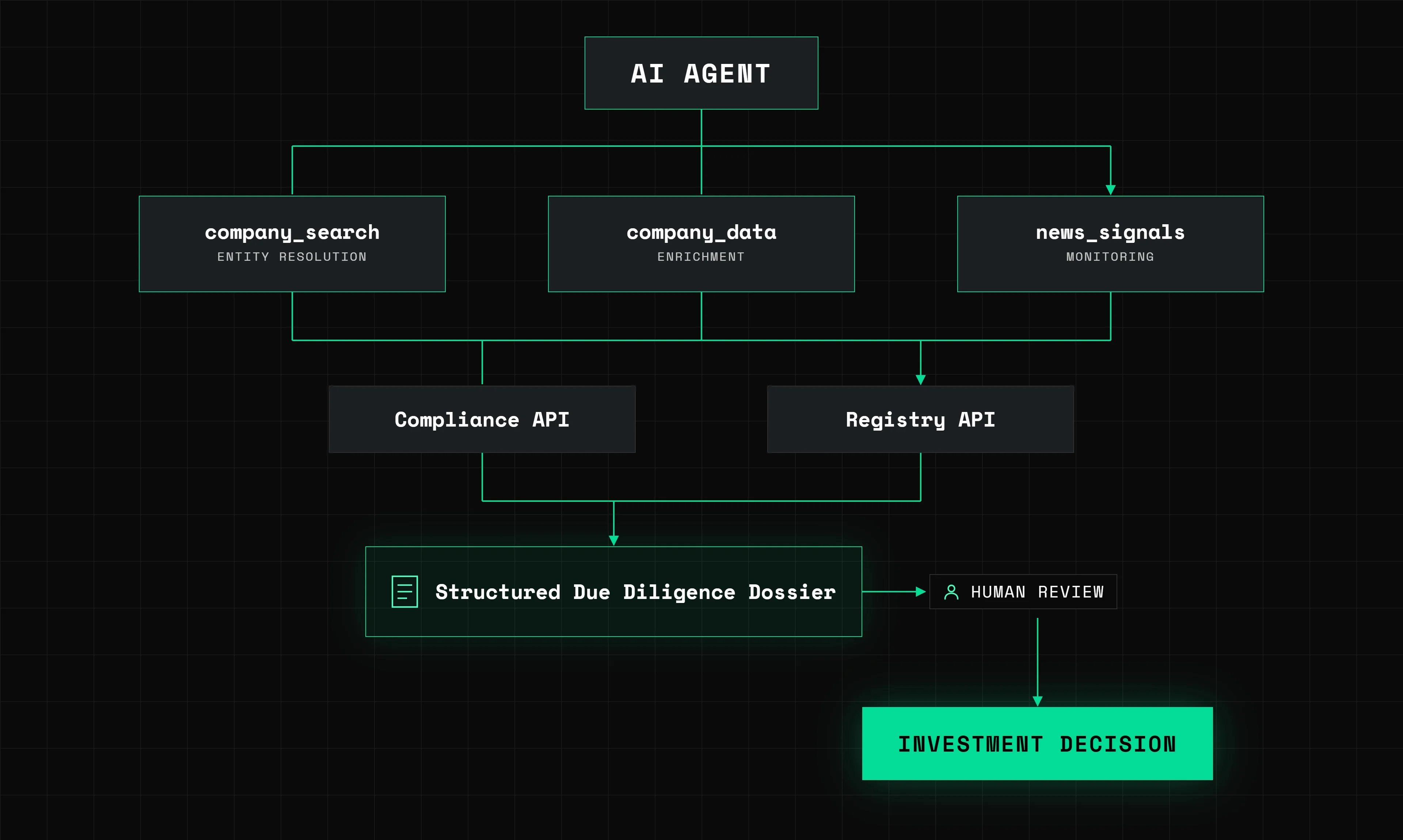
For teams building this with akta.pro, the workflow maps to three core endpoints: company_search for entity resolution, company_data for enrichment (billed per section, so you only pay for what you pull), and news_signals for event monitoring. The API returns deterministic schemas, meaning the output format is consistent and machine-parseable on every call, which matters when you are feeding results into an LLM, a dashboard, or a downstream automation.
Where Automation Stops and Human Judgment Starts
Bain's 2026 Global Private Equity Report argued that diligence workstreams (market prospects, product attributes, IT architecture, go-to-market) are too often treated as unrelated questions, when an integrated view is what actually matters. That integration is a human task.
Here is what still requires a person in the loop:
- Interpreting data in deal context: A 30% headcount decline could be a red flag or a deliberate efficiency play. The API gives you the number. A human decides what it means for the specific deal.
- Assessing management quality: No API call tells you whether a CEO is the right operator for the next stage of the business. That comes from reference calls, in-person meetings, and pattern recognition from prior deals.
- Evaluating competitive moat durability: Bain recently disclosed that it uses AI-generated code replicas of target software products during diligence to test how easily a company's product could be replicated. That is a judgment exercise about defensibility, not a data lookup.
- Negotiation strategy: What you discover in diligence shapes how you structure the deal: price adjustments, indemnification clauses, earn-out provisions. This is adversarial reasoning, not data enrichment.
How AI Agents Are Changing the Unit Economics of Due Diligence
If a full due diligence report costs $50,000 to $150,000 in analyst time and fees for a mid-market deal, a range consistent with Papermark's cost breakdown, and an API-plus-agent workflow produces 70% of that output for under $500 in data costs, the math changes how many targets a fund can evaluate per deal.
Research on angel returns shows investors who spent more than 20 hours on diligence achieved a 5.9x return multiple versus 1.1x for those under 20 hours. More diligence correlates with better returns, and APIs make "more diligence" economically feasible even for smaller checks.
FAQs
What is due diligence on a private company?
Due diligence on a private company is a systematic investigation of a business's financial, legal, operational, and commercial condition before an investment, acquisition, or partnership. Because private companies are not required to file public disclosures like their listed counterparts, the process relies more heavily on primary research, registry data, third-party databases, and direct management engagement to verify claims and identify risks. Structured company data APIs like akta.pro replace much of that manual assembly, returning firmographics, ownership signals, and entity-resolved news through a single call instead of a multi-source manual search.
How long does private company due diligence take?
The timeline ranges from days to months depending on deal complexity. Initial qualification can be completed in hours with API-based screening, akta.pro's company data and news signals endpoints, for instance, return a structured profile in seconds per company, which is what makes same-day initial qualification realistic. Full confirmatory diligence typically runs 4 to 8 weeks for mid-market transactions. In competitive auctions, operational diligence may need to happen within 24 to 48 hours.
What types of APIs are used in automated due diligence?
The core API categories include company data enrichment APIs (firmographics, financial estimates, ownership), news and signal monitoring APIs (entity-resolved company news with event categorization), compliance screening APIs (sanctions, PEP, adverse media), and corporate registry APIs (formation data, filings, UBO records). akta.pro is one of the few providers combining company data and news signals in a single platform rather than requiring two separate subscriptions, while others specialize in a single layer, compliance (OpenSanctions, Middesk) or corporate linkage (Dun & Bradstreet, Moody's Orbis).
Private company due diligence is a data assembly problem before it is an analytical one. APIs solve the assembly. The analysis is yours.