Ask Claude about Apple and you get a competent answer. Ask it about Ensemble Health Partners headcount over the last four quarters, Vestberry's competitor set, or which mid-market cold-storage operators just raised a Series B, and you hit a wall. Claude was not trained on private markets, and the public web indexes those signals badly.
That gap is why analysts still keep two windows open: Claude in one, PitchBook or Dealroom.co in the other. The Model Context Protocol (MCP) closes it. MCP lets Claude call an external data provider mid-conversation and reason over the response the same way it reasons over your prompt. Connect the right server and Claude stops guessing about private company data and starts pulling it.
Quick answer: To access private company data in Claude, add a private-company-data MCP server as a custom connector. Open Customize, then Connectors, paste the provider's MCP URL such as akta.pro's, and authenticate once. Claude can then pull firmographics, funding, and signals inside any chat. Setup takes about three minutes.
This guide covers the four ways to get private company data into Claude, what each is good for, and the 3-minute setup that most analysts and builders land on.
Why Claude Doesn't Know Anything About Private Companies (Yet)
Private companies do not file with the SEC. They do not publish quarterly financials. Their headcount, revenue, ownership structure, and funding history sit inside a handful of paid databases and a long tail of press releases, LinkedIn signals, and Glassdoor pages that no LLM has fully absorbed. Anthropic's own Claude for Financial Services rollout leans on PitchBook, S&P Global Capital IQ, and Snowflake precisely because that data is not native to the model.
So when you ask Claude about a private target, one of three things happens. It refuses, it hedges, or it invents a headcount number that reads as plausible but is wrong. None of those belong in a diligence workflow.
Prompting harder does not fix this. Giving Claude a live data source does, and that is exactly what an MCP connector provides.
The Four Ways to Get Private Company Data Into Claude
There are four viable routes today. They are not equivalent, and picking the wrong one costs you accuracy, budget, or a weekend of engineering. Here is how they compare before we go deeper on each.
| Route | Best for | Private-markets coverage | Setup effort |
|---|---|---|---|
| Directory connectors | Tools your firm already pays for | Thin today | Lowest, one click |
| Custom remote MCP connectors | Most analysts and teams | Broadest | Low, about 3 minutes |
| Claude API with MCP connector | Builders and automated pipelines | Depends on provider | Medium, some code |
| Financial services plugins | PE, IB, and equity research teams | Curated, provider-dependent | Medium, install core plugin first |
1. Directory connectors (fastest, narrowest coverage)
Claude ships with a Connectors directory of pre-verified integrations. You log in, click connect, and the data is available in every conversation. This is the path for tools your firm already pays for that happen to have shipped an MCP server. As of 2026, the private markets side of that directory is thin. Public-markets and productivity tools dominate.
If your provider is not listed, you are in one of the next three lanes.
2. Custom remote MCP connectors (the workhorse)
Custom connectors let Claude reach any service that exposes a remote MCP endpoint over HTTPS. This is where most private company data now lives. A provider publishes an MCP server URL, you paste it into Claude, authenticate once, and every future conversation has that data on tap. Custom connectors are available on Free, Pro, Max, Team, and Enterprise plans, with free users capped at one.
One detail matters: Claude connects to your MCP server from Anthropic's cloud infrastructure, not your local device, so servers behind a VPN or corporate firewall will not work without additional configuration. For public data providers this is a non-issue. For internal systems it is the whole problem.
3. The Claude API with the MCP connector (for builders)
If you are building an agent, a report generator, or a research pipeline on top of Claude, the Messages API supports MCP servers directly. You pass an mcp_servers array in your request and Claude can call the tools without you writing a custom MCP client. This is how firms embed private company data into automated deal screening, portfolio monitoring, or CIM drafting workflows.
4. Financial services plugins (curated, opinionated)
Anthropic shipped a set of open-source financial services plugins covering financial analysis, investment banking, equity research, private equity, and wealth management. The core financial analysis plugin includes shared MCP connectors for financial data providers and must be installed first. These plugins bundle skills like /comps and /dcf with pre-wired data sources. They are powerful when your workflow matches the template and limiting when it does not.
The 3-Minute Setup: Connecting a Private Company Data MCP to Claude
The steps below use akta.pro, which was purpose-built as a private company data and signals API for agent workflows. The mechanics are identical for any MCP-native provider.
Step 1. Grab an API key. Sign up at the akta.pro API playground, open API Keys in the sidebar, and generate one. The key is shown once, so copy it immediately. Keys look like wk_xxxxxxxxxx....
Step 2. Add the connector in Claude. Open Claude and go to Customize, then Connectors, then click the plus button to add a custom connector. Enter a name and paste the server URL: https://mcp.akta.pro/mcp. Click Add and complete authentication.
Step 3. Start using and pay as you go. In a fresh chat, ask something like: "Pull the firmographic and management profile for Ensemble Health Partners." Claude invokes the company_data tool, returns structured Markdown, and cites the source in line.
That is the whole setup. No config file, no restart, no build. On Cursor, VS Code, or Claude Code, the equivalent config is a two-line JSON block pointing at the same URL with the API key as an x-api-key header.
What You Can Actually Ask Claude Once It's Connected
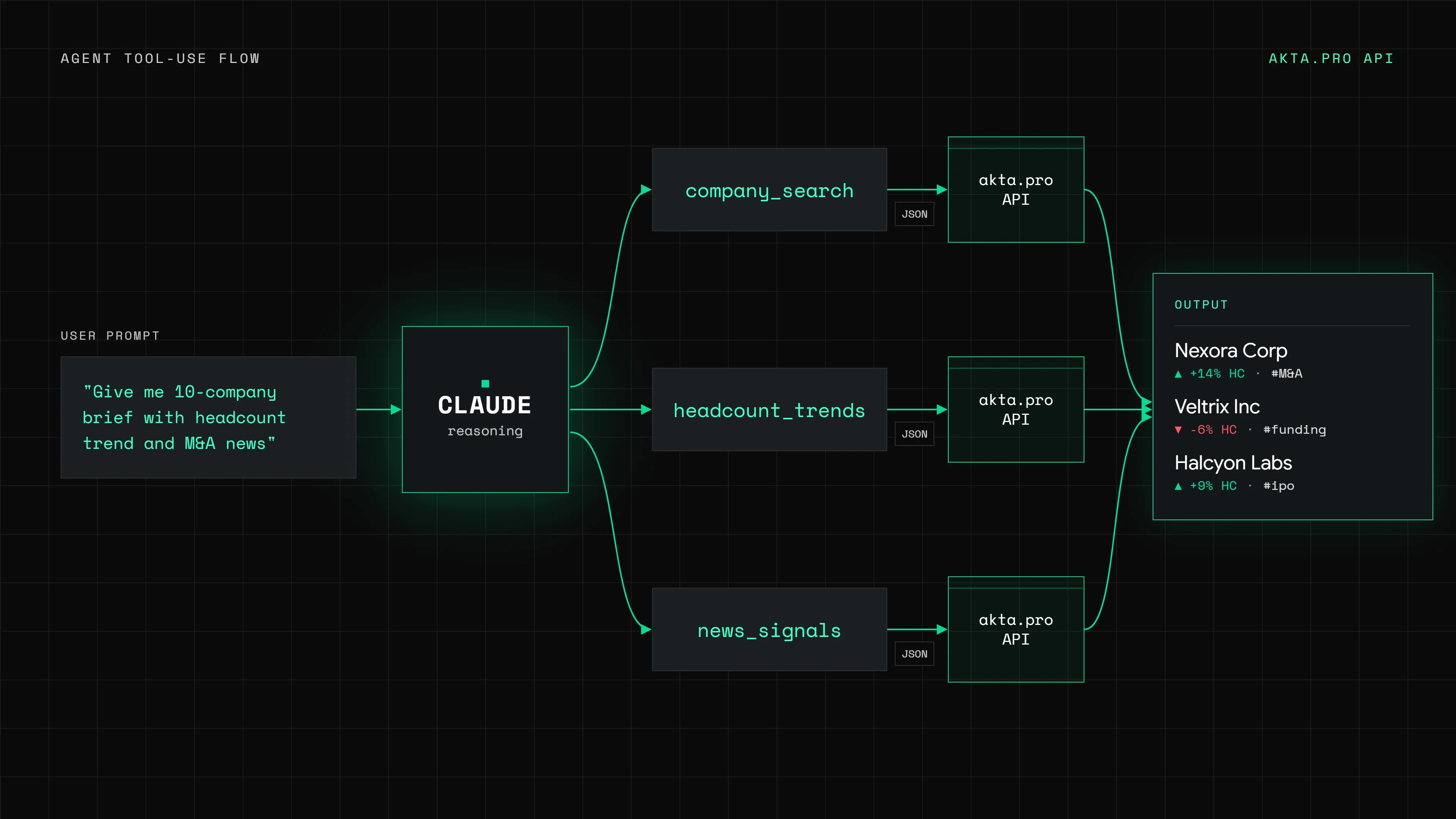
The connector gives Claude a specific set of tools. Naming them matters, because Claude routes based on tool descriptions.
Resolve first, then query. Private company data providers all face the same problem: which "Stripe" do you mean? The akta.pro company_search tool resolves a name or website to a canonical UUID. This is the same discipline that S&P and PitchBook apply internally. Skip it and, in akta.pro's own testing, you pull data for the wrong entity on roughly 8% of ambiguous names.
Firmographics and profile. The company_data tool returns a structured Markdown profile that includes business description, funding history, leadership, competitor set, and market position. Enterprise tiers expose deeper funding_detail and mna_and_investment sections.
Signals, not just news. The news_signals tool returns categorized news with sentiment and de-duplication. Legacy news APIs return raw article dumps. The akta.pro feed filters roughly 80% of the noise before it reaches Claude's context window, which saves tokens and keeps the reasoning clean.
Alternative data. The headcount_trends, website_traffic, employee_reviews, and job_posts tools give Claude the workforce and demand signals that make a growth thesis defensible.
Here is what a real prompt looks like once this is wired up:
"For the following ten companies, give me a one-paragraph summary, the headcount trend over the last 12 months, and any capital markets news from the last quarter. Flag anything that looks like an M&A signal."
Without a connector, Claude apologizes. With one, you get the ten-company brief in the time it takes to refill your coffee.
The Contrarian Take: Most Firms Are Buying the Wrong Data Layer
The instinct at most PE and VC firms is to bolt Claude onto their existing PitchBook seat. That works until you count the math. A single PitchBook or S&P seat costs roughly $25,000 a year and gives one person a login. If your deal team is five analysts running twenty screens a week each, you are paying for shelfware two-thirds of the time.
Agent workflows invert the pricing model. Instead of buying seats for humans who might query, you buy request volume for agents that will.
| Approach | Pricing model | Rough cost | Best fit |
|---|---|---|---|
| Legacy seat (PitchBook, S&P Capital IQ) | Per human seat, per year | ~$25,000 per seat | Analysts who log in and click |
| Pay-as-you-go API (akta.pro) | Per request | ~200,000 requests for the price of one legacy seat | Agent workflows that query at scale |
Pay-as-you-go APIs like akta.pro turn the equivalent of one legacy seat into roughly 200,000 requests, which is closer to how AI-native workflows actually consume data. If you are still paying per seat for data your agents need to query millions of times, you are subsidizing the last generation of software.
Security, Cost, and Governance
A few things are worth knowing before you connect anything to a corporate Claude workspace.
Data does not train the model. Anthropic does not use Claude API traffic for training by default, and enterprise MCP providers such as akta.pro carry their own SOC 2 Type II and ISO 27001 posture. Confirm both before you roll out.
Audit trails matter. TrueFoundry and similar AI gateways can route Claude's model and tool calls through a centralized layer, so you keep one audit trail across every user, every MCP server, and every request. In a regulated environment, that is a requirement, not a nice-to-have.
Watch the token math. Every MCP tool response consumes context window. Providers that return dense, filterable JSON rather than raw article dumps are materially cheaper to run at scale. This is the single biggest hidden cost of a naive MCP setup, and it is why akta.pro filters and structures data before it reaches Claude.
How We Tested This
The setup steps above were run against a live Claude workspace on a Pro plan and the akta.pro MCP server at https://mcp.akta.pro/mcp in September 2026. Plan availability for custom connectors is drawn from Anthropic's connector documentation. The entity-resolution and noise-filtering figures are akta.pro's own internal measurements across ambiguous company names and news feeds, so treat them as directional benchmarks rather than third-party audits.
FAQs
What is private company data?
Private company data is financial, operational, and market information about companies that are not publicly traded. It covers revenue estimates, headcount, ownership structure, funding history, leadership, product lines, and news signals. Because private firms have limited disclosure requirements and rarely publish standardized financials, this data is fragmented across databases, filings, press coverage, and alternative sources, which is why providers like akta.pro exist to consolidate it.
Can Claude access private company financials directly?
No, not without a connector. Claude's training data does not include structured private company financials. Connecting an MCP-based provider such as akta.pro gives Claude on-demand access to firmographics, funding history, and revenue estimates during a conversation.
Is a Claude connector the same as an MCP server?
No. An MCP server is the backend endpoint that exposes the tools and data. A Claude connector is the frontend link that tells Claude which MCP server to call and how to authenticate. One MCP server, such as the akta.pro endpoint, can be exposed through many connectors across Claude, Cursor, VS Code, and Claude Code.
Can I use Claude connectors for free?
Yes. Custom connectors using remote MCP are available on Free, Pro, Max, Team, and Enterprise plans, and free users are limited to one custom connector. The Claude side is free on paid plans; the cost sits with the data provider. Pay-as-you-go APIs like akta.pro start at zero and bill on request volume, which suits agent workflows better than a five-figure annual seat.
How much does it cost to add private company data to Claude?
The Claude side is free on paid plans. The data side depends on the provider. Legacy vendors like PitchBook and S&P Capital IQ run five figures per seat annually. Pay-as-you-go APIs designed for agent consumption, such as akta.pro, run on request volume and start at zero, which is usually a better fit for AI workflows.
Which private company data provider works best inside Claude?
Any provider that ships a hosted MCP server will work. The ones designed for agentic consumption, with compact JSON, deterministic schemas, entity resolution, and source attribution, reduce token cost and hallucination risk. akta.pro was built specifically for this pattern. Providers that only offer raw REST APIs require you to build and maintain your own MCP wrapper.
The gap between "Claude is impressive" and "Claude actually replaces workflow" is almost always a data problem. Connect private company data through an MCP connector and the model you already pay for turns into a research analyst you can run around the clock.
To try it, the akta.pro playground issues an API key in under a minute, and the connector setup takes two more.