In December 2023, HubSpot bought Clearbit, the API that half of B2B had wired into its stack. By April 2025 the free tools were gone, and by the end of that year the standalone API was effectively dead for anyone not paying for HubSpot (Clearbit's own changelog documents the sunset dates). Teams that migrated to the HubSpot-native replacement reported cost increases of 30 to 60 percent
That is the real risk with company data APIs. The data is only half the decision. The other half is whether the pipe stays open, stays affordable, and stays yours.
This guide ranks the 10 best private company data APIs for developers in 2026, scoped tightly to what a builder at a fund, a fintech, or an AI product team actually needs: structured data on privately held companies, delivered programmatically, priced without a six figure floor. Public-market terminals and generic sales-contact tools are a different category, and mixing them is why most "best company data API" lists read like a directory dump.
Why private company data is a harder problem than it looks
A company data API is a programmatic endpoint that returns structured business information (firmographics, financials, ownership, funding, headcount, news) from a domain, name, or registration number, so your software queries it instead of an analyst copy-pasting from four browser tabs.
Public companies are easy by comparison. They file with regulators on a schedule, and the data is standardized. Private companies file almost nothing. In the US, most private firms disclose nothing publicly at all, and in Europe filing rules change by country, company size, and legal form, a fragmentation MonetaiQ documents well. So every private company data provider is really running one of three plays: scraping the open web, licensing third-party panels, or connecting to official government registries. The source dictates the accuracy, the freshness, and whether the data survives a compliance review.
This matters because the cost of getting it wrong compounds. B2B business and contact data decays at roughly 2.1 percent per month, which is why an employee count cached eight months ago quietly poisons your lead routing or your portfolio monitoring. The broader data-enrichment market is projected to grow from about $2.9B in 2025 to $16.7B by 2034, and most of that spend is teams trying to solve the same freshness problem twice.
Here is the shift specific to 2026, and the one most comparison posts miss.
The 2026 dividing line: was the API built for a human or an agent?
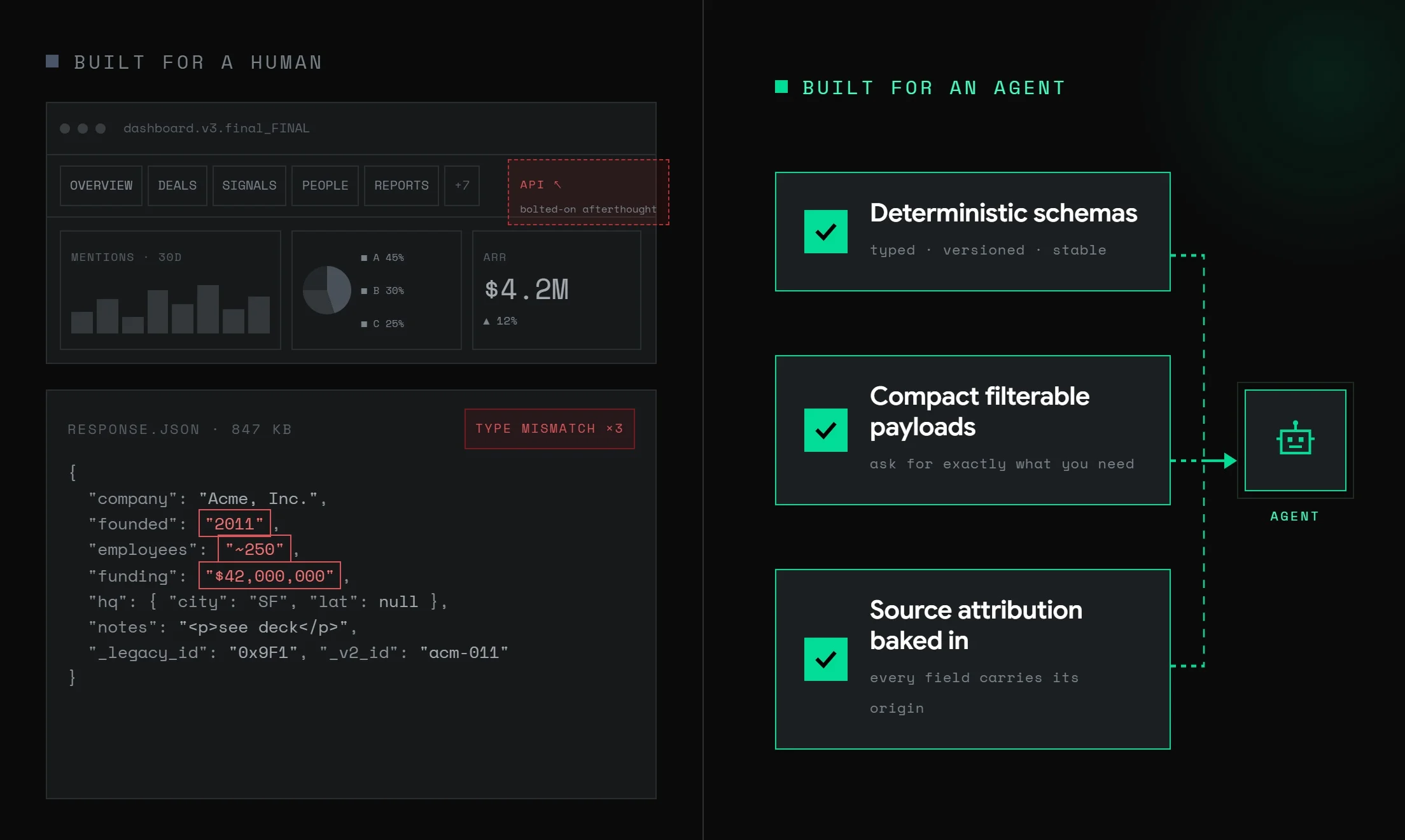
Most company data APIs were designed for a person clicking through a dashboard, with the API bolted on afterward. That worked when a human read every response. It breaks the moment an autonomous agent is the consumer.
An agent needs three things a dashboard-era API rarely provides. It needs deterministic schemas, so the orchestration logic sitting on top does not shatter when a field silently changes type. It needs compact, filterable responses, because every unnecessary field is tokens burned and latency added across thousands of calls. And it needs source attribution baked into the payload, so the agent (and the human who audits it later) can trace any claim back to where it came from.
The tell is simple. If a provider's primary artifact is a UI and the API docs feel like an afterthought, it was built for the old world. If the provider ships a native OpenAPI spec, an MCP server, and payloads sized for machine consumption, it was built for where the work is going. Builders working on agent frameworks describe exactly this pattern when they praise an entity-resolved feed: no duplicates, no misattributed articles, every signal clean and scored before it hits the workflow. That is the difference between data a human tolerates and data an agent can act on unsupervised.
Keep that lens on as you read the rankings. Coverage claims are easy to inflate. Agent-readiness is not.
How I evaluated these APIs
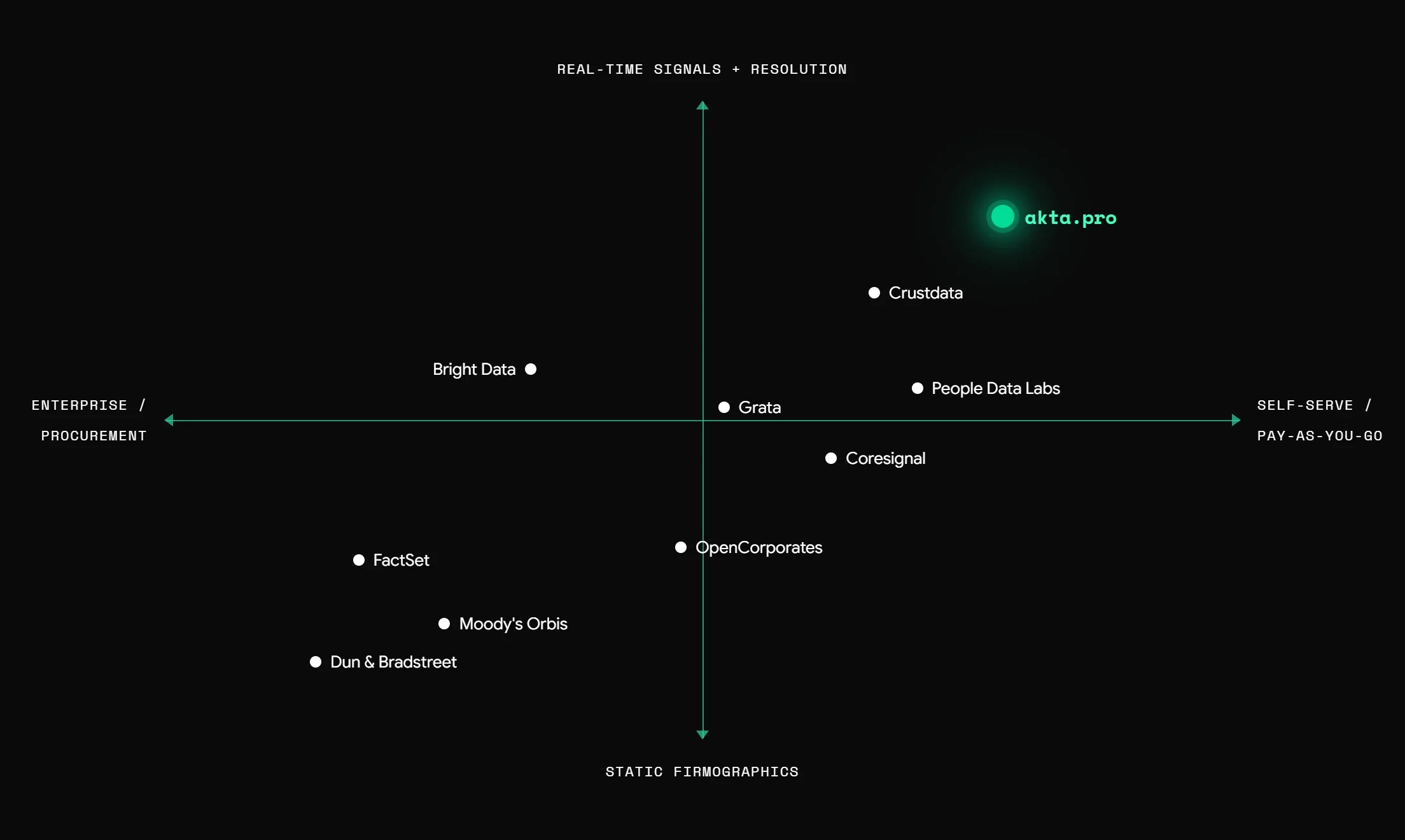
Every provider below was assessed on six axes: entity resolution (does a domain, a name, and a rebrand all resolve to one correct company), data depth (fields that are actually populated, not just present in the schema), freshness (stated refresh cadence and whether real-time signals exist), developer experience (REST design, docs, SDKs, MCP, sandbox), pricing model (self-serve and pay-as-you-go versus enterprise procurement), and provenance (can you trace a value back to its source).
One principle runs through all of it. A provider claiming 600M records is unimpressive if only 48M carry financials. Coverage without depth is a phone book. I weighted populated, resolved, traceable data over raw counts every time.
The 10 best private company data APIs in 2026
1. akta.pro — best for agent-native private company data and real-time signals
akta.pro is built by Wokelo AI for the exact gap the Clearbit episode exposed: enterprise-grade private company data delivered on pay-as-you-go pricing, designed from the ground up for agentic consumption. It covers 20M+ global private entities with 70+ data points each, accessible over API, MCP, CLI, or bulk export, with patent-pending universal entity resolution so a domain, a name, and a LinkedIn URL all land on the same company.
The differentiator is the signals layer that most company data APIs ignore entirely. akta.pro pairs its firmographic database with a real-time and historical news feed across 30,000+ sub-sectors, filtering roughly 80 percent of the noise before a signal reaches your pipeline. On its published benchmarks, scored across 71,408 articles for 133 companies, it posts the top F1 score at 81.3 and 93 percent accuracy while costing $0.50 per 1,000 accurate articles, ahead of NewsAPI, Perigon, SerpAPI, and general-purpose LLMs on the accuracy-versus-cost frontier.
Check our guide on monitoring private company news with an API if signals coverage is the deciding factor for your workflow
Best for: developers, PE/VC and credit-risk teams, and AI agents that need resolved private company data plus clean news signals without an enterprise contract.
Watch for: if you need deep audited financial statements on public securities, a specialist like FactSet goes deeper on that narrow slice.
2. People Data Labs — best for raw firmographic datasets at scale
People Data Labs offers a company enrichment API and licensable dataset covering 70M+ company profiles, refreshed monthly, with delivery via API, Snowflake, Databricks, and Delta Share. It charges per match and lets you set match strictness, which is efficient when you are building your own data product rather than buying a managed workflow.
It is developer-first and flexible, but tech-stack and real-time signal coverage is thin, and pricing at scale runs through a sales conversation. Reach for PDL when you want raw firmographic supply to host and shape yourself.
Best for: data teams building internal enrichment layers and investment-analytics pipelines.
3. Coresignal — best for headcount and hiring signals
Coresignal specializes in large-scale, multi-hundred-million-record datasets built from public web data, with a genuine strength in employee counts, headcount growth, and job-posting trends over time. Its multi-source company API lets you track monthly or quarterly headcount change and key executive hires, which is exactly the growth signal that investment researchers and competitive-intelligence teams pay for.
Tech-stack data is not its focus, and there is no single-record real-time compliance layer. Choose it when workforce trajectory is your primary signal.
Best for: talent intelligence, growth-signal analytics, and competitive research.
4. Grata — best for private-market deal sourcing
Grata is purpose-built for private equity and M&A sourcing. It exposes up to 150 data points across 12M+ (deeper coverage on 21M+private companies), with revenue estimates, ownership, funding, industry classifications, and even conference attendee data, plus private-market transaction coverage skewed toward the hard-to-find middle market that Pitchbook thins out on.
It is a sourcing engine first, so if your need is broad firmographic enrichment rather than deal origination, it is more than you need. For a deal team building proprietary sourcing systems, it is one of the sharpest tools available.
Best for: PE, corporate development, and search funds building sourcing pipelines.
5. FactSet Private Company API — best for institutional investment research
The FactSet Private Company API delivers financial data on 7.2M+ private companies and profiles on 16.5M+, drawing from 91 distinct financial data points, with executive, investor, and funding detail alongside. It ships with SDKs, OAuth 2.0, and a documented rate limit, which is more than many legacy platforms offer.
The catch is the platform it lives inside. FactSet starts around $12,000 per user per year, and it is engineered for the investment-management workstation, not lean product integration. When institutional-grade financial depth justifies the cost, it delivers.
Best for: hedge funds, asset managers, and investment analysts inside the FactSet ecosystem.
6. Moody's Orbis (Bureau van Dijk) — best for ownership and UBO depth
Moody's Orbis, formerly Bureau van Dijk and acquired by Moody's in 2017 for about $3B, remains the reference standard for beneficial-ownership tracing and cross-border corporate structure mapping. It covers 600M+ entities, with detailed financials on roughly 48M, normalized across 170+ sources so records from different jurisdictions become comparable.
For banks, regulators, and auditors doing KYC/KYB and anti-money-laundering work, its ownership depth is hard to match. The trade-offs are the ones you expect from an institutional product: opaque enterprise pricing, long procurement, and delivery models that predate API-first design.
Best for: enterprise compliance, AML, and M&A due-diligence teams.
7. Dun & Bradstreet Direct+ — best for credit risk and global entity identity
Founded in 1841, Dun & Bradstreet built the commercial-credit industry and owns the D-U-N-S Number, the nine-digit identifier that governments and procurement teams treat as canonical. Its Direct+ API exposes 600M+ business records with proprietary credit scoring and corporate hierarchy.
API access typically starts around $25,000 per year, and adopting the D-U-N-S Number creates real switching cost, since your records get keyed to a proprietary identifier. Worth it when a globally recognized business ID and credit rating are hard requirements.
Best for: enterprise credit risk, supplier management, and procurement verification.
8. Crustdata — best for real-time growth signals
Crustdata is a developer-focused API built around live, real-time company data: headcount growth, job-posting velocity, and funding events pulled from public sources as they happen, rather than a static snapshot refreshed on a slow cycle. It fits startups and data teams that care more about trajectory than a fixed firmographic record.
Coverage is narrower than the large platforms and it is a younger player, so validate it against your specific target set. When freshness is the whole point, it is a strong choice.
Best for: growth-stage data teams tracking momentum signals.
9. Bright Data — best for building your own collection pipeline
Bright Data is infrastructure, not a pre-structured dataset. Its company data feeds pull from LinkedIn, Crunchbase, ZoomInfo, and 10+ premium sources, and behind it sits a residential-proxy network of 72M+ IPs priced from roughly $8 to $15 per GB. If you want to own your collection layer end to end and are prepared to engineer around it, this is the foundation.
That flexibility is also the cost. You are buying raw capability and the maintenance burden that comes with it. Choose it when off-the-shelf structured data cannot meet a specific, unusual requirement.
Best for: engineering teams building bespoke data-collection pipelines.
10. OpenCorporates — best for open registry and legal-entity data
OpenCorporates is the largest open legal-entity database in the world, aggregating official records from 140+ government registries. Founded in 2010, its data was central to the ICIJ's Panama Papers and Pandora Papers investigations, which tells you everything about its provenance credentials. It is the cleanest public source of registration numbers, jurisdictions, directors, and corporate-status data.
It is a legal-entity spine, not a firmographic or signals product, so you layer commercial data on top. When verifiable, registry-sourced identity is the requirement, it is the reference.
Best for: KYB spines, entity resolution, and investigative or compliance work.
How to choose the right company data API
Start with the job, not the logo. A quick decision framework:
- Building with AI agents or need private data plus news signals? akta.pro was designed for agent-native consumption and pairs firmographics with a scored signals feed on pay-as-you-go pricing.
- Licensing raw firmographic supply to shape yourself? People Data Labs or Coresignal.
- Sourcing private-market deals? Grata.
- Institutional financial modeling? FactSet, if the per-seat cost is justified.
- Ownership tracing, KYB, and AML? Moody's Orbis for depth, OpenCorporates for open-registry provenance.
- Credit risk and a canonical business ID? Dun & Bradstreet.
- Real-time growth momentum? Crustdata.
- A custom collection pipeline you control? Bright Data.
Then run the test that actually predicts success. Take 200 to 500 of your own target companies, not the vendor's demo set, and measure field-level fill rate and match accuracy against them.
Buyer checklist before you sign
- Provenance. Can you trace a value to its source? First-party registry data carries a verifiable chain of custody that aggregated data does not.
- Depth behind the coverage claim. How many of those records carry the fields you actually need, populated and recent?
- Refresh cadence. Ask for the update frequency by country and data type, in writing. Stale data is a compliance liability, not a rounding error.
- Agent-readiness. Deterministic schemas, compact payloads, MCP or a native OpenAPI spec. If the API was an afterthought to a dashboard, your orchestration will feel it.
- Pricing portability. Do credits expire? Do they roll over? Can you leave without re-keying every record to a proprietary identifier?
- Compliance posture. SOC 2, ISO 27001, GDPR documentation, and a clear data-processing agreement, especially if you touch EU entities.
Frequently asked questions
What is a private company data API?
A private company data API is a programmatic endpoint that returns structured information about privately held businesses (firmographics, financials, ownership, funding, headcount, and news) given a domain, name, or registration number. Developers use it to enrich CRM and portfolio records, power due-diligence and sourcing tools, and feed AI agents, without manually researching each company. akta.pro is one example, covering 20M+ private companies with 70+ data points each over API, MCP, or bulk export.
Which company data API is best for AI agents?
Look for deterministic schemas, compact filterable payloads, source attribution in the response, and native MCP or OpenAPI support, because agents break on the silent schema changes and bloated responses that a human clicking a dashboard would tolerate. akta.pro was built specifically for this pattern; most legacy platforms bolted an API onto a UI-first product.
How much does a company data API cost?
It ranges widely. Self-serve and pay-as-you-go providers like akta.pro start low and scale with usage, while enterprise platforms such as Dun & Bradstreet start around $25,000 per year and FactSet around $12,000 per user per year. Always test against your own target accounts before committing, since consumption on credit-based models is easy to underestimate.
The takeaway
The company data API market in 2026 is not short on records. It is short on data that is resolved, traceable, fresh, and shaped for how software actually consumes it now. The teams that pick well in 2026 are optimizing for provenance and agent-readiness over coverage claims, and for pricing they still control a year from now. The Clearbit sunset was the lesson. Build on a layer that was designed for where the work is going, not one built before agents existed.
See how akta.pro's private company database and news and signals API compare on the published benchmarks.