One in four company records in a typical B2B database goes stale within twelve months. People change jobs, companies get acquired, headcount doubles overnight, and your CRM keeps displaying the version it captured at signup as if nothing happened. Gartner puts the annual cost of this silent rot at $12.9 to $15 million for the average organization.
A company enrichment API is what stops that from compounding.
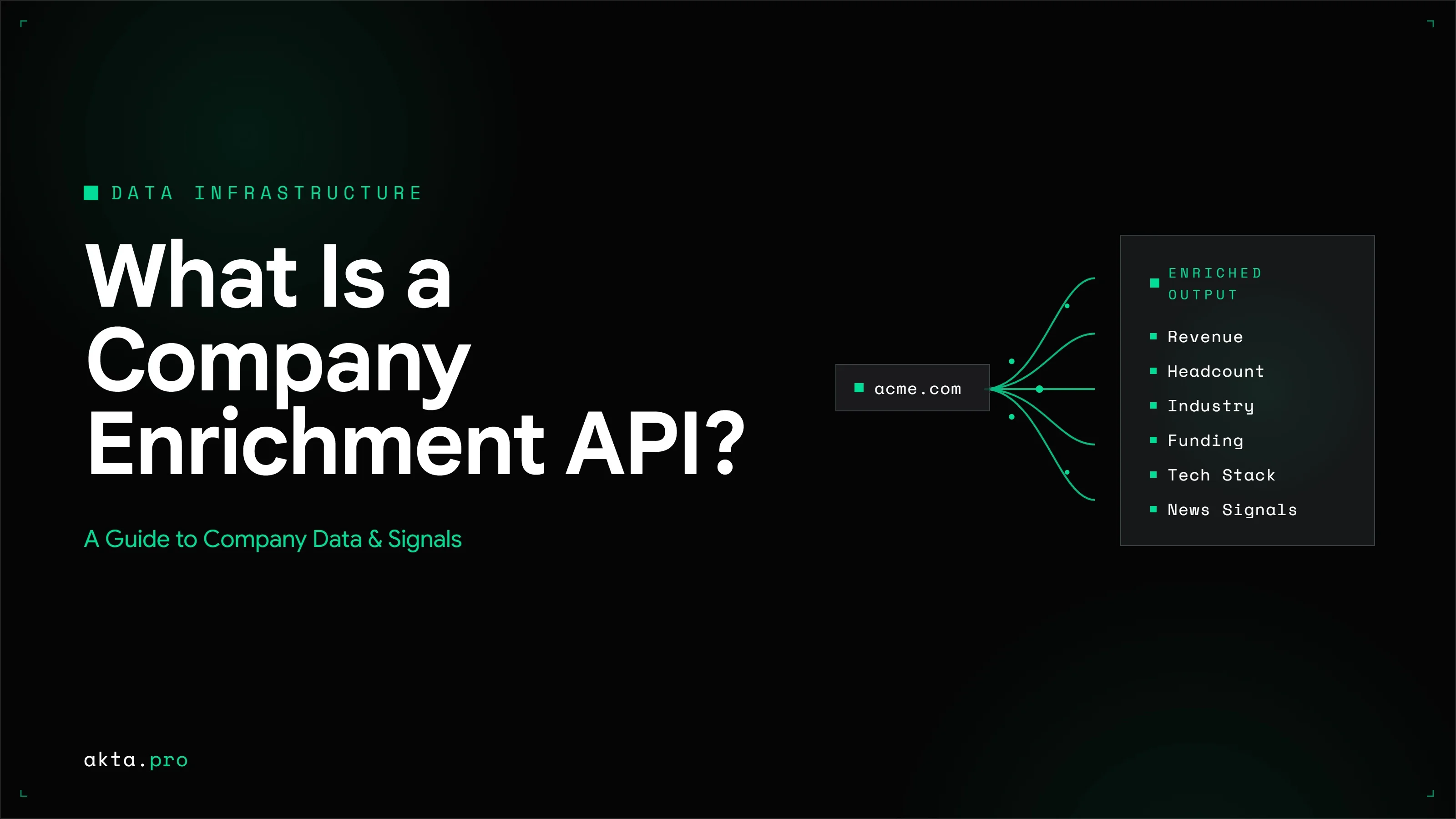
In plain terms, it takes a thin identifier you already have a domain, a company name, sometimes just an email address and returns a full, structured company profile. Firmographics. Revenue estimates. Headcount. Industry codes. Funding history. In the best implementations, real-time news signals and event data too. One API call, a few hundred milliseconds, and a bare CRM record becomes something your team can actually route, score, and sell into.
This guide covers how company enrichment APIs work, what data they return, how to evaluate one without relying on vendor marketing, and where most providers quietly fall short: private and mid-market companies.
How It Works: Input In, Profile Out
You send the API a request with what you have. It matches that against its company graph, resolves the entity, and returns a JSON payload.
| Input type | Example | Best for |
|---|---|---|
| Domain | stripe.com | Most reliable — a work email gives you one for free |
| Company name | Stripe, Inc. | Useful but ambiguous across subsidiaries and former names |
| Company ID | Provider-specific ID | Follow-up calls after initial resolution |
| LinkedIn URL | linkedin.com/company/stripe | Prospecting workflows |
The more you give it, the more confidently it matches. A domain plus a company name resolves more reliably than either alone. Response times range from 200ms to 3 seconds depending on the provider and whether the result is cached.
One distinction worth getting right early: company enrichment and contact enrichment are separate endpoints. Company enrichment returns organizational data — revenue, headcount, industry, tech stack, funding. Contact enrichment returns data about people — emails, phone numbers, job titles. You likely need both, but they solve different problems. A vendor with great phone numbers may have shallow company data, and vice versa. Evaluate them separately.
What Data You Get Back
A standard company enrichment API response covers these categories:
| Category | Typical fields |
|---|---|
| Identity | Company name, legal name, domain, description |
| Size | Employee count, headcount range, growth rate |
| Financials | Revenue estimate, revenue range, total funding |
| Classification | Industry, sub-industry, NAICS/SIC codes |
| Location | HQ address, city, country, office count |
| Structure | Parent company, subsidiaries, ownership type |
| Digital presence | LinkedIn URL, website traffic, social profiles |
| Technology | Tech stack, frameworks, infrastructure |
The practical value here depends on field coverage (how many fields actually come back populated) and field accuracy (whether those values are correct). A provider can list 100 fields in their schema and return nulls for 60 of them on your target accounts. Always test on your own data.
Beyond firmographics: signals and event data
Static firmographics describe what a company is. They do not tell you what a company is doing right now.
A company that raised a Series B last week, hired three enterprise sellers, and launched in a new geography is a fundamentally different prospect than its firmographic snapshot suggests. The next generation of enrichment adds this signal layer on top of the static base: funding rounds, executive changes, product launches, hiring surges, M&A activity. If your company enrichment API returns only snapshot data, you are missing the timing signals that power deal sourcing, portfolio monitoring, and competitive intelligence.
Why This Matters More Than It Did Two Years Ago
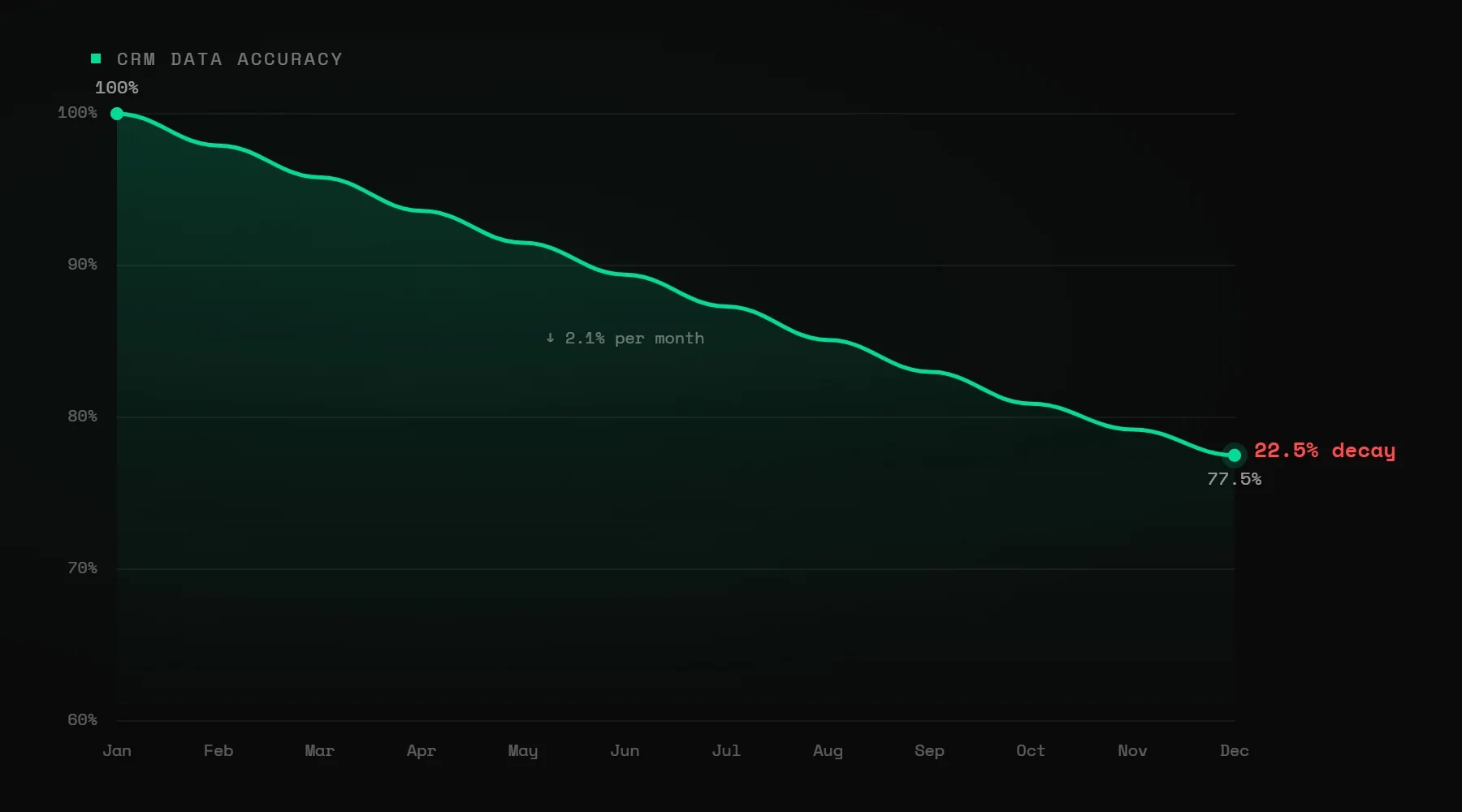
B2B company data decays at approximately 2.1% per month, compounding to roughly 22.5% annually. In tech and SaaS, annual decay runs 35–50%. That was already expensive.
Two shifts have made enrichment infrastructure rather than a nice-to-have:
AI agents now consume company data programmatically. LLM-powered copilots, automated scoring, and GTM workflows need clean, structured, current input to function. A stale CRM record doesn't just mislead a rep, it degrades every automated system that touches it.
The market is growing accordingly. The global data enrichment market hit roughly $3.16 billion in 2026 and is growing at 10–12% CAGR, according to The Business Research Company. More spend, more vendors, more noise to cut through.
How to Evaluate a Company Enrichment API
Every vendor claims millions of records and high accuracy. Those claims are marketing until you test them on your own accounts.
| Criterion | What to measure | How to test |
|---|---|---|
| Match rate | % of your domains that return a result | Send 500 real accounts from your CRM |
| Field accuracy | % of returned values that are correct | Spot-check 50–100 records against known truth |
| Field coverage | % of schema fields populated per record | Count non-null fields across your batch |
| Private company depth | Coverage of sub-500-employee and early-stage companies | Include SMBs and startups in the test list |
| Latency | Median and P95 response time | Time your API calls across the batch |
| Cost per matched record | True cost factoring match rate | Total spend ÷ usable records returned |
| Signal coverage | Funding, hiring, M&A, news events | Check if the API returns event data or just static fields |
An independent 2026 benchmark by OpenBenchmarks tested nine providers on 282 domains. Match rates ranged from 80.8% to 100%. Enrichment success rates ranged from 30% to 89%. The provider with the highest match rate was not the one with the highest field accuracy. That variation is exactly why you test.
The private company coverage gap
This is what most evaluation frameworks miss. Most enrichment APIs were built for sales teams targeting enterprise accounts databases optimized for large, well-indexed companies with strong LinkedIn presence. Send them a 200-person SaaS startup or a family-owned manufacturer outside the US, and the response comes back sparse or empty.
Coverage claims like "100M+ companies" sound impressive but say nothing about depth. The real question: how many of those records carry actual revenue estimates, funding data, and current headcount? For private company data APIs, the answer separates providers built for enterprise prospecting from those built for research, investing, and competitive intelligence.
Single-provider vs. waterfall: One API typically covers 50–68% of a target list. Waterfall enrichment chains multiple providers in sequence to push coverage toward 75–80%+. The trade-off is complexity, latency, and reconciling conflicting data. The alternative is choosing a provider with inherently broader coverage especially for private companies rather than stitching together multiple narrow ones.
Where akta.pro Fits
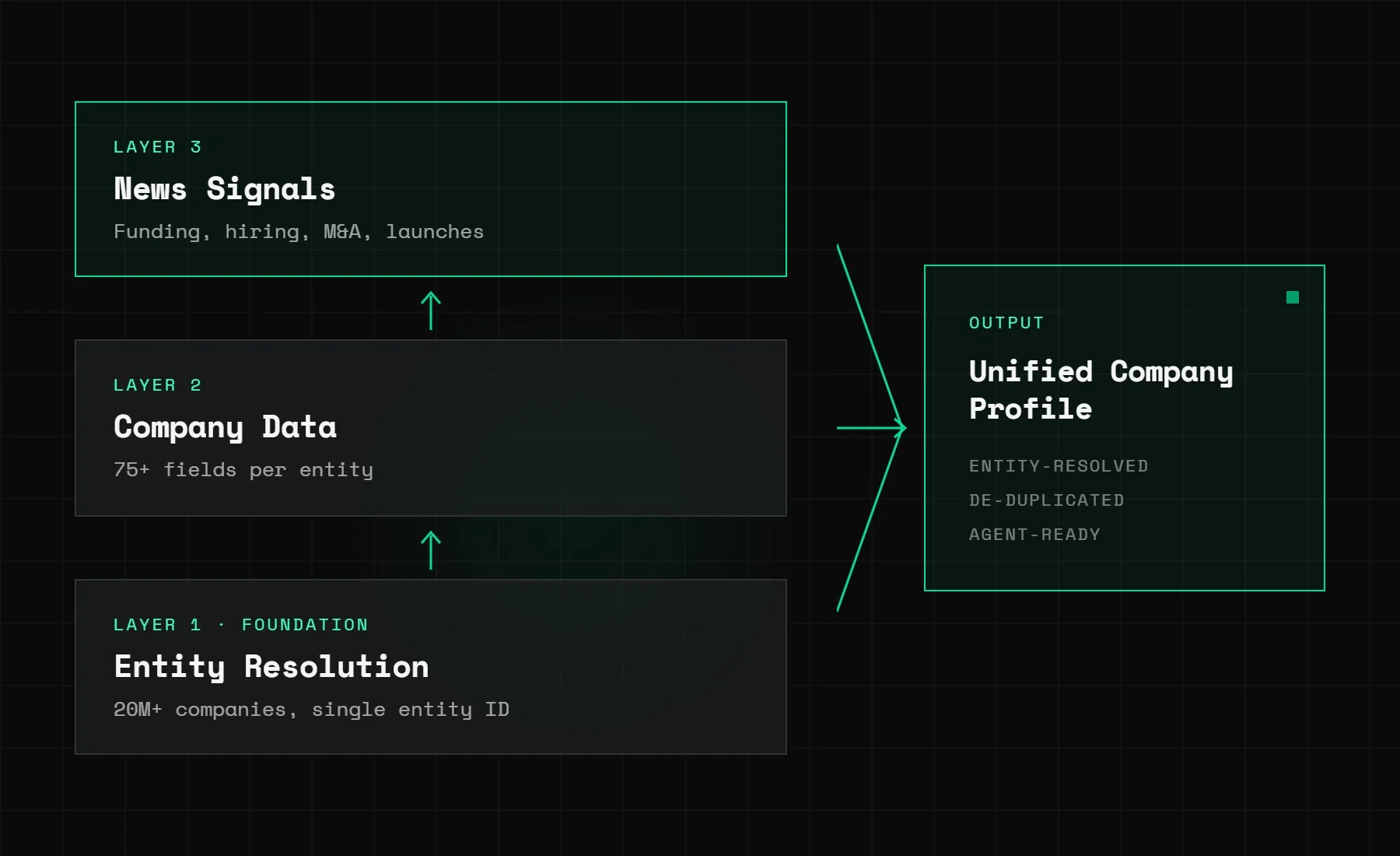
akta.pro's company database covers 20M+ companies globally with 75+ data points per company. Three things set it apart from enrichment APIs designed for enterprise sales:
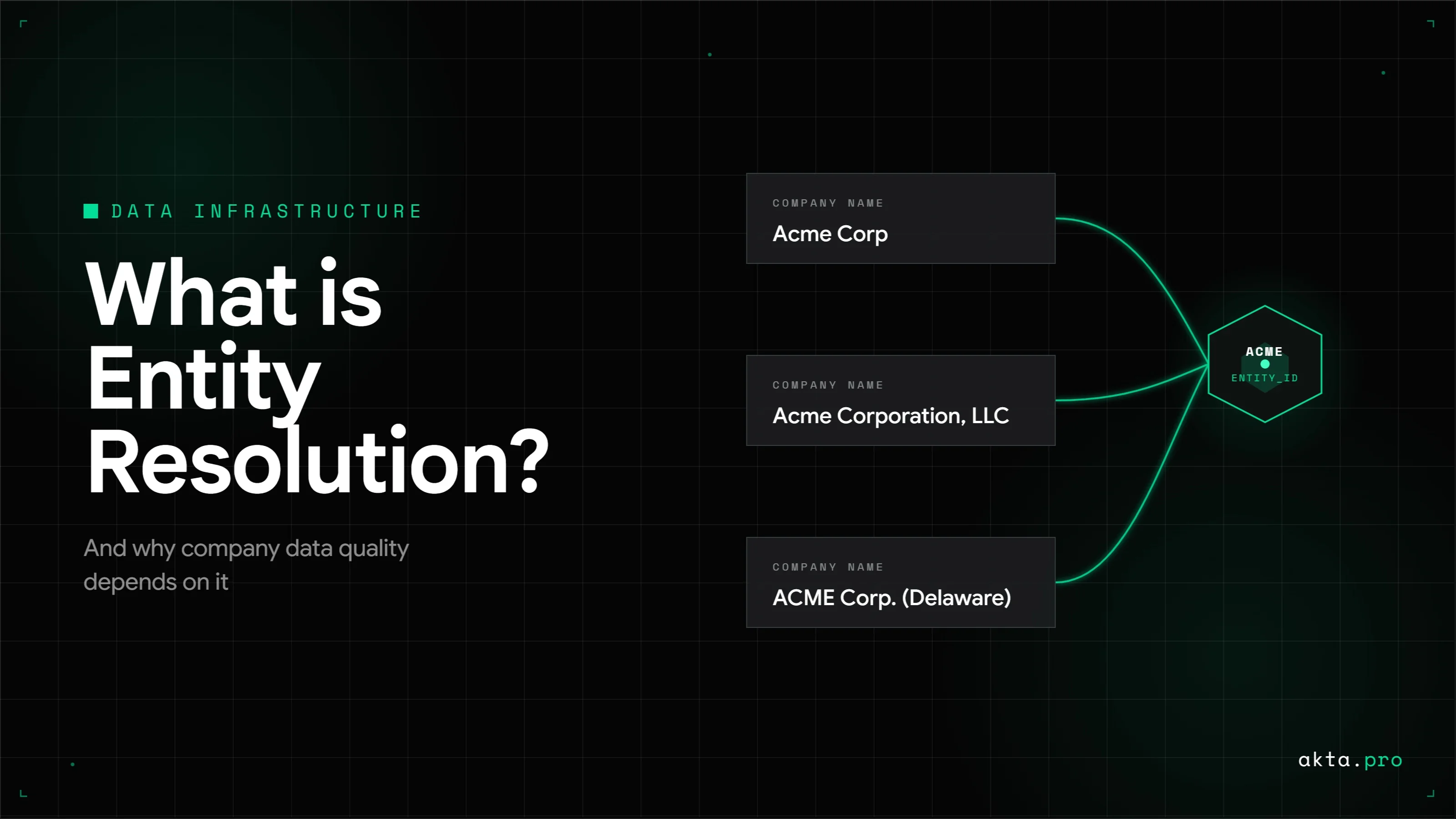
Entity resolution is the foundation. Every name, domain, and subsidiary resolves to a single entity ID. Bring your own data and it maps to the same graph, no separate matching step. This is what determines whether enrichment returns the right company or the wrong one.
News signals are a first-class enrichment dimension. Funding, hiring, executive moves, launches, M&A — all entity-resolved and structured, delivered as part of the same intelligence layer. Not a separate product. akta.pro's company news retrieval benchmark measures how this performs across providers.
Private companies are the point. The database was purpose-built for private and mid-market companies — the startups, growth-stage businesses, and regional players that the enterprise-sales databases miss.
Access via REST API, MCP (for AI agent workflows), CLI, or bulk export.
Frequently Asked Questions
What is a company enrichment API?
A company enrichment API takes a partial identifier — a domain, company name, or ID and returns a structured company profile with firmographic, financial, and classification data. It replaces manual company research with a programmatic call that returns results in milliseconds.
How much does a company enrichment API cost?
Pricing varies widely. Pay-per-record models range from $0.01 to $0.35 per company. Platform subscriptions start around $49/month for self-serve and exceed $15,000/year at enterprise tiers. The meaningful metric is cost per matched, usable record on your specific target list — not the headline price per credit.
How often should you re-enrich company data?
At minimum, quarterly. B2B data decays at ~2.1% per month. In fast-moving sectors, that exceeds 35% annually. Teams running high-velocity outbound or portfolio monitoring typically re-enrich monthly. The cost of re-enrichment is almost always less than the cost of acting on stale records.
Can a company enrichment API cover private companies?
It depends entirely on the provider. Most were optimized for large, well-indexed companies. Private companies and startups are the coverage gap that separates providers built for enterprise sales from those built for investment research, competitive intelligence, and deep market mapping. Test match rates on your actual target list before committing.