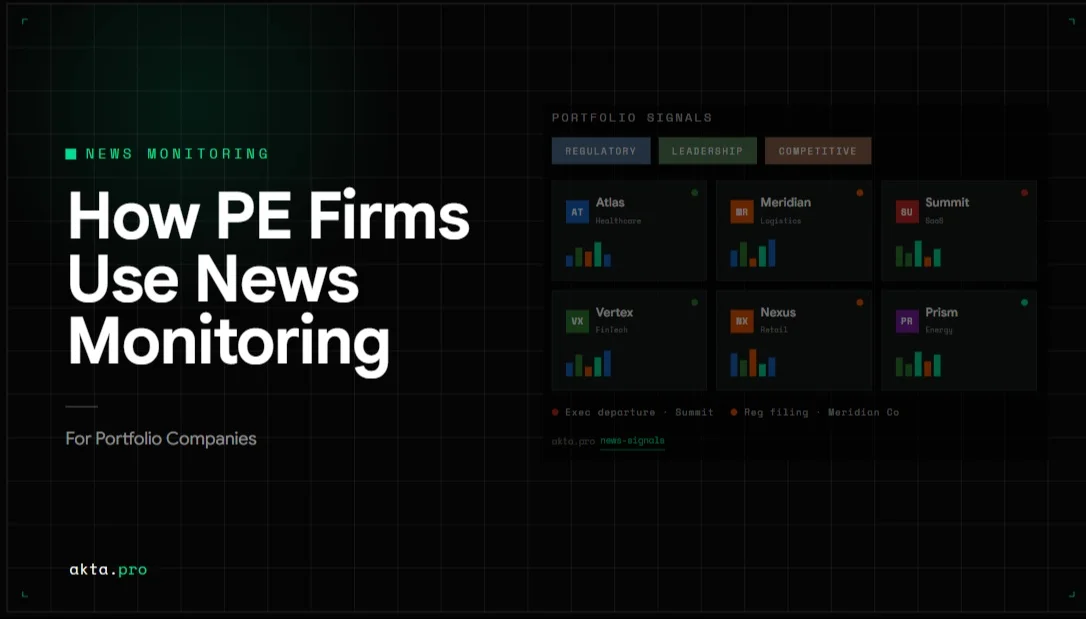
PE firms use news monitoring to continuously track published news about portfolio companies, their competitors, and their end markets, and to surface risks and opportunities that fall between formal reporting cycles. The practice has become a core operating function as hold periods extend and the gap between quarterly board packs and real-time risk widens.
The context matters. Bain's 2026 Global Private Equity Report puts the industry's exit backlog at 32,000 unsold companies worth $3.8 trillion. Buyout assets exiting in 2025 had been held for roughly seven years on average, up from five to six between 2010 and 2021. McKinsey's research on 100+ PE funds with post-2020 vintages found that GPs focused on operational value creation achieved 2 to 3 percentage points higher IRR than peers.
In practice, operating teams use news monitoring for three things.
Risk interception. A regulatory filing against a portfolio company's largest customer, a key executive's departure at a supplier, or negative press about a competitor's product recall — these events affect portfolio company value, and they surface in news before they show up in the next management report. A monitoring feed tagged by signal type lets an operating partner act the same week the event breaks, not six weeks later at the board meeting.
Cross-portfolio correlation. A supplier appearing in distress-related news might serve three portfolio companies in different sectors. Without entity-resolved monitoring, that shared exposure stays invisible until it hits the P&L at each company separately. Structured news signals let a fund-level team check exposure across the entire portfolio the day the news breaks.
Exit readiness. This is the most PE-specific use of news monitoring and the one most often missing from generic monitoring tools. Tracking competitor M&A activity, sector multiple expansion, strategic buyer announcements, and IPO filings in adjacent companies helps deal teams time exits and build the narrative for LP reporting. An operating team that sees a strategic acquirer making bolt-on acquisitions in the same vertical can position a portfolio company for that buyer before a banker brings the idea.
Five Signals That Trigger a Response
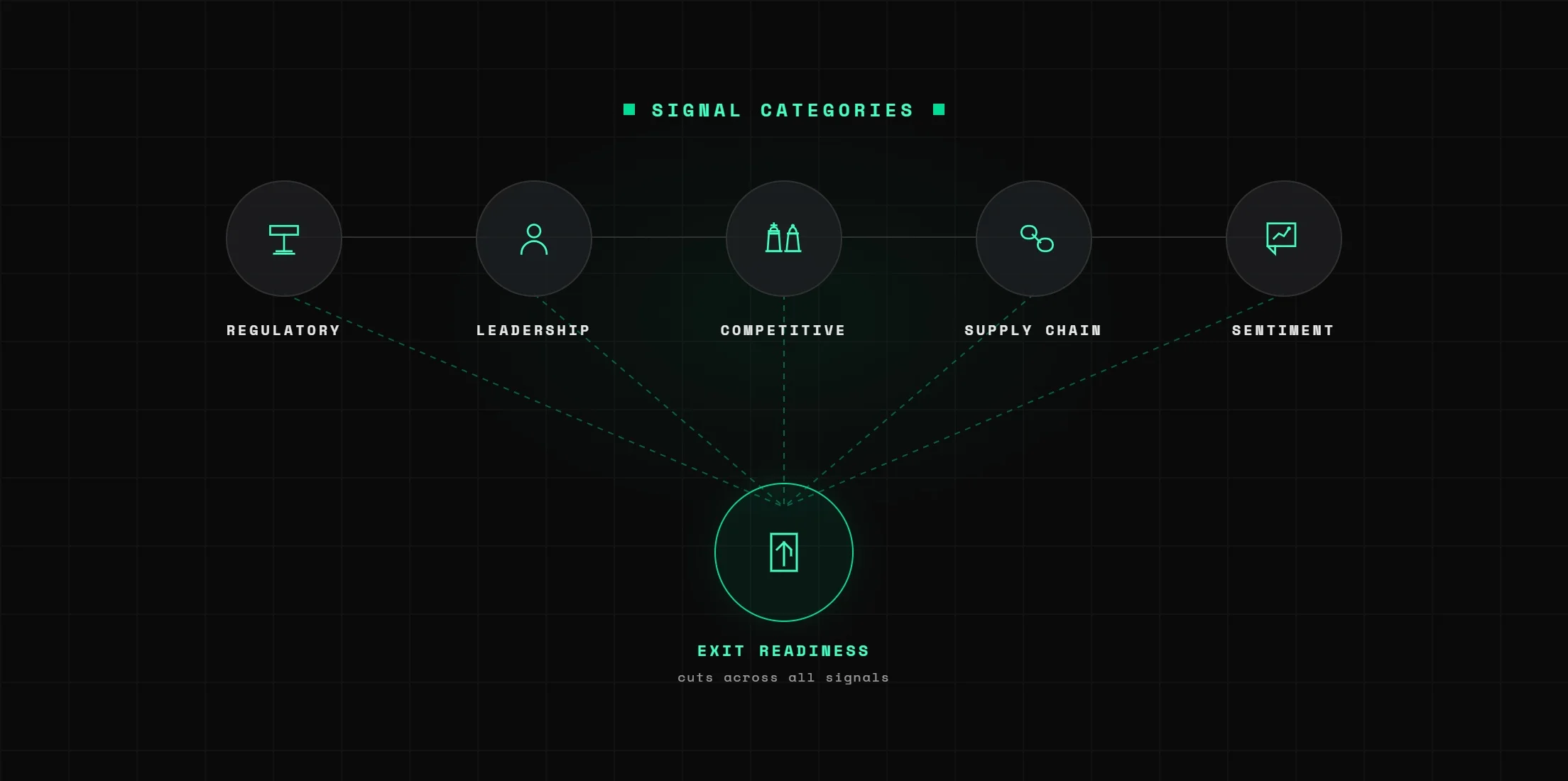
The value of news monitoring depends entirely on what you track and how you respond. The most effective PE operating teams organize their monitoring around five signal categories, each tied to a specific playbook.
| Signal Type | What It Catches | Typical PE Response |
|---|---|---|
| Regulatory & Legal | Lawsuits, compliance actions, policy changes affecting the portfolio company or its sector | Engage legal counsel; assess valuation impact; update LP risk disclosures |
| Leadership & Governance | Executive departures, board changes, key-person risk events | Activate succession planning; re-evaluate management equity alignment |
| Competitive Moves | Competitor funding rounds, product launches, market entry, pricing shifts | Reassess the portfolio company's competitive positioning and thesis assumptions |
| Supply Chain & Operational | Supplier distress, logistics disruptions, raw material price movements | Cross-check portfolio exposure; engage procurement at the portfolio company |
| Sentiment & Reputation | Negative press coverage, social media incidents, customer complaints at scale | Coordinate response with the portfolio company's comms and IR teams |
A sixth dimension runs across all five: exit-readiness signals. Sector M&A announcements, strategic buyer expansion, comparable-company IPO filings, and valuation multiple trends don't fit neatly into one category, but they're what deal teams need to time an exit window. Monitoring these signals separately, with alerts routed to the deal lead rather than the operating partner, keeps the exit lens active throughout the hold.
Key insight: The cross-portfolio view is where news monitoring creates the most value a PE firm can't get any other way. A single supplier distress signal that touches three portfolio companies in different sectors is invisible without entity-resolved, portfolio-wide monitoring.
Why Generic Monitoring Breaks for Private Company Portfolios
Most teams start with Google Alerts. It's free, it's simple, and it works for public companies with unique, well-indexed names. For private company portfolios, it breaks in three specific ways: no entity resolution (a fund holding a company called "Atlas" gets alerts about every Atlas on the internet), limited source coverage (private company events surface in regional and trade publications that Google Alerts doesn't reliably index), and no structure (raw links with no categorization, sentiment tagging, or deduplication). Contify's analysis found that Google Alerts missed approximately 40% of relevant business content, while irrelevant results consumed the analyst time meant for actual analysis.
The gap is structural, not cosmetic. Here's what changes when you move from keyword alerts to an entity-resolved news API:
| Capability | Google Alerts | Entity-Resolved News API |
|---|---|---|
| Entity resolution | None — keyword matching only | Maps articles to specific company records across 20M+ entities |
| Source breadth | Major English-language publishers | Includes regional, trade, and non-English sources |
| Signal categorization | None — raw links | Structured categories: funding, leadership, legal, product, etc. |
| Deduplication | None | Automatic — one signal per event, not one per article |
| Historical archive | None | 12+ months for trend analysis and due diligence |
| API integration | Email or RSS only | REST API, Slack, CRM, and AI agent workflows |
For a deeper look at alternatives beyond Google Alerts, akta.pro's guide to Google Alerts alternatives for company monitoring covers the full landscape.
Building a News Monitoring Stack for a PE Portfolio
A news monitoring stack built for a PE portfolio needs four things that generic media monitoring tools don't prioritize: entity resolution across private companies, structured signal categories matched to PE workflows, source breadth that covers regional and trade publications, and an integration layer that routes signals to the right person on the deal or operating team.
Here's the practical sequence for a fund with 15 portfolio companies.
Define your entity universe: Start with every portfolio company. Add two to three direct competitors per company, any customer or supplier representing more than 10% of a portfolio company's revenue, and the strategic acquirers active in each company's sector. For a 15-company portfolio, that's roughly 80 to 120 entities. Map each to a domain or provider-specific ID. Sloppy entity lists produce blind spots from day one.
Set your signal tiers: Not every signal needs the same routing. Regulatory actions and executive departures go to Slack immediately. Competitor funding rounds and product launches go to a weekly digest. Exit-readiness signals (sector M&A, IPO filings, buyer expansion) go to the deal lead as a separate stream. Sentiment shifts feed a dashboard the operating team reviews before board prep.
Connect the API: akta.pro's news signals platform provides entity-resolved, categorized signals accessible via REST API with pay-per-request pricing. For a walkthrough, the guide on setting up API-based company news monitoring covers authentication, query structure, and integration patterns. akta.pro's company news retrieval benchmark quantifies source coverage against other providers.
Build alert routing: Map signal categories to delivery channels. Slack for urgent, email digest for routine, dashboard for portfolio-wide trend tracking. If your team uses AI-assisted research workflows, MCP (Model Context Protocol) integration lets an LLM agent pull and summarize portfolio signals on demand, which is increasingly how operating teams prepare for board meetings and quarterly LP reports.
Iterate after one week: Review what generated noise and what was missing. Add subsidiaries or trade names. Tighten category filters. The first iteration is never the last, but it should be usable within days.
KPMG's 2025 PE Value Creation Survey found that 52% of PE firms could not meet LP bespoke reporting demands in real time. News monitoring is one of the fastest ways to close that gap: not by replacing financial reporting, but by supplementing it with the external signals that quarterly financials always lag.
Frequently Asked Questions
What is news monitoring in private equity?
News monitoring in private equity is the continuous tracking of published news about portfolio companies, their competitors, suppliers, and sectors to surface risks and opportunities between formal reporting cycles. It covers regulatory actions, leadership changes, competitive moves, operational disruptions, sentiment events, and exit-readiness signals like sector M&A and strategic buyer activity. PE teams use entity-resolved monitoring rather than generic keyword alerts to ensure accuracy across private companies that lack standard market identifiers like tickers.
How do PE firms monitor portfolio companies in real time?
PE operating teams combine internal financial reporting (monthly management accounts, KPI dashboards) with external signal monitoring via news APIs that deliver entity-resolved, categorized alerts. They configure alert tiers by signal type: immediate Slack notifications for regulatory actions or executive departures, weekly digests for competitive intelligence, and a separate stream for exit-readiness signals routed to the deal lead. The most effective setups integrate these signals into Slack, CRM, or AI agent workflows rather than relying on email-based alerts.
Why is entity resolution important for portfolio company news monitoring?
Private companies lack the standard identifiers (tickers, CIKs) that make public company monitoring straightforward. A portfolio company named "Summit" shares its name with hundreds of other businesses. Without entity resolution at the API level, monitoring systems return irrelevant results that require manual filtering. Entity-resolved news APIs map each article to a specific company record across millions of entities, eliminating false positives. For PE teams monitoring 15 to 40 portfolio companies plus competitors and suppliers, entity resolution is the difference between a useful signal feed and hours of wasted triage per week.