Public company news flows through well-mapped channels. Tickers tag every article, SEC filings land on EDGAR within hours, and earnings call transcripts get indexed before the market opens. Private companies get none of that. Their news surfaces in local business journals, regional press releases, and niche trade publications, sometimes nowhere at all until a deal closes.
In short: a private company news API pulls structured, entity-resolved news signals from across the web for companies that don't file with regulators. Instead of keyword alerts full of false positives, it returns articles already mapped to the right company, tagged by event type, with a searchable history. Platforms like akta.pro do this across 20M+ private company records so the resolution and tagging happen before results ever reach your pipeline.
This guide covers why private company news monitoring is a different problem from general news tracking, what a purpose-built API does, and how to set one up.
Why Private Company News Is a Different Problem
General news APIs work well for public companies and broad-topic monitoring, but three things break that model for private companies.
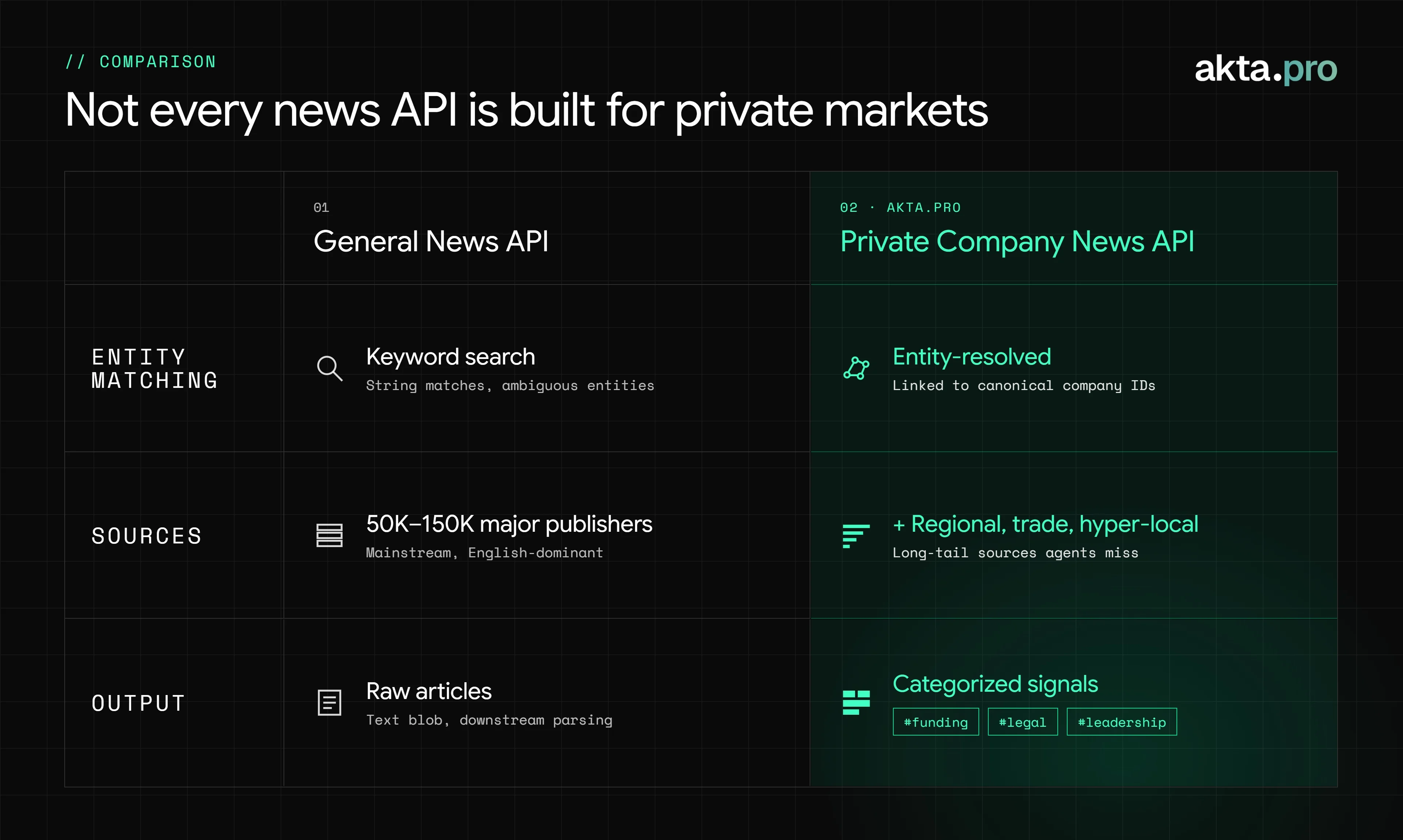
No standard identifiers exist: Public companies have tickers, CIKs, and LEIs. Private companies have a name, maybe a domain, and whatever metadata a provider has assembled. A query for "Mercury" could return results about the planet, the bank, or the defunct car brand. Without entity resolution at the API level, you spend more time filtering noise than reading signal.
News sources are fragmented and hyper-local: A Series B fundraise for a logistics startup in Hyderabad may only appear in a regional business daily. General news APIs index the top 50,000 to 150,000 publishers globally, and private company events often surface beyond that list.
Disclosure is voluntary: Public companies must disclose material events. Private companies choose what to announce, so news about leadership changes or customer wins arrives piecemeal through third-party reporting rather than filings. A private company news API has to resolve entities across those messy mentions, not just match keywords.
What a Private Company News API Actually Does
Entity resolution maps each article to a specific company record, handling name variants, subsidiaries, and common-name ambiguity. Query "Brex" and you get news about the fintech company, not every headline containing the word. akta.pro resolves entities across 20M+ company records, which is what separates a company news API from a keyword search wrapper.
Structured categories like funding rounds, leadership changes, and legal events let you build alerts and dashboards without writing your own classification logic on top of raw headlines.
Historical archive access lets you reconstruct a company's trajectory over months or years, which matters for due diligence timelines: when it first appeared in filings, when hiring picked up, whether its funding narrative shifted.
Five Workflows Where a Private Company News API Adds Real Value
News monitoring isn't one workflow. Different teams consume company signals differently. Here are five common patterns.
Portfolio Monitoring for PE and VC Firms
A fund holding 15 to 40 portfolio companies can't rely on quarterly board decks to catch emerging risks. An API that delivers tagged news signals — regulatory action, executive departure, negative press, or competitor funding enables real-time portfolio dashboards that surface what matters between reporting cycles.
According to the Exabel Alternative Data Buy-side Insights & Trends 2026 report, 94% of buy-side firms surveyed across the US, UK, Hong Kong, and Singapore plan to increase alternative data spending in 2026. More than half said their budgets grew by 50% or more over the past two years. Private company news is one of the most direct forms of alternative data, it tells you what is happening at a company right now, without waiting for a financial statement.
Due Diligence and Deal Screening
Before committing to a deal, investment teams need to know what's been said publicly about a target company over the past 6 to 24 months. A private company data API with historical archives lets analysts pull a structured timeline of every material mention — lawsuits, partnership announcements, product recalls, funding rounds — in a single API call instead of hours of manual searching.
Competitive Intelligence
Corporate strategy teams tracking five to ten competitors don't need a Bloomberg terminal. They need a company news API that returns structured signals about competitor product launches, geographic expansion, hiring surges, and pricing moves. When those signals arrive as categorized JSON payloads, they feed directly into internal dashboards or Slack alerts.
Risk and Compliance Monitoring
Compliance teams running adverse media screening or third-party risk monitoring need continuous coverage, not periodic spot-checks. A news monitoring API with entity resolution reduces false positives (the biggest operational cost in adverse media workflows) and ensures coverage extends to the hyper-local sources where regulatory actions and litigation first appear.
Sales and Account Intelligence
Revenue teams tracking prospect companies can trigger outreach based on real-world signals. A target company closes a funding round? That's a buying signal. They announce a new product line? That may create need for your product. A company news API turns those events into structured triggers for CRM workflows.
How to Set Up Private Company News Monitoring With an API
Here's a practical walkthrough for getting from zero to a working news monitoring pipeline. The specifics vary by provider, but the pattern is the same.
Step 1: Define Your Entity Universe
Start with the list of companies you care about. This might be a portfolio company list, a competitor set, a prospect universe, or a watchlist of acquisition targets. Map each company to whatever identifier the API uses - company name, domain, or a provider-specific ID. A sloppy list creates blind spots from day one.
Step 2: Choose the Right API and Authenticate
Evaluate providers based on five criteria (covered in the next section). Once selected, create an account and generate an API key. Most providers follow standard REST patterns. For example, to pull entity-resolved news for a company using the akta.pro API:
curl -G "https://docs.akta.pro/api-reference/news-signals" \
  -H "x-api-key: YOUR_API_KEY" \
  --data-urlencode "company=brex" \
  --data-urlencode "category=Legal & Regulatory,Leadership & Governance" \
  --data-urlencode "limit=25"
This returns structured JSON with articles tagged by category, date, source, sentiment, and entity — no additional NLP needed on your end.
Step 3: Structure Your Queries
Structure your queries around the categories you actually monitor: capital markets and transactions, strategic developments, leadership and governance, legal and regulatory, workforce and talent, and competitive threats. Filter by category and date range to cut noise.
Step 4: Build Alerts and Integrations
Common patterns include Slack alerts for high-impact categories, dashboard feeds for portfolio reviews, CRM enrichment, and spreadsheet exports. If your provider supports MCP, you can also route signals through AI agents for automated triage. The akta.pro documentation covers these integration patterns.
Step 5: Tune and Iterate
After a week of signals, review what's noise and what's missing, then adjust category filters and alert thresholds.
What to Look for When Evaluating a Private Company News API
Not all news APIs are equivalent for private company monitoring. Here's what separates a good provider from one that creates more work than it saves.
| Criterion | What good looks like |
|---|---|
| Entity resolution | Returns news for a specific company entity, not raw keyword matches |
| Source breadth | Covers regional and trade publications, not just major outlets |
| Category taxonomy | Structured event tags (funding, leadership, legal) built in |
| Historical archive | At least 12 months of coverage for due diligence and trend analysis |
| API and AI agent support | Clean REST endpoints, consistent JSON, and MCP server access |
| Pricing model | Pay-per-request options for teams that need to prototype before committing |
Providers like akta.pro combine entity resolution across 20M+ companies, category tagging, and pay-per-request pricing, which is what most of this list is checking for.
The Entity Resolution Problem That Undermines Most News Pipelines
Set up keyword monitoring for a company called "Atlas," and your feed fills with articles about Atlas Copco, Atlas Air, Atlas Lithium, Project Atlas at Google, and local businesses across three continents. An analyst filtering that noise every morning loses roughly 25 hours a quarter, per watchlist.
In public markets this barely happens, since tickers are unique. In private markets, where companies share names and rebrand constantly, entity resolution is the difference between a useful signal feed and an expensive firehose of noise. Gresham Technologies notes that private market records often arrive with nothing more than a company name and country. An API that resolves entities at the data layer, before results reach your pipeline, removes this problem entirely.
Getting Started
Five years ago, this capability meant stitching together data vendors and maintaining entity maps by hand. Today, a single API call to a provider like akta.pro returns entity-resolved, categorized, deduplicated news with sentiment scoring and historical archive access. Start with a small list of 10 to 20 companies, run it for a week, and evaluate signal quality before expanding to a full watchlist.
Frequently Asked Questions
How do you track private company news?
The most scalable method is through a private company news API that provides entity-resolved, structured news signals for specific companies. Unlike manual Google Alerts or keyword searches, an API returns categorized articles (funding, leadership changes, legal events) mapped to specific company entities, eliminating false positives from name ambiguity. You authenticate with an API key, query by company name or ID, filter by category and date range, and receive structured JSON responses.
What is a company news API?
A company news API is a programmatic interface that delivers news articles about specific companies in a structured, machine-readable format (typically JSON). It differs from a general news API by linking each article to a resolved company entity rather than returning raw keyword matches. Advanced providers include event categorization, sentiment scoring, deduplication, and historical archives. These APIs are used for portfolio monitoring, competitive intelligence, due diligence, and risk management workflows.
Can you use a news API with AI agents?
Yes. Private company news APIs that support MCP (Model Context Protocol) can be called directly by AI assistants and autonomous agents. This means an LLM-based research agent can query company news, parse structured responses, and incorporate real-time signals into investment memos, risk reports, or competitive briefs without custom middleware. Providers like akta.pro offer MCP server access alongside their REST API, supporting both traditional integration and AI-native workflows.