Most "best news API" guides rank providers by source count: 500,000 sources, a million sources, three million articles a day. None of that tells you whether an API can correctly identify that an article about "Mercury" refers to the fintech company, the planet, or the chemical element, and route it to the right analyst.
Choosing a news API for company intelligence means picking the provider that resolves the right entity, classifies the right event, and returns enough metadata that an analyst or an AI agent can act on it without manual cleanup, not the one with the biggest source count.
The global alternative data market is projected to reach $29.6 billion in 2026, per Grand View Research, and news data sits at the core of that growth. This guide is a practical framework for evaluating news APIs when the downstream use case is company monitoring, competitive intelligence, or risk detection, not a headline ticker. Platforms built for that use case, akta.pro among them, look different from ones built for content aggregation, and the difference shows up in five specific places.
What a News API Actually Needs to Do
A news API delivers structured news data from hundreds or thousands of sources into applications and pipelines. You send a query, a keyword, a company name, a date range, and get back structured JSON with title, source, date, and, in better APIs, sentiment scores and entity tags.
That definition is incomplete for intelligence workflows. The real question is not whether you can get news articles via API, but whether you get the right articles about the right entities, classified by the right events, with enough metadata that a downstream system can act on them. Gartner's 2026 Critical Capabilities report on Competitive and Market Intelligence Platforms found purpose-built intelligence platforms deliver a 60% or greater reduction in manual effort gathering and analyzing intelligence, and much of that gain comes from the data layer itself.
Why Source Count Is the Wrong Starting Metric
Every news API vendor leads with source count. It is the easiest number to inflate and the hardest to verify.
An API claiming 500,000 sources may include defunct blogs, duplicated RSS feeds, content farms, and scraped pages that add volume without adding signal. For a media monitoring team tracking brand mentions, raw volume might matter. For an investment team monitoring a portfolio of 50 companies across 12 countries, what matters is whether the API covers the local trade publications, regulatory portals, and company newsrooms where material information first appears.
The better metric is what Webz.io's Ran Geva has called event recall: does the API capture the meaningful events your team cares about? A factory fire reported first by a regional outlet. A regulatory filing published on a government portal. An executive resignation announced on a company newsroom page before it hits wire services.
To test event recall, build a "must-capture" list before starting any trial. Pick 10 to 15 known events from the past 90 days, a mix of M&A announcements, leadership changes, regulatory actions, funding rounds, and operational incidents and check whether the API surfaced them, from which sources, and how quickly. This tells you more about coverage quality in 20 minutes than a vendor's source count page tells you in 20 slides.
Five Evaluation Criteria That Actually Matter for Intelligence Workflows
Feature matrices are everywhere. Most compare the wrong things. Here are the five dimensions that separate a news API you can build intelligence on from one that just delivers articles.
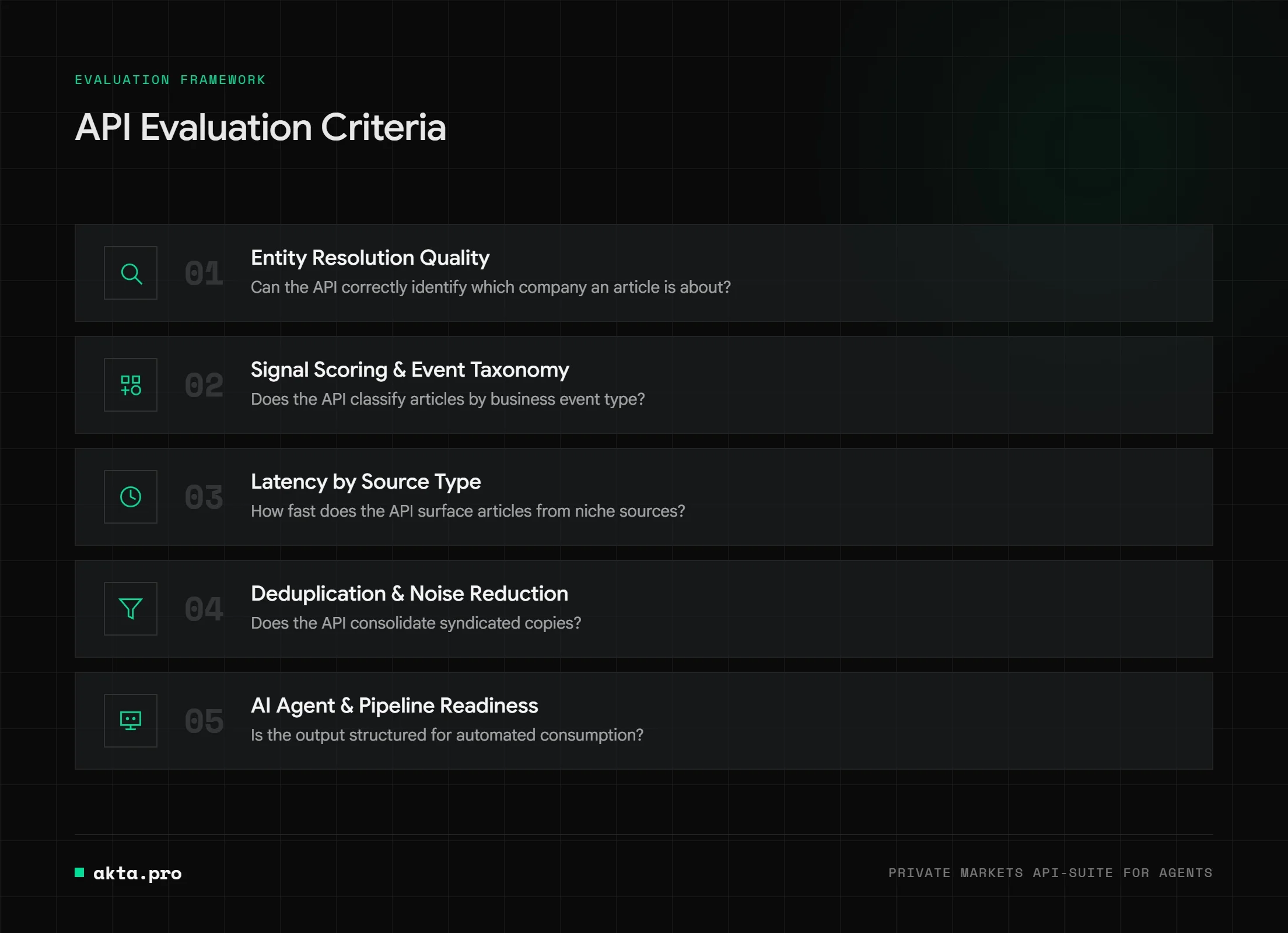
Entity Resolution Is the Make-or-Break
Entity resolution, correctly identifying which real-world company an article refers to, is the single most important capability in a news API for company intelligence. "Apple" could mean Apple Inc., Apple Bank, or Apple Hospitality REIT. Test it with a gold set of 20 to 30 entities covering common names and subsidiaries, and measure precision and recall. akta.pro's entity resolution across its 20M+ company database is patent-pending and built for private companies, where naming conventions are least standardized.
Signal Scoring and Event Taxonomy
Raw article counts are not intelligence. Knowing Tesla had 4,200 articles last week tells you nothing; knowing 12 were "Leadership & Governance" events is actionable. A strong API classifies articles by event, not just topic. akta.pro uses an 86-category event taxonomy with AI-generated newsworthiness scores.
Latency Across Source Types
"Real-time" is a marketing term, not a specification. What matters is latency for the sources that carry early signals: corporate newsrooms and regulatory portals, which often publish material information before wire services do. During a trial, measure how fast the API surfaces a company press page versus a major publisher.
Deduplication and Noise Reduction
A single event can generate dozens of articles: the original report, syndicated copies, and wire pickups. Without deduplication, these flood dashboards and inflate volume metrics. A risk team needs one clean record per event; a PR team may want every pickup instead. Test it on a high-syndication event and check for clustering.
AI Agent and Pipeline Readiness
As workflows incorporate AI agents, output format becomes its own evaluation criterion. An agent needs stable JSON schemas and entity tags it can reason about, not raw HTML requiring custom parsing. MCP server availability matters too, letting an agent call an API natively. akta.pro offers MCP server access, API, CLI, and bulk export
Company Intelligence vs. General News: Different APIs for Different Jobs
The news API market has two distinct segments that buyer's guides usually conflate.
General news APIs (NewsAPI.org, GNews, TheNewsAPI) are built for headline feeds and content aggregation, returning basic metadata and leaving enrichment to the consumer. Intelligence-grade APIs (Contify, akta.pro, NewsCatcher, Webz.io) invest in entity resolution, event classification, and deduplication, returning enriched data a system can act on directly. A general news API can cost nothing at the free tier or $49 a month; an intelligence-grade one typically starts at $99. Per the APITube Buyer's Guide, teams that bolt sentiment and entity extraction onto a basic API typically spend $200 to $500 a month on enrichment already built into an intelligence-grade API.
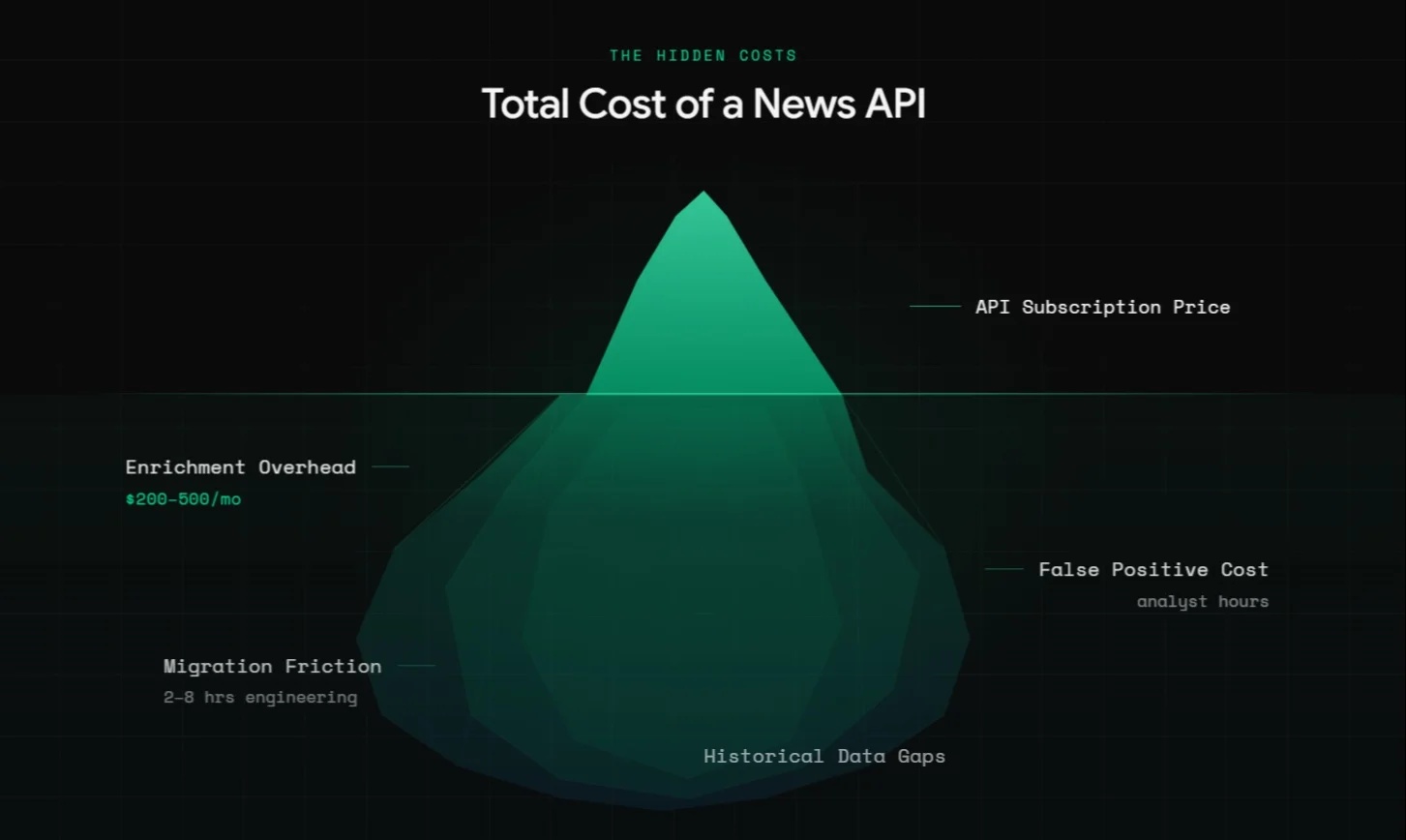
The Hidden Costs Most Buyer's Guides Skip
Enrichment overhead. If the API returns only titles and URLs, your team builds and maintains a parsing, cleaning, and enrichment pipeline. That is engineering time, cloud compute, and ongoing maintenance. Every schema change at the source level breaks something downstream.
False positive cost. For a content aggregator, a false positive is a slightly irrelevant article in a feed. For an intelligence team, a false positive is a misrouted alert that consumes analyst attention, triggers an unnecessary escalation, or (in risk workflows) causes a false alarm. Multiply that by hundreds of monitored entities and the cost compounds.
Migration friction. As the APITube guide correctly notes, switching news API providers takes 2 to 8 hours of engineering time if you have abstracted your client behind an adapter interface. Without that abstraction, you are rewriting parsers, remapping entity taxonomies, and rebuilding alert logic. Build the adapter from day one.
Historical data gaps. Some APIs archive only 30 days of content. Intelligence workflows often need 6 to 12 months of historical data for trend analysis, benchmark comparisons, or backtesting. Check archival depth before you commit — retrofitting historical data from a different provider is painful and sometimes impossible.
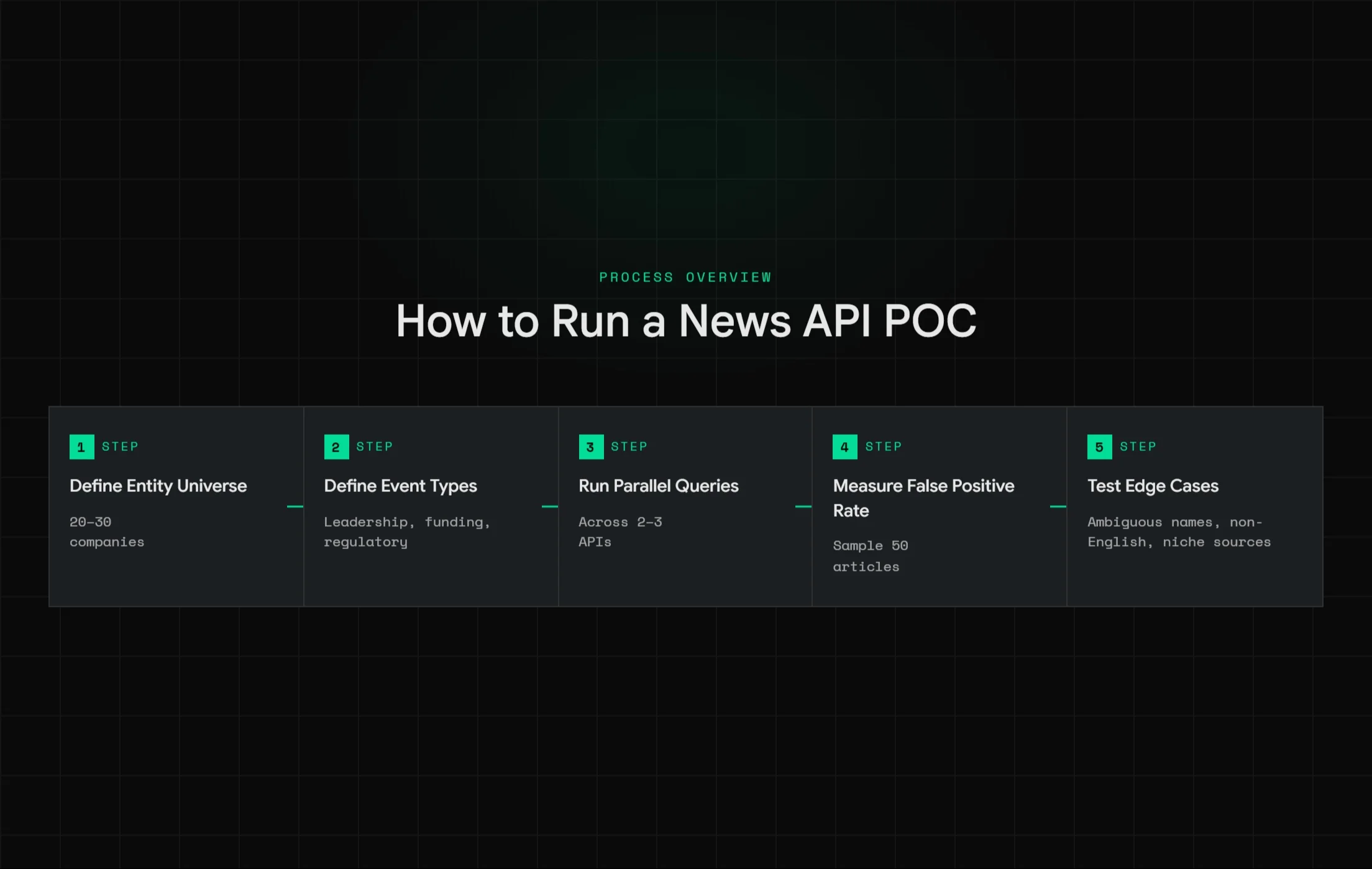
How to Run a Proof-of-Concept That Tests What Actually Matters
-
Define your entity universe. Pick 20 to 30 companies, including obscure subsidiaries and non-English entities.
-
Define your event types. Write down the events your team acts on: leadership changes, funding rounds, regulatory actions.
-
Run parallel queries across 2 to 3 APIs using identical entity lists and date ranges.
-
Measure false positive rate. Sample 50 tagged articles per API. A 90% precision rate versus 60% means half the noise disappears.
-
Test edge cases. Ambiguous names, non-English articles, and a high-volume news day all reveal gaps a clean demo hides.
This kind of evaluation takes a day or two, not weeks, and it gives engineering, product, and intelligence teams a comparison they can actually align on.
Frequently Asked Questions
What features should a news API have for market intelligence?
For market intelligence use cases, a news API should provide entity resolution that maps articles to specific companies (not just keyword matches), event or topic classification that categorizes articles by business-relevant events (M&A, leadership changes, regulatory actions), sentiment analysis, deduplication to avoid counting syndicated copies of the same story, and historical data access for trend analysis. Source quality metadata — knowing whether an article comes from a trade publication, a company newsroom, or a content aggregator — is also important for assessing signal reliability.
What is the difference between a news API and a market intelligence platform?
A news API is a data delivery layer. It provides structured articles and metadata through an API endpoint that developers integrate into their own systems. A market intelligence platform (like Contify, AlphaSense, or Valona Intelligence) is a complete application that includes data collection, analysis, dashboards, alerts, and collaboration tools. The 2026 Gartner Magic Quadrant for Competitive and Market Intelligence Platforms evaluated these end-to-end platforms, positioning AlphaSense and Valona Intelligence as Leaders. Teams with existing infrastructure and developer resources often prefer APIs. Teams that need a turnkey solution lean toward platforms.
How much does a news API cost?
News API pricing ranges from free tiers with significant limitations (typically 100 to 200 requests per day, restricted to non-commercial use) to $49 to $249 per month for production plans, to custom enterprise pricing above $500 per month. The total cost of ownership is often higher than the subscription price: teams using basic APIs typically spend an additional $200 to $500 per month on separate NLP services for enrichment, according to industry analysis. Intelligence-grade APIs that include enrichment, entity resolution, and event classification cost more upfront but can reduce total cost by eliminating the need for additional processing infrastructure.
Looking for a news API built specifically for company intelligence and market signals? akta.pro delivers entity-resolved company news, an 86-category event taxonomy, AI-scored newsworthiness, and agent-ready outputs across 20M+ private companies. Start with a free trial.