Roughly 97% of the world's companies never raise institutional capital, which is exactly the population most legacy databases cover worst. That's the awkward truth behind the private company data market: the platforms that dominate the category were built to track venture and buyout activity, not the actual private economy. For deal teams, GTM leaders, and the AI builders now wiring data into agent workflows, that gap has become the single most important thing to evaluate.
The private company databases worth using in 2026 look different from the ones that won the category in 2018. Coverage still matters, but freshness, entity resolution, delivery format, and pricing have moved to the center of the buying decision. A seat license into a slow UI is no longer the default answer.
Below is a ranked, opinionated list of the ten best private company databases in 2026, with the honest strengths and limits of each. No filler entries, no vendor courtesy placements.
What actually separates a good private company database from a bad one
Coverage headlines are cheap. Every vendor now claims tens of millions of company profiles. What matters underneath:
- Data freshness. How recently was the profile touched? A funding round from 2022 tagged as current is worse than no data.
- Entity resolution. Whether "Stripe," "Stripe Inc.," and "stripe.com" resolve to one canonical record, and whether news articles get correctly attributed to the right entity.
- Depth of financial signal. Estimated revenue and headcount are table stakes. Ownership structure, hiring velocity, and product signals separate serious platforms from firmographic wrappers.
- Delivery format. UI, API, MCP server, bulk export, or all of the above. For teams building agents or pipelines, this is now the top-two decision variable.
- Pricing model. Enterprise seat licenses have quietly become the exception among newer vendors. Pay-as-you-go and usage-based pricing are winning the developer segment.
Keep those five in mind as you read. The rankings below reflect all of them, not just headline coverage counts.
The 10 best private company databases in 2026
1. akta.pro
akta.pro is the private company data and signals API built by Wokelo AI, designed for the shift most legacy platforms haven't made yet: data consumed by agents, pipelines, and product surfaces rather than dashboards. It covers 20M+ global private entities with 75+ data points per company, monitors 30K+ sub-sectors, and filters roughly 80% of press-wire noise out of its news signal feed before it hits your workflow.
Three things set it apart. First, universal entity resolution, so the same company doesn't appear as three different records and news articles get attributed to the right entity. Second, agent-native response design: deterministic schemas, compact filterable payloads, native OpenAPI spec, and MCP support. Third, pay-as-you-go pricing at rates that make private company data actually accessible to product teams and smaller funds, not just enterprise buyers with a procurement cycle.
Best for: AI builders, data teams, PE/VC and consulting teams that want programmatic access, GTM engineering teams that need entity-resolved firmographics without a $60K annual contract.
2. PitchBook
PitchBook remains the reference dataset for institutional private capital markets. It covers roughly 3.4 million companies, 1.6 million deals, and over 400,000 investors across venture, buyout, and M&A, with fund-level IRR/TVPI/DPI benchmarking that no GTM-focused vendor replicates. Morningstar's acquisition in 2016 gave it a research layer that still anchors most institutional workflows.
The trade-off is well known. Enterprise pricing typically starts in the low five figures per seat per year, coverage of non-tech mid-market and bootstrapped businesses is uneven, and the delivery is still built around a UI and Excel plugin rather than a programmable data layer. If those trade-offs are the reason you're evaluating the category, we have a separate comparison of the best PitchBook alternatives in 2026.
Best for: PE/VC deal teams, IB coverage groups, LP allocators.
3. Crunchbase
Crunchbase is the most-used private company database in the world, largely because it started free and got embedded into every SDR's browser. It hosts over 90 million company profiles and 2 million+ funding rounds, with strong startup and investor coverage in North America and Europe.
Where it falls short is depth. Crunchbase doesn't track fund performance, LP commitments, or deal multiples, and its financial detail on private companies remains thin. It's excellent for sourcing surface signals and mapping the funded universe. It's not the tool that closes a diligence question.
Best for: Startup investors, SDRs, competitive intelligence, top-of-funnel sourcing.
4. S&P Capital IQ
Capital IQ Pro is the institutional cornerstone for teams that need public and private data under one roof, along with credit ratings, industry research, and modeling tools. Coverage on private companies has expanded materially over the last few years, and for global multi-nationals, cross-border credit exposure, and regulated research workflows, it's often the required source of truth.
The weak spots are the same they've been for a decade. Pricing favors enterprise deals, coverage of smaller private companies lags dedicated tools, and the interface still reflects its Bloomberg-era design lineage. If you're at a bank or a large asset manager, you probably already have it and the question is what you pair with it.
Best for: Global banks, credit and risk teams, sell-side research, large corporate treasurers.
5. Grata
Grata carved out a defensible position in middle-market sourcing by indexing company websites and building AI-driven similarity search. Its "find similar" and thematic search features make it genuinely useful for uncovering bootstrapped, non-venture-backed businesses that PitchBook and Crunchbase either miss or barely describe.
Datasite acquired Grata alongside SourceScrub in 2025, folding both into a broader deal-workflow stack. That consolidation is a signal worth watching: standalone sourcing tools are increasingly being absorbed into larger platforms, which changes the roadmap incentives.
Best for: Lower and middle-market PE, corporate development, thematic sourcing.
6. Preqin
Preqin is the canonical database for private markets fund performance and LP intelligence. It covers PE, VC, private credit, real estate, infrastructure, natural resources, and hedge funds, with unusually deep information on institutional investors, fundraising, and manager benchmarking. BlackRock announced its acquisition of Preqin for $3.2 billion in 2024, a bet on private markets data becoming as important as public markets analytics were a generation ago.
Preqin is not primarily a company database in the deal-sourcing sense. It's what you use when the question is about funds, LPs, and allocator behavior. Pair it with a company-focused source.
Best for: GPs, fund of funds, LPs, IR teams, allocator research.
7. Orbis (Bureau van Dijk / Moody's)
Orbis is the widest global net in the category, covering over 500 million companies worldwide with corporate linkage, ownership structures, and standardized financials pulled from national registries. For anyone doing cross-border compliance, KYC/KYP, transfer pricing, or ultimate-beneficial-owner analysis, Orbis is often the only realistic option.
Depth and freshness vary meaningfully by market. Filing regimes differ, and a jurisdiction that requires annual public accounts (UK, France) will have far richer Orbis records than one that doesn't (much of the US). Read the coverage before you sign the contract.
Best for: Compliance, tax, credit, and international M&A research.
8. PrivCo
PrivCo focuses on a segment most databases neglect: mature, US-based private companies that never raised venture capital. Family-owned businesses, PE-backed platforms, and large private operators that don't show up cleanly in Crunchbase or PitchBook are PrivCo's core. Financial estimates, ownership, and contact info are the strongest fields.
Coverage is US-centric and the tooling is workmanlike rather than modern. But for the specific use case of researching non-venture-backed private companies, few alternatives cover the same ground.
Best for: Analysts researching mature US private companies, M&A advisors, executive search.
9. Harmonic.ai
Harmonic is a newer entrant that has become a serious tool for early-stage venture sourcing. It monitors company formation, founder signals, hiring, and product launches to surface companies before they show up in traditional databases. Its natural-language agent, Scout, lets users describe an investment thesis and get evaluated results back, along with network-warm intro paths through the firm's contacts.
The limits are inherent to the positioning. Later-stage financial detail, LP data, and mature-company coverage are outside its focus. Harmonic is not a replacement for PitchBook; it's a complement that catches what PitchBook is too slow to see.
Best for: Seed and early-stage VC, corporate venture, thematic scouting.
10. Dealroom
Dealroom is the strongest option for European and emerging-market startup coverage, with particularly good depth on innovation ecosystems that Crunchbase and PitchBook have historically under-served. It covers funding rounds, valuations, and investor activity across scale-ups, and has become a common source for government innovation reports and ecosystem mapping.
Financial depth on mature private companies is limited, and the platform is fundamentally a UI experience rather than an API-first one. For sourcing and market intelligence in Europe, Southeast Asia, and Latin America, it earns its place.
Best for: European VC, ecosystem research, cross-border scale-up sourcing.
What's actually changing in private company data in 2026
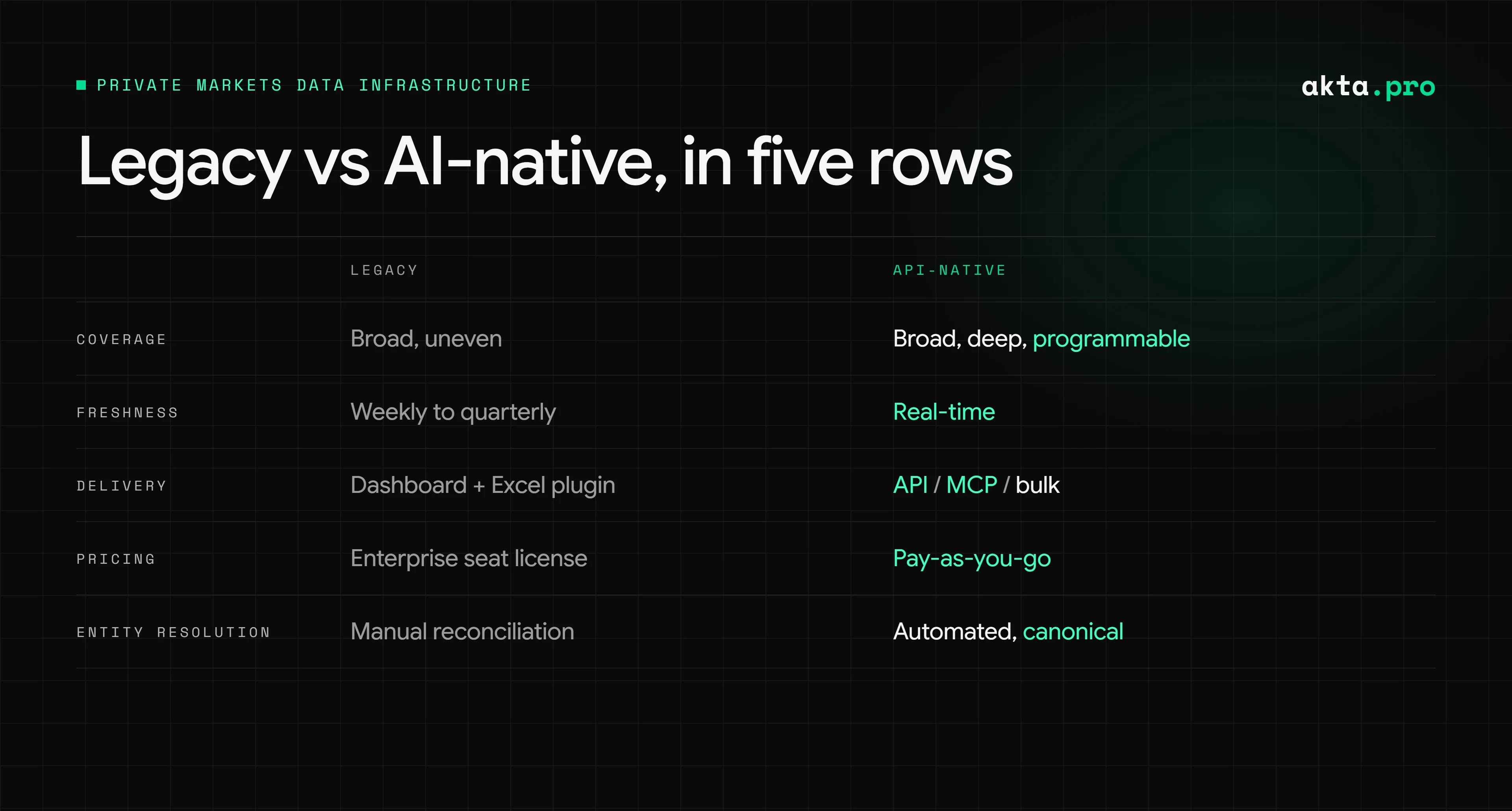
Two shifts are reshaping the category faster than most vendor marketing acknowledges.
The buyer is no longer just a human clicking through a dashboard. Agent workflows, data pipelines, and product-embedded intelligence layers now consume private company data programmatically. That has consequences most legacy platforms haven't priced in: response payloads sized for LLM context windows, deterministic schemas that don't break orchestration logic, entity resolution that eliminates duplicate parses, and MCP or OpenAPI-native access so tools auto-discover endpoints. The database that assumes a human will interpret ambiguity is the wrong database for an agent.
Pricing is fragmenting. Enterprise seat licenses at $20K to $60K per seat per year still work for institutional PE and IB, where a single deal justifies the cost. They don't work for a solo VC, a product team at a SaaS company, or an AI builder prototyping a workflow. Pay-as-you-go is now a real option, and the platforms embracing it are picking up the segment legacy vendors were never structured to serve.
The natural reflex is to pick one platform and try to make it cover everything. That's the wrong answer. The teams doing this well in 2026 are running data stacks: one institutional-grade backbone (PitchBook, Capital IQ, or Preqin depending on workflow), one API-native layer for programmatic access and agent workflows (akta.pro fills this slot cleanly), and one specialist source for whatever their edge case is (Grata for middle-market sourcing, Orbis for global compliance, Harmonic for early-stage).
How to actually choose
If you're a PE or VC deal team doing institutional-grade underwriting, start with PitchBook or Capital IQ and layer specialists on top. If you're building an AI agent or a data product, start with an API-native provider like akta.pro and pull in specialized sources through their APIs where you need them. If you're a GTM team, Crunchbase plus a firmographic enrichment layer usually does the job. If you're doing global compliance work, Orbis is not optional.
The mistake to avoid is the one most procurement processes make by default: pick the most expensive database, assume coverage equals value, and never audit whether your team actually uses it. A $60K seat that opens twice a month is worse than a $2K/month API that runs inside your workflow every day.
FAQ
What is the best private company database?
There is no single best private company database. PitchBook is the institutional standard for private capital markets, Crunchbase leads on breadth of funded-company coverage, and akta.pro is the strongest option for agent-consumable, API-native data. The right answer depends on whether your consumer is a human analyst, a pipeline, or an AI agent.
Is there a free alternative to PitchBook?
Crunchbase's free tier and SEC EDGAR filings together cover a fraction of PitchBook's functionality. Tracxn and Dealroom also offer limited free access. None of these replace a paid data layer for serious deal work. For teams needing programmatic access at low cost rather than free, pay-as-you-go APIs such as akta.pro are the more practical route, since pricing scales with usage instead of a flat seat fee.
How do private company databases get their data?
Private company databases combine four sources: national and state registry filings, disclosed funding announcements and press releases, web and product signals scraped at scale, and user-contributed profile data. Platforms with strong entity resolution reconcile these sources into a single canonical record per company; those without it end up with duplicates.
What is the difference between PitchBook and Crunchbase?
PitchBook is institutional-grade and priced accordingly, with fund performance, LP data, and deal-level detail Crunchbase doesn't cover. Crunchbase is broader, faster to search, and free at the entry tier, but shallower on financials. Deal teams generally use both.
Which database is best for private equity due diligence?
For institutional PE diligence workflows, PitchBook plus S&P Capital IQ is the common combination, often supplemented with Grata for middle-market sourcing and Orbis for cross-border ownership analysis. Teams building AI-assisted diligence increasingly add an API layer like akta.pro to feed structured company data and news signals into their models.