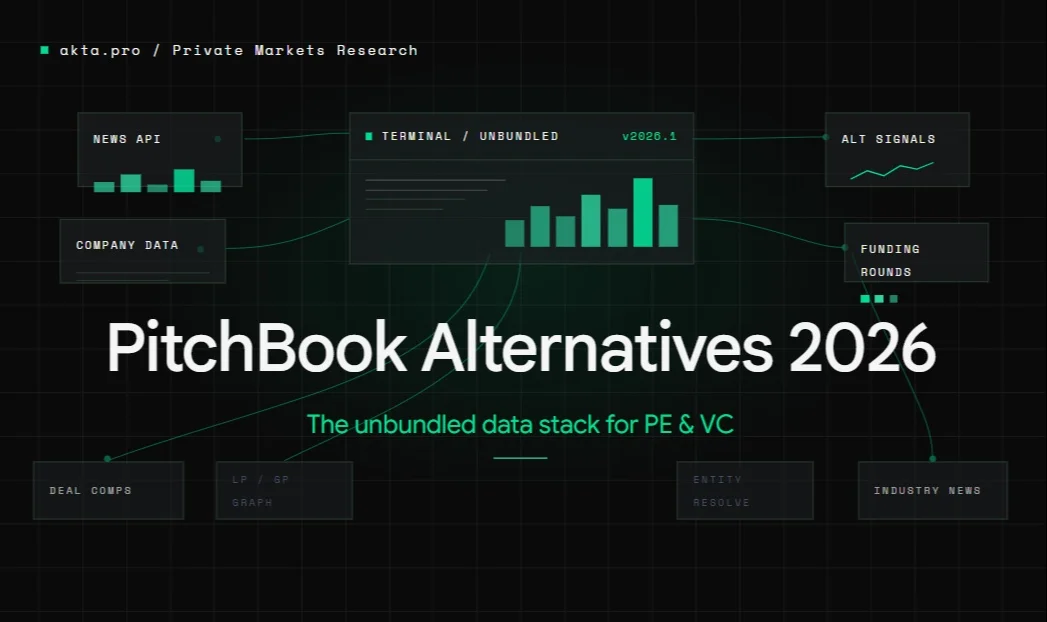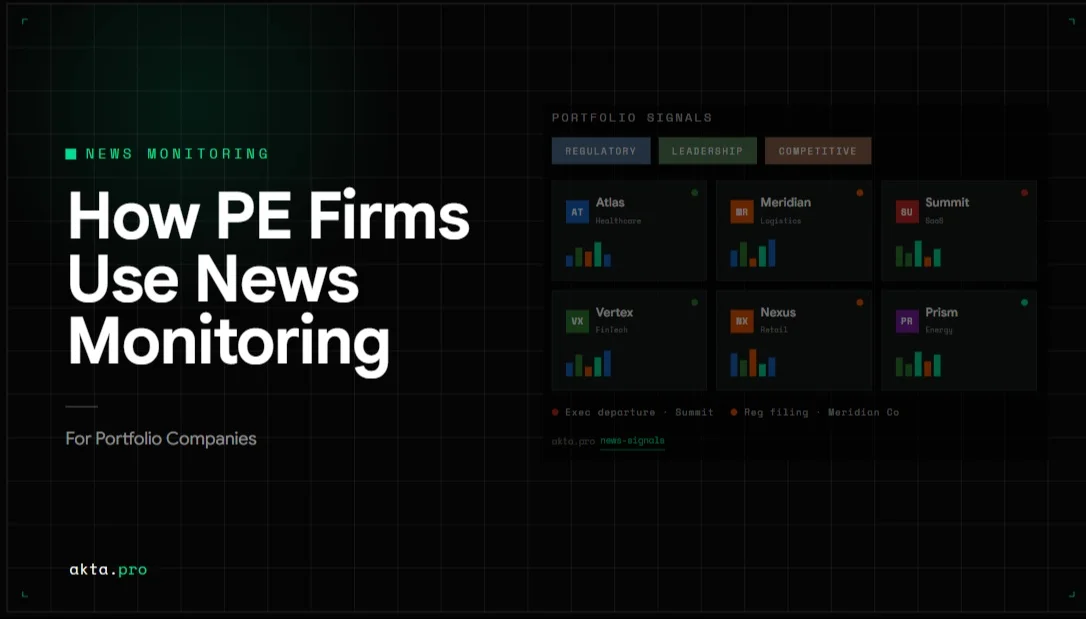
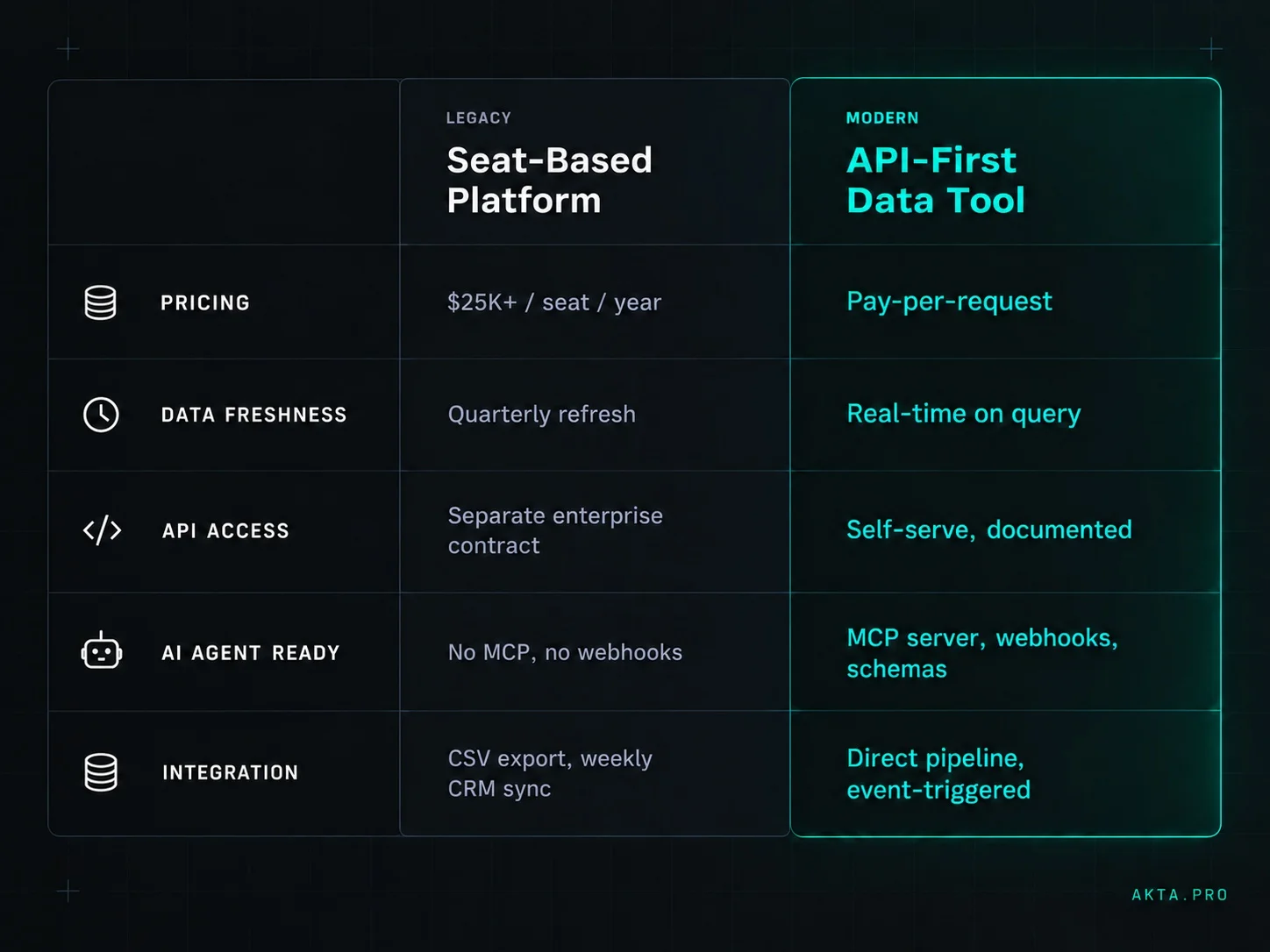
PitchBook contracts range from $20,000 to $124,000 per year, according to 114 verified buyer transactions compiled by Vendr. For that spend, deal teams get a dashboard they share with every other fund running the same screens, data that refreshes every three to four months on company profiles, and an API that requires a separate enterprise contract with no public documentation.
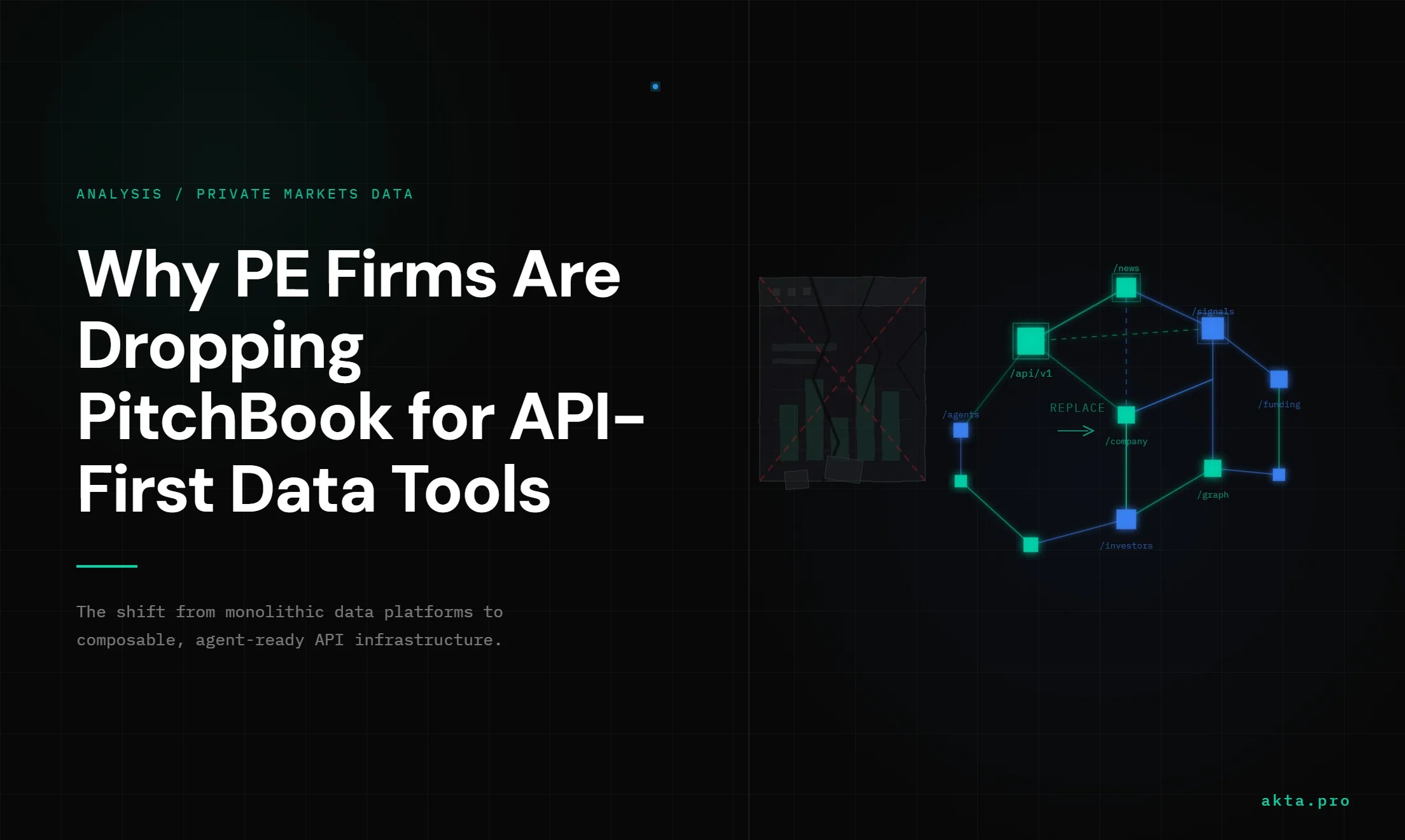
"Dropping" does not mean deleting. What PE firms are actually doing is cutting PitchBook seat counts, keeping a few licenses for fund benchmarking and LP research, and redirecting freed budget into modular, API-first data tools that plug directly into their CRM, deal pipeline, and AI workflows. The shift is not about finding a cheaper PitchBook. It is about building a data infrastructure where the data moves with the deal team's process, not the other way around.
The Structural Problem With Seat-Based Data Platforms
PitchBook earned its position as the default private markets data platform. It tracks 6 million+ companies, 2.6 million investments, and 557,000 investors. For fund performance benchmarking, LP intelligence, and deal comp analysis, the depth is difficult to match.
The friction appears when deal teams try to operationalize that data. PitchBook was built as a research tool. The platform assumes a human sits at a dashboard, runs a search, reads results, and exports a spreadsheet. That workflow made sense in 2015. It does not match how the best-performing PE deal teams work in 2026.
Three problems keep surfacing across firms that have outgrown the dashboard model.
Data freshness degrades deal execution. PitchBook's headcount data lags 12 to 18 months behind actual figures, according to Crustdata's analysis. Company profiles refresh quarterly. Private company valuations are delayed 45 to 60 days. For a deal team tracking hiring spikes as leading indicators of growth, that lag means the signal arrives after faster-moving funds have already made contact. As one user noted on Reddit, referenced by Crustdata: "PitchBook only claims that their data is ~60% accurate and they are ok with this."
Every fund with a license runs identical screens. When 50 firms search for "lower-mid-market SaaS companies, 100 to 300 employees, Southeastern US," PitchBook returns the same list, sorted the same way, to all of them. The database creates parity, not edge. The fund that builds a custom pipeline combining headcount growth velocity, job posting signals, and web traffic into a proprietary scoring model sees a different, more refined universe. Building that model requires programmatic access to raw data.
The API exists, but it is not built for builders. PitchBook does offer a RESTful API, but API access requires a separate enterprise contract on top of the platform subscription. There are no published rate limits, no public endpoint reference, no official SDKs, and no webhook support. PitchBook charges credits per API request, and calls fail with a 402 error when the balance runs out. For a developer evaluating what they can build, that opacity is the first constraint.
What API-First Data Tools Actually Are
An API-first data tool is a platform designed from the start around programmatic access. The API is not an add-on layered onto a dashboard product. It is the primary interface. Everything the platform can do is accessible through documented, versioned endpoints with published rate limits, transparent pricing, and standard authentication.
For PE firms, this means three things in practice:
Data flows into existing systems automatically. Instead of an analyst exporting a CSV from PitchBook and pasting it into a CRM, an API-first private company data tool pushes enriched company profiles directly into DealCloud, Salesforce, or Affinity through scheduled or event-triggered calls. The data stays current because the pipeline runs continuously, not when someone remembers to export.
Custom scoring and filtering become possible. A private equity data API with 70+ structured data points per company lets a deal team define their own investment thesis as a query. Rather than using a platform's predetermined filters, the team builds scoring logic specific to their fund strategy: weight revenue growth at 3x, penalize customer concentration, flag leadership changes in the last 90 days. That logic lives in their system, not locked inside a vendor's UI.
AI agents can use the data. Deloitte's 2025 survey of 1,000 senior corporate and PE leaders found that 86% already use generative AI in their M&A workflows. Bain's Global M&A Report 2026 found 45% used AI tools in M&A in 2025, more than double the prior year. AI agents need structured, API-accessible data to function. A dashboard with no API is invisible to an agent. An API-first tool with deterministic schemas, entity resolution, and pay-per-call pricing is built for exactly this kind of consumption.
The Economics: Seat Licenses vs. Pay-Per-Call
The pricing difference between legacy platforms and API-first data tools is not just about total cost. It is about cost architecture.
PitchBook's standard plan starts at roughly $25,000 for three users, with additional seats at approximately $7,000 per year each. A 10-person deal team runs $60,000 to $80,000 per year. Enterprise contracts with API access, CRM integration, and premium modules can reach $124,000+, based on Vendr's transaction data.
API-first providers price by usage. A platform like akta.pro charges per request, with no seat licenses, no annual minimums, and no separate API contract. A team that needs 200,000 API calls across company enrichment, news signals, and entity resolution pays for what it consumes. The same budget that covers one PitchBook enterprise seat can fund hundreds of thousands of structured data requests.
This changes the access pattern inside a firm. With seat-based licensing, only licensed users touch the data. Associates with seats export CSVs for principals without seats. The data degrades every time it changes hands. With API-first access, the data feeds directly into shared systems. Every team member, and every AI agent, operates on the same current dataset.
Why PE Firms Are Making the Switch Now
Two forces are accelerating the move away from monolithic data platforms toward API-first data tools in private equity.
AI workflows demand structured, programmatic data access. EY reports that 84% of US private equity firms have appointed a Chief AI Officer, and 88% have invested more than $1 million in generative AI. McKinsey's M&A outlook documented roughly 20% average cost reduction on deal processes and 10% to 30% shorter timelines at firms using AI systematically. These AI systems need data delivered through APIs, not trapped behind a login screen.
When a deal team connects an AI research agent to an API-first private company data API, the agent can resolve a target company, pull firmographics and funding history, monitor news signals, and flag material events, all without human intervention. Try doing that with a platform where API access requires a separate enterprise contract and credits that expire.
The composable data stack has reached PE. The best-performing PE firms now run a layered tech stack, not a single monolithic platform. Third Bridge for expert intelligence, PitchBook or an alternative for deal data, Capital IQ for financial modeling, DealCloud for pipeline management, and Tableau for portfolio reporting, according to Third Bridge's 2026 analysis. API-first tools fit naturally into this architecture because they are designed to interoperate. A private company data API that offers entity resolution across 20M+ companies and delivers structured, deterministic responses can slot into any layer of that stack.
The direction is clear in industry surveys too. Bain's midyear 2026 PE report states that firms seeing the greatest AI impact are not simply layering AI tools onto existing processes but moving quickly to redesign workflows and strengthen the data foundation. Strengthening the data foundation starts with replacing rigid, seat-gated data with modular, API-accessible data infrastructure.
What to Look For in an API-First Data Tool for PE
Not every platform that offers an API qualifies as API-first. Some bolt an API onto an existing dashboard product with restrictive rate limits, incomplete field coverage, and pricing that penalizes programmatic use. Evaluate based on these six criteria:
Documentation and developer experience. Is the API documentation public? Are there SDKs, code samples, and a sandbox environment? PitchBook's API docs are behind platform authentication and not publicly accessible. API-first tools publish their docs openly because the API is the product.
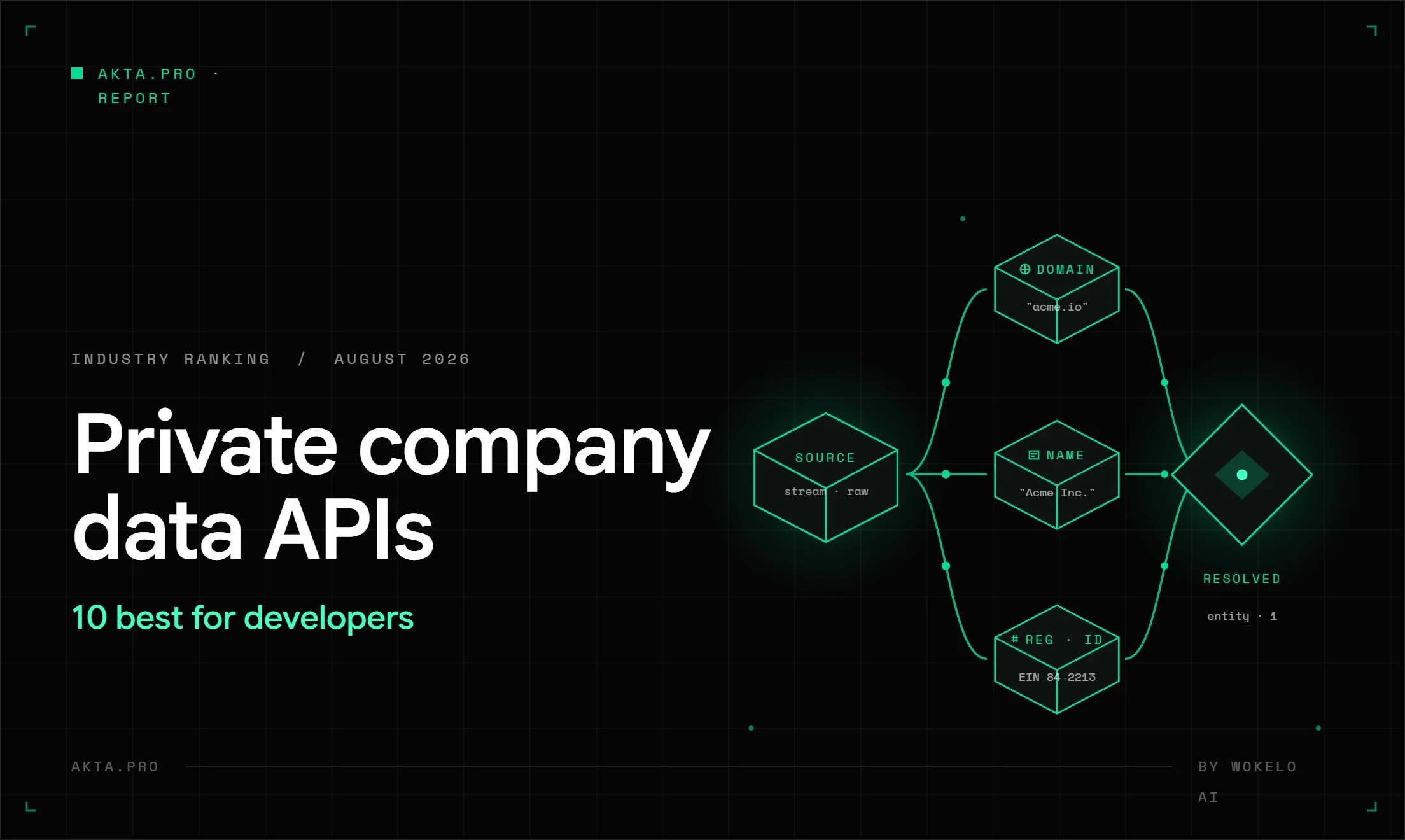
Entity resolution. Private company data is messy. The same company appears under different names, domains, and identifiers across sources. A provider with patent-pending entity resolution across 20M+ global entities, like akta.pro, resolves "Stripe," "stripe.com," and "Stripe, Inc." to a single canonical record. Without entity resolution, your pipeline produces duplicates and mismatches.
Data freshness architecture. Ask whether data refreshes on a batch cycle (monthly, quarterly) or in real-time on query. For portfolio monitoring and signal-based sourcing, the difference between learning about a leadership change today versus 90 days from now determines whether you act first or react last.
Pricing transparency. Can you calculate your annual data cost before signing a contract? API-first providers publish credit costs per endpoint. If a vendor requires a sales call to tell you what an API call costs, the pricing model is built for the vendor's benefit, not yours.
AI and agent compatibility. Does the platform offer an MCP server, structured response schemas, and support for AI agent workflows? As of 2026, multiple API-first providers ship MCP servers. akta.pro, Crustdata, Harmonic, and others offer direct integration with Claude, ChatGPT, and other AI platforms through standard protocols.
Coverage depth and breadth. PitchBook covers roughly 6 million companies, weighted toward VC-backed firms. API-first providers cover different slices. akta.pro covers 20M+ private companies globally with 70+ data points per company plus entity-resolved news signals across 30,000+ sub-sectors. Evaluate whether the provider's coverage matches your fund's investment thesis.
How akta.pro Fits: API-First Private Company Data in Practice
To make this concrete, here is what API-first access looks like for a PE deal team using akta.pro, one of the providers built from the ground up around this model.
akta.pro covers 20M+ private companies globally with 70+ structured data points per company, including firmographics, business model, product offering, management, financials, technology stack, and industry classifications. It also delivers real-time, entity-resolved news signals across 30,000+ monitored sub-sectors, with ~80% noise filtered before the data reaches your pipeline.
In independent benchmarks, akta.pro ranked #1 across news providers on accuracy (93%), F1 score (81.3), and cost per 1,000 accurate articles ($0.50), outperforming SerpAPI, NewsAPI, Perigon, and GPT-based extraction.
Three things make it specifically relevant for PE teams moving off seat-based platforms:
Pay-per-request pricing with no seat licenses. There is no annual contract minimum and no separate API add-on fee. A deal team pays for exactly the enrichment calls, news queries, and entity resolutions it consumes. For a firm spending $60,000+ on PitchBook seats for operational data workflows, the same budget funds hundreds of thousands of API calls through akta.pro.
Built for AI agents, not just humans. akta.pro ships an MCP server that connects directly to Claude, ChatGPT, Cursor, and other AI platforms. Response schemas are deterministic, payloads are compact, and every data point includes source attribution. An AI research agent can resolve a target company, pull its full enrichment profile, scan its news signal history, and surface material risks or opportunities without human data wrangling.
Patent-pending entity resolution across 20M+ entities. The same company appears as "Databricks," "databricks.com," and "Databricks, Inc." across different data sources. akta.pro's entity resolution maps all variants to a single canonical record, which eliminates the duplicate-and-mismatch problem that plagues most PE data pipelines stitching together multiple vendors.
For teams building portfolio monitoring dashboards, automated deal sourcing pipelines, or AI-powered company research workflows, this is the kind of infrastructure that makes API-first a practical upgrade rather than an abstract concept.
PitchBook Is Not Going Away. The Use Case Is Splitting.
This is not a story about PitchBook dying. PitchBook remains the strongest platform for fund performance benchmarking, LP intelligence, and deal comp databases. Those are research use cases where a curated, human-verified database viewed through a dashboard is the right tool.
The use cases that are migrating to API-first tools are the operational ones: deal sourcing pipelines, CRM enrichment, portfolio company monitoring, AI-powered research agents, and automated signal detection. These workflows need real-time data, programmatic access, and pricing that scales with usage, not headcount.
Most firms making this transition do not cancel PitchBook entirely. They reduce seat count, keep it for fund-level analysis and LP research, and redirect the freed budget into API-first tools for operational workflows. The result is better data where it matters most, at lower total cost, with infrastructure that supports the AI-enabled workflows 76% of PE firms are now investing in, according to EY's H1 2026 PE Pulse.
The question for PE data leaders is no longer "PitchBook or not PitchBook." It is: which parts of your data workflow need a dashboard, and which need an API?
Frequently Asked Questions
What are API-first data tools?
API-first data tools are platforms where the API is the primary product interface, not an add-on to a dashboard. They offer documented endpoints, published rate limits, transparent per-call pricing, and standard authentication. For PE firms, this means private company data, news signals, and enrichment flow directly into CRMs, deal pipelines, and AI agents without manual exports.
Why are PE firms moving away from PitchBook?
PE firms are not abandoning PitchBook entirely. They are shifting operational workflows, such as deal sourcing, CRM enrichment, and portfolio monitoring, to API-first tools that offer fresher data, programmatic access, and usage-based pricing. PitchBook's quarterly data refresh cycle, separate API contract requirement, and per-seat pricing create friction for teams building automated, AI-enabled deal workflows.
How much does PitchBook cost per year?
PitchBook does not publish pricing publicly. Based on 114 verified buyer transactions from Vendr, contracts range from $20,000 to $124,000 per year, with a median annual value of around $30,000. Single-user subscriptions typically start at $12,000 to $20,000. API access requires an additional enterprise contract with credit-based billing.
What is the best PitchBook alternative for private equity data?
It depends on the workflow. For programmatic company enrichment, news signals, and portfolio monitoring, akta.pro offers 20M+ private companies with 70+ data points, pay-per-request pricing, MCP integration for AI agents, and the highest-ranked news accuracy among API providers at 93%. For early-stage deal sourcing, Harmonic and Crustdata track pre-funding startups that PitchBook misses. For fund-level benchmarking and LP intelligence, PitchBook and Preqin remain the strongest options.
How do API-first data tools integrate with PE workflows?
API-first tools connect to PE tech stacks through REST APIs, webhooks, and MCP servers. Common integrations include pushing enriched company data into DealCloud or Salesforce, feeding AI research agents with structured company profiles, automating portfolio news monitoring, and building proprietary deal scoring models that run against live data.