A single PitchBook seat now runs $20,000 to $30,000 a year for a typical mid-market fund, and up to $124,500 for enterprise contracts with full module access. Vendr's transaction data on 114 verified contracts shows the median customer pays around $30,875 a year, and add-on modules like the VC Exit Predictor push that higher.
The best PitchBook alternatives in 2026 are akta.pro for API-native and agentic workflows, S&P Capital IQ Pro for public-market analysis, Preqin for LP research, Grata for middle-market sourcing, and Crunchbase for low-cost VC data. Most firms combine two to four of these tools and cover more ground than PitchBook alone at a lower total cost.
That is the short answer. The rest of this guide, written by the growth team at akta.pro after evaluating these platforms across live PE and VC workflows, breaks down all 10 options, what each one is best for, what it costs, and how to stack a few of them into a data setup that beats a single terminal.
What is PitchBook and what does it cost in 2026?
- PitchBook is diverse, and a proper alternative depends on your usecase. The private markets data stack has unbundled into sourcing, LP research, document intelligence, and an API layer.
- Highest-volume swap by mandate: Grata for middle-market sourcing, Preqin for LP work, Capital IQ for public comps, Harmonic for AI-native VC sourcing, and akta.pro for programmatic and agent-driven company data and news signals workflows.
- Cheapest serious option: akta.pro for private company data, news, and signals. Crunchbase Pro at roughly $49 per month for VC ecosystem data.
- Best for automation: an API-first provider like akta.pro, priced pay-as-you-go rather than per seat.
- The move that saves the most: unbundle PitchBook into a specialized stack instead of renewing it wholesale.
PitchBook is a private markets data platform that provides company profiles, deal and transaction records, and fund performance data. Venture capital, private equity, investment banking, and corporate development teams use it for deal sourcing, due diligence, and fundraising research. It is strongest in later-stage and buyout deal data and in fund benchmarking.
Pricing is quoted per seat and is not published. PitchBook's per-seat pricing typically scales from about $7,000 per additional user after the base plan, and auto-renewal clauses often carry 5 to 10 percent annual escalators. For a growing PE firm running twelve seats across sourcing, portfolio, and IR, the platform quietly becomes the fourth or fifth largest line item on the tech budget.
That price would be tolerable if PitchBook were still the only serious answer. In 2026, it is not. Sourcing platforms have gone AI-native, LP research now sits with specialists, and a category of API-first providers has emerged for firms that want private company data piped straight into their own agents, CRMs, and diligence workflows at a fraction of terminal pricing.
Why teams are rethinking PitchBook in 2026
Three shifts are driving the conversation.
The first is contractual. Buyers are pushing back on per-seat pricing and escalator clauses. Vendr's negotiation guidance for the platform now specifically flags capping those escalators as a priority, which tells you where the pressure is.
The second is workflow. Deal teams do not run diligence inside PitchBook. They export tables, paste them into Excel, cross-reference on LinkedIn and news, then rebuild the picture in a memo. The terminal was designed as a research destination, not a data source. Associates now run parallel workflows across three or four tools and increasingly hand parts of those workflows to AI agents, and that older model shows its age.
The third is coverage philosophy. PitchBook's dataset is optimized around funded companies and disclosed transactions. A fund with a founder-owned, bootstrap-heavy mandate, or a team screening 8,000 targets a year against a thesis, will find that half the universe it cares about does not appear until it has already been picked over.
None of this means PitchBook is a bad product. It means PitchBook is expensive for what most teams actually use it for. The real question is what to combine it with, or replace it with.
How to evaluate a PitchBook alternative
Five criteria separate a useful tool from a shelfware line item.
-
Coverage that matches your mandate. VC deal flow, LP research, middle-market sourcing, and corp-dev target screening are four different data problems. A platform strong at one is often mediocre at another.
-
Data freshness and entity resolution. Deduplication, name normalization, and event attribution are the unglamorous work that separates enterprise data from a scrape. Test any vendor on ten companies you already know deeply before trusting it on the 10,000 you do not.
-
Integration surface. DealCloud, Affinity, Salesforce, and internal data lakes are where the data has to live. A platform without a working API or CRM sync is a research silo, and analysts will route around it.
-
Pricing model fit. Per-seat pricing punishes firms with occasional users. Pay-as-you-go API pricing punishes heavy dashboard users. Match the model to how the data actually gets consumed.
-
Agent-readiness. By late 2026, most serious funds run at least one internal AI workflow against their data stack. Platforms with deterministic schemas, MCP servers, and stable output contracts are worth more than platforms with prettier interfaces.
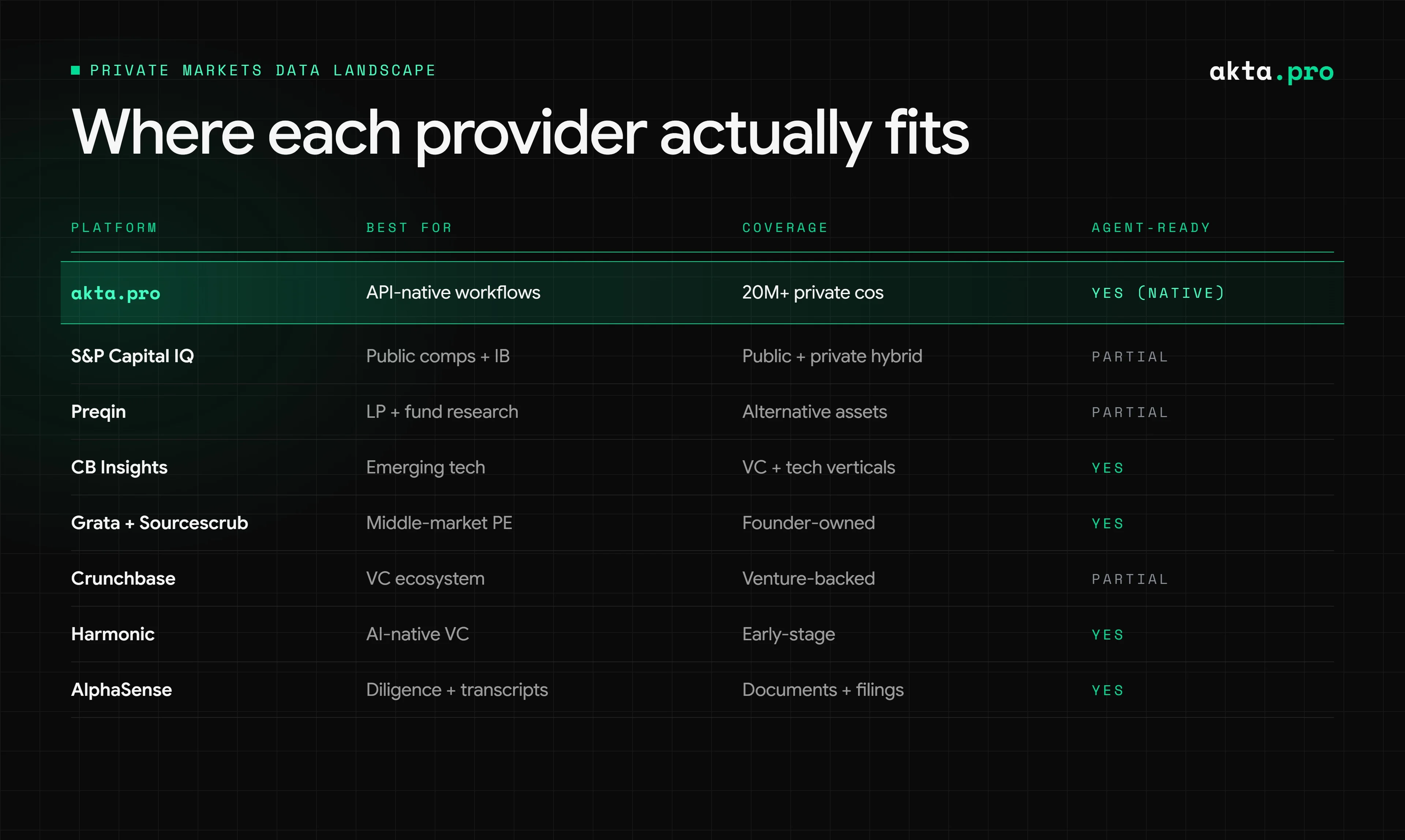
The 10 best PitchBook alternatives in 2026 at a glance
| Tool | Best for | Coverage | Pricing model | API / agent-ready |
|---|---|---|---|---|
| akta.pro | API-native and agentic workflows | 20M+ private companies | Pay-as-you-go | Yes, MCP support |
| S&P Capital IQ Pro | Public comps and IB workflows | Public and private, broad | Per seat, ~$12k–$25k/user/yr | Excel add-in |
| Preqin | LP research and fund-of-funds | Fund and LP data, alternatives | Per seat, ~$2k–$7k/user/mo | Limited API |
| CB Insights | Emerging-tech thesis work | 1M+ companies, analyst research | Per seat, ~$2.5k–$8.3k/mo | Basic |
| Grata + Sourcescrub | Middle-market PE sourcing | 21M+ private companies | Custom quote | Limited |
| Crunchbase | Cost-conscious VC coverage | 4M+ companies | From ~$49/mo | API on higher tiers |
| Tracxn | Global emerging-market coverage | 2,500+ sector feeds | ~$4,400/user/yr | API available |
| Dealroom | European ecosystem intelligence | 2M+ startups | From ~€37,500/yr | API available |
| Harmonic | AI-native VC deal sourcing | 35M+ companies | ~$500+/user/mo | Yes, Scout agent |
| AlphaSense | Document and transcript search | 10,000+ premium sources | Enterprise, quoted | Document AI |
Figures are current as of August 2026 and reflect published ranges and vendor pages. Pricing is heavily negotiated, so treat every number as directional.
The 10 best PitchBook alternatives in 2026
1. akta.pro, for API-native and agentic workflows
The category most PitchBook comparisons still miss is API-native private markets infrastructure. Terminal pricing assumes analysts do the work by hand. In 2026, most funds we talk to run at least one workflow (deal screening, portfolio monitoring, or thesis validation) that they would rather hand to an agent overnight than keep an associate on until 11 PM.
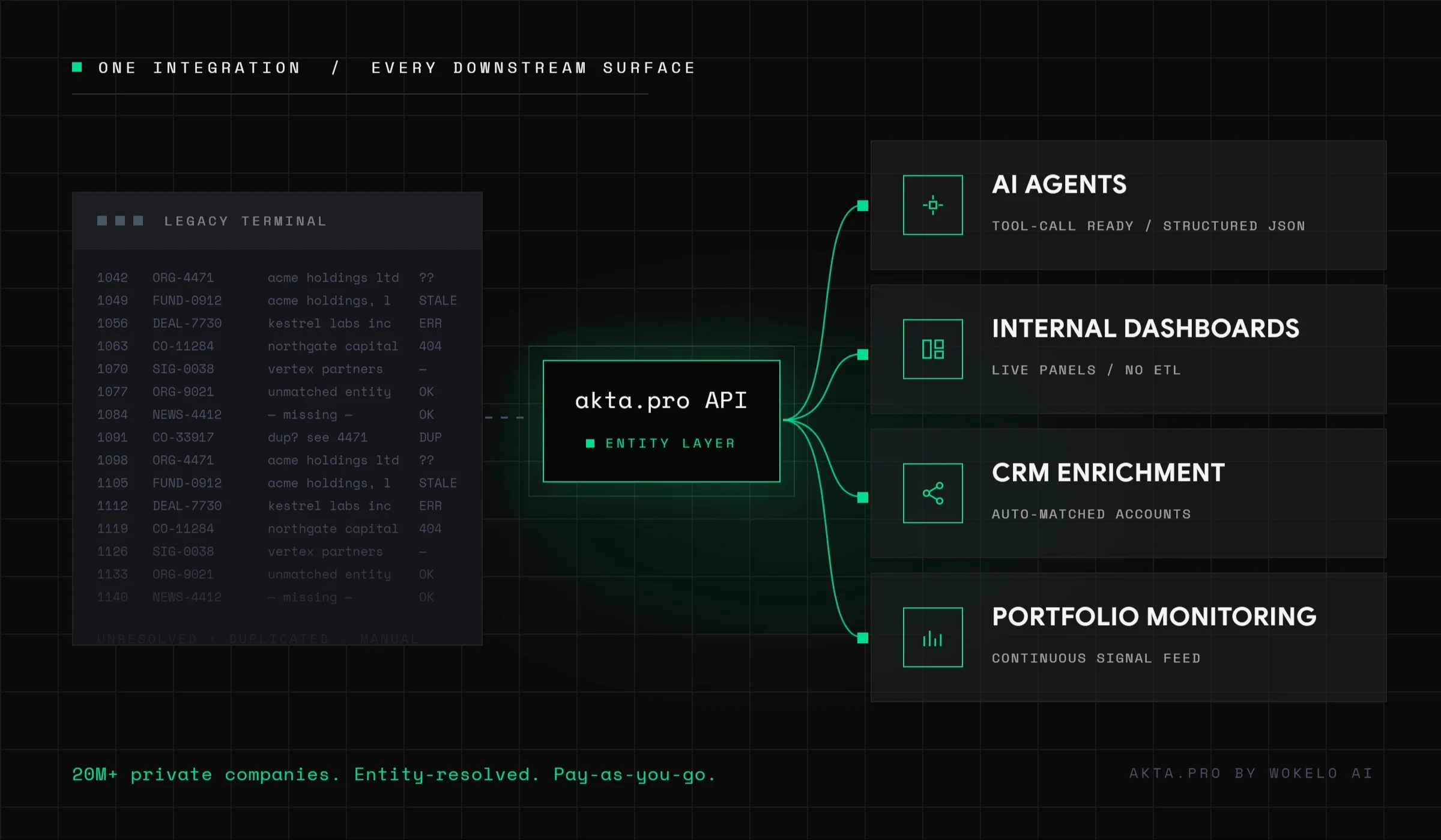
akta.pro is built for that shift. It covers 20 million-plus private companies through four API products: Company Data, Company News, Industry News, and Alternative Signals. It ships patent-pending entity resolution, an 86-category event taxonomy, and MCP support so agents can query it directly. Pricing is pay-as-you-go rather than per seat, which changes the economics for firms that do not need 15 people staring at a dashboard.
This is not a like-for-like replacement for a research terminal. It is the layer underneath one. Firms use akta.pro to power internal dashboards, automate portfolio adverse-signal monitoring, enrich CRMs, feed AI-generated IC memos, and build proprietary sourcing pipelines against their own theses rather than a vendor's. It is also the strongest fit if "pitchbook api" is what brought you here, because an API is the whole product rather than an add-on.
Best for: PE, VC, and corp-dev teams running programmatic workflows, quant-oriented funds, portfolio operations, developers, AI builders, GTM, and in-house AI teams.
Pricing: Pay-as-you-go, billed on usage rather than seats.
2. S&P Capital IQ Pro, for public-markets crossover and IB workflows
Capital IQ is the natural PitchBook substitute for teams that spend more time on public comparables, credit analysis, and M&A precedent transactions than on venture-stage sourcing. It sits inside the S&P Global ecosystem, plugs into Excel natively, and is the standard at nearly every bulge-bracket and mid-market investment bank.
It beats PitchBook on financial modeling depth, transcripts, credit ratings, and the S&P sector taxonomy. It loses on early-stage venture data and founder-owned company coverage.
Best for: Investment banks, credit funds, and PE firms running public comp-heavy workflows.
Pricing: Roughly $12,000 to $25,000 per user per year, heavily negotiated at scale.
3. Preqin, for LP research and fund-of-funds
Preqin, acquired by BlackRock in 2024 for approximately $3.2 billion, is the dominant LP-side database for alternative assets. Fund performance data, GP track records, allocator profiles, and dry powder metrics are its core. For fundraising, GP due diligence, or LP allocation research, PitchBook's LP data is thinner and less current than Preqin's.
Best for: IR teams raising a fund, funds-of-funds, placement agents, and LP-side researchers.
Pricing: Roughly $2,000 to $7,000 per user per month at typical mid-market tiers, higher for full module access.
4. CB Insights, for emerging-tech thesis work
CB Insights is closer to a research house than a data terminal. Its analyst-curated market maps, Mosaic health scores, and vertical reports on AI, fintech, defense tech, and climate make it the tool of choice for CVCs and growth funds that lead with thematic research.
The catch is cost. CB Insights pricing runs roughly $2,483 to $8,333 per month, which is comparable to PitchBook's entry range rather than a discount. It is a complement, not a cost-saver.
Best for: Corporate venture arms, growth-stage VCs, and corporate strategy teams.
5. Grata and Sourcescrub, for middle-market PE sourcing
Grata and Sourcescrub combined in 2025 following Datasite's acquisition of Sourcescrub, creating the largest dedicated middle-market sourcing platform. Grata covers 21 million-plus private companies with a focus on founder-owned and PE-eligible targets, and Sourcescrub's conference-attendee and industry-award methodology fills in businesses that never surface in traditional databases.
This is where mid-market PE firms should look first. PitchBook's sub-$50M revenue coverage is genuinely thinner than either platform individually, and the combined dataset widens the gap.
Best for: Middle-market PE, corp-dev teams, and sell-side bankers running founder outreach.
Pricing: Custom quote.
6. Crunchbase, for cost-conscious VC ecosystem coverage
Crunchbase remains the cheapest serious way to track the venture ecosystem. Crunchbase Pro starts around $49 per month and while it covers a narrower universe than PitchBook, its funding-round, founder, and news data is more current on early-stage companies than most people assume.
Emerging fund managers and angels get 60 to 70 percent of what they need from a Crunchbase and LinkedIn Sales Navigator stack for under $200 a month. The trade-off is fund-level and LP data, which Crunchbase does not attempt to cover.
Best for: Emerging VC managers, angel investors, and corp-dev teams doing lightweight scouting.
Pricing: From roughly $49 per month.
7. Tracxn, for global emerging-market coverage
Tracxn's differentiator is its 2,500-plus micro-sector feeds and dedicated coverage of Southeast Asia, Africa, Latin America, and the Middle East. PitchBook's international private company data thins out considerably outside the US and Western Europe. For a mandate that covers emerging Asia or Africa specifically, Tracxn is often the primary source and PitchBook is the backup.
Best for: Global funds, DFIs, ecosystem builders, and emerging-market VCs.
Pricing: From roughly $4,400 per user per year.
8. Dealroom, for European ecosystem intelligence
Dealroom leans into ecosystem context: which companies are hiring in Berlin fintech, which sub-sectors are compounding in Nordic climate tech, which scaleups government agencies are tracking. It is more curatorial than PitchBook and stronger for European deal flow specifically.
Best for: European VCs, corporate strategy teams, and LPs mapping regional ecosystems.
Pricing: From roughly €37,500 per year.
9. Harmonic, for AI-native VC deal sourcing
Harmonic shows where the sourcing category is heading. Its AI agent Scout runs natural-language queries against the company database, scores companies against user-defined criteria, and surfaces warm-intro paths through team calendars and LinkedIn. For seed and Series A teams that want to see companies before the first round closes, Harmonic is the strongest AI-native alternative on the discovery side.
Best for: Seed and Series A VCs, scout networks, and corporate innovation groups.
Pricing: Roughly $500 or more per user per month.
10. AlphaSense, for document and transcript intelligence
AlphaSense is not a company database in the PitchBook sense. It is a search and summarization engine that indexes broker research, expert-call transcripts, filings, and news across public and private markets. For diligence where the answer sits inside a 200-page 10-K or a set of five-year-old expert calls, nothing else on this list comes close.
Pricing is enterprise and quoted on request, which means it stacks alongside a database tool rather than replacing one.
Best for: Diligence-heavy teams, credit and public-equities analysts, and corporate strategy.
How PE and VC firms should actually stack these alternatives
No firm we have seen in 2026 runs on one platform. The useful question is not which alternative replaces PitchBook, but which combination costs less and covers more. Three archetypes hold up in practice.
The emerging VC fund (sub-$100M AUM). Crunchbase Pro plus Harmonic plus a lightweight API like akta.pro for programmatic enrichment. Total cost lands around $12,000 to $25,000 a year across three tools, roughly the price of a single PitchBook seat.
The middle-market PE firm ($500M to $3B AUM). Grata for sourcing, Capital IQ for public comps and modeling, Preqin for LP work, and an API layer like akta.pro for internal dashboards and CRM enrichment. The cost is roughly equivalent to a 10-seat PitchBook contract, with materially better sourcing coverage and workflow integration.
The large multi-strategy fund ($5B-plus AUM). Everything above, plus AlphaSense for diligence, CB Insights for thematic work, and PitchBook itself retained as a benchmarking cross-check. At this size the incremental cost of adding platforms is small relative to fee income, and coverage gaps are the real constraint.
The pattern is the same in each case. The terminal-plus-CRM model of the 2010s has given way to a specialized stack with an API layer underneath that makes the whole thing programmable.
Cheaper and free alternatives to PitchBook
There is no free tool with data quality comparable to PitchBook, but several options cover parts of the job at a fraction of the cost.
- Crunchbase has a free tier that shows basic company and funding data, and Crunchbase Pro at about $49 per month is the cheapest serious VC dataset.
- LinkedIn is useful for people-level research but carries no deal or valuation data.
- SEC EDGAR and state filings surface Form D fundraising activity for free, though they require manual parsing.
- akta.pro is known for it's depth and quality of data and the cheapest route for teams that want programmatic data without paying for dashboard seats, because its pay-as-you-go model bills only for what you query.
For serious private markets work, the minimum viable stack starts around $50 per month for VC scouting and rises from there depending on mandate.
Where the private markets data category is heading
Two shifts are worth watching over the next 18 months.
First, LLM-driven interfaces are moving from novelty to default. Harmonic's Scout, CB Insights' briefings, and every major vendor's AI copilot are early versions of how analysts will interact with data. Vendors without deterministic API outputs will struggle to feed those interfaces reliably, which is why agent-readiness now belongs on the evaluation checklist.
Second, the economics of terminals are getting harder to defend. The private markets data business was built on the assumption that clean data was scarce and workflows were manual. Neither holds today. Firms that treat data as infrastructure rather than a subscription will run leaner and see more.
For most PE and VC firms in 2026, the answer to "what should we do about PitchBook" is not to replace it wholesale. It is to unbundle it: move sourcing to a specialist, move LP work to Preqin, move programmatic workflows to an API like akta.pro, and re-evaluate what is left worth paying for.
How we evaluated these PitchBook alternatives
The akta.pro growth team compiled this list from three inputs: published pricing and coverage data from each vendor's own pages and negotiation datasets such as Vendr, hands-on evaluation of how each platform performs in live PE and VC sourcing and diligence workflows, and conversations with fund operators about how they actually stack tools. Coverage counts and pricing reflect figures available as of August 2026 and are updated when vendors change them. Where a number is negotiated or quoted privately, it is labeled as directional rather than fixed.
Frequently asked questions
What is the best alternative to PitchBook?
There is no single best PitchBook alternative, because different tools serve different workflows. For middle-market PE sourcing, Grata combined with Sourcescrub is the strongest replacement. For LP and fund research, Preqin. For AI-native VC deal sourcing, Harmonic. For programmatic and API-based workflows, akta.pro. Most firms use two to four of these together and cover more ground than PitchBook alone.
What are the best PitchBook alternatives for PE and VC firms in 2026?
The best PitchBook alternatives in 2026 are akta.pro, S&P Capital IQ Pro, Preqin, CB Insights, Grata with Sourcescrub, Crunchbase, Tracxn, Dealroom, Harmonic, and AlphaSense. akta.pro fits API-native and agentic workflows, Capital IQ fits public-market and IB analysis, Preqin fits LP research, Grata fits middle-market sourcing, and Crunchbase fits cost-conscious VC coverage.
Is PitchBook worth the price in 2026?
PitchBook is worth its cost mainly for large firms with dedicated research teams that need broad coverage across VC, PE, and M&A in one interface. For emerging VC managers, LP-focused GPs, or PE firms with a specific sector or size mandate, PitchBook's $20,000 to $70,000 annual pricing is often 30 to 70 percent more than a specialized stack that covers the same use cases better.
What are cheaper alternatives to PitchBook?
Crunchbase Pro at roughly $49 per month is the most affordable serious alternative for VC ecosystem data. akta.pro's pay-as-you-go API model is materially cheaper than PitchBook for teams that do not need multiple dashboard seats, because it bills on usage rather than per seat. Tracxn and Dealroom sit in the middle, from roughly $4,400 per user per year and €37,500 per year respectively.
Is there a free alternative to PitchBook?
There is no free alternative with comparable data quality. Crunchbase has a free tier that shows basic company and funding data, LinkedIn helps with people-level research but has no deal or valuation data, and SEC EDGAR surfaces Form D filings for free with manual effort. For programmatic access without dashboard seats, akta.pro's pay-as-you-go model keeps entry cost low. A serious private markets stack starts around $50 per month.
What is the difference between PitchBook and Crunchbase?
PitchBook covers more depth across PE, VC, M&A, and fund-level data and is designed for institutional workflows. Crunchbase focuses on venture ecosystem data, particularly funding rounds and founder profiles, at roughly 2 percent of PitchBook's cost. For pure early-stage VC sourcing, Crunchbase covers most of what teams need. For fund performance, LP research, or M&A comparables, it does not.
Does PitchBook have an API?
PitchBook offers data feeds and an API as paid add-ons layered on top of its per-seat licenses, so programmatic access carries terminal-level pricing. Teams that want an API as the primary product, rather than an extra, tend to choose an API-first provider such as akta.pro, which delivers private company data, news, and signals through four products with MCP support and pay-as-you-go pricing.