Companies with a clearly defined firmographic ICP achieve 68% higher account win rates than those without one, per SiriusDecisions research absorbed into Forrester. That lift doesn't come from having more records. It comes from having the right structural filters applied before a single dollar of pipeline is worked.
Firmographic data is that filter. And yet most teams treat it as a commodity. They assume their provider has it covered, they load a list into their CRM, and they discover six months later that the headcount buckets are wrong, the revenue bands are estimated from job postings, and three records for the same company are sitting in different segments.
This blog covers what firmographic data actually contains, where it breaks down, and how it's used across every team that depends on knowing what a company is before they try to sell to it, invest in it, or build software for it.
What Firmographic Data Actually Means
Firmographic data is the structured set of company-level attributes used to classify and segment organizations. It includes industry classification, employee headcount range, annual revenue band, geographic location, ownership type, founding year, funding stage, and operating status. It is to companies what demographic data is to individuals: the structural profile that determines fit before behavior or intent can narrow the field.
The term derives from "firmography," coined as a B2B parallel to demography. Where demographic data covers an individual's age, gender, and location, firmographic data covers an organization's size, structure, and sector. Dun & Bradstreet, one of the oldest business data providers, defines it as "company-level attributes that create a clear framework for grouping similar businesses." That framing matters: firmographic data is primarily about classification, not description.
The Core Firmographic Attributes
Not all firmographic fields carry the same analytical weight. These are the ones that actually move targeting decisions:
Industry classification sits at the center of any ICP. Most systems use NAICS codes for North American prospecting, SIC codes for SEC-linked or legacy datasets, or proprietary taxonomies that offer finer vertical resolution. The resolution matters. "Software" is an industry. "Vertical SaaS for construction" is a segment you can sell into precisely. The difference between NAICS code 5112 and a vendor-specific sub-taxonomy can mean the difference between 200,000 companies and 4,000.
Company size is typically measured by employee headcount or annual revenue. Both carry measurement error. Headcount changes with every hiring cycle. Revenue for private companies is rarely disclosed. For this reason, headcount range buckets (1-10, 11-50, 51-200, 201-500, 500+) are more reliable than precise employee counts when the target segment is private companies.
Ownership type and funding stage determine how companies buy. A VC-backed Series B company in aggressive growth mode buys differently than a bootstrapped services firm protecting margins. A public company has procurement processes and compliance requirements a pre-revenue startup doesn't. These distinctions are not cosmetic; they change your sales motion, pricing strategy, and contract structure.
Operating status is the firmographic field teams forget to filter. A company incorporated in 2020, acquired in 2023, and now operating as a subsidiary under a different name still appears as an independent entity in most databases. Filtering on operating status eliminates irrelevant targets and prevents outreach to companies that no longer exist in the form you expect.
Geographic location covers headquarters address and operational presence. The two don't always match, particularly for multinationals or companies with distributed teams. Territory assignment and regulatory compliance both depend on knowing which is which.
Firmographic vs. Demographic vs. Technographic Data
These three data types appear together constantly in B2B discussions, but they answer different questions and feed different parts of the go-to-market stack.
| Data Type | What It Describes | Core Attributes | Primary Use |
|---|---|---|---|
| Firmographic | The company as an entity | Industry, headcount, revenue, location, ownership, founding year | ICP definition, account segmentation, territory design |
| Demographic | An individual within the company | Job title, seniority, department, geography | Contact persona building, personalization, outreach |
| Technographic | Tools and platforms in use | CRM, cloud provider, marketing stack, data tools | Stack compatibility, displacement selling, integration targeting |
Firmographic data tells you which companies to target. Demographic data tells you who at those companies to reach. Technographic data tells you how those companies operate and what they might replace.
The sequencing error most teams make: applying intent signals before firmographic filtering. Intent data shows which companies are actively researching a category. But if those companies don't fit your ICP by size, industry, or ownership structure, you're chasing in-market signals from accounts that will never close. Firmographic qualification has to come first. akta.pro's company data is designed to serve that first-filter role with accuracy across the private company universe that most intent and technographic providers never properly cover.
Where Private Company Firmographic Data Gets Hard
Firmographic data quality drops significantly as you move from large public companies to the private and mid-market segment. This isn't a minor caveat. For most B2B teams, PE firms, and GTM builders, the private company segment is where the majority of their addressable market actually lives.
For public companies, firmographics are anchored in regulatory filings. The SEC mandates structured disclosures for publicly traded entities: audited financials, headcount disclosures, and subsidiary maps. The data is filed, verified, and refreshed on a mandated schedule. Industry classification, revenue, and organizational structure are accurate because they legally have to be.
For private companies, none of that applies. A firm with 300 employees and $40M in revenue doesn't file public financials. Its headcount might surface in job postings, LinkedIn profiles, or press releases. Its revenue is estimated from signals like office footprint, hiring patterns, and industry benchmarks. Its subsidiary structure is scattered across state-level incorporation records, often under different entity names.
Revenue estimates for the same private company frequently vary between providers. Headcount is accurate to a band, not a precise number. Operating status can lag actual events by months.
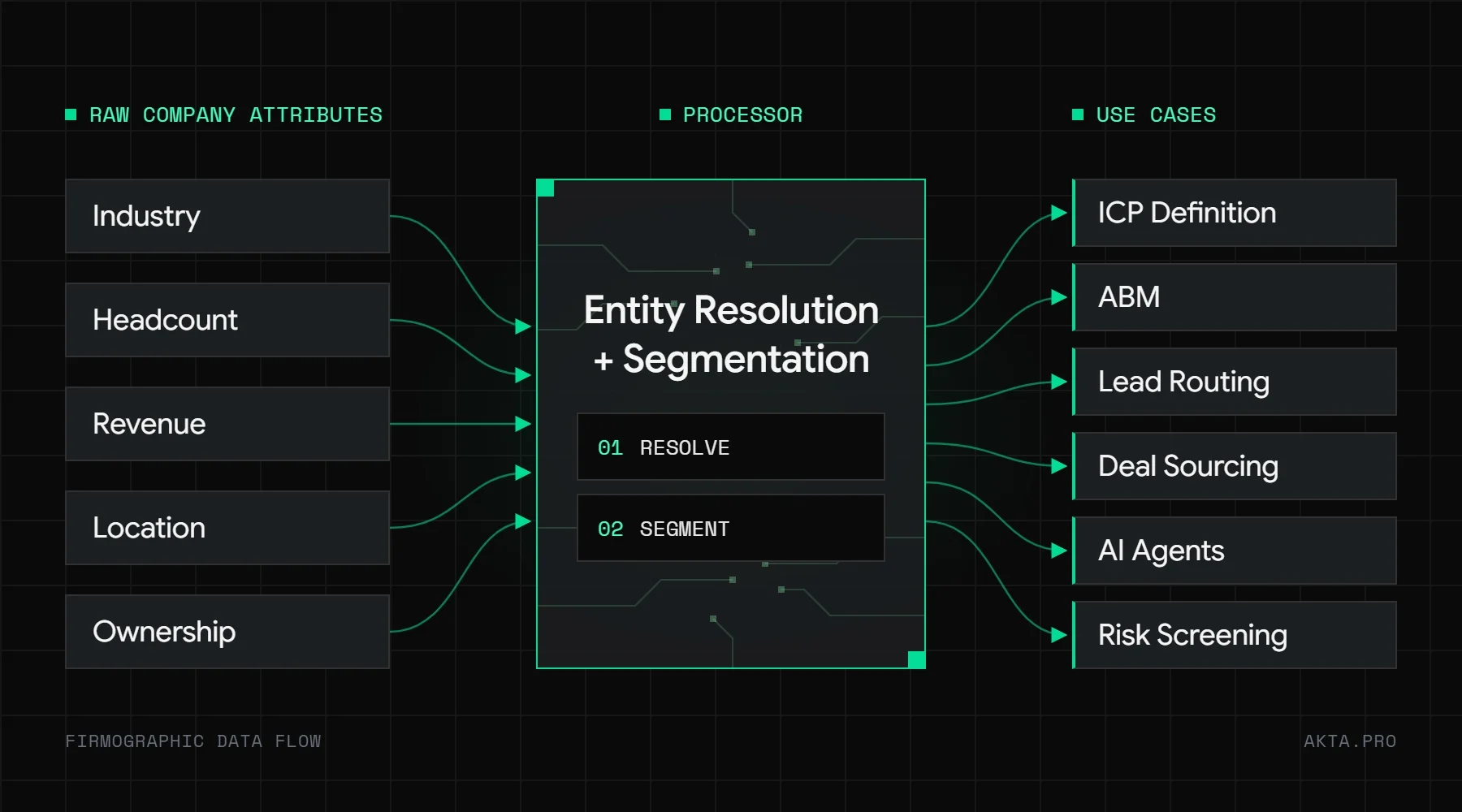
This is exactly where akta.pro's approach differs. akta's entity resolution collapses every name variant, domain, and subsidiary into one canonical entity ID across all 20M+ companies in our database. When "Wokelo AI Inc." appears in one source and "Wokelo AI" in another and a subsidiary registers as a third entity, our system maps them to one record. The firmographic profile you pull is about one company, not three fragments of one. That precision matters whether you're running a PE screening workflow, building an AI prospecting agent, or doing KYP checks at scale.
Six Use Cases for Firmographic Data
| Use Case | Who Uses It | What Firmographic Data Does |
|---|---|---|
| ICP definition | Sales, Marketing, RevOps | Sets the structural filters for target account selection |
| ABM and account lists | Demand gen, field marketing | Builds and tiers the account universe |
| Lead scoring and routing | RevOps, CRM teams | Classifies inbound accounts, routes to the right motion |
| Investment deal sourcing | PE, VC, Corporate Dev | Screens opportunity universes against investment theses |
| AI SDR and prospecting agents | Sales teams, AI platforms | Provides the structured input layer for automated outreach |
| KYP and risk screening | Finance, compliance, procurement | Establishes ownership structure and operating status for due diligence |
1. ICP definition and validation
Every ideal customer profile is, at its core, a firmographic filter: industry, size, stage, ownership type, and geography. The exercise also reveals when the definition is too broad. "Technology company, 50-500 employees" covers hundreds of thousands of companies globally. Sharp firmographic criteria force the ICP into a range where marketing budgets and sales capacity can realistically address it. Teams using akta.pro query our 20M+ company database against their exact firmographic criteria to validate whether their ICP has sufficient addressable market before they commit pipeline to it.
2. Account-Based Marketing
ABM depends on account list precision. Firmographic segmentation builds the initial universe: industry plus headcount band plus location plus funding stage. Teams then tier accounts by estimated deal size or strategic fit. akta.pro's API and MCP access let demand generation teams build and refresh these lists programmatically, so the ABM universe reflects current company status rather than a snapshot from the last list pull.
3. Lead scoring and inbound routing
When a contact fills out a demo form, their company's firmographic profile determines whether they route to an enterprise AE, a mid-market rep, or a self-serve nurture sequence. Manual research is too slow at volume. Automated enrichment via akta.pro's company data API appends ownership category, headcount range, and industry classification in real time, so routing happens on accurate data rather than whatever the lead typed in the form field.
4. Investment deal sourcing and portfolio monitoring
PE and VC teams use firmographic data to screen deal flow before human analysts engage. A firm running a healthcare IT sector thesis can filter by industry taxonomy, headcount band, revenue range, and funding stage across thousands of companies in minutes. Portfolio monitoring applies the same data in reverse: track headcount changes, operating status, and funding events across existing investments to catch early signals of stress or inflection. akta.pro covers this directly through our company data API and news signals, with the signals investors track mapped to the same entity IDs as the underlying firmographic records. For alternative signals on startups and growth companies, we layer in 10+ non-traditional datasets on top of the firmographic foundation.
5. AI SDR and prospecting agents
AI sales agents need structured firmographic data as their first input layer. Without it, they hallucinate company context or act on stale signals. With clean firmographic records tied to accurate entity resolution, an AI agent can identify ICP-fit companies, personalize outreach at the attribute level, and trigger sequences based on firmographic changes like headcount growth or a new funding round. akta.pro was built specifically for this use case: our API and MCP integration are designed for agent-native consumption, not just human-facing dashboards. Firmographic data quality is the ceiling on AI SDR performance, and akta.pro is the data layer serious teams wire in before anything else.
6. Know Your Partner and third-party risk screening
In financial services, consulting, and enterprise procurement, firmographic data is the starting point for vendor and partner due diligence. Ownership type, operating status, corporate hierarchy, and location all factor into Know Your Partner (KYP) checks. A company that appears independent but is actually a subsidiary of a sanctioned entity is only detectable with accurate corporate hierarchy data and entity resolution that collapses shell and subsidiary records correctly. That's a structural capability, not a data coverage problem. It's one reason compliance teams at firms using akta.pro rely on our entity graph rather than generic commercial databases.
Why Data Freshness Beats Raw Coverage
The provider with the largest headline database number is not necessarily the most useful one. A database with 200M company records, most of them stale, produces worse outcomes than one with 20M records that are actively maintained.
B2B company data decays at 30-70% annually depending on the segment and specific attribute tracked. Gartner estimates poor data quality costs organizations an average of $12.9 million per year. The cause is almost always the same: teams act on data that was accurate at collection and hasn't been refreshed since.
Individual firmographic attributes don't decay at the same rate:
- Headcount changes with every meaningful hiring cycle or reduction. Ranges are more stable than precise counts but still shift over 12 months.
- Operating status lags reality the most. Acquisitions, shutdowns, and restructurings often take months to surface in commercial databases.
- Funding stage and ownership category shift at funding events, which happen rapidly at growth-stage companies.
- Industry classification is the most stable attribute, but vertical pivots and product shifts do occur, particularly at early-stage companies.
Refreshing a firmographic database annually is the absolute minimum. For high-velocity segments like VC-backed growth-stage companies, quarterly re-enrichment is the floor.
akta.pro takes a different approach. It monitor 30,000+ sub-sectors with real-time news signals tied directly to company entity IDs. A headcount change, leadership shift, or funding event surfaces as a signal against the same company record. The firmographic profile updates from live evidence rather than waiting for the next scheduled crawl. Our benchmark for news retrieval, tested across 71,408 articles and 133 companies, reflects the same entity-resolved foundation that underpins the firmographic data, which is why we can make accuracy claims that aren't just marketing copy.
Frequently Asked Questions
What is the difference between firmographic and demographic data?
Firmographic data describes organizations: industry, headcount, revenue, location, ownership structure, and growth stage. Demographic data describes individuals: job title, seniority, department, age, and geography. In B2B, firmographics identify which companies to target, while demographics identify who at those companies to reach. Most ICP frameworks use both layers together, with firmographic fit as the first filter and contact-level demographics as the second. akta.pro covers the company side of that equation across 20M+ entities globally. For the full field set, see the akta.pro company data dictionary.
What are examples of firmographic data?
Common firmographic data points: software industry (NAICS 5112), 250 employees, $30M-$50M annual revenue, headquartered in Amsterdam, privately held, Series B funded, founded in 2018, operating status active. akta.pro's company data API surfaces 11 dedicated firmographic fields (name, legal name, website, company type, founding year, company description, operating status, ownership category, headcount range, and website screenshot) alongside 64+ additional data points spanning financial estimates, funding history, technology stack, management profile, and strategic signals. That depth is what makes akta.pro useful beyond basic list building.
Why is firmographic data important for B2B sales?
Because 73% of B2B buyers actively avoid suppliers that send irrelevant outreach (Gartner, 2025), and relevance starts with knowing whether a company fits your ICP before any message goes out. Firmographic data is what powers that first qualification. It answers whether the target is the right industry, the right size, and the right ownership structure before any behavioral or intent signal becomes meaningful. Teams that skip this step waste pipeline capacity on accounts that will never close. At akta.pro, we've seen the clearest impact in the private company segment, where most providers give teams false confidence on coverage they haven't actually verified.
How often does firmographic data need to be refreshed?
For active pipeline databases, quarterly re-enrichment is the minimum viable cadence. B2B company data decays at 30-70% annually across the full attribute set. High-volatility fields like operating status, headcount, and funding stage should be monitored continuously via event-driven news signals rather than relying on periodic bulk refreshes. Annual refreshes produce a false sense of data health while silently degrading targeting precision. akta.pro's real-time signal layer handles this automatically, which is why teams building AI prospecting agents wire into our API rather than downloading a static export.
What makes private company firmographic data harder to maintain than public company data?
Public companies file audited financials and mandatory disclosures on regulatory schedules. Private companies have no such obligation. Their revenue is estimated. Their headcount is crawled from job boards and professional networks. Their organizational structure is pieced together from state incorporation records across multiple jurisdictions. The data degrades faster and requires significantly more active maintenance to stay reliable. Most commercial firmographic databases cover public companies accurately and private companies inconsistently, particularly in the mid-market where most B2B addressable markets are concentrated. akta.pro was specifically designed for the private company coverage problem, combining continuous crawling, real-time news signal monitoring, and patent-pending entity resolution to keep private company firmographic records current rather than frozen at the point of last crawl.