Ninety percent of investment advisers now use or plan to use alternative data, up from 62% just two years earlier, according to Lowenstein Sandler's 2025 Alternative Data Report. Yet most of that adoption sits in public equities and hedge fund strategies. For startup investors, the gap is wider: the pitch deck and a few founder calls still form the backbone of most early-stage evaluation.
That's a problem. Startups are information-asymmetric by design. They don't file 10-Ks or have five years of audited revenue. The data a founder hands you is curated to tell a specific story. Alternative data fills the space between that curated narrative and operational reality, giving investors a way to stress-test claims and spot red flags before wiring capital.
What Counts as Alternative Data for Startup Evaluation
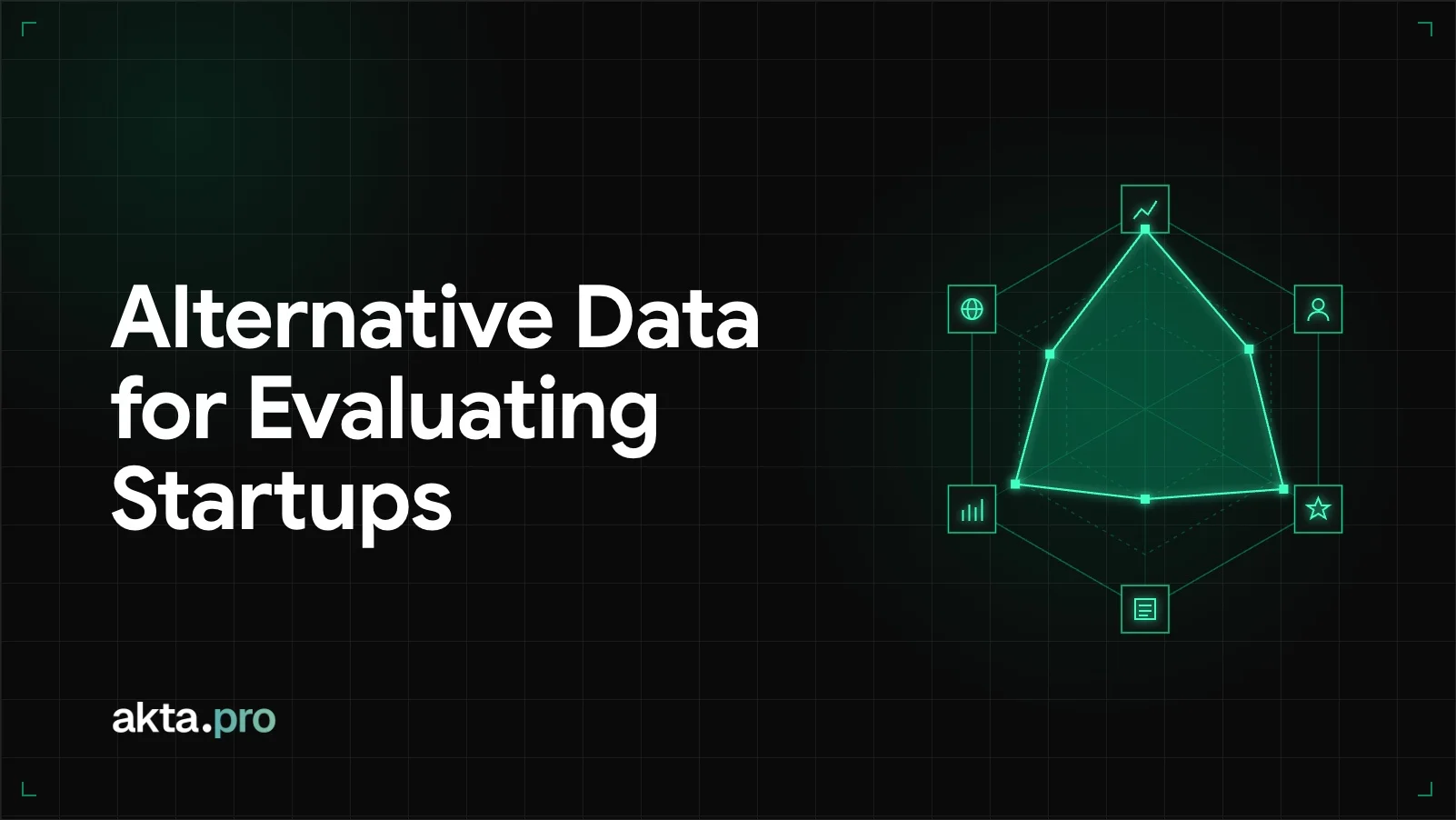
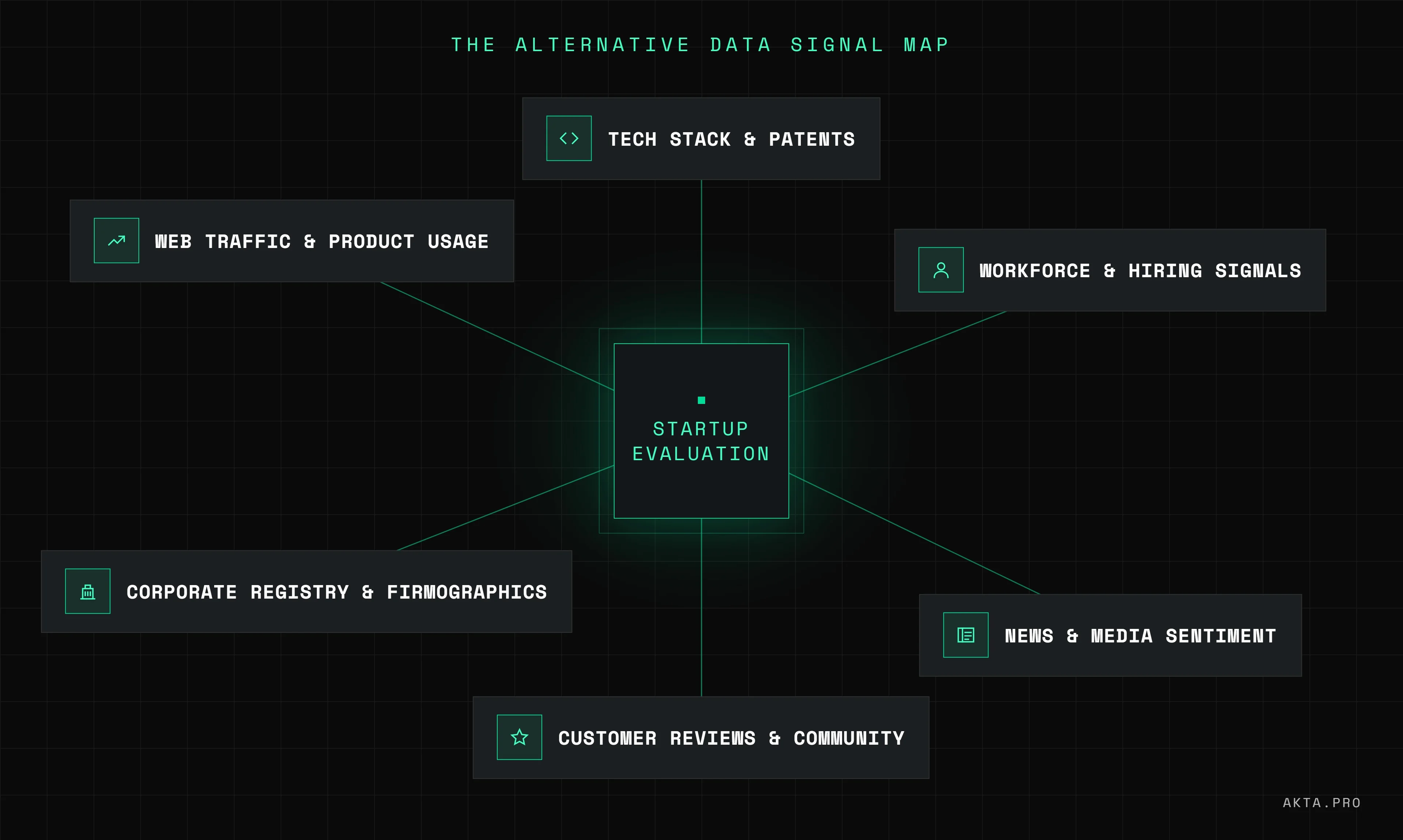
Alternative data means information from non-traditional sources, outside financial statements, pitch decks, and cap tables. The Alternative Data Council defines it as anything providing insights not available through traditional channels. For startups, the useful signals fall into six categories:
- Web traffic and product usage data (site visits, conversion patterns, app downloads)
- Workforce and hiring signals (job postings, team growth, role composition)
- News signals and media sentiment (press coverage, funding announcements, negative event detection)
- Customer and community signals (app reviews, G2/Trustpilot ratings, social mentions, Reddit discussion)
- Technology signals (tech stack, GitHub activity, patent filings)
- Corporate registry and firmographic data (incorporation records, ownership structures, funding history)
The market itself is growing fast: Grand View Research puts it at $18.8 billion in 2025, with hedge funds still the majority of spend, but VC and PE firms are closing the gap fast, and 89% of advisers plan to increase their alternative data budgets.
Startup-focused alternative data used to be scattered across dozens of point tools, one for traffic, another for hiring, a third for news. Platforms like akta.pro now provide entity-resolved company enrichment, news intelligence, and alternative signals across 20M+ private companies in a single API, making it practical for a two-person seed fund to run a data-informed process that used to need a dedicated data team.
The Five Signal Categories, Briefly
Web traffic and product usage. The closest thing to a real-time revenue proxy pre-revenue. Watch unique-visitor growth, traffic source mix (organic vs. paid), geographic distribution against expansion claims, and app download velocity via Sensor Tower or data.ai. Flat traffic alongside claimed hockey-stick growth is a red flag.
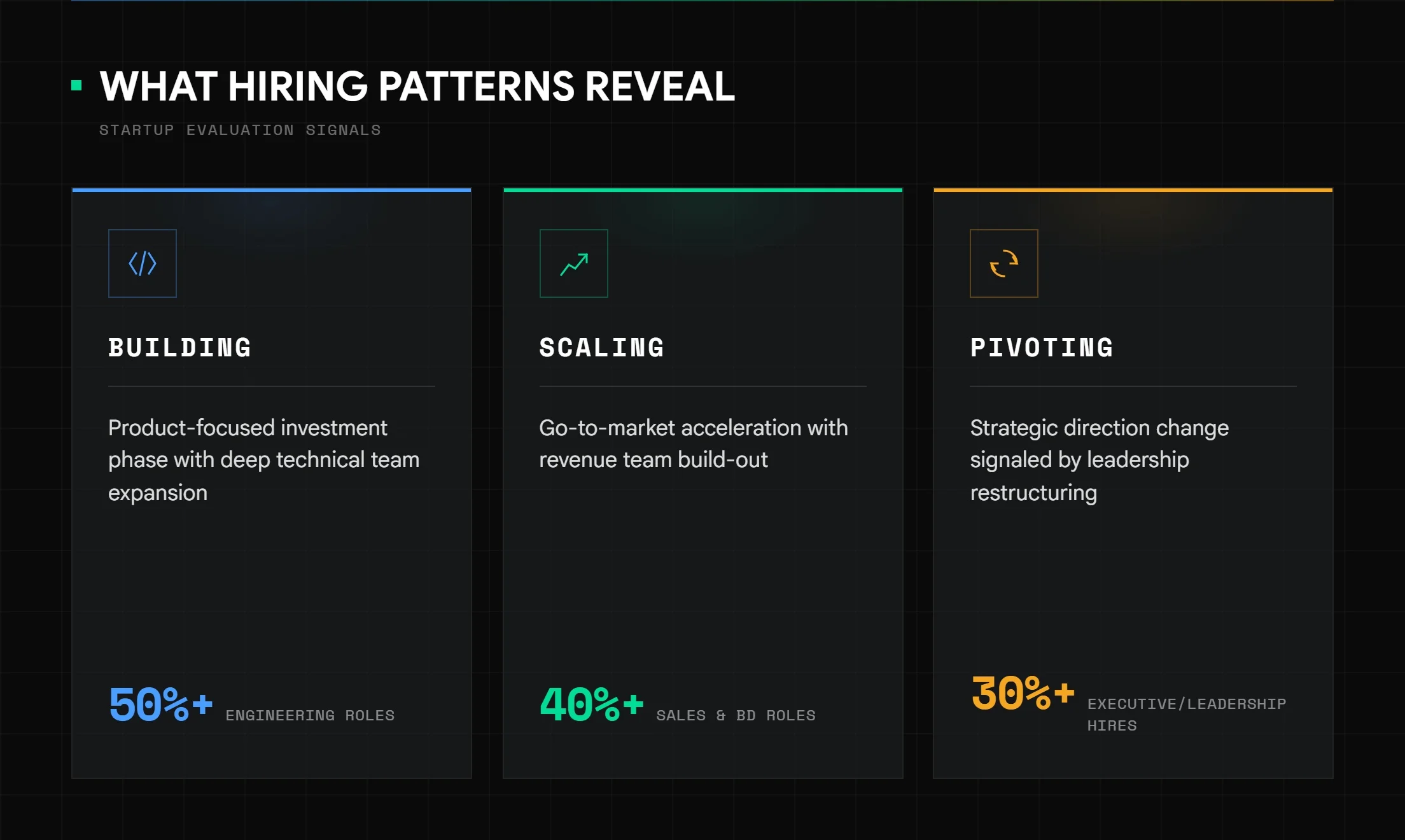
Hiring and workforce signals. What a company hires for reveals its actual priorities better than any deck slide. Track hiring velocity, role composition (engineering-heavy means build mode, sales-heavy means scaling), Glassdoor sentiment, and key-person departures, one of the strongest predictors of operational trouble.
News signals and sentiment. Press coverage is external validation, but raw mention counts are a blunt instrument, what matters is the trajectory. A sustained pattern of coverage across credible sources is a momentum signal; a cluster of negative stories in a short window often precedes bigger problems. News signal platforms apply entity resolution and sentiment scoring at scale so an investor tracking 200 companies isn't reading every article manually., see our guide on monitoring private company news through an API for how to set this up.
Customer and community signals. G2, Trustpilot, and App Store reviews are the most unfiltered data available, customers don't write them to impress investors. G2 reviews also surface competitor comparisons customers made themselves. A thriving GitHub community or genuine Reddit discussion demonstrates traction paid marketing can't replicate.
Tech stack, patents, and developer activity. BuiltWith and Wappalyzer reveal whether technical claims hold up; a startup claiming proprietary AI but running on off-the-shelf tools may have less defensibility than its pitch implies. GitHub activity proxies development velocity. Patent filings indicate long-term competitive positioning, especially for biotech, deep tech, and hardware.
Matching Alternative Data Signals to Investment Stage
Not every source matters at every stage.
| Stage | What matters most |
|---|---|
| Pre-seed / Seed | Founder and team quality, early community signals (waitlist growth, ProductHunt activity), registry data to verify incorporation claims |
| Series A | Web traffic trends, hiring patterns, early news coverage, first G2/App Store reviews |
| Series B+ | The full signal set, functioning as continuous portfolio monitoring rather than a one-time diligence pass |
SignalFire, the VC firm managing roughly $3 billion in assets, has built its entire model on this principle. Its Beacon platform tracks billions of data points to identify high-potential startups before they reach traditional deal flow, and CalPERS, the largest U.S. pension fund, committed $100 million to the firm, a strong institutional bet on the data-driven approach. As founder Chris Farmer put it when the firm closed its last raise, the goal is to "use our scale to outgun everyone at the seed."
How Investors Actually Access Alternative Data at Scale
Manual research, Glassdoor, G2, traffic estimates, one company at a time, works for two or three deals a quarter. It breaks down at fifty inbound opportunities a month. The shift underway is from manual lookups to a single API call returning structured company data, news signals, and firmographic context together. The value isn't in any one signal; it's in the pattern across several at once, rising traffic plus accelerating hiring plus positive news tells a very different story than rising traffic alone.
Most investors start with manual research: checking a startup's Glassdoor page, scrolling through G2 reviews, pulling SimilarWeb traffic estimates one company at a time. That works when you're evaluating two or three deals a quarter. It breaks down when you're screening fifty inbound opportunities a month or monitoring a portfolio of thirty companies.
The Signal vs. Noise Problem: What Alternative Data Can't Tell You
It's an input, not an oracle. Traffic spikes can be artificial, a viral post can look like organic growth without converting to customers; check multi-month trends. Hiring signals lag, a posted role isn't a filled one. Sentiment is noisy, a few bad reviews are normal, a pattern about the same issue is a signal. Coverage is uneven, a startup selling hardware to five enterprise customers may generate almost no trackable data without being a bad investment. And compliance matters: the same Lowenstein Sandler report found data ownership and privacy (42%), cybersecurity risk (41%), and vendor reliability (40%) are top investor concerns, using scraped data without a compliance review creates real legal exposure.
The best approach treats alternative data as one input that confirms or challenges what you learn from the team, the financials, and reference calls. When signals align, conviction goes up. When they diverge, you have better questions to ask.
Frequently Asked Questions
What is alternative data in startup investing?
Alternative data for startup investing refers to non-traditional information sources, such as web traffic, hiring patterns, app reviews, news signals, and technology data, that investors use to evaluate companies beyond pitch decks and financial statements. These sources provide external, often real-time perspectives on a startup's traction, operational health, and market positioning.
What are the most useful alternative data sources for evaluating early-stage startups?
The most actionable sources for early-stage evaluation are web traffic data (Similarweb, SEMrush), hiring and workforce signals (LinkedIn, Harmonic, Aura Intelligence), customer reviews and ratings (G2, App Store, Trustpilot), news signals and company enrichment data (akta.pro covers news intelligence, firmographics, and alternative signals across 20M+ private companies through a single API), and developer activity data (GitHub, BuiltWith). The specific mix depends on the startup's stage and sector.
How reliable is alternative data for making investment decisions?
Alternative data is most reliable when used as a complementary input alongside traditional diligence, not as a standalone decision-making tool. Its strengths are real-time visibility, external validation, and breadth of coverage. Its weaknesses include data quality inconsistency, coverage gaps for offline or enterprise businesses, and the potential for misinterpretation without proper context. According to Lowenstein Sandler's 2025 survey, 90% of investment advisers use or plan to use alternative data, suggesting broad institutional confidence in its value when applied correctly.