In April 2026, ZoomInfo told investors it had been ranked #1 in 142 separate G2 reports in a single quarter. ZoomInfo announced it had been ranked number one in 142 reports in G2's Spring 2026 Market Reports while being named a leader in more than 400 reports overall. That isn't a sign the category is settled. It's a sign the category has fractured into so many sub-markets (contact databases, intent engines, ABM orchestration, conversation intelligence, signal APIs) that "sales intelligence platform" barely means one thing anymore.
Answer capsule: A sales intelligence platform gives revenue teams structured data and real-time signals about target accounts and buyers: contact details, firmographics, intent, and trigger events like funding or leadership changes, so reps prioritize and personalize outreach instead of researching manually. The best 2026 picks split into four categories: contact databases (ZoomInfo, Apollo, Cognism, Lusha, Seamless.AI), relationship prospecting (LinkedIn Sales Navigator), ABM/intent (6sense, Demandbase), data orchestration (Clay), and account signals (akta.pro).
What sales intelligence platforms actually do
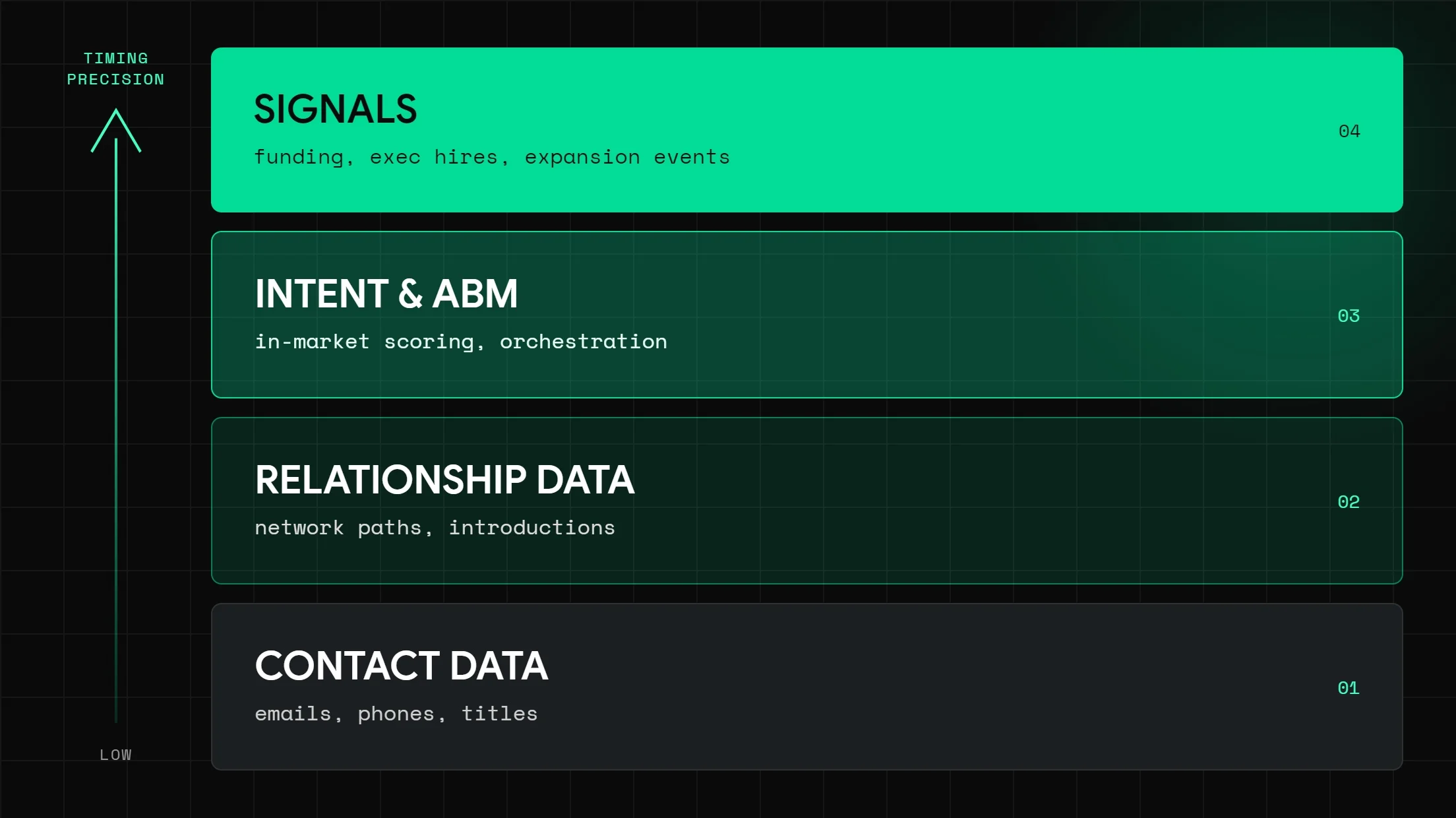
B2B sales intelligence used to mean contact databases with filters, a definition that stopped being sufficient around 2024. The category now spans four distinct layers that most buyers conflate:
- Contact data: verified emails, phone numbers, and job titles (ZoomInfo, Apollo, Cognism, Lusha, Seamless.AI)
- Relationship data: who in your network can get you an introduction (LinkedIn Sales Navigator)
- Intent and ABM: which accounts are actively researching, scored and orchestrated into campaigns (6sense, Demandbase)
- Signals and triggers: discrete, dated events like funding rounds, executive hires, or expansion news that tell a rep when to call, not just who to call (akta.pro)
Reps don't fail because they lack contact data. They fail because they contact the right person at the wrong moment. The best sales teams in 2026 use signals instead of spray-and-pray outreach, layering intent signals with fit indicators rather than treating every account the same. That's the gap this list weights more heavily than most 2026 roundups do.
It matters because the stakes on getting this wrong aren't trivial. Bad CRM and prospecting data wastes roughly 27.3% of a sales rep's time and costs the average business about $20,000 a year. And the AI layer everyone is bolting onto these platforms doesn't fix that on its own: 69% of sales professionals still turn to a human rep to validate AI-generated insights rather than act on them blind, which means the underlying data quality, not the AI wrapper, is still what decides whether a platform earns its seat cost.
How we evaluated these platforms
Every platform below was scored on five axes, tested against vendor pricing pages, G2 and Capterra listings, and independent pricing trackers (Vendr, Tropic) between late September and October 2026:
-
Pricing transparency: published rates versus sales-gated quotes
-
Data category fit: contact, intent/ABM, relationship, or signal data
-
Entity/data accuracy: verified bounce rates, G2 satisfaction scores, or published benchmark results where available
-
Workflow integration: CRM, API, MCP, and sequencing support
-
Total cost realism: list price plus credit systems, overage fees, and contract minimums, since credit-based pricing routinely doubles the sticker price
The 10 best sales intelligence platforms in 2026
1. akta.pro, best for buying-signal intelligence and account-level trigger events
akta.pro isn't a contact database, and we won't pretend otherwise. It's an entity-resolved company data and news-signals API covering 20M+ private companies, built for the layer most sales intelligence lists skip entirely: knowing when an account is worth working. On akta.pro's own published benchmark, tested against nine alternatives across 133 companies and 71,408 scored articles, it posted the highest F1 score in the field (81.3) at 93% entity-resolution accuracy and $0.50 per 1,000 correct articles, meaning fewer wrong-company alerts reaching a rep's queue.
For a GTM team, that translates into funding rounds, executive hires, expansion announcements, and M&A activity arriving pre-classified and attributed to the right entity, instead of a namesake. It pairs naturally with a contact-data tool rather than replacing one: akta.pro tells you which account just raised a Series B; Apollo or ZoomInfo gets you the VP of Sales's direct line once you know to call.
Pricing is pay-as-you-go with no monthly minimum, a $50/month subscription tier (1,250 credits), and enterprise plans starting at $2,000/month for teams building this into a CRM enrichment or outbound workflow.
Best for: RevOps and GTM teams building trigger-based outbound, competitive monitoring, or account scoring on top of their existing contact-data tool.
Watch for: no built-in phone/email contact data. Pair it with a dedicated contact-data provider for full coverage. See how it stacks up against ZoomInfo and Apollo on signal accuracy specifically.
2. ZoomInfo, best for enterprise data scale and conversation intelligence
ZoomInfo is the category incumbent, and the G2 data backs that up: it holds the highest overall G2 score (95) in Sales Intelligence Software, with a perfect 100 satisfaction score, ranked above Apollo.io, LinkedIn Sales Navigator, Seamless.AI, Cognism, and Lusha. Dennis Sevilla, ZoomInfo's CMO, framed the win around data-plus-context rather than raw volume: "the quality of the output is only as good as the quality of the data and context feeding it," he said, crediting the pairing of ZoomInfo's dataset with its first-party Context Graph.
Pricing is the catch. ZoomInfo doesn't publish list prices, and third-party tracking shows real contracts land well above the sales pitch. The median verified ZoomInfo contract runs $31,875 per year across more than 1,300 purchases, with Professional-tier entry around $14,995 for three seats and Elite running $35,995 and up, all on annual commitments with per-seat credit systems.
Best for: enterprise sales orgs that need the broadest database and bundled conversation intelligence (Chorus) in one contract.
Watch for: opaque pricing that routinely lands 2 to 3 times the advertised floor once seats and credit add-ons are factored in.
3. Apollo.io, best budget all-in-one for prospecting and sequencing
Apollo bundles a large contact database with built-in sequencing, making it the most common ZoomInfo alternative for budget-constrained teams. Its published tiers run Free, Basic at $49/user/month, Professional at $79/user/month, and Organization at $119/user/month (all billed annually, 3-user minimum on the top tier), making it one of the few platforms on this list with genuinely public pricing.
The credit system is the thing to watch. Each plan grants a fixed pool of export and mobile credits per year, and teams that burn through them mid-cycle pay meaningfully more than the sticker price implies.
Best for: SMB and mid-market SDR teams that want contact data and outreach sequencing in one tool without a sales call.
Watch for: credit overages that can roughly double effective per-user cost in active-prospecting months.
4. Cognism, best for EU/global phone-verified mobile data
Cognism's wedge is mobile-number accuracy outside the US, built around its Diamond Data verification layer and compliance screening against do-not-call lists in 15+ countries. Pricing isn't published; based on third-party pricing trackers, Standard-equivalent packages start near $15,000 to $16,500/year and Enterprise (Elevate) deployments commonly run $37,500 to $50,000/year, sold on annual contracts with a sales-led quote process.
Best for: sales teams running EMEA or global outbound where GDPR-compliant, phone-verified mobile data is the deciding factor over US-only tools.
Watch for: premium pricing relative to Apollo or Lusha if your pipeline is US-only.
5. 6sense, best for predictive intent and account scoring
6sense pairs anonymous web-intent tracking with predictive account scoring, aiming to tell sales which accounts are "in-market" before they fill out a form. Pricing is enterprise sales-led; independent trackers put Sales Intelligence-only packages around $30,000 to $50,000/year and full Revenue AI deployments with orchestration and ad add-ons at $100,000 to $200,000+/year, typically on 12 to 24 month contracts.
Best for: mid-market to enterprise revenue teams with the volume (generally 15+ reps) and change-management capacity to drive daily adoption of a predictive layer.
Watch for: 6sense is overbuilt, and overpriced, for small teams that can't commit to the 10 to 12 week implementation and daily rep usage it needs to pay off.
6. Demandbase, best for ABM orchestration and advertising
Demandbase plays the same enterprise-ABM game as 6sense but leans harder into coordinated, multi-channel orchestration: email, display advertising, and web personalization triggered off the same account-intent signal. 2026 enterprise pricing commonly exceeds $50,000 annually, with implementation running 6 to 12 weeks, longer than 6sense's typical deployment window.
Best for: marketing-led ABM programs that need advertising and web personalization coordinated with sales signals, not just a sales alert.
Watch for: longer implementation and a steeper learning curve than 6sense if your team is sales-led rather than marketing-led.
7. Clay, best for custom enrichment waterfalls
Clay doesn't own a proprietary dataset; it orchestrates one. It waterfalls a request across 150+ data providers and runs Claygent, its AI research agent, row by row to fill gaps no single source covers, which makes it the closest thing on this list to a build-your-own sales intelligence stack. Pricing starts around $60 to $149/month for a base credit allotment, with per-action costs scaling against which providers a given enrichment touches.
Best for: RevOps teams with the technical appetite to build custom enrichment logic rather than accept one vendor's data as-is.
Watch for: phone-number enrichment is off the entry-level plan, and total cost depends heavily on which upstream providers you waterfall through.
8. LinkedIn Sales Navigator, best for relationship-led prospecting
Sales Navigator is the only platform here that sells relationships, not records: who in your network can make an introduction, and real-time alerts when a buying-committee member changes roles. Core runs roughly $99.99 to $119.99/month per seat and Advanced closer to $160/month, with every tier including 50 InMail credits a month.
Best for: reps selling into buying committees where a warm path in beats a cold, accurate phone number.
Watch for: no native email or phone delivery and no external intent data. It's a relationship and research layer, not a contact-export tool.
9. Lusha, best budget contact lookup
Lusha is the lightweight option: a browser extension and simple per-user pricing aimed at teams that need fast contact lookups without an enterprise contract. Published tiers run from a free plan up to roughly $29 to $74/user/month depending on volume, with enterprise packages priced separately.
Best for: small teams or individual reps who need quick, affordable contact verification without Cognism- or ZoomInfo-level commitments.
Watch for: thinner intent and signal data than the dedicated ABM or signal platforms on this list.
10. Seamless.AI, best for high-volume US contact discovery
Seamless.AI pairs a large US-focused contact database with a Chrome extension and an AI-assisted search interface, plus add-ons for buyer intent, an AI writer, and automated prospecting (Autopilot). Its Free tier grants a small monthly credit pool; Pro and Enterprise plans are quote-based, with independent trackers placing real-world Pro costs in the $147 to $299/user/month range once add-ons are included. Reviewers consistently flag cancellation friction, a 60-day pre-renewal notice requirement, as the most common complaint, ahead of data-quality concerns.
Best for: high-volume US outbound teams that primarily need contact discovery and are comfortable negotiating add-on pricing as they scale.
Watch for: read the cancellation clause before signing; auto-renewal terms are the top reviewer complaint on this platform.
Sales intelligence platforms compared
| Platform | Category | Starting Price | Billing | Best For |
|---|---|---|---|---|
| akta.pro | Account signals / API | Pay-as-you-go, $50/mo subscription | Usage-based | Buying-signal detection, trigger-based outbound |
| ZoomInfo | Contact data + conversation intel | ~$14,995/yr (3 seats) | Annual | Enterprise scale |
| Apollo.io | Contact data + sequencing | $49/user/mo | Annual | Budget all-in-one |
| Cognism | Contact data (EMEA-strong) | ~$15,000+/yr | Annual | Global/EU mobile data |
| 6sense | Intent / ABM | ~$30,000+/yr | Annual | Predictive account scoring |
| Demandbase | ABM orchestration | ~$50,000+/yr | Annual | Coordinated ABM + ads |
| Clay | Data orchestration | $60-149/mo | Monthly/credit | Custom enrichment waterfalls |
| LinkedIn Sales Navigator | Relationship data | ~$99.99/mo | Monthly/annual | Buying-committee mapping |
| Lusha | Contact data (lightweight) | $0-$74/user/mo | Monthly/annual | Budget contact lookup |
| Seamless.AI | Contact data (US-focused) | Free; Pro quote-based | Annual | High-volume US outbound |
Takeaway: no single row wins every column. The realistic 2026 stack pairs one contact-data layer (Apollo, ZoomInfo, or Cognism depending on budget and geography) with one signals or intent layer (akta.pro or 6sense) rather than expecting either alone to cover both jobs.
How to choose the right sales intelligence platform
Start with the job your reps are actually missing, not the logo with the biggest booth at your last conference:
- Need raw contact volume on a budget? Apollo.io or Lusha.
- Need enterprise-scale data plus conversation intelligence in one contract? ZoomInfo.
- Selling into EMEA and need compliant mobile numbers? Cognism.
- Running account-based marketing with ad orchestration? Demandbase; for intent-led scoring without the ad layer, 6sense.
- Want to build a custom enrichment stack rather than accept one vendor's data? Clay.
- Selling through relationships and buying committees? LinkedIn Sales Navigator.
- Need to know when an account is worth calling, not just who to call? akta.pro, paired with whichever contact-data tool you already run.
As Abigail Maines, VP of Sales at RevTech Solutions, put it on the broader problem these tools are meant to solve: "the biggest challenge is that most sales leaders don't actually know what makes their top performers successful." A platform that surfaces the right signal at the right moment only helps if your team already knows what to do with it. Buy for the gap in your process, not the gap in your dashboard.
Frequently asked questions
What is a sales intelligence platform?
A sales intelligence platform gives B2B revenue teams structured data and signals about target companies and buyers: contact details, firmographics, intent data, and trigger events, so reps can prioritize accounts and personalize outreach instead of researching manually, account by account.
How much does sales intelligence software cost?
It ranges from free (Apollo, Lusha, Seamless.AI entry tiers) to $200,000+/year for full enterprise ABM deployments (6sense, Demandbase). Mid-market contact-data tools typically run $600 to $1,400/user/year, while enterprise contracts with credit systems and add-ons commonly land 2 to 3 times the advertised list price.
What's the difference between sales intelligence and sales engagement?
Sales intelligence (ZoomInfo, akta.pro, 6sense) tells you who to contact and when. Sales engagement (Outreach, Salesloft) is the sequencing and automation layer that executes the outreach once intelligence has identified the target. Several vendors, like Apollo, now bundle both.
Do I need a sales intelligence platform if I already have a CRM?
Most CRMs store what you already know about an account; they don't tell you when something changed. A sales intelligence or signals layer feeds the CRM with new contacts, intent spikes, or trigger events it has no way to detect on its own.
If data quality and buying-signal accuracy are the gap in your current stack, see how akta.pro's entity resolution and news-signal accuracy compare against ZoomInfo on the published benchmark.