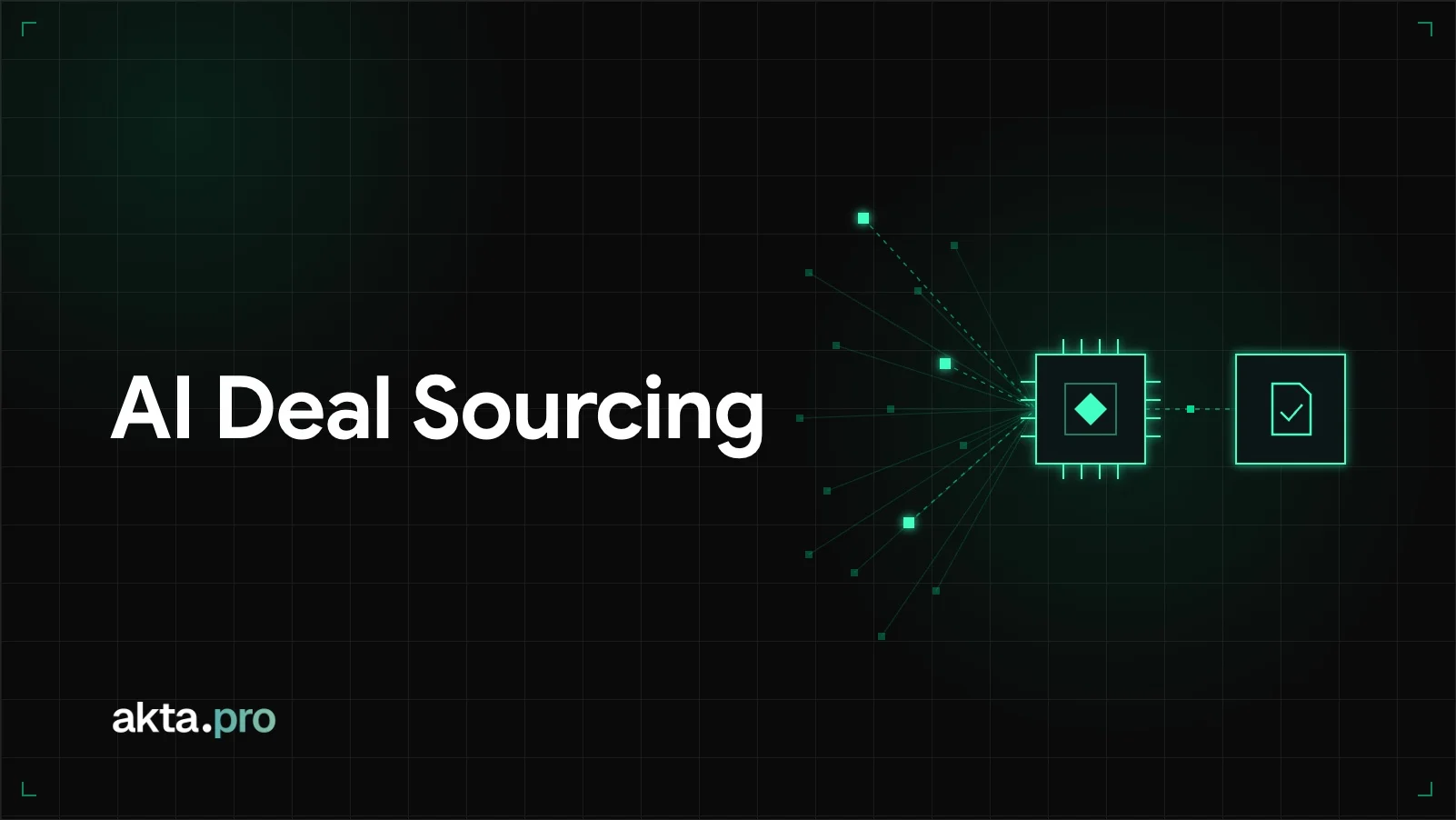
AI deal sourcing is the use of machine learning, natural language processing, and structured data APIs to identify, evaluate, and monitor potential acquisition or investment targets. It replaces manual research workflows and static database queries with automated, continuous intelligence pipelines that scan live company data, news signals, and alternative data sources.
An AI deal sourcing system does three things:
- Discovery. It scans structured company databases, the open web, and proprietary data feeds to find companies matching a specific investment thesis. Instead of keyword searches against fixed taxonomies, it reads what a company actually does: its product descriptions, customer segments, and business-model signals.
- Enrichment. Once a target is identified, the system pulls firmographics, funding history, management profiles, revenue estimates, competitive positioning, technology stack, and go-to-market motion. A company name becomes an investment-grade profile in minutes, not days.
- Monitoring. The system tracks signals that indicate transaction likelihood or thesis fit over time: leadership changes, funding rounds, headcount shifts, regulatory filings, expansion announcements, and competitive moves. These signals are entity-resolved, matched to the correct company rather than just a name string, and scored for relevance and impact.
This three-layer architecture is what separates AI deal sourcing from running prompts against public data. The former gives you structured, citation-backed, entity-resolved intelligence with an audit trail. The latter gives you plausible-sounding text with none.
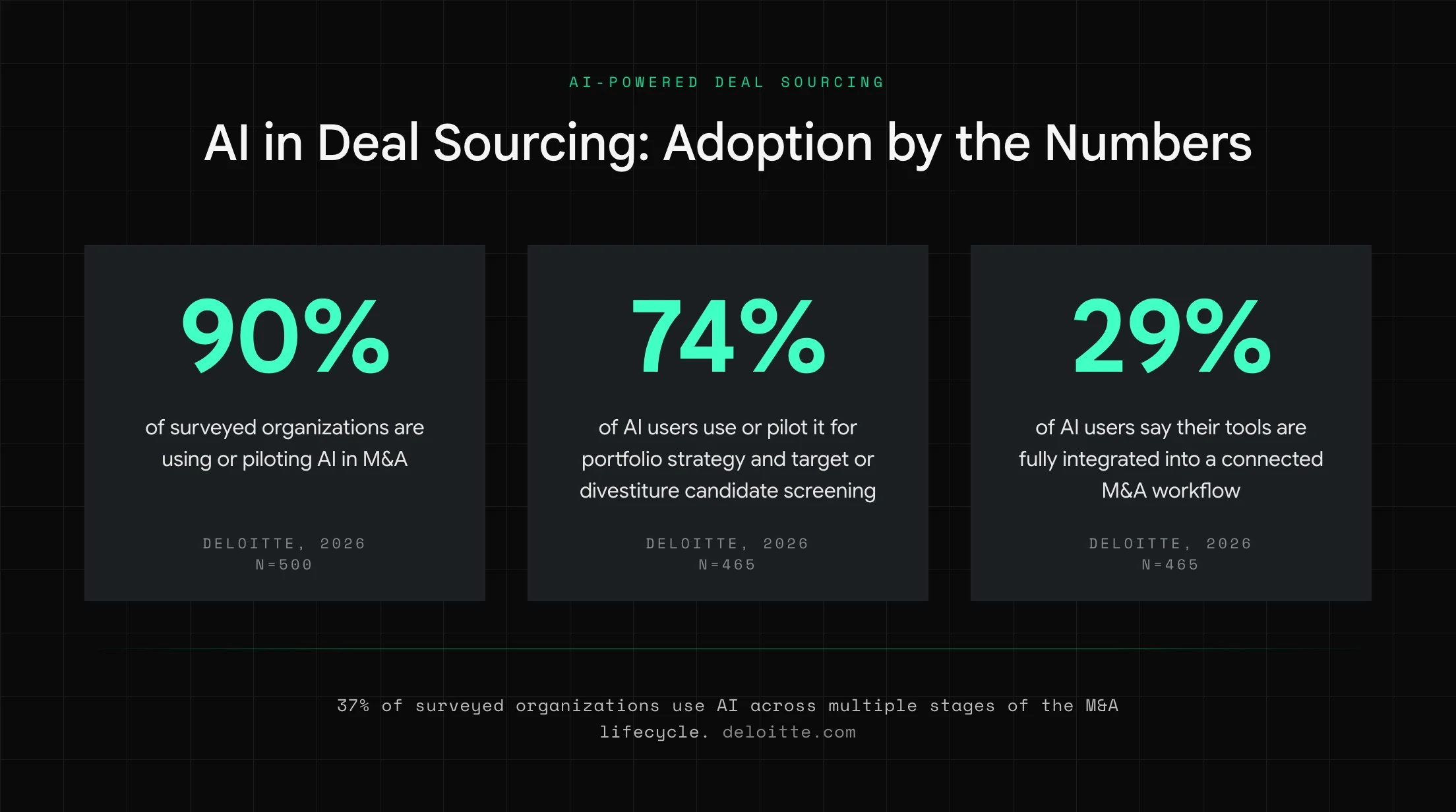
Why Traditional Deal Sourcing Has a Ceiling
The average private equity firm sees just 17.6% of the deals that fit its mandate, according to the Deal Origination Benchmark Report from Sutton Place Strategies (now part of With Intelligence), which tracks sourcing performance across 176 qualified PE firms annually. More than 80% of relevant opportunities never get surfaced.
Two structural limits explain the gap:
Banker-led processes are narrow by design. An intermediary brings you deals filtered through their understanding of your thesis, their existing relationships, and their incentive to run an efficient auction, and the same deal often lands on five other desks at the same time.
Database subscriptions give everyone the same view. PitchBook, Capital IQ, and Dealroom give broad coverage, but every subscriber sees the same companies classified the same way. When 50 PE firms run the same filters against the same taxonomy, the output is identical. There's no proprietary edge in a shared dataset. Sutton Place's data shows market coverage has stayed flat between 16% and 18% for years, even as deal flow has ticked up. Firms aren't finding more of what's out there, they're just processing the same fraction faster.
AI deal sourcing exists because this model hit its ceiling years ago. Platforms built around a single entity-resolved dataset, akta.pro is one example, are designed specifically to close that gap, rather than replicate the same shared taxonomy every subscriber already sees.
AI Deal Sourcing vs. Traditional Deal Sourcing
| Stage | Traditional approach | AI-powered approach |
|---|---|---|
| Market mapping | An associate builds a target list in Excel using database filters and sector-banker conversations. Takes 1-2 weeks; outdated by the time it reaches the IC. | A discovery API generates a thesis-matched company universe in minutes, updated continuously as companies enter the market or change profile. |
| Target screening | Manual review of CIMs, filings, and news per company. A team screens 10-15 targets per week. | Automated enrichment profiles generated in bulk; scoring models rank by thesis fit and transaction likelihood. Teams screen 50+ targets per week without adding headcount. |
| Signal detection | The deal team learns about a company's situation when a banker calls or news breaks, and by then every competing firm knows too. | Continuous monitoring flags leadership turnover, funding signals, and regulatory events in real time, before intermediary channels surface them. |
| Outreach timing | BD teams work static call lists, often reaching companies at the wrong moment. | Transaction-likelihood scoring times outreach to when a company is most receptive: post-funding, post-executive-change, or mid growth-inflection. |
Affinity's research documented that MassMutual Ventures now triages investment opportunities up to 5x faster after adopting AI sourcing, and Bessemer Venture Partners reclaimed 234 hours per analyst annually by integrating AI into their workflows.
Every capability in the "AI-powered" column above maps to a single API call on a platform like akta.pro: discovery, enrichment, and signals all running off the same entity-resolved company graph, rather than three disconnected tools with three different taxonomies.
The Three-Layer Architecture Behind Modern Deal Intelligence
Firms getting real results from AI deal sourcing aren't just subscribing to a platform. They're connecting three distinct data layers. Skipping any one of them creates a blind spot.
Target Discovery: Scanning Beyond Static Databases
Static databases classify companies using rigid industry codes (SIC, NAICS). A company that straddles two sectors, or has pivoted its business model in the last 18 months, gets misclassified or missed entirely.
Platforms like Grata use NLP to read company websites the way an analyst would, interpreting product descriptions, customer segments, and commercial signals rather than relying on self-reported categories. This matters most in the lower middle market, where companies rarely appear in mainstream databases.
The most powerful version of this is API-based discovery: submit a natural-language thesis description and get back a structured, relevance-scored list of matching companies. This turns the web into an on-demand company database instead of a fixed vendor taxonomy.
Company Enrichment: From Name to Investment Thesis
Finding a company is step one. Deciding whether it deserves 15 minutes of a principal's time requires structured data on what it does, who runs it, how it's funded, and what its growth trajectory suggests.
Traditional enrichment is manual: an associate pulls data from multiple sources, cross-references it, and formats a memo. AI deal sourcing compresses this into an API call. akta.pro's company data API returns 75+ structured data points across 20 million entities: firmographics, business model, management team, financial estimates, technology stack, competitive moat, and go-to-market motion.
Signal Monitoring: Catching What Databases Miss
Databases show what a company looked like at its last update. Signals show what's happening now. A Google alert for "Acme Corp" returns press releases and irrelevant mentions alongside the one article that matters: the CFO departure, the regulatory filing, the market expansion.
akta.pro's signals API matches every article to the correct company entity, deduplicates across sources, filters roughly 80% of noise before delivery, and classifies each signal across 80 event types: funding rounds, executive changes, product launches, layoffs, M&A activity, regulatory actions, and more. Each carries sentiment and impact scoring, so a pipeline separates a routine mention from a material leadership change automatically.
Beyond news, alternative signals add depth: headcount trends show whether a company is scaling or contracting; job-posting patterns reveal strategic priorities months before press announcements; web-traffic shifts signal market traction. A company that just lost its CEO, posted 15 engineering roles in three weeks, and saw a 40% spike in web traffic is telling you something a quarterly database refresh won't catch.
Building the Network Layer: Where AI Still Needs Relationships
AI deal sourcing expands what a team can see. It doesn't replace the relationship work that gets a deal done. Two things worth keeping in the loop:
- Warm introductions still close faster. Signal-driven discovery (an akta.pro alert flagging a target's leadership change, for instance) tells you a company is in-market; your firm's own network, co-investors, portfolio-company contacts, former colleagues, is usually still the fastest path to a first conversation. Treat AI-surfaced companies as a prioritized list to route through relationships, not a cold-outreach queue.
- Narrow the pilot before you scale it. The best adopters run one sector, one geography, one workflow first, measure conversion rate and cycle time against a baseline, then expand. Firms that deploy AI across every workflow at once tend to get expensive pilots with unclear ROI.
A Step-by-Step AI Deal Sourcing Pipeline
Here's what an automated deal research workflow looks like end to end, using API-based infrastructure.
-
Define the thesis as a structured query. A growth equity firm targeting B2B SaaS companies in logistics with $5M-$50M ARR translates that thesis into search parameters and queries a company intelligence API across 20M+ companies, filtered by industry code, business model, revenue estimate, and sector keyword. The API returns a universe of 200+ matching companies with unique entity IDs, in structured JSON, feeding directly into the CRM. No manual list-building.
-
Enrich every company to screening depth. For each company, the pipeline calls the company data API for firmographics, management bios, funding history, tech stack, competitive moat, and financial estimates: the same fields, same depth, every time. An analyst can make go/no-go calls on 50 companies in a sitting instead of five.
-
Set up continuous signal monitoring. The pipeline subscribes to news signals for every company in the universe, filtered to the event types that matter for deal timing: executive departures, funding rounds, expansion announcements, M&A activity, layoffs, regulatory changes. Each signal arrives entity-resolved, deduplicated, and scored, so the deal team gets an alert the day it publishes, not three weeks later.
-
Score and prioritize. Enrichment data and signal history feed a scoring model that ranks the universe by thesis fit, transaction likelihood, and recency of material signals. High-score, fresh-signal companies move to the top of the outreach queue; stale, quiet ones drop to monitoring status.
-
Connect to the workflow. Through API or MCP (Model Context Protocol) integrations, the pipeline plugs into tools the deal team already uses. akta.pro's MCP server lets AI assistants like Claude or ChatGPT query company data and news signals directly, so a principal can ask "give me the top three signal-active companies in our logistics SaaS universe" and get a sourced, structured answer in seconds.
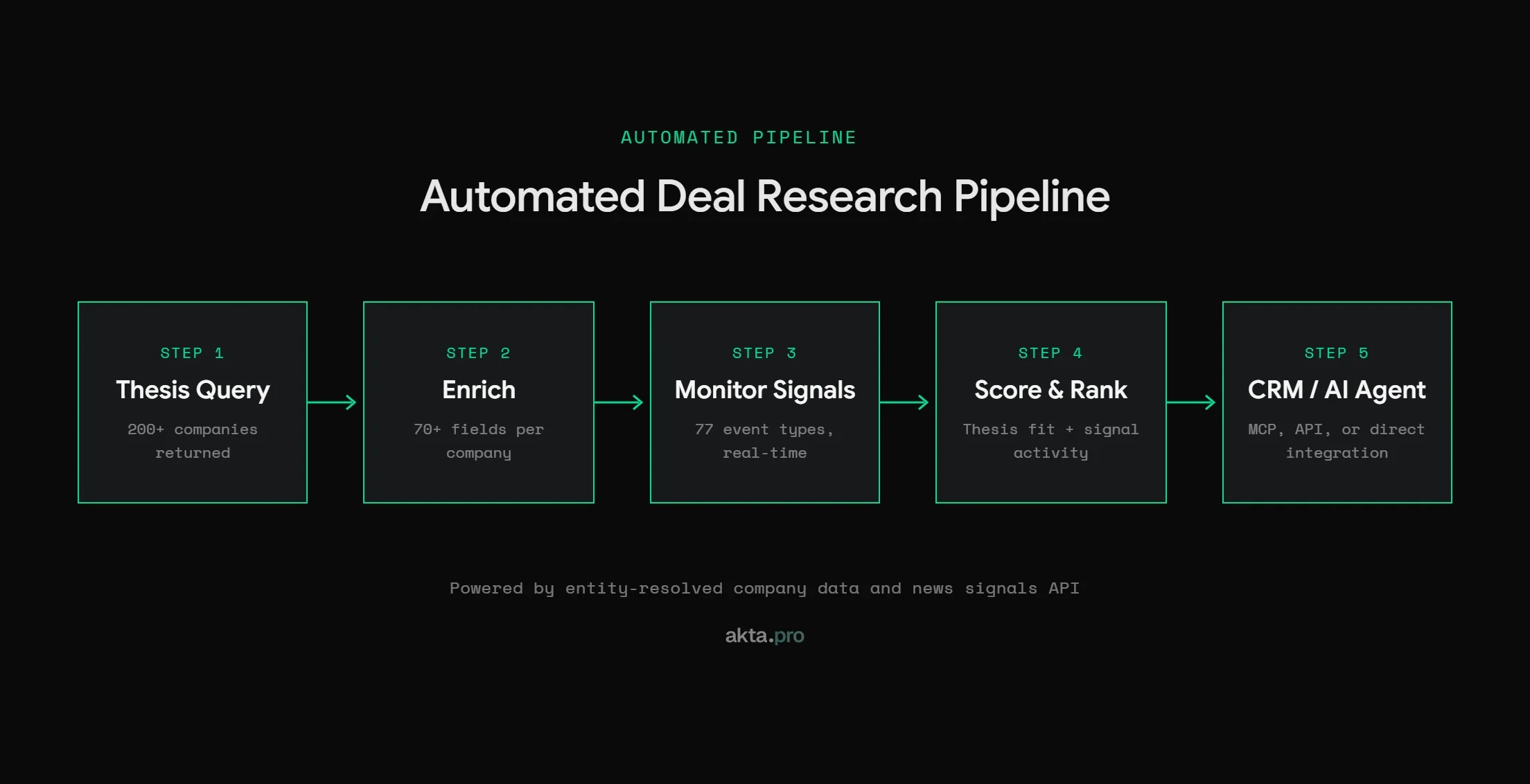
Thesis query > Discovery API (company universe) > Enrichment API (firmographic profile) > Signals API (continuous monitoring) > Scoring model (prioritized list) > CRM / deal memo
Who Does What: Banks, Data Feeds, CRM, and the Investment Committee
A deal doesn't move from a database query to a signed term sheet through software alone. Four distinct parties still touch every serious opportunity, and it's worth being precise about what each one actually does in an AI-assisted pipeline:
- Data feeds are the input layer, not the decision-maker. In the RM Equity Partners example above, that's five separate source layers, LinkedIn, press archives, national company registries, investor databases, and direct search — all routed into a single scoring model. Data feeds tell the system what's true about a company; they don't decide whether it's a fit.
- Banks and intermediaries still originate a meaningful share of deal flow, and nothing about AI sourcing displaces that. What changes is the mix: a banker-run auction filters candidates through their own relationships and incentives (see "Banker-led processes are narrow by design" above), while an AI pipeline surfaces the companies that never reach a banker's desk at all - too small, too niche, or too far off the beaten path for an intermediary to shop around.
- CRM and outreach tooling is where the scored, ranked output actually lands for a human to act on. A high-scoring company from the model doesn't become a conversation on its own; someone still has to route it into a call list, time the outreach (post-funding, post-executive-change, or mid growth-inflection, as noted earlier), and track where it sits in the pipeline.
- The investment committee is the human-review gate, not a rubber stamp. It sees the structured output, the score, the sub-score breakdown, the confidence bands on any estimated figures but its job is precisely the part that doesn't encode into a scoring model: judging management quality, cultural fit, and the qualitative case for the thesis. In the RM Equity Partners example, that's the explicit division of labor: the model ranks a 20,000-company universe on checkable criteria, and the deal team decides which qualifying names are actually worth pursuing.
Skip any one of these roles and the pipeline breaks in a predictable way: no data feeds means nothing to score; no banking relationships means missing the deals that are genuinely relationship-gated; no CRM/outreach layer means a good score never turns into a conversation; and no IC means nobody is accountable for the judgment calls a model can't make.
Choosing an AI Deal Sourcing Platform: What to Look For
Not every "AI-powered" sourcing tool covers all three layers. Before evaluating vendors, check each candidate against these criteria:
| What to check | Why it matters | How akta.pro handles it |
|---|---|---|
| Entity resolution across sources | Without it, a signal about "Acme Inc." on one feed and "Acme Corporation" on another won't merge, and you'll miss the pattern. | Every company and signal resolves to one entity ID across akta.pro's full graph. |
| Breadth of company coverage | Lower middle-market and international targets are exactly where static databases (SIC/NAICS-based) undercount. | 20M+ companies, including the lower middle market most legacy databases miss. |
| Depth of enrichment fields | 75+ structured fields per company (funding, tech stack, GTM motion) is a meaningfully different starting point than firmographics alone. | 75+ structured data points per company via the akta.pro company data API. |
| Signal event taxonomy | A platform classifying signals across dozens of event types (funding, leadership, regulatory, M&A) supports automated triage; a raw news feed doesn't. | 80 event types, each scored for sentiment and impact, through the akta.pro signals API. |
| API / MCP access | Determines whether the data can actually plug into your CRM and scoring model, or whether it's a dashboard you have to check manually. | Native API plus an MCP server that lets Claude or ChatGPT query it directly. |
What Separates Firms That Get ROI from AI Sourcing
A consistent pattern emerges across research from Deloitte, Bain, and FTI Consulting. Firms capturing real value from AI deal sourcing share four traits:
- They treat data as infrastructure, not a subscription. Firms still losing to this problem run five platforms, each with its own taxonomy and entity-resolution logic. Firms winning build a unified data layer where company records, signals, and alternative data resolve to a single entity ID across every source.
- They use signals, not just snapshots. A profile from January says nothing about August. The signal layer (entity-resolved news, headcount data, hiring patterns, web traffic) is what gives AI deal sourcing its timing advantage.
- They start narrow and expand. Bain's 2025 Global Private Equity Report found the best adopters run focused pilots, one sector, one geography, one workflow, before scaling what works.
- They keep humans in the loop on judgment calls. AI deal sourcing automates research, enrichment, and monitoring. It doesn't automate investment judgment. Scoring models rank and prioritize; people still decide.
Frequently Asked Questions
How can AI improve deal sourcing?
AI improves deal sourcing across three dimensions: coverage (scanning thousands of companies instead of dozens), speed (compressing multi-day research into minutes through automated enrichment), and timing (monitoring live signals, such as executive changes, funding events, and headcount shifts, to flag transaction windows before competitors see them). According to Deloitte's 2025 GenAI in M&A Survey, 35% of GenAI adopters in M&A apply it specifically to target identification and screening. Platforms like akta.pro operationalize this by running discovery, enrichment, and signal monitoring off one entity-resolved company graph, so a deal team gets consistent coverage instead of three tools that each define "the same company" differently.
What is AI deal sourcing?
AI deal sourcing uses machine learning, NLP, and structured data APIs to automate the identification, enrichment, and monitoring of potential investment or acquisition targets, replacing manual research and static database queries with continuous intelligence pipelines. In practice, this often means a platform such as akta.pro handling discovery, enrichment, and monitoring from a single dataset rather than three disconnected tools stitched together after the fact.
What data sources power AI deal sourcing platforms?
Structured company databases (firmographics, financials, funding history), live web intelligence (websites, job postings, regulatory filings), entity-resolved and sentiment-scored news feeds, and alternative signals (headcount trends, web traffic, product reviews, social activity). The akta.pro platform covers 20M+ companies with 75+ data points each, plus real-time news classified across 80 event types: the combination that lets a discovery query, an enrichment profile, and a signal alert all reference the same underlying entity.
Can deal sourcing be fully automated with AI?
Discovery, enrichment, and signal tracking are well-suited to automation, since they involve processing large volumes of structured and unstructured data at speed. Investment judgment, relationship-building, and the final decision to pursue a deal remain human functions. Tools like akta.pro are built to automate the discovery, enrichment, and monitoring stages specifically, while leaving outreach and the investment decision to the deal team: the most effective implementations use that combination to expand the deal universe and compress research timelines, not to replace the people evaluating the results.