A typical buyout in 2015 needed about 5% annual EBITDA growth to return 2.5x over five years. Bain's 2026 Global Private Equity Report puts the same return at 10% to 12% growth today.
Commercial due diligence (CDD) is the buyer's independent test of a target's market, customers and competitive position, run before signing to decide whether the growth in the deal model is real. It replaces management's forecast with evidence on demand, retention, pricing and share, and it sets the price that evidence can support.
What is commercial due diligence?
CDD is an exercise that typically focuses on the key commercial assumptions in a business plan and projections. In private equity, that means a platform or add on deal where the sponsor needs to know whether the market, the customers and the competitive position support the model.
Four formats cover most engagements. Buyer CDD is the full review a sponsor commissions. Vendor CDD is commissioned by the seller to answer buyer questions early. Red flag CDD is a fast screen for deal breakers, and top up CDD fills gaps left by earlier work.
What is the difference between financial and commercial due diligence?
Financial due diligence tests whether reported earnings are accurate and repeatable. Commercial due diligence tests whether the market, customers and competitive position will sustain those earnings and the growth above them. The two meet at revenue quality, where a financial finding on churn should trigger a commercial look at why customers leave.
| Workstream | Question it answers | Core evidence | Typical output |
|---|---|---|---|
| Commercial | Will customers keep buying, and is the plan realistic? | Market model, customer calls, cohorts, competitor data | Growth gap and risk register |
| Financial | Are the reported numbers real and repeatable? | Ledgers, quality of earnings, working capital | Adjusted EBITDA |
| Operational | Can the company execute and scale? | Systems, processes, capacity | Cost and capability assessment |
| Legal | Do contracts or liabilities change the deal? | Contracts, IP, litigation | Issues list and deal protections |
Each workstream owns one question. The deal team's job is to make the four answers consistent with each other.
Why commercial due diligence matters more in the "12 is the new 5" era
In a typical 2015 buyout (per Bain's analysis), half the purchase price was borrowed at 6% to 7%. Bain's estimate for today is borrowing costs of 8% to 9% and leverage of 30% to 40%, with purchase multiples that are high and no longer expanding. Bain's Rebecca Burack says returns now require "significantly more operational improvement and revenue growth."
Rising multiples powered over 50% of buyout returns in the cheap money years, and holding periods at exit have drifted toward seven years. Growth now has to come from the business, and CDD is where a sponsor finds out how much growth the business can deliver.
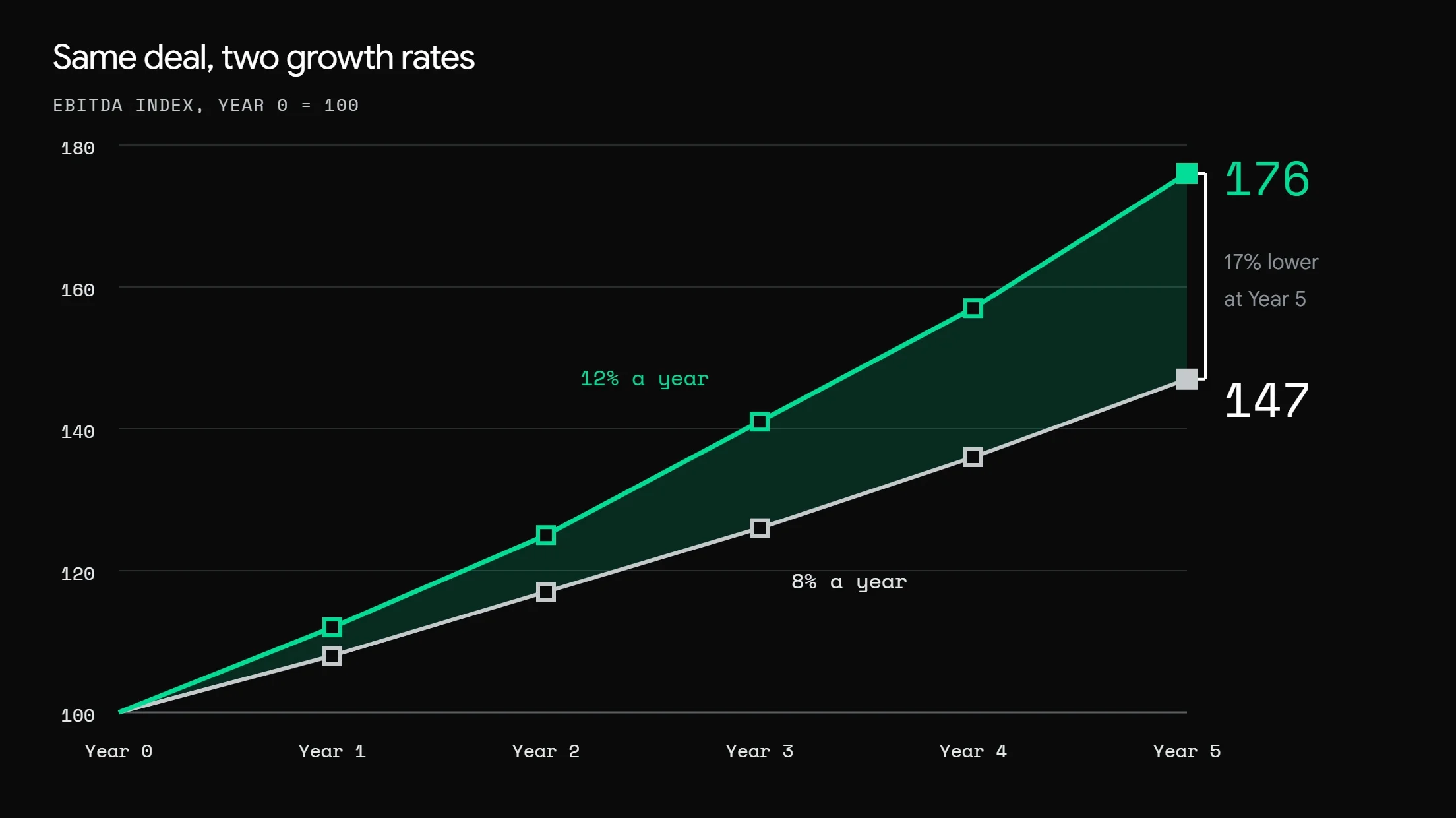
That points to one number worth producing. Define the growth gap as required growth minus supported growth. Required growth is what the model needs to hit the target return. Supported growth is what market, customer and competitive evidence will back. As an illustration, 100 of EBITDA compounding at 12% reaches 176 after five years. At 8% it reaches 147, about 17% less at the same exit multiple. A four point gap is a price conversation.
Bain's authors call conventional diligence "largely defensive", an exercise in confirming what the information memorandum says. Confirming a document cannot tell you whether the growth in it is real.
The commercial due diligence checklist: six workstreams
Each workstream should end in a number the model can use.
| Workstream | What it tests | Strongest evidence | Red flag |
|---|---|---|---|
| Market | Size, growth and structure | Bottom up model from customer counts and spend, triangulated with analyst data | Management's market size cannot be rebuilt from units |
| Customers | Why they buy, stay and leave | Cohort retention, concentration, independent customer and lost customer calls | Largest accounts on short terms or testing a rival |
| Competition | Share, differentiation, momentum | Win and loss data, pricing pages, release cadence, rival funding and hiring | Share loss hidden by market growth |
| Revenue quality | Recurrence, price versus volume | CRM and billing exports, pipeline conversion, price and volume bridge | Growth that came from price rises that cannot repeat |
| Growth plan | Evidence behind each lever | Forecast rebuilt from the customer level, with base, upside and downside cases | Levers with no pilot data |
| Risks and value creation | What breaks the case and what adds upside | Ranked register mapped to price and purchase agreement protections | Risks listed but not priced |
The rows interact. A weak customer finding should change the forecast, and a competitor finding should change the retention assumption.
How to run commercial due diligence in five steps
Papermark's guide puts preliminary CDD at two to four weeks before a letter of intent and full CDD at four to eight weeks after it. Five steps fit inside that window.
-
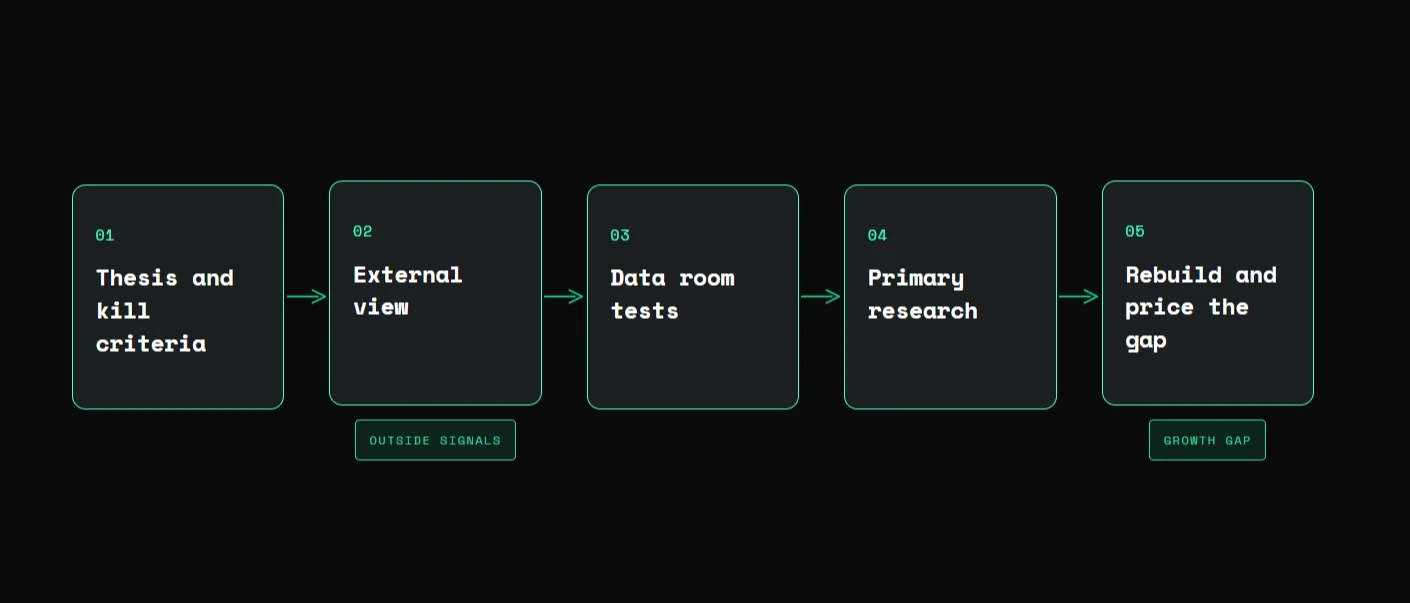
Write the thesis and the kill criteria: State the growth the model needs, the three assumptions that carry it, and the findings that would stop the deal. Do this before the data room opens.
-
Build the external view first: Size the market from units and spend, map competitors, and pull outside signals on the target. This is the cheap step, and it sets the questions for every step after it.
-
Test the data room: Rebuild retention by cohort, concentration by account and a price and volume bridge from CRM and billing exports instead of summary decks.
-
Run primary research the target does not curate: Interview current customers, lost customers and independent experts. References chosen by management skew positive, so source part of the sample independently, and include customers who left.
-
Rebuild the forecast and price the gap: Model base, upside and downside cases from the customer level, compute the growth gap, and map it to price, structure and protections such as earn outs. Lead the commercial due diligence report with the gap, then the evidence.
How much does commercial due diligence typically cost?
No neutral price list exists, and the figures that circulate mostly come from vendors with something to sell, so this guide does not repeat them. The cost of a CDD depends on scope: the number of expert calls, survey fielding, the geographies covered, and how many hours senior partners spend on the engagement.
Treat any quote as a starting point for a scoping call. Ask what share of the fee goes to expert network access and customer sourcing, how many interviews are included, and who on the team runs them.
The evidence most CDD scopes skip: signals from outside the data room
The data room shows what management chose to show. Customer calls show what a small sample says. Outside signals show what the market does continuously, and they do not tip off the target.
Jen Holland, co leader of Alvarez & Marsal's CDD practice, said in September 2026 that sponsors want "conviction about how value gets created" and no longer settle for a point in time view of a market. Conviction needs evidence that updates. A claims versus signals sheet turns each management claim into a test.
| Management claim | Outside signal that tests it | akta.pro data |
|---|---|---|
| "We are winning share in the mid market" | Rival funding, launches and hiring over 12 months | News signals, company data |
| "Customers are expanding with us" | Named customer partnerships and rollout announcements | News signals |
| "The product is differentiated" | Release cadence against rivals, review volume and sentiment | News signals, product reviews |
| "The team is stable and scaling" | Headcount by function, open roles, leadership changes | Headcount trends, job posts |
| "No material legal exposure" | Litigation, regulatory actions, negative sentiment coverage | News signals |
Identity is the first thing that breaks in a competitor map. On October 14, 2026 we searched the domain glean.com in akta.pro's company search. It returned 25 candidates, including three separate private companies named exactly Glean, in enterprise AI search, social media management and note taking software. A map built on name matching would mix them, which is why entity resolution decides data quality.
News is only useful when it is accurate. On akta.pro's own benchmark of 71,408 articles across 133 companies, akta.pro scored an F1 of 81.3 with 93% accuracy and 72.7% coverage, at about $0.50 per 1,000 accurate articles. Perigon led on coverage at 73.7%, so the result is a trade between accuracy and recall. The method is published in akta.pro's news retrieval benchmark.
None of this replaces customer calls. Signals generate the questions and calls answer them. For teams that want the data layer automated, see how to automate the data assembly layer of private company diligence and the guide to alternative data for private company due diligence.
Carry the work into the first 100 days
Bain describes Hg's $6.4 billion take private of OneStream as integrated diligence, with commercial, technical, product, AI and go to market work combined into one inquiry in which each team's findings fed the others. The same logic applies to the handoff. Alvarez & Marsal's Liz Pearsons describes the aim as surfacing value creation opportunities "from day minus one."
The risk register becomes the first monitoring list. The signals used before signing can keep running after close, which is the approach in how PE firms use news monitoring for portfolio companies.
Frequently asked questions
Who conducts CDD for a PE deal?
Strategy consultancies such as Bain, L.E.K. and Alvarez & Marsal handle many large deals, and specialist boutiques cover many mid market deals. Some sponsors run lighter reviews in house when they hold deep sector experience, often buying expert calls from networks. Lenders sometimes commission their own review on larger financings.
When should a PE firm run CDD?
Run a light pass early, before a letter of intent, to decide whether the opportunity deserves a full budget. Run the full review after the sponsor has exclusivity or the letter of intent, in parallel with financial and legal work, so findings reach the final bid and the purchase agreement.
Can AI replace commercial due diligence?
AI compresses data assembly and first draft analysis. It does not own the judgment calls: which customer to believe, whether a moat is real, and what price the growth gap justifies. Teams get the most from AI when it feeds an integrated review that a senior person still owns.
Start the next target with a claims versus signals sheet built from akta.pro's news signals and company data, then bring it to the first customer call.