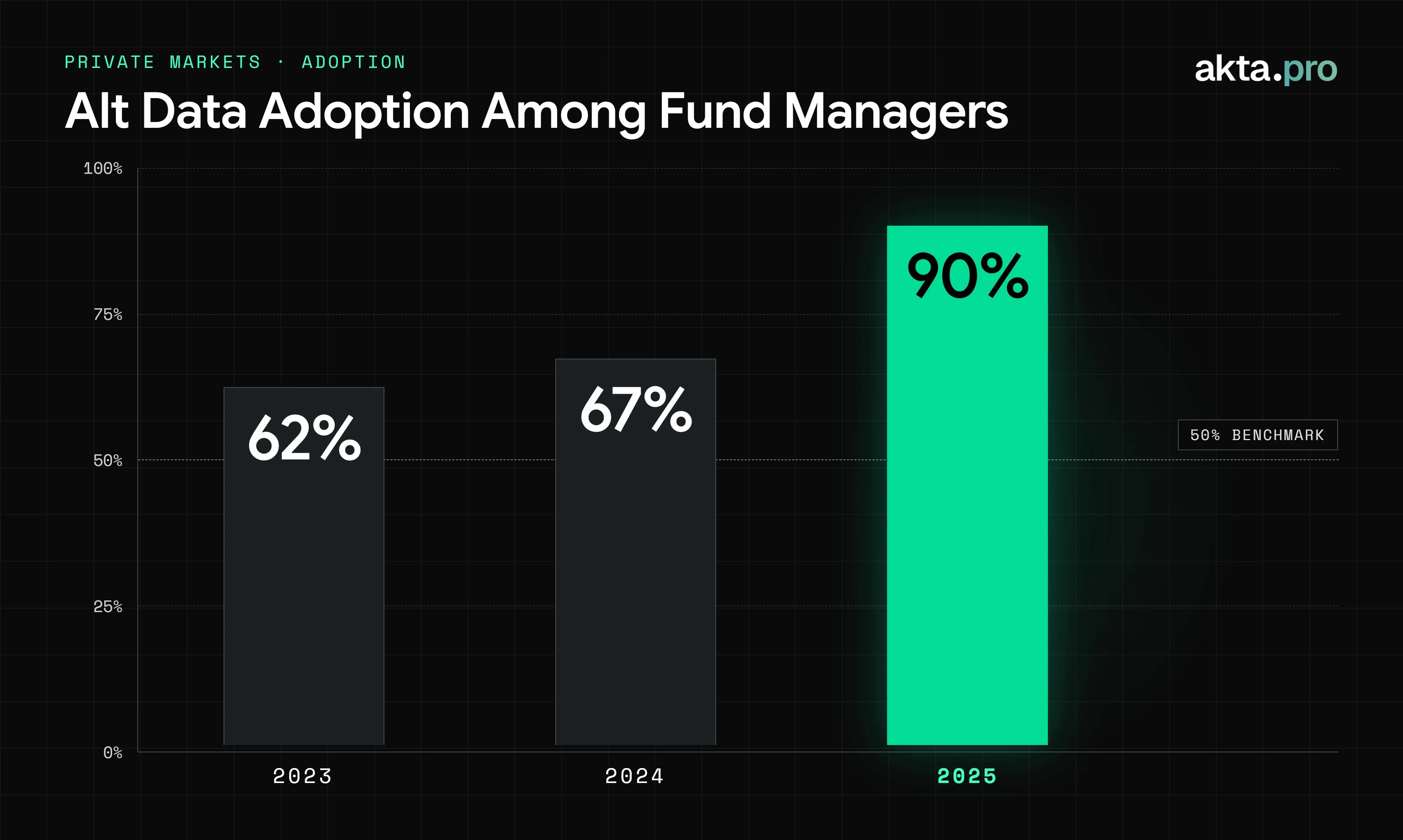
Ninety percent of investment advisers at PE, hedge fund, and VC firms now use alternative data, up from 62 percent two years earlier, according to a Lowenstein Sandler's 2025 of 107 fund managers, and 89 percent plan to increase their alt data budgets in 2026.
Alternative data for private company due diligence means using non-traditional information sources, web traffic, employee sentiment, job postings, and search demand, to evaluate a business that files no 10-K and has no analyst consensus to anchor to. Most of the alt data industry was still built for public equities, so the tools built for a public company earnings preview do not automatically work on a private target.
This guide covers which alt data types actually produce usable signals for private companies, where the quality problems sit, and how platforms like akta.pro are consolidating a fragmented category into one entity-resolved company profile.
What Counts as Alternative Data for Private Company Analysis
Alternative data, in the investment context, refers to information used to evaluate a company or market that falls outside traditional sources like financial statements, SEC filings, analyst reports, and management presentations. For private companies, the "traditional" data pool is already thin. There are no 10-Ks. There is no consensus estimate to anchor to. The confidential information memorandum (CIM) provided during a sale process is the company's own narrative about itself.
Alternative data fills the space between what a private company tells you and what is actually happening in its market, with its customers, and inside its workforce.
Neudata, the intelligence firm that tracks the global alt data ecosystem, estimates that investment managers spent approximately $2.8 billion on alternative data in 2025, a 17 percent increase year-over-year. The broader market, including corporate and non-investment buyers, is valued at roughly $18.8 billion and growing at a 37.6 percent compound annual rate, per Grand View Research.
The growth is real. But the utility for private company due diligence specifically depends on the data type, the target company's sector, and the question you are trying to answer.
The Alt Data Types That Actually Work for Private Company DD
Not all alternative data is created equal for private company evaluation. Some categories produce consistently useful signals. Others are better suited for public equity earnings previews and add limited value when you are underwriting a mid-market SaaS business or a regional services platform.
Here is a practical breakdown, organized by the DD question each data type helps answer.
Web Traffic and Digital Engagement Data
The DD question it answers: Is this company growing, plateauing, or declining? How does its digital presence compare to peers?
For any business with a meaningful online footprint (SaaS, e-commerce, digital media, marketplaces), web traffic trends from providers like SimilarWeb, Semrush, or Sensor Tower serve as a rough proxy for commercial momentum. Traffic data mapped over 12 to 24 months can validate or contradict management's growth narrative before you even open the data room.
The limitation is real, though. Web traffic estimators rely on panel-based modeling and clickstream samples, and accuracy drops significantly for smaller sites. SparkToro's analysis found that even the best tools (Semrush, SimilarWeb) showed meaningful deviation from actual Google Analytics data, with error rates climbing for sites under 500,000 monthly visits. For a mid-market private company, that describes most targets.
Use web traffic data directionally, not as a revenue proxy. It is most useful for competitive benchmarking: is the target gaining or losing share of digital attention relative to two or three named peers? Platforms like akta.pro fold website traffic trends into a broader private company profile, so you can view traffic alongside headcount and news activity for the same entity instead of stitching together three separate vendor exports.
Employee and Workforce Signals
The DD question it answers: Is this company scaling, contracting, or churning through talent? What does the internal culture look like?
Job posting volume and velocity, tracked from LinkedIn, Indeed, and corporate career pages, reveal hiring intent months before headcount changes show up in any reported figures. A sudden spike in engineering job postings at a private company may signal a new product initiative. A sustained drop might indicate budget cuts or leadership turnover.
Employee review platforms like Glassdoor and Blind provide a different layer: sentiment data. PE firms evaluating acquisitions routinely scrape or license Glassdoor review data to assess culture risk. High turnover signals, complaints about leadership changes, or patterns of declining satisfaction across a target's reviews can surface problems that management presentations will not mention.
Eagle Alpha's research highlights how workforce data has become one of the most popular alternative data categories for PE, alongside web traffic and consumer transaction data. One of Neudata's case studies describes a vendor that assessed a large AI company's hiring activity ahead of a potential PE investment, using a proprietary scoring system to benchmark talent quality and stability against peers. Stable hiring trends and low attrition reinforced investor confidence.
The signal here is strong when the target has enough employees (typically 50+) to produce a statistically meaningful review sample and enough job posting history to show trends. This is also one of the categories where consolidation helps more than in most. Employee reviews, job postings, and headcount trends each come from different platforms with different update cadences, and pulling them separately for every target slows down a deal team. akta.pro surfaces employee sentiment, job posting activity, and headcount trend data for a company alongside its news signals, so a workforce read on a target does not require three separate subscriptions and three separate exports to reconcile.
Consumer Review and Product Sentiment Data
The DD question it answers: How do customers actually feel about this company's product or service? Are satisfaction trends improving or deteriorating?
For B2C companies, product review data from Amazon, Trustpilot, Google Reviews, and category-specific platforms can quantify customer sentiment in ways that Net Promoter Score surveys (controlled by the company) cannot.
For B2B targets, G2, Capterra, and TrustRadius reviews offer similar intelligence. A Neudata case study documents how a PE firm used voice-of-customer analysis across European beauty and wellness brands to identify a mid-sized company that outperformed peers on experience quality, loyalty, and operational reliability. That data flagged the company as an attractive acquisition target before it entered a formal process.
The practical value here is in competitive positioning. Absolute review scores matter less than relative trends. A target whose G2 satisfaction scores are declining while two competitors are gaining ground tells you something that a management presentation's "97% customer retention" slide will not.
Search and Intent Data
The DD question it answers: Is demand for this company's category growing? How is branded search trending versus competitors?
Google Trends data, normalized and mapped to sectors or companies, provides a demand signal that works for both consumer and B2B businesses. Rising branded search volume for a private company typically correlates with growing market awareness. Category-level search trends can validate or challenge market-sizing assumptions in a CIM.
This data type is especially useful early in the diligence process, during thematic screening or commercial DD, when you want to understand demand trajectory without relying on the company's own projections. Platforms like Paradox Intelligence and Google's own tools provide this in structured formats.
Satellite Imagery, Geolocation, and Foot Traffic
The DD question it answers: For physical businesses, are locations performing? Is foot traffic consistent with claimed revenue?
This category made alternative data famous when RS Metrics started counting cars in Walmart parking lots from satellite images in the early 2010s. For private company DD, the application is narrower but still valuable.
PE firms evaluating retail acquisitions use foot traffic data from providers like Placer.ai and PassBy (formerly Near) to validate management claims about store performance. PassBy's own documentation notes that PE firms use this data as an independent, third-party view to complement internal financials during acquisition evaluation.
Satellite imagery has broader applications in infrastructure, construction, and real estate DD, where physical activity at a site (construction progress, inventory levels, shipping activity) provides signals that financial statements lag by weeks or months.
Tech Stack and Firmographic Data
The DD question it answers: What technology does this company use, and what does that reveal about its operations, sophistication, and growth stage?
Providers like BuiltWith, HG Insights, and Wappalyzer identify the technology stack a company runs. For a PE firm evaluating a SaaS target's competitive landscape, knowing which CRM, analytics, or infrastructure tools are deployed across an industry can indicate market penetration and technology maturity.
Neudata's research notes that a PE firm used tech stack and firmographic data to profile a target's existing and potential customers, identifying which companies were most likely to need the target's product based on the technologies they were already running. This turned alt data into a revenue-upside case, not just a risk-mitigation exercise.
Where Alternative Data Fits in the Private Company Deal Cycle
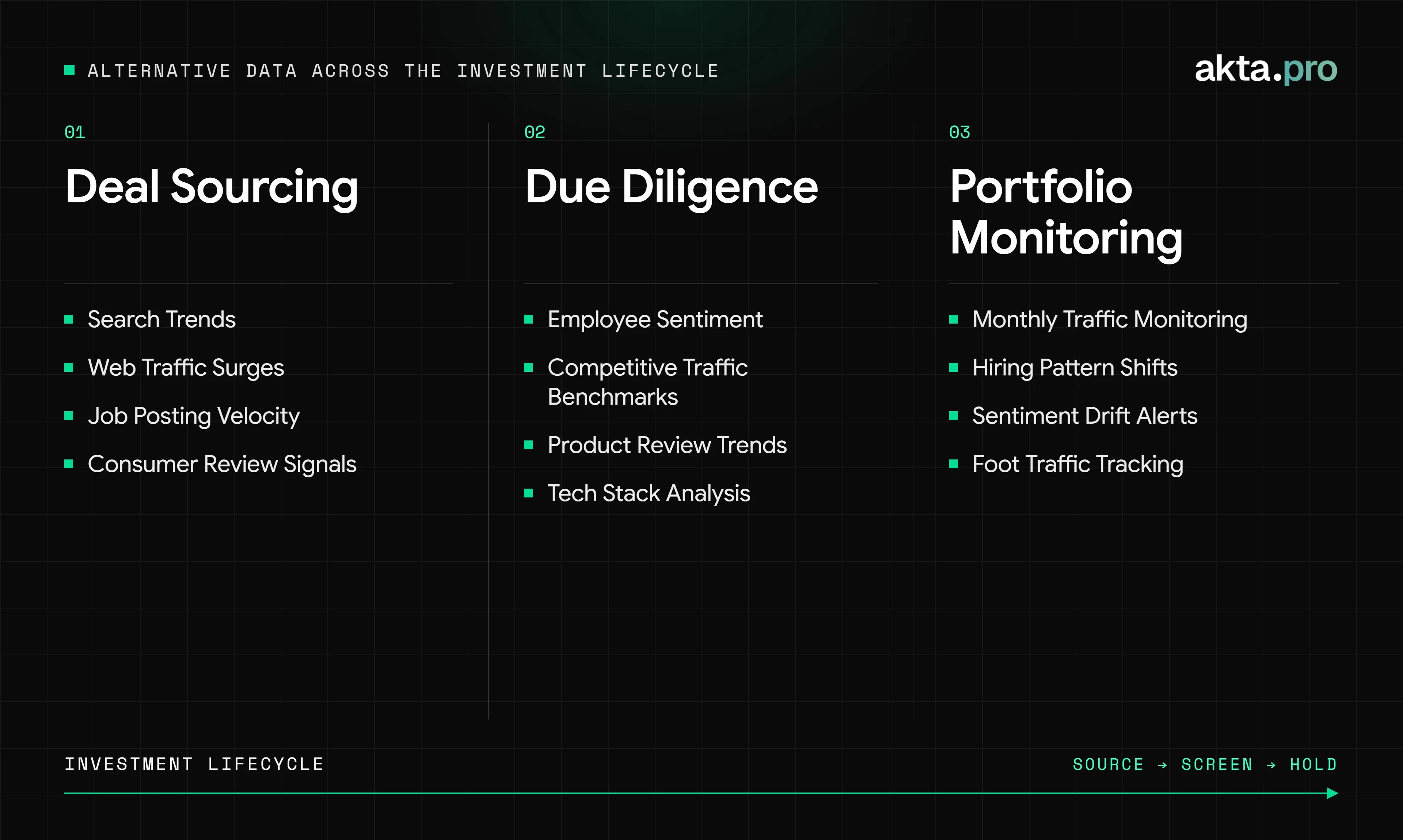
The three stages where alt data adds the most value for private company investors mirror the PE deal cycle itself.
Deal sourcing and thematic screening: Before a company enters a formal process, alt data can flag inflection points. Rising web traffic, accelerating job postings, or surging branded search volume in a sector can identify targets worth approaching. EQT's Motherbrain platform, built in 2016 and operational since 2018, combines public and web data with AI to identify and rank potential targets. It has directly sourced 15 investments, including companies like Peakon and AnyDesk, demonstrating that alt data-driven sourcing is not theoretical.
Due diligence: Once a target is in focus, alternative data stress-tests the investment thesis with evidence that is more current than historical financials or management projections. Demand signals (search, e-commerce interest), competitive positioning (share of voice, traffic vs. peers), and workforce stability (hiring velocity, employee sentiment) all provide independent checkpoints against the narrative in the CIM.
Portfolio monitoring: Post-acquisition, the same data sources provide ongoing performance tracking. This matters because, as one analysis of PE operations noted, GPs frequently do not discover a portfolio company is off-track until the quarterly board meeting. Alternative data can surface early warning signals weeks before the next board pack arrives.
The Quality Problem Nobody Wants to Talk About
Public companies have quarterly earnings to backtest a signal against. Private companies usually do not, and that gap creates three specific problems.
- Coverage gaps. Entity mapping is harder when a company shares a common name, operates through subsidiaries, or has little digital footprint, and most alt data providers were built for public tickers first.
- Sample size limits. Glassdoor reviews, web traffic, and app download data all get less reliable as a company gets smaller. Fifteen reviews from a 30-person company is not a statistically meaningful signal.
- No ground truth to backtest against. With a public company you can check a signal against known earnings. With a private one, there is often no way to validate a signal until after the deal closes.
The firms getting the most value treat alt data as triangulation, one input among several, rather than a standalone answer.
The Fragmentation Problem, and Why It Matters More Than the Data Itself
Web traffic lives with one vendor, employee sentiment with another, job postings and headcount with a third. A single company can appear as "Acme Corp," "Acme Corporation," or "Acme Inc." across three data sources with no shared identifier tying them together, and a wrong entity match makes every downstream signal worthless.
This is why the market is shifting toward consolidated private company data APIs instead of single-purpose datasets. akta.pro resolves a private company to one entity and attaches web traffic, employee reviews, job postings, headcount trends, social activity, and news signals to that profile through one API, so a deal team pulls one company's data footprint once instead of reconciling five vendor exports.
Compliance and Legal Boundaries
lternative data for private company research operates in a tightening regulatory environment.
- Data privacy. CCPA, GDPR, and state privacy laws govern how geolocation, scraping, and consumer behavior data can be collected and used for investment decisions.
- SEC scrutiny. Alternative data itself is legal, but the line between alt data and material non-public information can blur when data comes from insider sources or access-restricted platforms.
- Vendor diligence. Document which datasets are approved for which use cases, and confirm licensing terms actually permit the intended use before a deal team relies on them.
Building an Alt Data Capability for Private Company Research
For PE, VC, and corporate development teams that are earlier in their alternative data journey, a few practical principles apply.
- Start with the question, not the dataset. Define two or three specific things you want alt data to answer before subscribing to anything.
- Assign ownership. Data that sits in a portal but never reaches an IC memo is wasted spend.
- Triangulate, do not rely on one source. Combine web traffic, hiring trends, review sentiment, and search demand rather than betting on any single signal.
- Use structured APIs where possible. Platforms such as akta.pro for company intelligence and news signals cut the manual reconciliation work that slows a DD process down
Frequently Asked Questions
What is alternative data for private companies?
Alternative data for private companies refers to non-traditional sources used to evaluate businesses that are not publicly listed: web traffic, employee sentiment, job posting trends, consumer reviews, satellite imagery, search demand, and tech stack data. These sources help investors assess performance, competitive position, and growth trajectory without relying solely on self-reported financials.
How reliable is alternative data for private company valuation?
Alternative data provides directional signals, not precise financial metrics. Web traffic can show a growth or decline trend but not a revenue figure. Reliability improves when multiple data types are triangulated and the target has enough digital presence and employee scale for a meaningful sample. Treat it as one input in the valuation process, not a substitute for financial due diligence.
What are the best alternative data sources for private company analysis?
The most effective sources depend on the target's sector and the specific DD question. For digital businesses: web traffic, app analytics, and search trends. For B2B targets: product reviews, job posting data, and tech stack signals. For physical businesses: foot traffic data and satellite imagery. Most deal teams end up combining several single-purpose vendors to cover these categories, which is why consolidated platforms have gained traction. akta.pro brings website traffic, employee reviews, job postings, headcount trends, social activity, and news signals together under one entity-resolved company profile and a single API, reducing the vendor sprawl that typically slows down a DD process on a private target.