Programmatic acquirers, firms that run two or more small to mid-size deals a year, generate a 2.3% median excess shareholder return over peers, according to McKinsey's Global 2,000 research, and that gap has widened for over fifteen years.
Identifying acquisition targets programmatically means running an API based pipeline that continuously discovers, enriches, and ranks companies against a structured thesis, using live signals such as hiring velocity, funding history, and news activity instead of a one time database export.
This guide follows the same four-stage architecture that private company data platforms like akta.pro use to power live sourcing pipelines for PE firms, corp dev teams, and investment banks: the signals that predict readiness, how to wire them into a pipeline, and the mistakes that waste deal team time.
What Programmatic Acquisition Target Screening Actually Means
Programmatic M&A is a strategy built on volume, consistency, and thesis alignment. Instead of betting on one transformative deal, programmatic acquirers execute a steady cadence of smaller deals that compound into meaningful market capitalization over time. Bain's 2026 M&A Report confirmed that AI adoption in M&A more than doubled in 2025, with 45% of M&A executives now using AI tools on deals, up from single digits just two years prior.
Programmatic acquisition target screening is the sourcing engine underneath this strategy. It replaces episodic, manual searches with an automated pipeline that continuously discovers, enriches, and ranks potential targets against defined criteria. The critical difference from traditional screening: it operates on live data, uses natural language criteria instead of rigid SIC/NAICS codes, and runs continuously rather than producing a static export that goes stale within weeks.
For PE firms running buy-and-build strategies, corporate development teams expanding into adjacent markets, or investment banks building buyer lists, this shift changes both the coverage and the speed of sourcing. Grata's 2026 sourcing report estimates that analysts spend 40-60% of their time on manual research tasks (company summaries, ownership research, financial estimation, and initial fit scoring) that AI tools can now handle.
The Signals That Actually Predict Acquisition Readiness
| Financial & Structural | Growth & Momentum | Alternative & Unstructured |
|---|---|---|
| Revenue trajectory | Hiring velocity & role types | Employee review sentiment |
| EBITDA margins | Patent filings & R&D activity | Job posting language shifts |
| Funding history & investor profile | Web traffic trends | Executive departures |
| Ownership structure | App download data | Regulatory filings |
| PE hold period timing | Media mentions & press coverage | Social & conference signals |
PE-backed companies nearing the end of a typical three to seven year hold period, and family-owned businesses with a founder nearing retirement, are structurally positioned for an exit. Traditional databases rarely surface either group systematically.
Lowenstein Sandler's Alternative Data Report found that 62% of investment firms now use alternative data, with private equity adoption doubling year over year. A manufacturing company posting roles for machine learning engineers is signaling a technology shift before it becomes public knowledge. akta.pro's news and signals layer tracks these job posting changes, hiring velocity, and media mentions across 20M+ private companies, so the pattern surfaces in the pipeline instead of in a quarterly review.
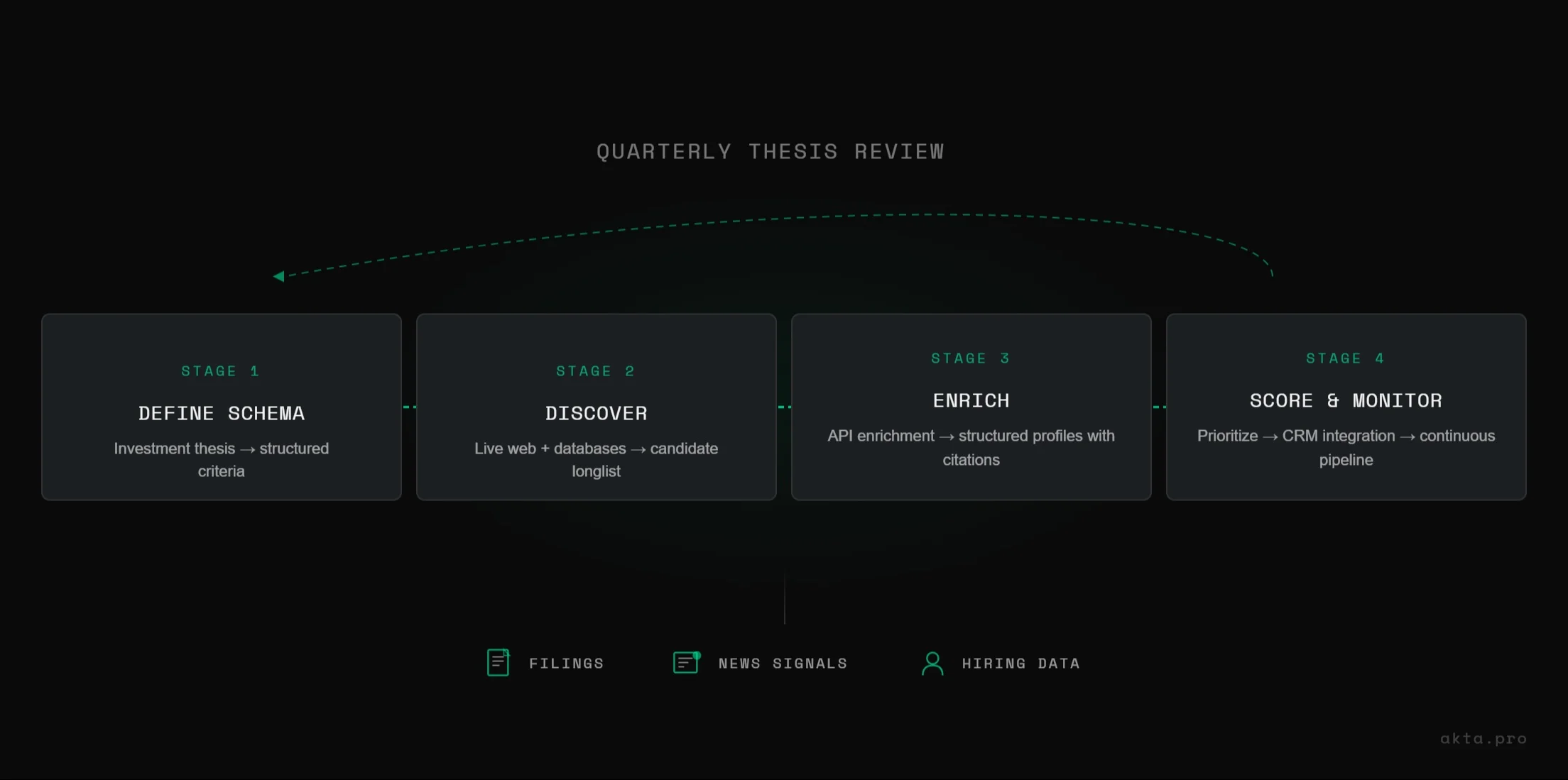
Building a Programmatic Sourcing Pipeline: The Four-Stage Architecture
The pipeline has four stages, each composable and auditable. The goal is to separate concerns: discovery is not enrichment, enrichment is not scoring, and scoring is not monitoring. Collapsing these stages makes the pipeline harder to debug and less adaptable to changing theses.
Stage 1: Define Your Target Schema
Encode your investment thesis as a structured schema. This step is more important than most teams realize. A vague thesis produces vague results.
Bad: "We're looking for interesting technology companies."
Good: "B2B SaaS companies in North America with 50-200 employees, estimated $5M-$20M ARR, selling to healthcare providers, with engineering headcount growth above 20% in the trailing six months."
The schema should specify: industry vertical, geography, company size parameters (headcount, revenue range, funding stage), technology focus, and the growth or readiness signals you care about. Unlike a traditional database filter limited to SIC codes and revenue buckets, an API-based pipeline can interpret natural language criteria and match against live web data.
Stage 2: Discover Targets from Live Sources
Static databases serve a purpose. They index millions of companies and standardize fields for fast lookup. But they share structural limitations. Stale data on quarterly or monthly refresh cycles. Coverage gaps where early-stage startups, niche verticals, and international markets are underrepresented. Fixed taxonomies that do not match most investment theses.
Live-web discovery solves these problems. An API that queries the open web in real time (company websites, press releases, job boards, funding announcements, regulatory filings, and news coverage) captures companies that are too new, too niche, or too international for pre-packaged databases.
The timing advantage matters. A fintech startup that closed its Series B three days ago shows up in live web results immediately. In a static database, it may not appear for weeks. By then, faster-moving competitors have already made contact.
The best sourcing workflows use both. Start with your database for initial universe building against broad criteria. Then layer live-web discovery to find companies the database missed and capture real-time signals. Private company data APIs like akta.pro provide structured data on 20M+ companies with entity resolution, filterable responses, and deterministic schemas designed for exactly this kind of pipeline integration.
Stage 3: Enrich and Validate Each Target
Discovery gives you a long list. Enrichment gives you depth.
For each company on the list, you need: financial metrics, leadership profiles, technology stack, competitive landscape, recent news, customer reviews, and regulatory status. Researching 50 companies by hand takes days of analyst time across multiple browser tabs, databases, and spreadsheets.
Enrichment APIs compress this to minutes per company. You define the fields you need, the API queries multiple sources, synthesizes findings, and returns structured data with citations. Deloitte's 2026 M&A Generative AI Study reported that approximately 86% of M&A organizations have now integrated generative AI into their workflows, and the most common use case is exactly this: accelerating the research and enrichment phase.
News signals are especially valuable at this stage. A target that looks good on firmographic data but has recent negative press about regulatory issues, customer churn, or leadership turnover needs to be flagged before it reaches your investment committee. Real-time news APIs with entity resolution ensure you are pulling news about the right company, not a similarly named entity in a different market.
For a deeper implementation pattern, we cover how to monitor private company news using an API across target and portfolio lists.
Stage 4: Score, Rank, and Monitor
With enriched profiles, apply your prioritization logic. This can be a proprietary scoring model, a weighted formula based on thesis criteria, or simply structured data that senior dealmakers review against their judgment.
For a technology rollup, patent activity and engineering headcount might carry high weight. For a distribution-focused acquisition, sales hiring and customer concentration matter more. The key is that structured, enriched data lets you compute scores across hundreds of targets in seconds rather than spending weeks on manual comparison.
Feed the results into your deal management system (DealCloud, Affinity, Salesforce, or even a well-structured spreadsheet) via API integration. Build dashboards that surface the highest-scoring targets for weekly pipeline reviews.
Then set the pipeline to run continuously. Markets evolve, new startups emerge, existing companies cross funding thresholds. A weekly discovery run piped into your tracking system turns point-in-time screening into ongoing market surveillance.
Where Static Databases Fall Short (And When They Still Work)
It is worth being precise about this, because the answer is not "throw away your PitchBook subscription."
Static databases remain the right tool for well-defined verticals with strong existing coverage, such as enterprise software or large-cap healthcare, and S&P Global's M&A coverage is a reference standard for transaction data and comps. The gap opens in niche verticals, emerging sectors, and bootstrapped companies that never raised institutional capital. PwC's 2026 M&A Trends outlook reported that global deal values rose 36% in 2025, driven by roughly 600 transactions above $1 billion, so stale coverage in a market moving this fast means missed deals.
Five Mistakes That Waste Deal Team Time
- Acting on a single signal: A hiring surge alone does not make a target acquisition-ready. Require at least three corroborating signals across different categories before a target moves to priority status.
- Skipping source citations: An "$15M ARR" claim sourced to a three-year-old blog post is not verifiable. Insist on per-field citations for every enriched data point.
- Running a set-and-forget pipeline: A thesis from six months ago may no longer match current strategy. Re-evaluate the target schema quarterly.
- Removing the human layer: AI accelerates discovery and enrichment. Relationship building, cultural fit judgment, and negotiation still require experienced dealmakers.
- Confusing coverage with relevance: Seventy million companies in a database means nothing if your thesis targets a 200-company niche and the database indexes 40 of them.
Frequently Asked Questions
How do you identify acquisition targets programmatically?
Programmatic identification uses API-based pipelines to continuously discover, enrich, and rank targets against a structured thesis. The pipeline queries live sources such as company websites, job boards, news, and regulatory filings, matches companies against natural language criteria, and returns scored profiles with citations. Platforms like akta.pro supply the entity-resolved company data and real-time signals this kind of pipeline depends on.
What is the difference between AI deal sourcing and traditional target screening?
Traditional screening filters a static database by industry code, revenue range, and geography, then exports a spreadsheet for manual enrichment. AI deal sourcing queries live web data against natural language criteria, enriches targets automatically, and runs continuously: live data and custom schemas instead of static exports and manual research.
How are PE firms using AI for acquisition target identification in 2026?
Bain's 2026 M&A Report found 45% of M&A executives used AI tools on deals in 2025, more than double the year before, concentrated in sourcing and due diligence. PE firms mainly use AI to expand target coverage without adding headcount and to monitor portfolio-adjacent markets, drawing on real-time company and news data from providers such as akta.pro.
Private company intelligence for acquisition target screening, due diligence signals, and market monitoring is available through the akta.pro API, with entity resolution, real-time news signals, and structured data across 20M+ companies.