Someone on your team drops a competitor's pricing page into Slack with one line: "thoughts?" You spend two hours on it, build a slide, and a week later nobody can say what changed because of it.
That gap between interesting and useful is what competitive intelligence analysis closes.
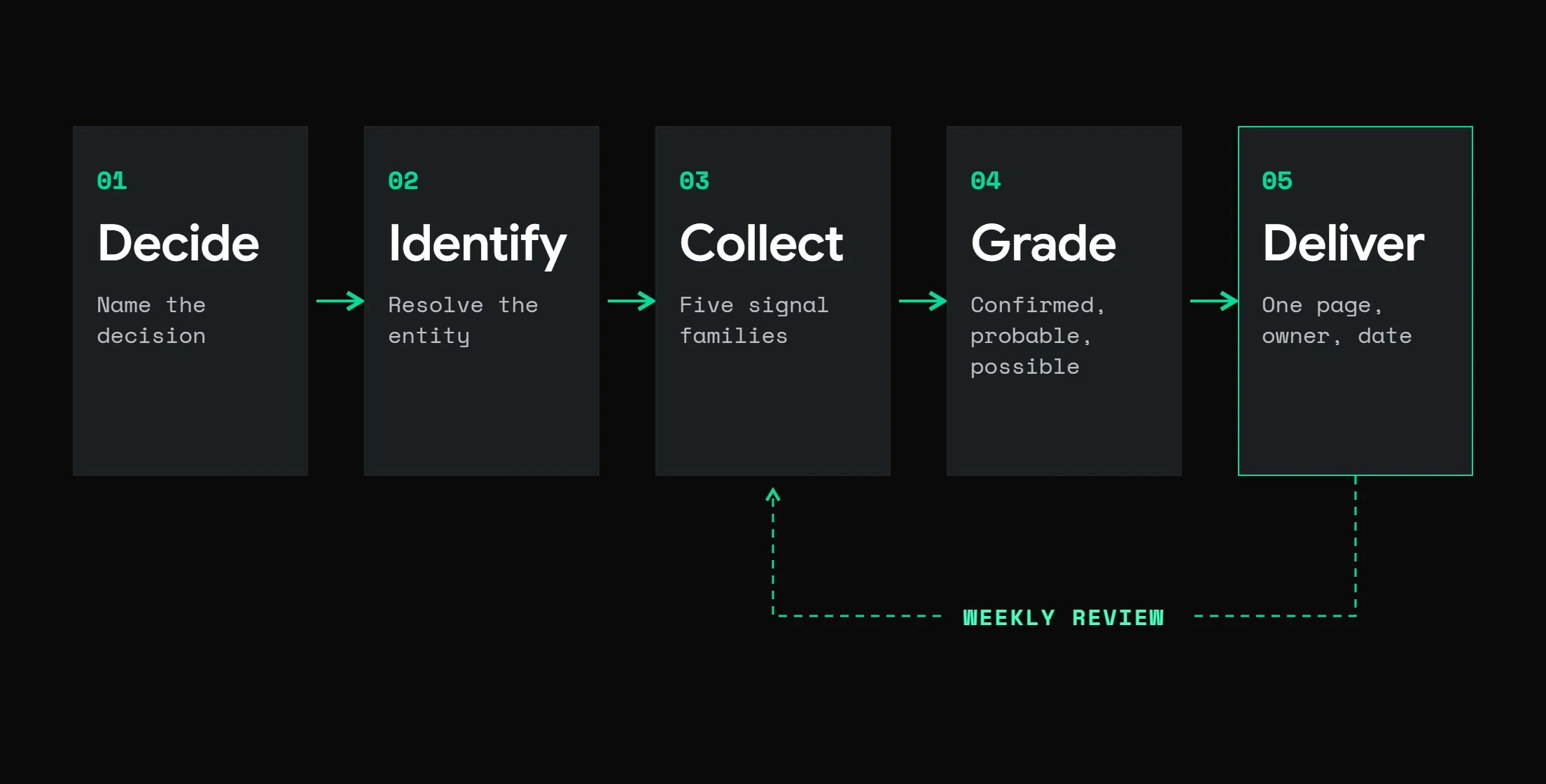
Competitive intelligence analysis is the work of turning competitor and market signals into a specific recommendation for a named decision. It runs in five steps: define the decision, pick and identify the right competitors, collect signals from several source types, grade the evidence, and deliver a single page call with an owner and a date.
akta.pro tracks news signals and company data on 20M+ private companies, and the examples below come from running this process against that data in October 2026.
What competitive intelligence analysis covers in 2026
Competitive intelligence analysis is the step between collecting information about rivals and acting on it. Collection produces facts. Analysis tests those facts against a question, rates how far you can trust them, and ends in a recommendation. It is wider than competitor analysis, which profiles one rival, because it also covers customers, technology, regulation and new entrants.
Gartner published its first Magic Quadrant for Competitive and Market Intelligence Platforms on April 21, 2026, a sign the category now has budget and a name. Its market definition describes platforms that help organizations "systematically gather, analyze, and act" on insight. Most programs stop at the first verb.
Two horizons shape the work. Tactical analysis supports short decisions such as a live deal, a price quote or a campaign. Strategic analysis supports long ones such as entering a market or building a feature. The steps below serve both. For definitions and history, read what competitive intelligence is.
Step 1: Start with the decision, not the competitor
The first step in competitive intelligence analysis is a decision statement: one choice your company must make, who owns it, and when. "Should we hold list price on the mid tier through Q1 if Competitor A launches a free plan?" is a decision. "Monitor Competitor A" is a task with no end.
Write down the three to five questions that decision depends on. Will the free plan include the feature our mid tier charges for? Which of our accounts overlap with theirs? How fast have they shipped similar changes before? These become your key intelligence topics, the field's term for the questions a program exists to answer.
Anything that answers none of them stays out of the collection plan. That rule also protects you when someone asks for "everything on a competitor."
Step 2: Pick the right competitors and resolve who they really are
Sort competitors into four tiers: direct (same buyer, same problem), adjacent (same buyer, different problem), substitute (a spreadsheet, an internal team, a consultant) and emerging (funded newcomers in your space). Follow a handful closely. Tracking fewer competitors in more depth beats a wide, shallow list, because each one needs a fresh hypothesis and not just a fresh feed.
Identity is the quiet failure point. A search for crayon.co in akta.pro returned 23 candidate entities in October 2026, including a competitive intelligence software company, a software asset management group and an early childhood education provider. klue.com returned two candidates and contify.com returned five. Pick the wrong one and every article, headcount chart and funding round that follows belongs to someone else.
Matching on names cannot fix this. Entity resolution can, and it explains the 32% to 58% figure at the top of this post. In the benchmark, akta.pro resolved to the right company 93% of the time. We built that benchmark, so treat it as a vendor result and re-run it with the published harness.
Step 3: Collect signals from five source families
Collect competitive signals from five families, because each fails in a different way: company data, news, product and pricing pages, hiring, and customer voice. No single family is reliable alone, and two families that agree are worth more than ten articles from one.
| Source family | Example signal | What it tells you | Main risk |
|---|---|---|---|
| Company data | Headcount trend, funding round, new office, leadership change | Capacity and direction of travel | Stale or mismatched records |
| News signals | Product launch, partnership, M&A, legal action | What the company chooses to publish | Wrong-company articles, PR spin |
| Product and pricing pages | New tier, changed packaging, new integration page | What they are selling now | Changes with no explanation |
| Hiring | A cluster of postings in one function or region | Where they plan to invest next | Backfill that looks like growth |
| Customer voice | Win and loss notes, call mentions, reviews | Why buyers pick them | Small samples, loud outliers |
Hiring and pricing pages tend to show a move before the press release does. Treat the release as confirmation, not discovery.
The Company Data API covers the first family with firmographics and structured profiles. The News Signals API covers the second and classifies each article against an 80+ event taxonomy, so you can filter to funding, leadership or product events instead of reading everything. If you still rely on keyword alerts, here are alternatives to Google Alerts for company monitoring. Whatever you use, stay with public sources and never misrepresent who you are.
Step 4: Grade the evidence before you interpret it
Grade every signal before you interpret it. A three level scale works: confirmed when two independent sources or a primary document agree, probable when one credible source fits the pattern, possible when it is a single weak signal or your own inference. Keep facts and inferences in separate columns.
Then test explanations against each other. Richards Heuer's Analysis of Competing Hypotheses, set out in the CIA's Psychology of Intelligence Analysis, asks you to list rival explanations and look for evidence that rules each one out, instead of collecting support for your favorite. An illustrative example:
Signal: Competitor A posts 14 sales roles in EMEA.
| Evidence | H1: EMEA push | H2: Backfilling churn | H3: Channel pivot |
|---|---|---|---|
| 14 new EMEA sales postings | Consistent | Consistent | Inconsistent |
| New euro pricing page | Consistent | Inconsistent | Neutral |
| Headcount flat for 90 days | Inconsistent | Consistent | Consistent |
| Distributor named in a press release | Neutral | Neutral | Consistent |
No row settles it. The euro pricing page and the flat headcount point in opposite directions, which tells you which signal to chase next. Count inconsistencies, not confirmations, and finish by writing the single observation that would change your mind.
Step 5: Deliver a single page call, not a competitor encyclopedia
Deliver each analysis as a single page that opens with the call, then states confidence, the evidence behind it, what would change it, an owner and a date. If a finding changes no decision on the table, it does not belong in the document.
-
The call: one sentence, such as "Hold list price and add the analytics feature to the mid tier by February."
-
Confidence: confirmed, probable or possible.
-
Evidence: three graded signals.
-
What would change it: the observation from Step 4.
-
Owner and date.
Sales needs a different format. In a SCIP interview, Ed Allison, who previously led competitive intelligence teams at Cisco, Symbol, Juniper and Polycom, puts it in one line: "Battlecards are about hyper-differentiation." A card that lists every difference loses to one that names the two that decide deals.
Measure the work by decisions, not documents: win rate in deals where the competitor appeared, days from first signal to decision, and the share of deliverables someone opened and used.
Where AI agents fit in competitive intelligence analysis
AI agents belong in collection and triage, not in steps one, four and five. An agent can watch fifty companies daily and flag events that match your key intelligence topics. It cannot own the decision, judge which hypothesis survives, or answer for the recommendation.
What the agent reads matters more than which model reads it. In the same benchmark, frontier models with web search had strong entity precision but surfaced only 29% to 56% of the real stories. The purpose built retrieval layer reached 72.7% recall at 92% overall precision. Use a retrieval layer to fetch and a model to reason, and read how to monitor private company news with an API to set up the first half.
Protect the analysis: your CI data is sensitive too
Your analysis holds pricing plans, account lists and strategy, which makes the stack a target. In June 2026 market intelligence vendor Klue said attackers entered its systems using a "compromised legacy credential" tied to an integration tool, and TechCrunch reported that data was stolen from an unspecified number of its customers.
Three habits transfer to any tool: list every integration that can read your CRM or call recordings, expire access tokens on a schedule, and keep strategic conclusions in a system with tighter access than the shared drive that holds raw research.
Common failure modes
| Failure | What it looks like | Fix |
|---|---|---|
| Tracking everyone | 30 competitors, no hypotheses | Cap the list and tie each name to a decision |
| Reading the wrong company | Namesake news in the feed | Resolve entities first and check the primary company flag |
| Confusing activity with intent | A hiring spike read as strategy | Write competing hypotheses and count inconsistencies |
| No owner | The report circulates and nothing changes | Put an owner and a date on every page |
FAQ
What is competitive intelligence analysis?
Competitive intelligence analysis is the process of evaluating information about competitors, customers and the wider market to support a specific business decision. It sits between collection and action: it grades evidence, tests explanations and ends in a recommendation.
How do you do a competitive intelligence analysis?
Define the decision, choose and correctly identify the competitors, collect signals from several source families, grade the evidence and test competing explanations, then deliver a single page recommendation with an owner and a date. Review signals weekly and refresh hypotheses quarterly.
What are the four P's of competitor analysis?
Product, price, place and promotion, the classic marketing mix. Compare each competitor on all four, then add what the mix leaves out: who they sell to, how fast they ship and where they hire.
Can akta.pro support competitive intelligence analysis?
Yes, for the collection layer. The Company Data API covers 20M+ entities with 75+ data points per company, and the News Signals API returns entity-resolved articles classified by event type. You still own the questions and the judgment.
Pick one decision this week, write the three questions it depends on, and run the five steps by hand before you automate anything. akta.pro is pay as you go, and the pricing page shows what a first test costs.