Key takeaways
- A company news API returns news that is already resolved to the right company, grouped by event, scored for relevance, and shaped as structured data an AI agent can act on in one call. Coverage is the easy part. Resolution and ranking are the real product.
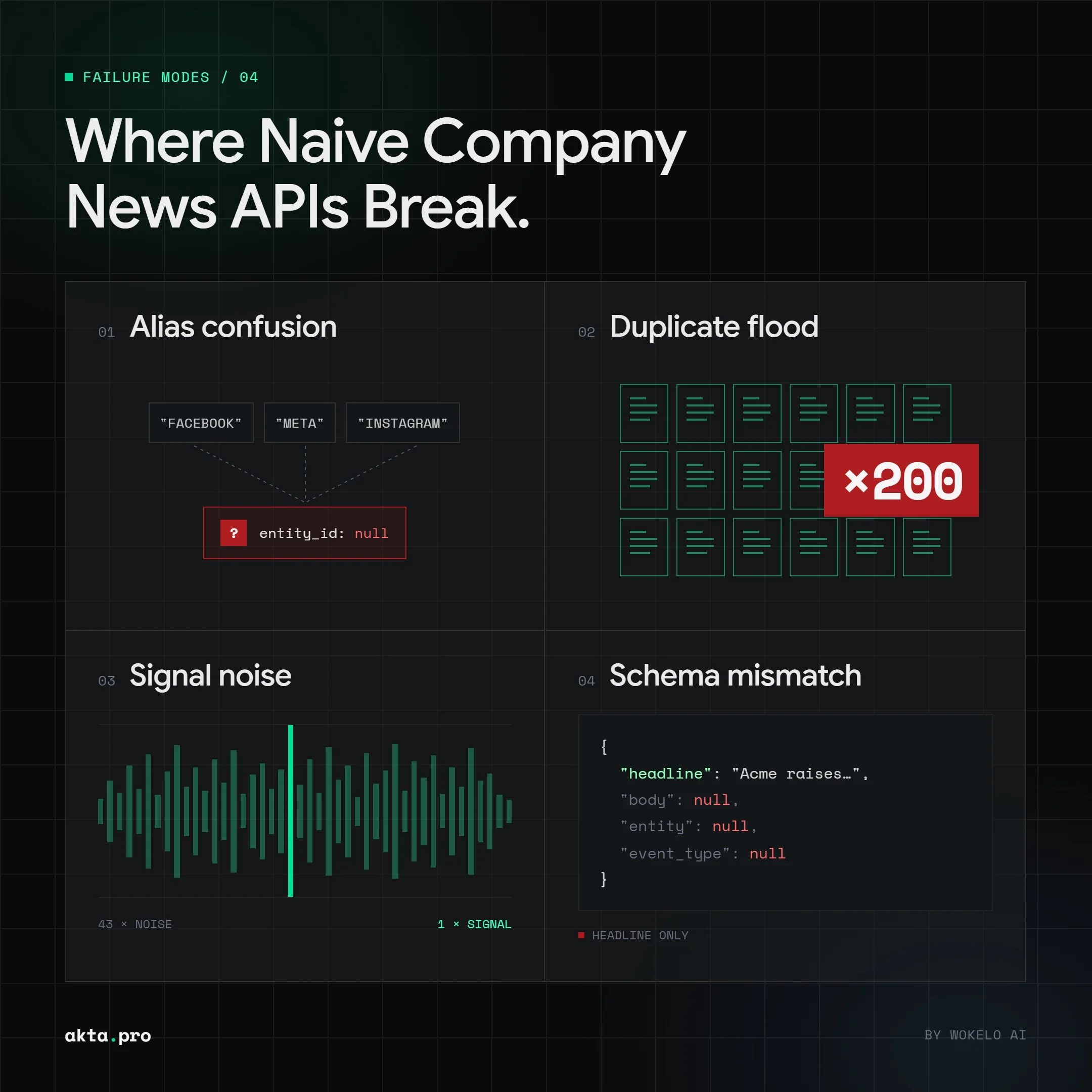
- Four problems break most feeds once an agent is doing the reading: aliases and subsidiaries, duplicate coverage, weak signals, and output built for a dashboard instead of a model.
- When one story lands across 200 or 500 outlets at once, grouping those articles is the difference between one downstream model call and hundreds.
- Choose a provider by testing it against those four problems, not by counting sources. The comparison table and the working code below show what to look for.
- In 2024, automated traffic passed human traffic on the web for the first time in a decade. The thing calling your API is increasingly software, so the output has to be built for software.
News APIs were built for people who scan headlines. Agents do not scan. They retrieve, rank, decide, and act in a fraction of a second, and most of the assumptions baked into an older news feed fall apart the moment a workflow starts running on its own.
A company news API is a programmatic feed that returns news already resolved to the right company, grouped by event, scored for relevance, and delivered as structured data a model can act on directly. If you are evaluating one in 2026, the question is no longer how many sources it covers. It is whether the data lands in your agent in a shape that does not multiply your engineering cost.
We build this layer at akta.pro, on Wokelo AI's database of more than 20 million companies, so this guide comes from the implementation side rather than the marketing side. Below you will find what a company news API has to do in the agent era, the four failure modes that trip teams up, how the main providers compare, working code to wire a feed into an agent, and a checklist for choosing one without falling for coverage theatre.
What a company news API is, and why the definition shifted in 2026
A company news API is a programmatic interface that returns structured news about specific companies, queried by company rather than by keyword. That much is not new. What changed in 2026 is the reader.
For an AI agent, four capabilities move from nice to have to load bearing. The feed has to resolve entity aliases and subsidiaries, collapse duplicate coverage of a single event, attach some measure of how material an article is, and return the full article body in a shape a model can consume. Miss any one of those and the work does not disappear. It moves into your own pipeline, where you pay to rebuild it.
Older keyword feeds index enormous numbers of sources and match on text, which sounds comprehensive until a search for "Tesla" comes back with Nikola Tesla, the Tesla Roadster, and a Walmart electronics aisle. A company news API built for agents treats each article as an event about a specific, resolved company. akta.pro sits in that second group, resolving companies across parent, subsidiary, and trading names on top of Wokelo AI's 20 million company records.
This matters because the audience changed. According to Imperva's 2025 Bad Bot Report, automated traffic reached 51 percent of all web traffic in 2024 and passed human traffic for the first time in a decade, and 44 percent of advanced bot activity that year was aimed at APIs. The clients hitting your feed are less and less likely to be people.
The four failure modes that break naive company news APIs
Almost every "we tried a news API and it did not work" story traces back to the same four problems. Each one is fixable, but only if the feed was designed for it in the first place.
| Failure mode | What goes wrong | What fixes it |
|---|---|---|
| Aliases | "Meta" and "Facebook" look like different companies | Entity resolution across aliases, subsidiaries, tickers, former names |
| Duplicates | 200 outlets cover one event, the agent reads all 200 | Grouping articles into one record per event |
| Weak signals | A passing mention is weighted like a recall | A relevance or materiality score per article |
| Wrong shape | The agent gets a link and needs three more calls | Full body plus company, event type, and score in one response |
Aliases, or the entity resolution problem
A company files under one name, gets acquired, changes its name, and shows up in a press release under a third name inside the same quarter. Meta is Facebook is Instagram is WhatsApp is Reality Labs. Alphabet is Google is Waymo is DeepMind. A keyword feed treats every one of those as a separate story. An agent reasoning about Alphabet's regulatory exposure needs them folded into a single company.
Entity resolution is one of the genuinely hard problems in data work. Our deeper piece on why entity resolution decides company data quality covers the mechanics. Here, the job is mapping aliases, subsidiaries, former names, and brands back to one company, at the speed news arrives, across millions of fresh articles a day. Skip it and you ship an agent that confidently routes a signal to the wrong company.
In practice this shows up as two questions worth asking any vendor. Can it tell the difference between an article that merely mentions a company and one that is actually about that company. And can it link a subsidiary back to its parent without you sending the exact legal name. akta.pro handles the first with a subject filter that keeps only the articles a company is truly the focus of, and the second through its resolved company graph.
Duplicates, or the event clustering problem
A single acquisition announcement gets covered by 200 outlets inside an hour. When a story breaks across 500 outlets at once, a naive pipeline drowns in copies. For a human that is mildly annoying. For an agent running a model call on every article, it is a 200 times cost multiplier and a 200 times latency multiplier, and after all of it the agent still does not know whether article number two added anything that article number one did not.
Grouping many articles about one event into a single record, with the rest attached as supporting coverage, is the line between a feed that scales to an agent and one that quietly drains your budget. akta.pro exposes this as a grouping option that collapses near duplicate articles from the same event, so the agent reads the event once.
Weak signals, or the materiality problem
Not every article is worth acting on. A footnote mention of Tesla in a "stocks to watch this week" roundup is not the same as Tesla announcing a recall, and an underwriting agent should not treat them the same way. Yet plenty of feeds return both with identical metadata.
A relevance or materiality score is the layer that lets a model triage before it reads. Without one, every team ends up building its own scorer, usually badly. akta.pro attaches a relevance tier to each article, high, medium, or low, so an agent can pull only the material events and leave the noise on the shelf. The score is not a marketing badge. It is a budget control.
Wrong shape, or the schema problem
A feed built for a human dashboard returns a headline, a link, a snippet, and maybe a date. The agent then has to fetch the link, render the page, parse it, work out which company it is about, decide whether it matters, and only then act. Every hop is a call, a token cost, and a place to fail.
A feed built for agents returns the full article body, the resolved company, an event type, a sentiment, a relevance score, and a timestamp in one response. That is the difference between one model call and three. akta.pro returns a compact record for triage and a detail call for the full text of the articles you decide to keep, so you are not paying to render pages you were never going to use.
How different teams use a company news API
The buyer here is not one persona. The use cases run from "I need a feature in my product" to "I need a signal for a trade," and each one changes what good looks like.
Private equity, venture capital, and investment banking
Deal teams watch target lists, catch trigger events such as leadership changes, fundraising, and regulatory action, and feed diligence research agents. They spend a large share of their time on sourcing rather than execution, so a structured company news feed wired into a CRM lets a sourcing agent rank companies by how much has actually happened lately, instead of by alphabetical accident.
The 2025 cycle raised the stakes. Private equity and venture capital investment in fintech alone reached $18.54 billion in 2025, up 44 percent year over year, even as deal volume fell about 34 percent to 240 deals, according to S&P Global Market Intelligence. Fewer, larger bets means a missed signal on a target or a portfolio company costs more than it used to. As 500 Global managing partner Amjad Ahmad told S&P Global, investors are gravitating toward infrastructure platforms that pair financial rails with data intelligence. When valuations run on that logic, the price of not knowing goes up.
Trading and quant desks
For systematic and discretionary desks, news is the catalyst layer. An agent watches for specific event types, earnings surprises, drug approvals, antitrust filings, on a resolved company, checks how material the article is, and routes it to an alert or an execution path. Feeds with no event classification force the desk to build its own language pipeline, and that build usually costs more than the subscription it was meant to avoid.
Competitive intelligence and business development
Account teams need to know when a target hires a new security chief, raises a round, loses a big customer, or opens an office in a new market. Across real business to business monitoring, the pattern is consistent. Generic feeds return noise, and the cost of filtering and matching that noise to the right company dwarfs the subscription. What these teams want is not news. It is company events scored for how sales ready they are.
Risk and compliance
Know your customer checks, sanctions screening, environmental and governance monitoring, and vendor risk all need adverse coverage on the entities a firm is exposed to. Here, completeness and provenance matter more than speed. The system has to be able to show that if a major outlet ran a damaging story about a vendor on a given day, the screening agent surfaced it by the next. Every record has to carry the publisher, the date, and a stable link an auditor can open.
Product teams shipping AI features
A research agent, a sales copilot, a market intelligence widget, a portfolio dashboard. Every one of these needs a news layer underneath. Building it in house means scraping, deduplication, entity recognition, scoring, and endless source maintenance, which is roughly the work of a small dedicated data team plus the scraper repair that never stops. The build versus buy math almost always points to buy, but only when the feed does the parts that are hard.
How the main company news APIs compare in 2026
Most feeds were built for a different reader than an agent. This table lines up the common options against the four failure modes and the one question that decides whether a feed is agent ready. Does it return the full article and structured context in a single call. Treat it as a starting map and confirm current details against each provider's own docs, since capabilities move quickly.
| Provider | Type | Resolves companies | Groups duplicate events | Relevance or event tags | Full body in one flow | Best fit |
|---|---|---|---|---|---|---|
| akta.pro | Company news for AI | Yes, resolved graph plus subject detection | Yes | Relevance tier, event type, sentiment | Yes, via detail call | Diligence, risk, B2B monitoring, RAG |
| NewsAPI.ai (Event Registry) | News intelligence index | Entity tagging | Yes | Sentiment and topic tags | Yes | Enterprise media monitoring, deep archive |
| Exa | Semantic search API | Limited | No | No news taxonomy | Yes, text and highlights | Semantic research agents, RAG |
| Firecrawl | Web and news search | No | No | No | Yes, markdown in one call | Live web agents, deep research |
| marketaux | Financial news API | Ticker tagging | No | Sentiment, entities | Partial | Retail fintech, ticker sentiment |
| Finnhub | Market data and news | Ticker level | No | Company news tagging | Partial | Market data plus news bundles |
| NewsAPI.org | Legacy keyword news | No | No | No | Snippet only | Prototypes, non production |
Two things stand out. First, most feeds solve retrieval, not resolution, so the four failure modes stay your problem. Second, the financial specialists resolve tickers well but not private companies, subsidiaries, or non public entities, which is exactly where diligence and business to business monitoring live.
How to choose a company news API in 2026
If you are comparing providers rather than designing the plumbing yourself, our guide on how to choose a news API for company and market intelligence walks through the full process. The decision comes down to a shorter list than most comparison posts admit.
-
Resolution depth. Does a query for "Meta" return Facebook, Instagram, WhatsApp, Oculus, and Reality Labs under one parent. Test the hard cases: a recently acquired private company, a public company under a new ticker, a subsidiary with its own legal name. If the feed needs the exact legal name, it has handed the resolution problem back to you.
-
Grouping and deduplication. Run a query during a known breaking story, say an earnings day for a large cap. Count the raw articles against the grouped events. A ratio like 200 to 5 is workable. A ratio of 200 to 200 means you are paying to deduplicate.
-
Materiality and event type. Are articles tagged by event, such as M&A, leadership change, regulatory action, product launch, earnings, lawsuit, or partnership. Is there a relevance score. If your agent has to read every snippet to triage, the feed has not done its job.
-
Shape for agents. Does the response carry the full body, not just a snippet. Is the company id stable and joinable across queries. Can the feed be exposed as a tool an agent can call without a heap of glue.
-
Latency and freshness. Trading and competitive intelligence want sub minute from publish to available. Diligence tolerates sub hour. Ask for the median and the tail numbers, not the marketing claim.
-
Sources and provenance. Major outlets, regulatory filings, press releases, regional language coverage, and the right forums, each with a stable link and a publisher name for the audit trail.
-
Custom filters. A curated list of a few thousand portfolio companies, a sector taxonomy, a sentiment threshold tied to your risk policy. Providers that support these save you a layer of code.
-
Pricing model. Per call billing punishes high recall workflows. A subscription with usage tiers and predictable annual pricing makes budgeting sane, which is why buyers in regulated industries flag predictable pricing as a requirement in its own right.
Wiring a company news API into an AI agent
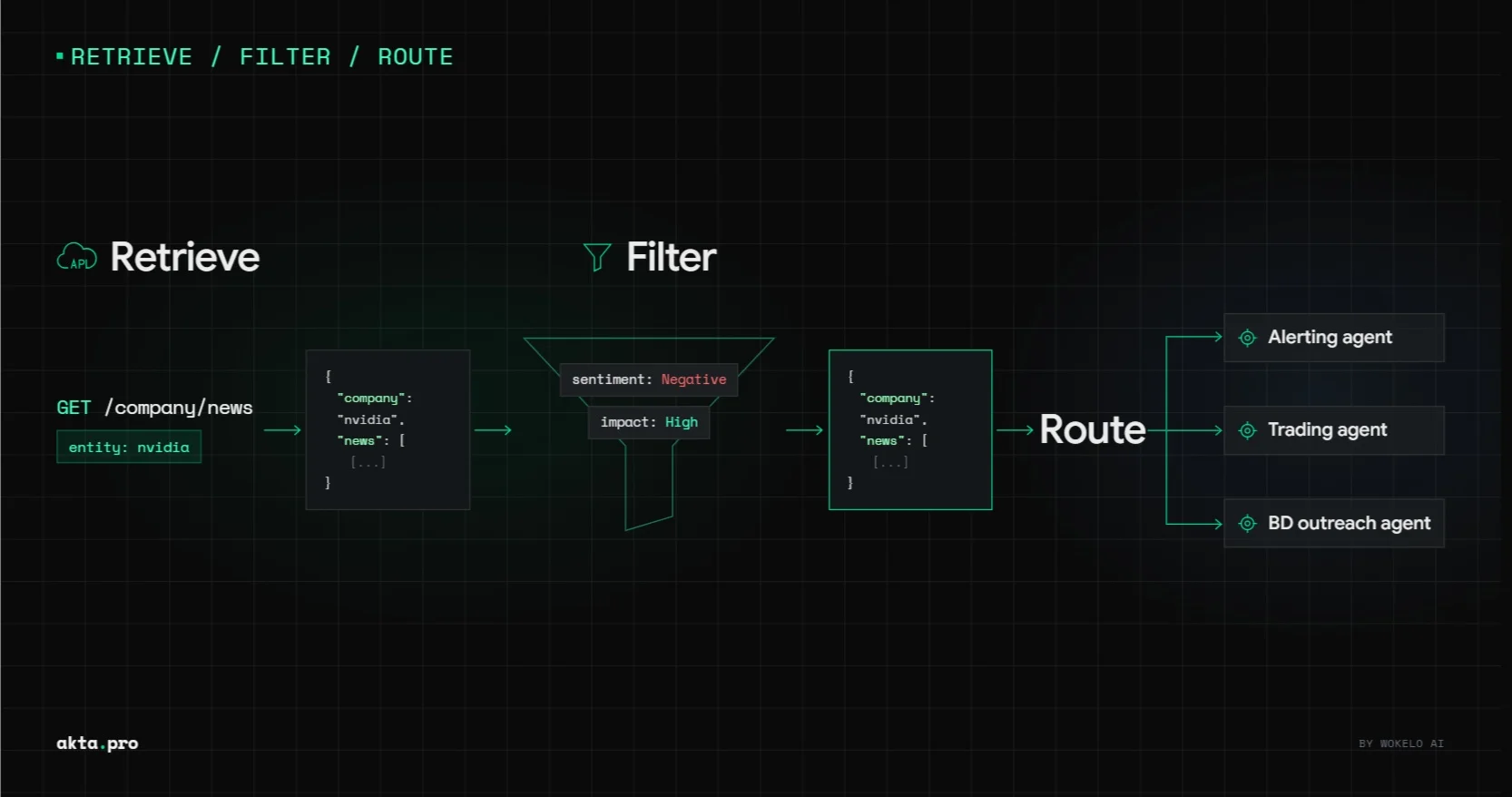
The smallest useful pattern has three stages: retrieve, filter, route. Here it is against akta.pro's news endpoint, whose parameters map straight onto the four failure modes. You resolve the company to a stable id, ask for grouped and high relevance articles filtered by event type, and let the event type decide what the agent does next. Set your key and base URL from the akta.pro API docs.
import requests

BASE = "https://api.akta.pro"
HEADERS = {"Authorization": "Bearer YOUR_API_KEY"}

def resolve_company(name: str) -> str:
    """Stage 0. Turn a messy name into a stable company id."""
    r = requests.get(f"{BASE}/company/search", headers=HEADERS,
                     params={"query": name}, timeout=10)
    r.raise_for_status()
    return r.json()["results"][0]["uuid"]

def retrieve(company_id: str, since: str):
    """Stage 1. Pull only material, deduplicated events about this company."""
    r = requests.get(f"{BASE}/news", headers=HEADERS, params={
        "primary_company": company_id,   # articles the company is actually about
        "group_articles": True,          # one record per event, not 200
        "news_score": "High",            # skip the low relevance noise
        "start_date": since,             # poll from your last successful run
        "limit": 50,
    }, timeout=10)
    r.raise_for_status()
    return r.json()["articles"]

def route(article: dict):
    """Stage 3. The event type decides which playbook runs."""
    playbooks = {
        "CM03": alert_deal_team,        # mergers and acquisitions
        "SD01": update_product_watch,   # product launches
        "WT02": flag_workforce_change,  # layoffs and workforce
    }
    for code in article.get("type_codes", []):
        handler = playbooks.get(code)
        if handler:
            return handler(article)
    return log_only(article)

def agent_loop(name: str, since: str):
    company_id = resolve_company(name)
    for article in retrieve(company_id, since):   # retrieve
        if article["news_score"] != "High":       # filter
            continue
        route(article)                            # route
Three things make this hold up. The agent never touches raw headlines until relevance and grouping have already done their work, which is how the token bill stays sane. The resolved company id is a stable join key, so you can line events up against an internal CRM or portfolio table without fuzzy matching. And the event type is what lets a single loop run different playbooks, so a leadership change and a regulatory action do not go down the same path.
For production, add exponential backoff on rate limits, a cache so you do not reprocess an event you have already grouped, and a fallback when the score is missing. None of that is exotic. But the feed has to return those fields for any of it to be possible.
Exposing the same feed as an agent tool
The cleanest way to make a feed agent native is to wrap it as a tool an assistant can discover and call on its own, using the Model Context Protocol. An agent running in a client like Claude or Cursor can then pull company news straight from a prompt, with no bespoke integration.
from mcp.server.fastmcp import FastMCP
import requests

mcp = FastMCP("company-news")

@mcp.tool()
def get_company_news(company_id: str, since: str) -> list[dict]:
    """Return grouped, high relevance news events for a resolved company."""
    r = requests.get("https://api.akta.pro/news",
                     headers={"Authorization": "Bearer YOUR_API_KEY"},
                     params={"primary_company": company_id, "group_articles": True,
                             "news_score": "High", "start_date": since},
                     timeout=10)
    r.raise_for_status()
    return r.json()["articles"]

if __name__ == "__main__":
    mcp.run()
What comes next: news as an agent tool, not a data feed
The interesting shift in 2026 is not bigger source counts. It is company news APIs presenting themselves natively as tools an agent can pick up.
The Model Context Protocol is the clearest version of that. A feed exposed as a tool, with capability discovery and clean, recoverable errors, is something an agent can find, call, and retry on its own, without glue code holding it together.
The second shift is the retrieval contract. Most feeds still treat a request as a stateless one off. In an agent context you want something closer to a standing instruction: give me everything material on this company since my last successful poll, ordered by how important the event is, grouped so I read each event once, and tell me if a story I already pulled has been retracted. That kind of contract shrinks both the work the agent does and the room it has to hallucinate. Retrieval-augmented generation cuts hallucinations by grounding a model in real retrieved text rather than its own memory, but it only helps as far as the retrieval layer is clean, and published evaluations still put error rates well into the double digits even with it.
The third shift is convergence. The same agent that needs a wire story about a regulatory action also needs the underlying filing, the analyst call transcript, and whatever private company context the firm already holds. Providers that treat news as one feed among several, joined on a shared company id, will outrun the pure news vendors. That is the idea behind Wokelo AI's approach of unifying a 20 million company database, premium datasets, news, and market intelligence with line level citations, with akta.pro as the company news surface of that stack.
Independent testing is catching up too. An open benchmark now ranks more than a dozen search and news providers on hundreds of company news questions by cost per correct answer, which is a more honest signal than any vendor's source count.
How much does a company news API cost?
Pricing falls into three shapes. Match the shape to your workload before you look at the number.
| Model | Typical range | Fits | Watch for |
|---|---|---|---|
| Per call | Roughly $0.001 to $0.01 per article | Low, spiky volume | Punishes high recall agent workflows |
| Tiered subscription | Roughly $99 to $5,000 plus per month | Steady production apps | Overage rates when a story breaks |
| Enterprise contract | Five to seven figures per year | High volume plus compliance | Negotiate predictable annual pricing |
For most production AI features, the engineering cost you avoid by buying a structured, resolved feed outruns the subscription by a wide margin. The real comparison is not the sticker price against a cheaper feed. It is the sticker price against the small data team you would otherwise hire to rebuild resolution, grouping, and scoring in house.
FAQ
What is a company news API?
A company news API is a programmatic feed that returns news about specific companies, queried by company rather than by keyword. A modern one also resolves aliases and subsidiaries, groups duplicate coverage of an event, scores relevance, and returns structured data an AI agent can retrieve, triage, and act on in a single call.
How is a company news API different from a general news API?
A general news API matches articles to keywords or topics. A company news API is organized around resolved companies and events, and usually adds event type, sentiment, and a relevance score. At scale the gap is obvious. A keyword search for "Meta" returns noise, while a resolved feed returns Meta the company and its subsidiaries.
Is there a free company news API?
There are free tiers, but they come with limits. Legacy providers offer free keys that are capped for development and often barred from production, and some semantic search APIs include a monthly free allowance. Free tiers rarely include entity resolution, event grouping, or relevance scoring, so they suit prototypes more than agent workloads.
Is a news API legal to use?
Using a licensed news API within the provider's terms is fine. Most providers license headlines, metadata, and, where agreed, full text for defined uses. The legal exposure sits in redistribution and long term storage of full text, not in retrieval, so read the license for caching, display, and sharing rights before you build on it.
Can I use a company news API for retrieval-augmented generation?
Yes, and most modern feeds are designed for it. The article body, the resolved company, and the date become the retrieved context for a model call. Cleaner inputs that are deduplicated, scored, and resolved cut both token cost and hallucination risk, because the quality of the retrieval layer sets the ceiling on the quality of the answer.
What is the best company news API for AI agents?
It depends on the workload. High recall research favors deep archive and strong resolution. Trading and competitive intelligence favor low latency and event classification. Business to business monitoring favors pre scored signals. Test candidates against the four failure modes, aliases, duplicates, weak signals, and wrong shape, rather than against a feature checklist.
What is materiality scoring in a company news API?
Materiality scoring is a rating attached to each article that estimates how much it matters to the company. A passing mention scores low. An earnings surprise or a regulatory action scores high. It lets an agent triage and route without reading every article first.
What is entity resolution in a company news API?
Entity resolution is the work of recognizing that different mentions, legal names, brand names, tickers, and former names, all point to the same real company. It is a core data quality task, since the same company is scattered across overlapping records all over the web. Without it, an agent misattributes signals to the wrong company.
The next phase of news infrastructure is being built for a reader that does not read. If your stack still treats news as a stream of headlines, the gap between what your agent can do and what it should do widens every quarter. Choose the company news API that resolves the company, groups the events, scores what matters, and then gets out of the way.
You can see it on live data. Try akta.pro's company news endpoint for free or read the API docs.