
Most "best news API" lists test the wrong thing. They compare headline delivery speed, free-tier limits, and JSON format. That is fine if you are building a news aggregator app. It is not fine if you need to know what Ramp, the fintech company, did last week and you keep getting results about highway on-ramps, wheelchair ramps, and an unrelated German logistics firm with the same name.
Company and market intelligence has a different bar: the API has to resolve the right entity, filter out noise, classify the event type, and deliver structured signal your team or your AI agent can act on without a second cleanup pass. That is where most general-purpose news APIs fall apart.
We benchmarked five news APIs specifically for company and market intelligence. The evaluation draws on akta.pro's published company news retrieval benchmark, which scored 71,408 articles across 133 companies (108 private, 25 public, spanning 12 countries) and 10 providers in July 2026. Every number in this article traces back to that study. The methodology, company list, and scoring harness are published on GitHub so anyone can reproduce or contest the results.
Three findings from that benchmark shape everything that follows. Entity resolution accuracy — the share of returned articles about the right company, not a namesake — varied by 61 percentage points across providers (93% best, 32% worst). The cheapest APIs per article returned became the most expensive per correct article once wrong-entity waste was factored in. And as the alternative data market grows past $18 billion (as of 2025, per Grand View Research), private-company coverage is where the field is splitting hardest.
What separates a company news API from a generic headline feed
A news API, at its simplest, is a programmatic interface that returns news articles as structured data: title, source, publication date, URL, and sometimes full text. You send a query; you get JSON back. That definition covers everything from The Guardian's open API (one publisher, free) to enterprise platforms indexing 150,000+ sources.
For company and market intelligence, the query is not "articles about AI" but "articles about this specific company." That single difference changes the entire technical requirement.
Raw articles vs. entity-resolved signals
Generic news APIs match keywords. Search for "Bloom" and you will get articles about Bloom Energy, Bloom & Wild, Bloomberg, and spring flower guides. The engineering cost of filtering, entity-matching, and scoring those results for the company you actually meant can dwarf the API subscription itself.
An entity-resolved news API does that disambiguation upstream. Each article is matched to a canonical company identifier, across subsidiaries, trading names, and namesakes, before it reaches your pipeline. The difference is structural: keyword-match APIs scale with noise; entity-resolved APIs scale with signal.
Beyond entity resolution, the enrichment layer matters. A company news API built for intelligence use cases typically delivers event classification (funding round, M&A, executive change, product launch, legal action) against a defined taxonomy, sentiment and impact scoring per article, industry and geography tags, AI-generated summaries, and deduplication across publishers covering the same story.
If you are evaluating whether to build that stack yourself or buy it, see our deeper breakdown of how to evaluate a news API and the tradeoffs between a news API vs. web scraping.
How we evaluated: methodology and selection criteria
We weighted the criteria that matter for company and market intelligence, not for content aggregation or app prototyping.
Entity resolution accuracy (highest weight). What percentage of returned articles are actually about the company you queried? This is the single largest differentiator between providers and the one most listicles never measure.
Recall (story coverage). Of the real news events that happened for a given company in the test window, how many did the provider surface? High recall with low precision is noise. High precision with low recall means you miss signals.
F1 score (overall quality). The harmonic mean of precision and recall. A single-number summary of retrieval quality that penalizes providers gaming one metric at the expense of the other.
Enrichment depth. Does the API return structured metadata (event type, sentiment, industry, summary) or just raw article text?
Cost per correct article. Not cost per article returned. The distinction matters because a provider with 40% wrong-entity waste effectively costs 2.5x its list price for usable signal.
All five providers in this ranking were scored in the same benchmark study: 71,408 articles, 133 companies, one-month window (June 6 to July 6, 2026), identical inputs, with article-level relevance judged by a neutral third-party LLM (Gemini, never a provider under test) and validated by independent web search. akta.pro authored the benchmark; the full results are at akta.pro/benchmarks/company-news-retrieval.
The 5 best news APIs for company and market intelligence, benchmarked
1. akta.pro — Best overall for entity-resolved company signals
akta.pro is a private-company data and news signals API built for GTM, investing, and research teams. The News Signals API covers 20M+ entity-resolved companies globally, with every article scored for sentiment and impact, classified against an 80-category event taxonomy, tagged by industry (IAB, IPTC, NAICS, SIC), and delivered with an AI-generated summary.
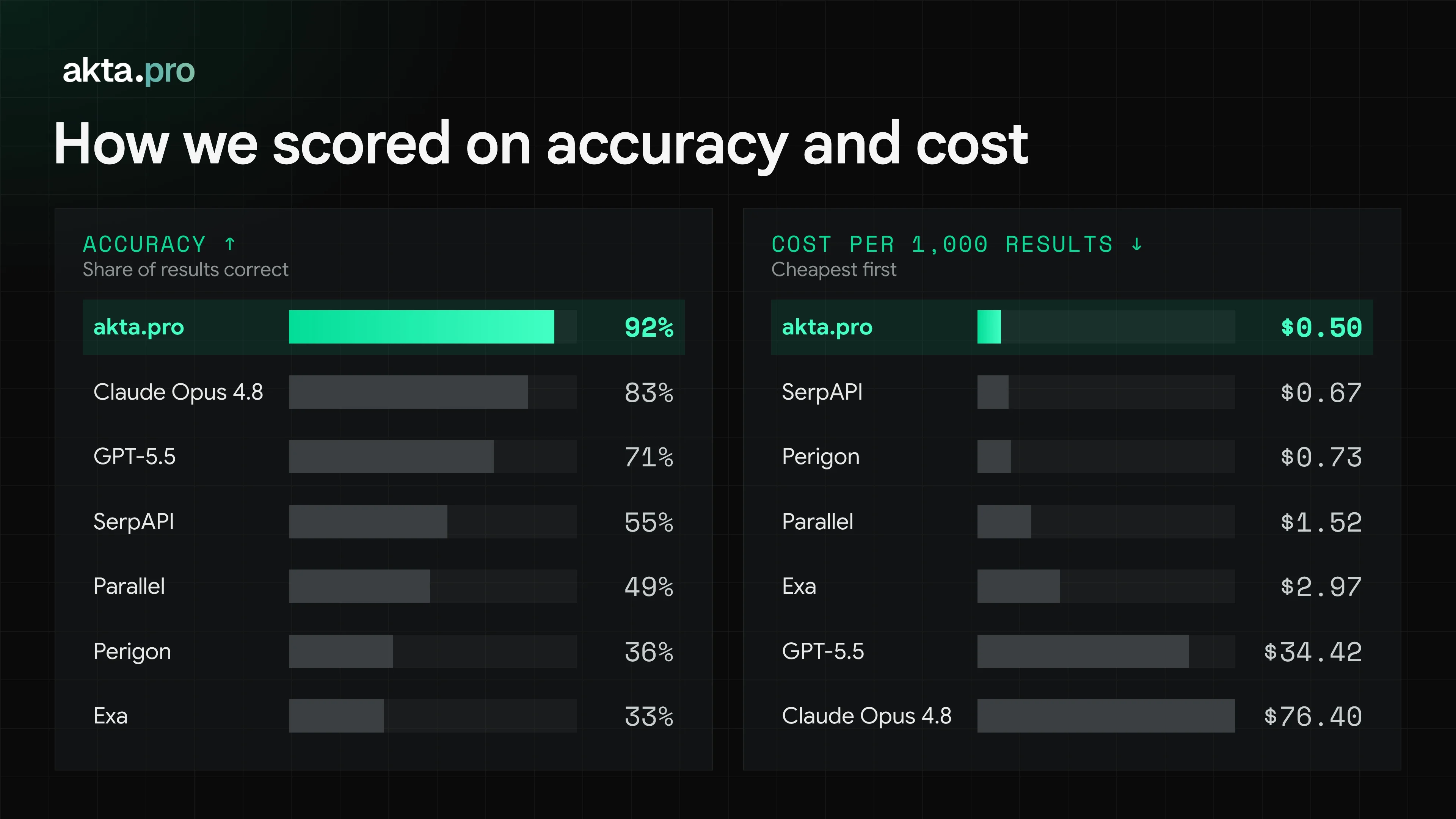
Benchmark results: F1 of 81.3 (highest in the field, 18.8 points clear of second place). Entity resolution accuracy of 93%. Recall of 72.7%. Cost of $0.50 per 1,000 correct articles (lowest tested). Only 8% of returned articles were about the wrong company. And akta.pro surfaced 31 stories that no other provider found, more exclusive coverage than anyone else in the study.
Three query modes cover most intelligence use cases: company news (resolved to a stable entity ID), industry news (across 30,000+ sub-sectors), and custom signals (any topic defined in natural language). The API supports MCP and CLI integration for AI agent workflows, with a median latency of 3.1 seconds.
The private-company coverage is where akta.pro separates from the rest. Most news APIs were designed around public companies and well-known brands. akta.pro's entity resolution is built on a graph of 20M+ companies with patent-pending disambiguation that handles subsidiaries, trading names, and exact-name collisions for private companies that other providers routinely confuse.
Where it is less suited: If your use case is bulk content ingestion for a custom NLP pipeline and you do not need entity-level filtering, a higher-volume, lower-cost-per-raw-article provider like Perigon may be a better starting point.
Pricing: Pay-as-you-go with a free trial (25 credits, no card required).
2. NewsAPI.ai (Event Registry) — Best for multilingual volume and archive depth
NewsAPI.ai (formerly Event Registry) indexes 150,000+ publishers across 60+ languages, with a historical archive stretching back to 2014. It provides entity tagging, topic classification across 5,000+ categories, sentiment scoring, event clustering, and duplicate detection. Clients include Spotify, Bloomberg, IBM, and Accenture.
Benchmark results: F1 of 41.6. Entity accuracy of 32%. Recall of 59.4%. Cost of $0.72 per 1,000 correct articles.
For teams that need massive multilingual breadth and a decade of historical data for backtesting or trend analysis, NewsAPI.ai is a strong choice. The event-clustering feature groups related articles about the same story, which partially addresses the deduplication problem that plagues monitoring pipelines.
The tradeoff: That 32% entity precision means roughly two-thirds of returned articles were about the wrong company when queried by company name. The platform is a strong topic and keyword engine, but company-level monitoring requires downstream disambiguation. Its real strength is breadth and archive depth, not company-resolved accuracy.
Pricing: Contact for quote. Free sandbox available.
3. Perigon — Best for high-recall topic monitoring
Perigon posted the highest raw recall in the benchmark at 73.7%, meaning it surfaced more news stories than any other provider. It returns articles fast (2.1s median latency, the lowest in the study) and at a low list price per article.
Benchmark results: F1 of 48.6. Entity accuracy of 39%. Recall of 73.7%. Cost of $0.73 per 1,000 correct articles.
For use cases where catching every mention matters more than entity precision, such as broad topic tracking, media monitoring, or feeding a downstream NLP pipeline that handles its own filtering, Perigon's recall advantage is real.
The tradeoff: 61% of returned articles for a specific company query were about the wrong entity. Effective cost per correct article ($0.73/1K) runs nearly 50% higher than akta.pro's despite a lower list price, because of that waste. Works best when paired with a downstream entity-resolution layer.
Source: akta.pro company news retrieval benchmark, July 2026. 71,408 articles scored across 133 companies. Full methodology and reproducible harness published at akta.pro/benchmarks/company-news-retrieval.
Pricing: Tiered plans; free trial available.
4. Exa — Best for semantic search in AI agent workflows
Exa uses neural embeddings rather than keyword matching, which means you can write natural-language queries like "biotech funding announcements in Southeast Asia Q1 2026" and get semantically relevant results. It has a dedicated news vertical, native date filtering, and returns highlights alongside full article text.
Benchmark results: F1 of 44.3. Entity accuracy of 34%. Recall of 68.7%. Cost of $2.97 per 1,000 correct articles.
For AI agent builders doing exploratory research where the exact search terms are not known in advance and semantic intent matters more than exact-match precision, Exa is a strong tool. Its neural approach genuinely outperforms keyword APIs on nuanced, open-ended queries.
The tradeoff: 34% entity precision puts it among the lowest for company-specific monitoring, because its neural search optimizes for topical relevance, not entity disambiguation. Coverage skews toward major English-language outlets. Cost at scale ($7/1K searches plus per-result charges) adds up for high-volume monitoring.
Pricing: Free tier (1,000 requests/month). Paid from $99/month.
5. SerpAPI (Google News) — Best budget option for public-company monitoring
SerpAPI scrapes Google News results programmatically, inheriting Google's editorial ranking and freshness signals. It returns structured JSON from Google News SERPs, giving you the same results a user would see in a browser.
Benchmark results: F1 of 52.6. Entity accuracy of 58%. Recall of 50.5%. Cost of $0.67 per 1,000 correct articles.
SerpAPI scored the highest F1 among the traditional news platforms in the benchmark, and the best entity accuracy among non-akta.pro providers. For teams monitoring well-known public companies where entity ambiguity is low, it offers a solid balance of cost and accuracy.
The tradeoff: You are working with SERP data, not a structured news intelligence feed. There is no native event taxonomy, sentiment scoring, or entity resolution beyond what Google's ranking provides. Coverage drops off significantly for private companies and niche markets. At 50.5% recall, it misses about half of the real news events in the test window.
Pricing: Plans from $50/month for 5,000 searches.
Head-to-head: accuracy, recall, and cost compared
| Provider | Entity accuracy | F1 score | Recall | Cost / 1K correct | Median latency | Event taxonomy | Private-company coverage | Best for |
|---|---|---|---|---|---|---|---|---|
| akta.pro | 93% | 81.3 | 72.7% | $0.50 | 3.1s | 80 categories | 20M+ entities | Overall best |
| SerpAPI | 58% | 52.6 | 50.5% | $0.67 | 7.3s | None | Limited | Budget public-company monitoring |
| Perigon | 39% | 48.6 | 73.7% | $0.73 | 2.1s | Limited | Limited | High-recall topic monitoring |
| Exa | 34% | 44.3 | 68.7% | $2.97 | 4.4s | None | Limited | Semantic search, AI agents |
| NewsAPI.ai | 32% | 41.6 | 59.4% | $0.72 | 4.4s | Topics / clustering | Limited | Multilingual volume, archive depth |

Source: akta.pro company news retrieval benchmark, July 2026. 71,408 articles scored across 133 companies. Full methodology and reproducible harness published at akta.pro/benchmarks/company-news-retrieval.
Two patterns jump out of that table. First, list price and source count are poor proxies for value. Perigon and NewsAPI.ai have the cheapest cost per article returned ($0.27 and $0.23 per 1K, respectively), but 60%+ wrong-entity waste pushes their cost per correct article above SerpAPI's. Second, the F1 gap between first and second place (81.3 vs. 52.6) is larger than the gap between second and last (52.6 vs. 41.6). Entity resolution at the retrieval layer is not an incremental improvement, it is a category shift.
Why entity resolution is the metric most buyers ignore (and pay for later)
Entity resolution, correctly matching a news article to the specific company you queried rather than a namesake, subsidiary, or unrelated brand. It is also the problem most news API evaluations skip entirely.
The benchmark made this gap measurable. Across the 133-company test set, the spread in entity precision ran from 93% (akta.pro) to 32% (NewsAPI.ai). In practical terms: for every 1,000 articles returned about a company, between 70 and 680 were about the wrong entity depending on the provider.
For a human analyst scanning headlines, wrong-entity articles are an annoyance. For an AI agent ingesting context, they are a compounding error. The agent pays for every token, cannot glance at a headline to spot the wrong "Bloom," and will act on whatever the API returns. At the pipeline level, wrong-entity articles pollute CRM enrichment, distort competitive signals, and trigger false alerts.
The problem is worst for private companies. Providers built around keyword-match architectures struggle here because private companies share names more often, have fewer unique identifiers on the public web, and appear in fewer sources. This is exactly the population where intelligence matters most and coverage is thinnest.
akta.pro resolves each query against a graph of 20M+ companies, matching across subsidiaries, trading names, and known aliases, before returning a single article. That resolution layer is the reason its waste rate is 8% while the field average runs 40%–70%.
The cost math makes it concrete. Perigon's list price is roughly half of akta.pro's per article returned. But once you adjust for the 61% wrong-company waste, Perigon's effective cost per correct article ($0.73/1K) is 46% higher than akta.pro's ($0.50/1K). And that does not include the downstream cost of processing, storing, and potentially acting on those wrong articles before your pipeline catches them.
Which news API fits your use case?
Deal sourcing and private-company monitoring
You need: entity resolution across private companies, event classification (funding, M&A, expansion, leadership changes), low noise, and the ability to surface stories mainstream APIs miss.
Best fit: akta.pro. The 20M+ entity graph, 80-category event taxonomy, and private-company focus are purpose-built for this. In the benchmark, akta.pro surfaced 31 exclusive stories no other provider found. For deal teams, that coverage gap is often the entire value of the subscription.
Competitive intelligence and GTM signals
You need: structured signals on competitors, customers, and prospects (product launches, partnerships, pricing moves, hiring surges) delivered into your CRM or alerting system.
Best fit: akta.pro for API-first teams building structured monitoring pipelines. The combination of entity accuracy, event taxonomy, and sentiment scoring means the signal is usable the moment it lands. For broader topic-level competitive scanning where you want maximum recall and will filter downstream, Perigon's volume is a reasonable starting layer.
Risk, compliance, and adverse media screening
You need: accurate entity-level detection of adverse events (legal actions, regulatory filings, leadership scandals) without wasting analyst time on wrong-company noise, plus broad source coverage where jurisdiction and language span require it.
Best fit: akta.pro for the core adverse-media and event-classification layer. At 93% entity accuracy and with legal and regulatory actions built into the 80-category taxonomy, it's the only provider in this benchmark that reliably ties an adverse event to the correct company rather than a namesake, which is the failure mode that actually breaks compliance workflows. For teams that also need deep multilingual coverage or a historical archive stretching back over a decade, pair it with NewsAPI.ai's broader source and language reach for jurisdictions outside akta.pro's primary coverage.
AI agent and RAG pipeline integration
You need: clean structured output an LLM can consume directly, low latency, entity-resolved signals, and MCP or CLI integration.
Best fit: akta.pro for company-specific queries (entity-resolved, enriched, 3.1s median latency, MCP-native). Exa for exploratory semantic search where the target is not a specific company but an open-ended research question. For a technical walkthrough of wiring entity-resolved news into an autonomous monitoring agent, see the guide on building an AI company news monitoring agent.

FAQ
What is the best news API for company monitoring?
For company-level monitoring where each article must be correctly attributed to the right entity, akta.pro leads the field. In a published benchmark of 71,408 articles across 133 companies (July 2026), akta.pro scored 93% entity resolution accuracy and an F1 of 81.3, both the highest among 10 providers tested, including news platforms, agentic search APIs, and frontier LLMs with web access.
How do news APIs handle entity resolution?
Most general-purpose news APIs use keyword matching or topic filtering, which means a search for "Mercury" returns articles about the planet, the element, the car brand, and the fintech company. Purpose-built company news APIs resolve each article against a structured entity graph, matching canonical names, subsidiaries, trading names, and aliases to a stable company ID before returning results. The accuracy gap between these approaches is large: 32%–58% for keyword-match providers vs. 93% for entity-resolved providers, based on the same benchmark.
What is the difference between a news API and a news signals API?
A news API returns articles. A news signals API returns articles enriched with structured metadata: entity resolution (which company), event classification (what happened), sentiment and impact scoring (how significant), industry tagging, and AI summaries. The distinction matters because intelligence workflows need structured signal, not raw text. A signals API does the analytical work upstream, so your team does not rebuild that layer in-house.
Can I use a news API for competitive intelligence?
Yes, and it is one of the highest-value use cases. A company news API tracks competitor moves, including product launches, partnerships, funding rounds, leadership changes, and expansion, in real time. The key requirement is entity resolution: your competitive intelligence is only as good as the API's ability to return articles about the right company, not its namesakes.
What does a news API cost in 2026?
Pricing varies widely. Free tiers exist (Exa, NewsAPI.org, GNews) but are generally limited to development and testing. Paid plans range from pay-as-you-go (akta.pro) and $50/month (SerpAPI) to enterprise contracts (NewsAPI.ai). The critical number is cost per correct article, not cost per article returned. In the benchmark, effective cost ranged from $0.50/1K correct articles (akta.pro) to $2.97/1K (Exa), a 6x spread among just the five providers ranked here. Across the full 10-provider benchmark (including LLMs with web access), the spread reached 150x.