Most competitive landscape analyses are logo collages. A grid of competitor names, a column of checkmarks that nobody stress-tested, and a summary slide that tells leadership what they already believed. This blog is about how to build the second kind of analysis, the kind that changes a pricing call, a product roadmap, a go-to-market bet, or a diligence verdict.
What is a competitive landscape analysis? A competitive landscape analysis is a structured process for identifying every relevant competitor, mapping how each player is positioned relative to the others, and locating where the gaps and threats are. It is wider than a single-competitor profile and narrower than a full market study. The output is a dated snapshot, not a permanent truth, that tells you where you can win, where you are exposed, and what a rival is likely to do next.
akta.pro tracks news signals and company data on 20M+ private companies globally. The examples in this guide draw on that data and on a company news retrieval benchmark we ran in July 2026 across 71,408 articles and 133 companies. We will tell you clearly when a claim comes from that benchmark versus from general practice.
What Is a Competitive Landscape Analysis?
A competitive landscape analysis is the map of all relevant players in your market, how they are positioned relative to each other, and where the openings are.
Three properties make a landscape useful. First, it is honest about scope: it counts every entity that competes for the same customer budget, including substitutes and the option of doing nothing. Second, it is grounded in primary evidence, not in what competitors say about themselves. Third, it is dated: a landscape is a snapshot of a moving market, and treating it as a permanent document is one of the most common ways it fails.
The point of the exercise is decisions. If a landscape does not change a call your team is about to make, on pricing, positioning, a hire, a product feature, or a deal, it was a slide, not an analysis.
Gartner published its first-ever Magic Quadrant for Competitive and Market Intelligence Platforms in April 2026, the first formal analyst coverage for the category. Gartner defines the platforms' mandate as helping organizations "systematically gather, analyze and act on actionable insights," with the emphasis on the third verb. Most programs stop at the first.
Competitive Landscape vs. Competitive Analysis vs. Market Analysis
These three terms get used interchangeably. They should not be, because each one hides a different blind spot.
| Term | Scope | Core Question | Blind Spot |
|---|---|---|---|
| Market analysis | Demand-side | How big is this market? Who is buying? | Does not show who else is fishing in the pond |
| Competitor analysis | One or a few rivals | What is Competitor X's strategy, pricing, and weakness? | Misses the substitute eating the category from the side |
| Competitive landscape analysis | All relevant players | Who competes with whom, and where is the open water? | Can miss macro demand drivers (supplement with market analysis) |
A market analysis that shows the market is large and growing tells you the pond is worth fishing, but not that four well-funded boats already crowd the best spot. A competitor analysis that dissects two obvious rivals can miss the adjacent player about to enter or the spreadsheet workflow that solves the same problem for free.
The landscape view forces you to count everyone competing for the same budget. That is the question the other two do not answer.
When You Need a Competitive Landscape Analysis
Four situations make a landscape analysis worth doing properly:
Market entry. Before committing capital to a new segment, you need to know who is already there, how they are winning, and where the entry barriers are. A landscape is the first tool.
Annual or quarterly planning. Strategy built on a landscape that is two years old is strategy built on fiction. High-performing teams treat the refresh as part of the planning cycle, not an optional pre-read.
Product pivot or repositioning. Moving up-market, entering a new use case, or shifting pricing requires knowing which players you are about to collide with and where the exposure is.
M&A, due diligence, and fundraising. This is where the stakes are highest. According to Bain & Company's 2026 M&A Midyear Report, global M&A deal value climbed 41% year-over-year to $2.4 trillion in the first five months of 2026, putting the market on track for its second-highest year on record. Every one of those transactions involves a buyer checking whether the target's competitive position is what the CIM says it is. The landscape section of a CIM is the first thing a commercial due diligence team attacks.
How to Do a Competitive Landscape Analysis: 7 Steps
Step 1 — Define the Market Around the Customer's Problem, Not Your Product
Draw the market boundary around the problem your customer is solving, not around your product category. If you sell project-management software, the competitive field is not only other project-management tools. It is also spreadsheets, email threads, and the choice to do nothing.
The temptation to draw the boundary narrowly is real: a narrow market makes you look dominant. This is also the single most common way a landscape becomes worthless. Narrow definitions are the first thing a sharp investor or buyer attacks, and they produce internal strategy built on false confidence.
Practical test: replace your product with the customer. What alternatives would they evaluate? What would they do if you did not exist? Each answer is a competitor.
Step 2 — List Every Player, Including Substitutes
Cast wide before you group. List direct competitors (same buyer, same problem), indirect competitors (same buyer, different approach), substitutes (a different technology or behavior that solves the same problem), and credible potential entrants, particularly large adjacent players who already own the customer relationship.
A long list you later prune is better than a short list that quietly omits the threat you did not want to acknowledge. Note whether each player is public or private; that determines which evidence sources you can use in Step 4.
Step 3 — Pick the Two Axes That Actually Decide Who Wins
A landscape map is only as useful as the two dimensions you choose. The axes should reflect how buyers in this market actually make decisions: not "good vs. bad" or "cheap vs. expensive," but the specific trade-offs that drive switching and stickiness.
Depending on the industry, the right axes might be: price point vs. breadth of offering, self-serve vs. enterprise sales motion, specialist vs. generalist, speed vs. customization, or geographic depth vs. global coverage.
A bad axis produces a chart where you conveniently sit in the top-right quadrant. Good axes are ones a customer would actually weigh, which means they might put you somewhere uncomfortable. That discomfort is the useful part.
Step 4 — Gather Primary Evidence, Not Competitor Marketing
This is where most analyses quietly fail. Filling a grid from competitors' own homepages gives you their positioning story, not their reality. Primary evidence tells a different story.
Public filings. For any public competitor, SEC EDGAR is the highest-value free source most practitioners ignore. The full-text search covers every electronic filing since 2001. Read Item 1 ("Business") and Item 1A ("Risk Factors") of a rival's 10-K: they are legally required to name their own competitors. A public competitor will hand you its competitive framing, complete with named rivals, under penalty of securities law.
Patents and hiring. Patents on Google Patents reveal what a competitor is building before they announce it. A cluster of recent filings in a new area is a leading indicator of product direction. Hiring patterns, a surge of sales hires in EMEA or a cluster of ML engineers, show where they are investing capital. Treat both as signals, not facts: hiring can be backfill, and patent filings can be defensive.
Pricing archaeology. The Wayback Machine stores historical snapshots of competitor web pages, letting you watch how pricing, packaging, and positioning evolved over time. A move from published pricing to "contact sales" is a significant strategic signal. A quietly dropped product tier tells you something failed.
Customer reviews. G2, Capterra, and Gartner Peer Insights surface recurring complaints and the features buyers actually care about. Read the negative reviews of your closest rivals: they describe the opening you need to fill.
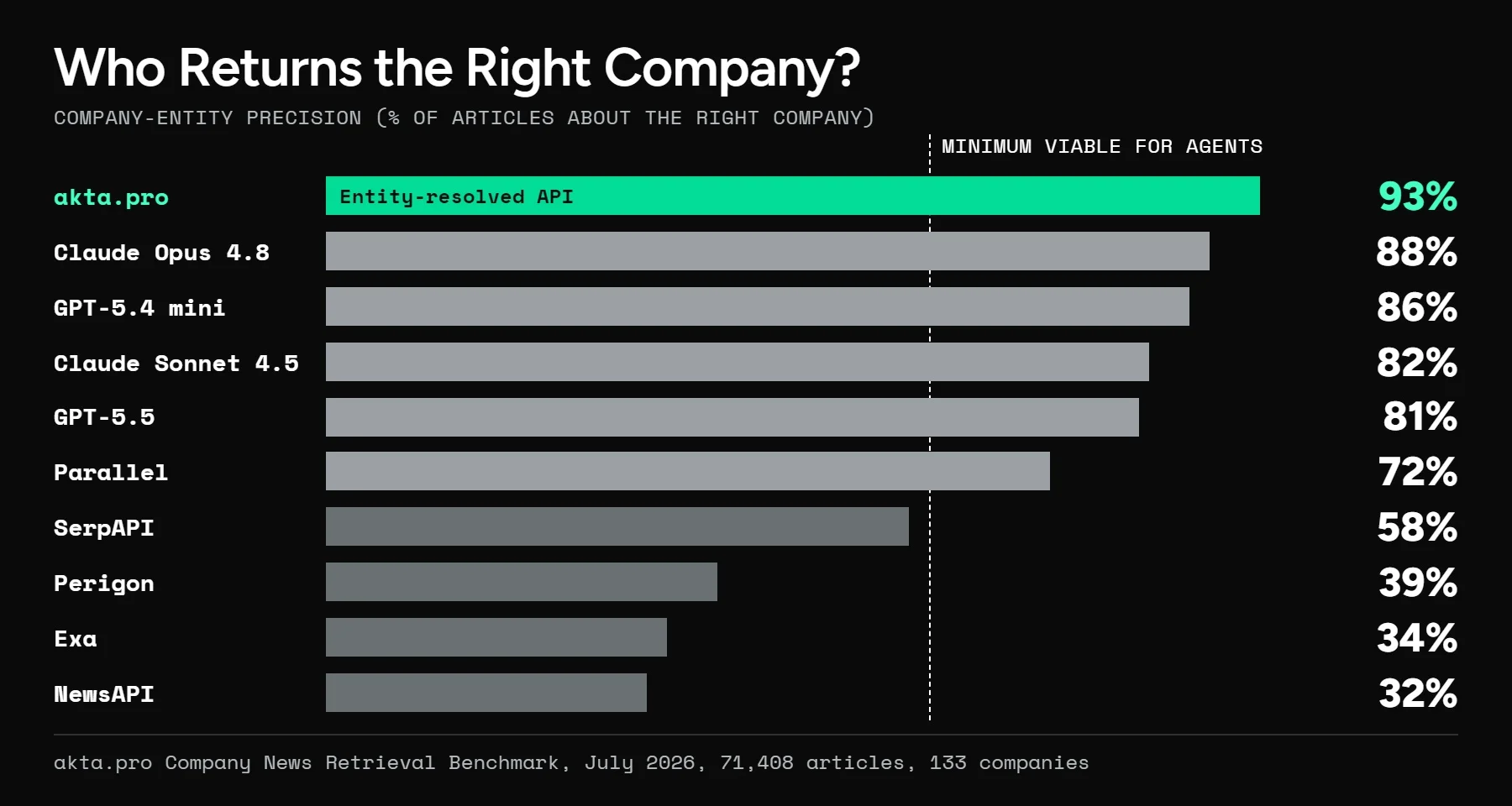
The private company problem. Here is what most guides skip entirely. For the majority of competitive landscapes, a large portion of relevant players are private companies, and mainstream news APIs and standard databases have a serious attribution problem. In akta.pro's company news retrieval benchmark, run across 71,408 articles and 133 companies in July 2026, traditional news platforms correctly attributed private company news only 32–58% of the time. The platforms returned articles at volume, but nearly half were about namesakes, homonyms, and unrelated brands.
For a human analyst skimming headlines, that noise is manageable. For an AI agent or automated monitoring system that acts on what it ingests, a 50%+ wrong-company rate is a material reliability failure. Entity resolution, matching each article to the correct corporate entity across subsidiaries, trading names, and namesakes, is what separates usable private-company signal from noise. The company data API at akta.pro covers 20M+ private companies with 93% entity resolution accuracy, the highest in the benchmark field.
Step 5 — Map Players Into Strategic Groups
Plot every player onto your chosen two axes and look for clusters. Firms that land near each other pursue similar strategies and face the same competitive dynamics. The gaps between clusters reveal positioning opportunities.
This technique, strategic group mapping, traces to Michael Porter's 1980 book Competitive Strategy. Its value is converting a flat list of rivals into a picture of who actually competes with whom. A crowded cluster signals margin pressure. An empty region is a hypothesis: it might represent an unserved need, or a position nobody occupies because customers have already decided they do not want it.
Sanity-check the empty regions before you celebrate them. White space that looks attractive on a 2x2 chart might be empty because a dozen companies tried and failed there. Find out which.
Step 6 — Find and Sanity-Check the White Space
An unoccupied quadrant on your map is a question, not a prize. For each gap, ask: why is this region empty? Three common explanations:
-
Genuinely unserved: a real customer need that no current player meets. These are rare and usually become clear through customer interviews and win-loss data, not from the map itself.
-
Failed territory: others tried and could not build a sustainable model there. Check whether any defunct players occupied this space and what happened to them.
-
Low demand: customers do not want this combination. The axes might look logical to you but not reflect how buyers actually decide.
For each candidate white space, test it against demand evidence, search interest, customer interview themes, win-loss patterns, before committing to it as a strategic opportunity.
Step 7 — Pressure-Test, Date It, and Set a Refresh Cadence
Hand the draft to someone incentivized to disagree: a salesperson who loses deals to these competitors, a customer who evaluated alternatives before choosing you, or a colleague with a different vantage point. Ask them to poke holes before the map becomes a deck.
Then stamp it with a date and a set of key assumptions. A competitive landscape without a date is a liability: whoever reads it next will assume it is current. Set a quarterly default cadence and trigger out-of-cycle updates whenever a merger, a funding round, a pricing change, or a new entrant hits your market.
The streaming market is the clearest recent proof of how fast a landscape changes. At the end of 2025, Netflix announced an agreement to acquire Warner Bros. Discovery at approximately $82.7 billion in enterprise value. Any landscape drawn in January 2026 would have shown Netflix absorbing HBO Max. By early 2026, Warner Bros. Discovery had moved to merge with Paramount Skydance instead, and Netflix withdrew. A map drawn in January was materially wrong by March, about one of the biggest structural questions in the entire industry.
5 Competitive Analysis Frameworks and Where Each One Misleads
Frameworks organize what you found in Step 4. They do not generate conclusions you did not earn. Use two or three that fit your question and stay alert to what each one cannot see.
| Framework | Best for | The blind spot |
|---|---|---|
| Porter's Five Forces | Assessing structural industry profitability | Static snapshot; tells you about the industry, not about individual rivals |
| Strategic Group Maps | Showing who actually competes with whom | Axes determine everything; lazy axes produce a flattering but false picture |
| Perceptual Mapping | Revealing white space and customer perception | Implies precision the data may not support; flattens complex markets |
| BCG Growth-Share Matrix | Portfolio decisions across a diversified competitor | Assumes share drives profitability, which is not always true |
| SWOT | Prompting structured thinking across internal and external factors | Invites unranked, unfalsifiable lists; confirms what the team already believed |
Porter's Five Forces was introduced by Michael Porter in his 1979 HBR article and updated in 2008. It analyzes industry attractiveness through five forces: threat of new entrants, bargaining power of buyers, bargaining power of suppliers, threat of substitutes, and rivalry among existing competitors. It tells you why the industry earns what it earns, not how to position within it. Use it to understand industry economics, then use a landscape map for the head-to-head.
Strategic group maps are the most directly useful tool for a landscape: they show which clusters of competitors actually face each other and which corners of the market are protected or crowded. The technique originates in Porter's 1980 book Competitive Strategy. A good strategic group map turns "here are all my competitors" into "here is who I actually compete with and why."
Perceptual maps place competitors on two axes that buyers care about, price versus breadth, or simplicity versus customization, to reveal clusters and open positions. Useful for board slides and positioning discussions. The risk is treating an empty quadrant as a proven opportunity before you have tested demand.
BCG growth-share matrix, developed by Boston Consulting Group founder Bruce Henderson around 1970, sorts products or business units into Stars, Cash Cows, Question Marks, and Dogs by growth rate and market share. It is built for portfolio decisions and works better for analyzing a diversified competitor than a single-product one.
SWOT is everywhere and loose. Its value is as a prompt to think about internal and external factors together. Force every SWOT entry to be backed by primary evidence from Step 4. An unsourced strength is an assumption masquerading as a fact.
The Private Company Problem Nobody Talks About
Most competitive landscape guides illustrate their frameworks with examples from public companies: Coca-Cola vs. PepsiCo, DoorDash vs. Uber Eats, Netflix vs. Disney+. The examples are tractable because public companies file disclosures, hold earnings calls, and have years of analyst coverage.
Your actual competitive landscape almost certainly includes private companies, and that is where the analysis breaks down.
Mainstream data sources and news APIs were built for public-company and consumer-brand monitoring. They match keywords and topics. When you query a private company with an ambiguous name, a company called "Aura," "Bloom," or "Crayon," you get articles about every entity that shares that name. In the akta.pro benchmark, the news platforms returned the right company's articles only 32–58% of the time. That means you are building a competitive picture with up to two-thirds noise.
The fix is entity resolution: a system that matches each result to the correct corporate entity across subsidiaries, trading names, and namesakes, using firmographic identity rather than string matching. Without it, your private-company competitive intelligence is unreliable at the foundation.
For teams tracking competitors at scale, portfolio monitoring, deal sourcing, automated GTM triggers, a purpose-built news signals API with entity resolution built in is the difference between a monitoring system that works and one that generates constant false positives.
The Half-Life Problem: Why Your Landscape Has an Expiry Date
A competitive landscape analysis is not a document. It is a snapshot of a market that is already moving the moment you finish it.
The streaming example above is dramatic but not unusual. Any of these events forces an immediate re-draw: a merger or acquisition, a major funding round, a new entrant from an adjacent category, a significant pricing change, a key executive departure, a product launch that redefines a category boundary.
Hunter Sones, Competitive Enablement Manager at Klue, described the ongoing nature of the work plainly: "To gain foresight in your own market, companies must conduct an ongoing competitive landscape analysis... your competitive landscape analysis should be a living report that gets dynamically updated and analyzed at a scheduled cadence."
A practical refresh policy:
| Trigger | Action |
|---|---|
| Merger or acquisition in your market | Re-draw immediately |
| Competitor funding round (Series B+) | Update that competitor's profile; check for axis changes |
| New entrant with real funding or traction | Add to the map; test whether it changes the axis choice |
| Competitor pricing change | Update; check whether it shifts their strategic group |
| Scheduled quarterly review | Refresh all competitor profiles; check for new entrants |
Treat the quarterly refresh as a standing meeting, not a one-off project. What makes it fast is having a live monitoring system: tracking competitor news via a company news API so that updates hit your team as they happen, not six months later during the annual planning cycle. For competitive intelligence analysis at that cadence, the data layer has to be reliable before the analytical layer can be.
Common Mistakes That Make a Competitive Landscape Analysis Worthless
Defining the market to flatter you. Drawing the boundary narrowly enough that you appear dominant is the most common failure mode and the most dangerous. A buyer or investor will immediately redraw the boundary and ask why you excluded the segments that compete for your budget.
Logo-collecting without evidence. A grid of competitor logos with checkmarks sourced from their own marketing is theater, not analysis. Every cell in a comparison table should trace to primary evidence: a filing, a customer review, a patent, a pricing snapshot, a call transcript. If you cannot source a claim, mark it unknown.
Treating the deliverable as permanent. A landscape that does not carry a date and a refresh plan is already becoming wrong. See the half-life section above.
Ignoring substitutes and non-consumption. The competitor you will not name because they are "a different category" is often the one actually taking your budget. The customer who does nothing, who defers the purchase, builds internally, or keeps the spreadsheet, is a competitor. They need to appear on the map.
Confirmation bias in win-loss. Win-loss data is the highest-value input to a landscape and the easiest to poison. Teams remember the losses that fit their narrative and explain away the ones that contradict it. Collect win-loss systematically, include the deals your sales team would rather not discuss, and let someone who disagrees with the conclusion review the raw data. An analysis that only confirms what leadership already believed did not need to be done.
Competitive Landscape Analysis in M&A and Due Diligence
In a deal context, competitive landscape analysis is not a strategic nicety. It is the backbone of commercial due diligence: the mechanism by which a buyer validates whether the target's claimed competitive position is real before wiring the money.
Bain's due diligence practice describes the mandate as validating "the market and profit pool outlook, competitive positioning, and customer advocacy." Read that list and you will recognize the landscape analysis workflow applied under a deadline and a term sheet.
With global M&A on track for its second-highest year on record, Bain's midyear report shows deal value up 41% year-over-year through May 2026, the volume of competitive validation work has never been higher. As Suzanne Kumar, EVP of Bain's Global M&A practice, stated in the report: "Companies are pursuing bold deals to secure the scale and capability they need for a fast-changing world." Every one of those deals requires someone to check whether the target actually holds the position it claims.
For a deeper walkthrough of how the landscape analysis integrates into the full commercial diligence process, see the guide to commercial due diligence for PE firms.
On the sell side, the landscape section of a CIM is both your best tool and your biggest exposure. A well-built landscape shows honest market definition, credible competitor placement, and a clear view of where the target wins and why. A flattering but thin landscape is the first thing the buy-side team attacks, and when it fails under scrutiny, it damages the credibility of everything else in the document.
For teams running automated competitive intelligence analysis in deal workflows, the data layer matters as much as the analytical framework. An agent monitoring 50 companies needs to retrieve the right company's news, not a namesake's. That is what entity resolution at the data layer solves, before the analysis even begins. You can research a company with the same infrastructure that powers a full landscape.
FAQ
What is a competitive landscape analysis?
A competitive landscape analysis is a structured process for identifying every relevant player in your market, mapping how each is positioned relative to the others, and finding where the gaps and threats are. It includes direct competitors, indirect competitors, substitutes, and potential entrants. The output is a dated snapshot, not a permanent document, that should directly inform a specific business decision: pricing, positioning, product investment, or a deal.
How is a competitive landscape analysis different from a competitive analysis?
A competitive analysis is a deep profile of one or a few specific rivals. A competitive landscape analysis maps all the relevant players in a market and how they relate to each other. The landscape gives you the full field; the competitor analysis gives you depth on individual opponents. Use both: the landscape to understand structure and positioning, the competitor analysis to prepare for head-to-head situations.
What frameworks are used in competitive landscape analysis?
The most useful are Porter's Five Forces (for assessing structural industry profitability), strategic group maps (for clustering rivals by strategy and showing who actually competes with whom), and simple two-axis perceptual maps (for revealing white space and positioning gaps). The BCG growth-share matrix helps when analyzing a diversified competitor's portfolio. SWOT is widely used but requires discipline to prevent it from becoming a list of unverifiable assumptions. No single framework is sufficient. Use two or three and know where each one misleads.
How do you research private company competitors?
Private companies do not file public financials, but they leave traces in public data. Read the SEC filings of their public customers, suppliers, and rivals, who often name private competitors in Risk Factors and Competition sections. Search patents on Google Patents and USPTO to see what they are building. Watch their hiring for where they are investing. Use the Wayback Machine to track how their pricing and positioning has changed. And use a company data source with real entity resolution. Mainstream news APIs attribute private company news correctly only 32–58% of the time, as measured in akta.pro's July 2026 benchmark across 71,408 articles and 133 companies.
How often should you update a competitive landscape analysis?
Quarterly as a standing cadence, plus immediately after any major event: a merger, an acquisition, a significant funding round, a new entrant, or a material pricing change. Never treat the analysis as a one-time deliverable. The Netflix example shows how fast a landscape can be wrong: an acquisition announced in December 2025 was off the table by March 2026. Stamp every version with a date and a set of key assumptions, so whoever reads it next knows what it was built on.