Your competitors made 11 strategic moves last quarter. You caught two of them. That gap is not a bandwidth problem; it is a tool selection problem.
Competitor monitoring tools are software platforms that automatically track rivals' business activity across digital channels, news sources, and company events, then surface those signals as alerts, dashboards, or structured data. The right stack covers SEO, pricing, brand mentions, website changes, sales intelligence, and company-level news. No single tool covers all eight dimensions, which is why most effective competitive intelligence setups run two or three specialized tools rather than one all-in-one dashboard.
We evaluated 30+ tools across every monitoring category, cross-checked pricing against 2026 buyer reports, and built this list around the question practitioners actually need answered: which tool wins for my specific job, and what does it actually cost to get started?
One finding stood out. Every major competitor monitoring list covers social listening, SEO, and website tracking. None of them cover company news signals for private company competitors, the category where most of your actual rivals live. That gap shapes this list.
Competitor Monitoring Is 8 Jobs, Not One
Most teams buy the wrong tool because they treat "competitor monitoring" as a single category. It is not. It is a set of distinct monitoring jobs, each requiring different data sources and different output formats.
What counts as a competitor monitoring tool?
A competitor monitoring tool is any software that automatically collects, filters, and surfaces information about rival companies to inform strategic decisions. The defining feature is automation: it runs continuously and alerts you when something material changes, rather than requiring a manual research sprint every quarter.
The confusion is that this definition spans radically different products. A tool that watches your competitor's pricing page and a tool that tracks their SEC filings are both "competitor monitoring tools" in the same way that a screwdriver and a drill are both "tools." Calling them interchangeable is what gets teams into trouble.
The 8 competitor monitoring jobs
| Job | What you're tracking | Signal type |
|---|---|---|
| Company news intelligence | Funding rounds, acquisitions, leadership changes, strategic events | Structured news events |
| SEO & search intelligence | Keyword rankings, backlinks, content performance | Search data |
| Traffic & market share | Competitor website visitors, channel mix | Estimated traffic |
| Website & pricing changes | Any page edits, pricing updates | Change detection |
| Social & brand mentions | What people say about rivals on social media | Unstructured text |
| Sales CI & battlecards | Win/loss patterns, sales-facing competitive intel | Curated intelligence |
| Ad intelligence | PPC keywords, display creatives, ad spend | Ad data |
| Financial research | Earnings calls, filings, analyst reports | Financial documents |
The eighth job on that table is the one every other list omits. Most of your actual competitors are private companies: they do not publish earnings calls, have no public stock price to track, and rarely appear in the SEO datasets that most CI tools rely on. Tracking them requires a completely different infrastructure.
How We Evaluated These Tools
Every tool on this list passed the same five checks, applied as of November 2026.
Job fit. We asked which of the 8 monitoring jobs a tool actually does well, as opposed to tolerably or as an afterthought. A tool mediocre at four jobs lost to a tool excellent at one.
Pricing transparency. We cite verified prices from vendor sites, 2026 buyer reports from Vendr and G2, and published third-party data. Where vendors do not publish pricing, we use buyer-reported ranges and note the source.
Signal quality vs. noise. A monitoring feed you learn to ignore is worse than no monitoring. We assessed how well each tool filters irrelevant signals before they reach you.
API and workflow access. Competitive intelligence that sits in a proprietary dashboard does not get acted on. We evaluated whether each tool can pipe data into Slack, your CRM, your data warehouse, or an AI agent.
Honest value. We assessed whether a tool earns its cost for the job it does, including whether the free alternative (Google Alerts, the Meta Ad Library, Ahrefs Webmaster Tools) is good enough to skip the paid tier.
At a Glance: 10 Competitor Monitoring Tools Compared
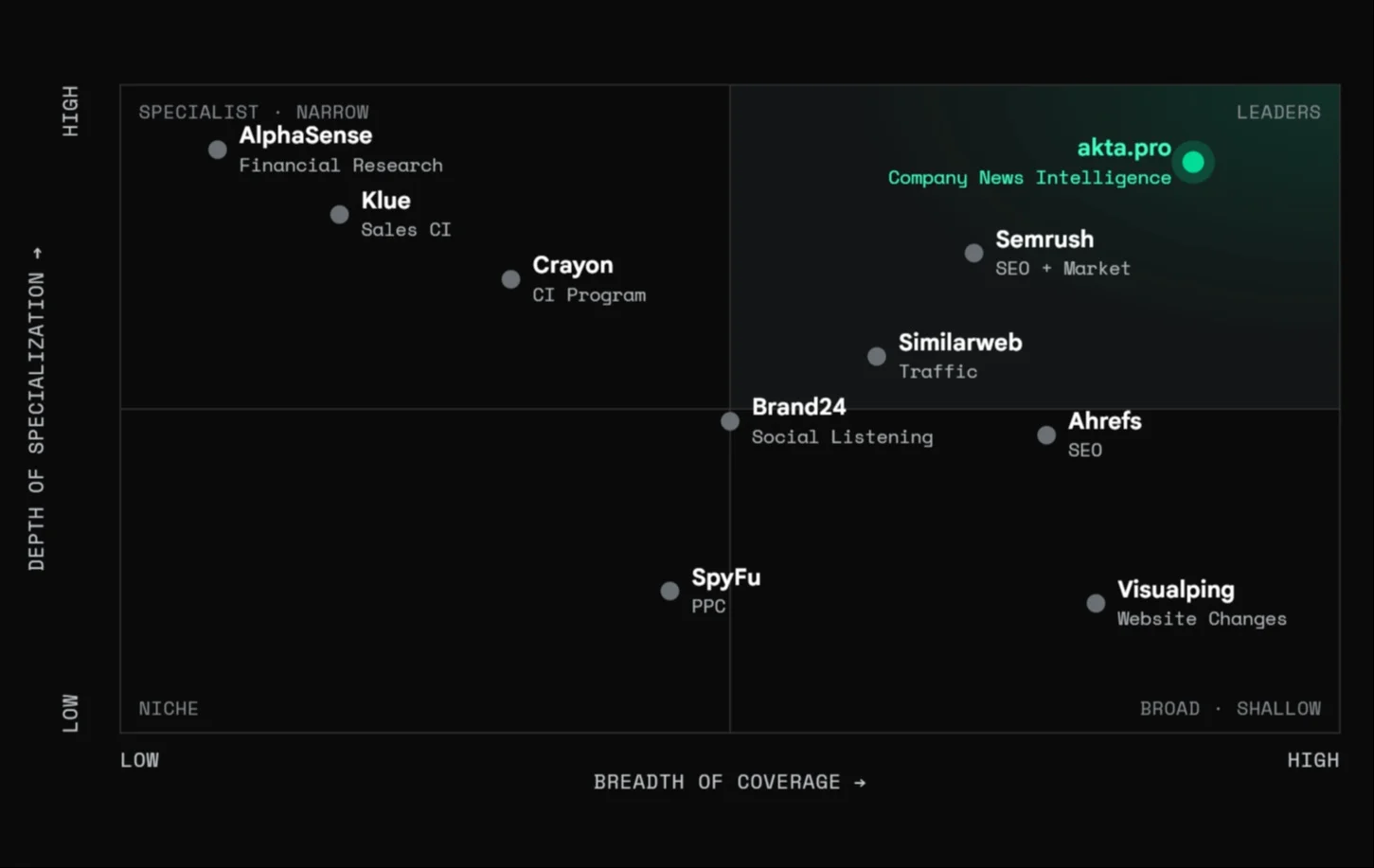
| Tool | Best for | Starting price | API access | Free option |
|---|---|---|---|---|
| akta.pro | Private company news signals | Pay-as-you-go (~$0.50/1K articles) | Yes, all plans | No |
| Semrush | All-in-one search & market intel | From $117/mo (annual) | Advanced tier+ | 7-day trial |
| Similarweb | Traffic & market share benchmarking | From $125/mo | Business tier | Free tier |
| Klue | Sales battlecards & win/loss | $20K–$40K/yr (custom) | Yes | Demo only |
| Crayon | Formal CI programs | $12.5K–$47K/yr (custom) | Yes | Demo only |
| Visualping | Website & pricing page monitoring | Free + from $10/mo | Business plans | Free plan |
| Brand24 | Brand mentions & social listening | From $149/mo | Yes | 14-day trial |
| Ahrefs | SEO & content gap analysis | From $29/mo (Starter) | Higher tiers | Webmaster Tools |
| SpyFu | PPC intelligence on a budget | From $29/mo (annual) | Yes | Limited free lookups |
| AlphaSense | Deep financial research | Custom enterprise | Yes | 2-week trial |
Prices verified from vendor pages, Vendr buyer reports, and G2 data, November 2026.
1. akta.pro — Best for Company News Signals and Private Company Intelligence
akta.pro fills the competitor monitoring job that every other tool on this list ignores: tracking what private companies are actually doing, not just their digital marketing footprint.
akta.pro, built by Wokelo AI, is a private company data and news signals API covering 20M+ global companies with 70+ data points each. For competitive monitoring, its core capability is real-time, entity-resolved company news. When a competitor closes a funding round, makes an executive hire, launches a partnership, faces a regulatory action, or gets covered in trade press, akta.pro captures and classifies that event, strips out noise, and delivers it in a structured format your tools can consume.
The noise problem is where most monitoring setups fall apart. Generic news APIs return everything that mentions a company name, including false positives, duplicate articles, and tangentially related content. akta.pro's patent-pending entity resolution maps every mention back to the correct company across name variations and subsidiary structures, then filters roughly 80% of irrelevant content before it reaches you.
In akta.pro's company news retrieval benchmark across 71,408 articles and 133 companies, the platform achieved an F1 score of 81.3, 93% accuracy, and 72.7% coverage, ranking ahead of GPT-5.5, SerpAPI, Perigon, Claude, Parallel, NewsAPI, and Exa on the same evaluation set. As Sid, co-founder at akta.pro, put it on Product Hunt: "our recent benchmarks show 93%+ entity-mapping accuracy, ahead of frontier reasoning models on the same task."
What it tracks: Funding rounds, acquisitions, leadership changes, product launches, partnerships, regulatory events, layoffs, and 100+ other classified event types. Also covers company firmographics (revenue estimates, headcount, industry codes, business model, funding history) across 20M+ private companies.
Who it's for: Product and strategy teams monitoring private company competitors. PE and VC firms tracking portfolio companies and deal targets. Sales and GTM teams that want company events as buying signals. Developers and AI builders who need structured company data inside agents or workflows.
API and integrations: akta.pro is API-first by design, with MCP server and CLI access alongside the REST API. Data flows directly into AI agents, data warehouses, Slack workflows, or any system that can hit an endpoint. It is explicitly built for the agent economy, not for browsing a dashboard.
Pricing: Pay-as-you-go. News API calls run approximately $0.01 per request plus $0.01 per article returned, working out to roughly $0.50 per 1,000 accurate articles at benchmark performance levels. Company enrichment runs separately per call. No monthly minimums, no annual contract requirement. Full pricing at akta.pro/pricing.
Pros: Only tool covering private company news at this scale and accuracy. API-first architecture. Entity resolution included, not sold as an add-on. Benchmarked and transparent about methodology. SOC2 Type II, ISO 27001 compliant. No model training on customer data.
Cons: No pre-built monitoring dashboard for non-technical users. Requires some API familiarity to get full value. Does not cover social listening, SEO, or website change monitoring.
Website: akta.pro
2. Semrush — Best for All-in-One Search and Market Intelligence
If you need one tool that covers your competitor's organic rankings, PPC strategy, content performance, backlink profile, and market traffic in a single subscription, Semrush is the benchmark.
Type a competitor's domain into Semrush and you get their top organic keywords, estimated traffic by channel, ad copy history, and backlink growth. The Keyword Gap and Backlink Gap tools answer the highest-value SEO competitor question directly: what do they rank for that we do not? That alone justifies the subscription for most marketing teams.
In 2026, Semrush added meaningful AI visibility tracking, monitoring how often a competitor's content appears in ChatGPT, Perplexity, and Gemini responses. This is becoming its own competitive battleground, and Semrush is one of the few tools treating it as a first-class metric alongside organic search.
Pricing: From $117/mo (annual) for the core SEO plan. The AI Visibility Toolkit is an add-on from $99/mo per domain, or included in the Semrush One bundle from $199/mo. API access requires the Advanced tier. Full pricing at semrush.com/prices.
Best suited for: Marketing teams that want defensible, citation-ready data on SEO, content, and paid search in one place. Not the deepest on any single dimension (Ahrefs beats it on backlinks; SpyFu beats it on PPC history), but covers the full surface area.
3. Similarweb — Best for Traffic Benchmarking and Market Share
Similarweb is the closest thing available to seeing a competitor's analytics. It models any website's total traffic, channel mix, audience demographics, and geographic spread from behavioral data signals across billions of daily data points.
The practical value is benchmarking. When a competitor claims rapid growth or a sales team asks "how big are they really?", Similarweb provides a directionally reliable answer. Its traffic source breakdown reveals channel strategy: a company suddenly getting 40% of its traffic from paid search is running an aggressive acquisition push, which is competitive intelligence worth having before it shows up in win/loss data.
One important caveat: Similarweb's data is modeled, not measured. For companies doing substantial volume (above roughly 50K monthly visits), the trends are reliable. For early-stage private competitors with thin public traffic, the numbers fall below the modeling threshold and should be treated as approximate.
Pricing: Free tier for basic checks. Self-serve from $125/mo. Business and enterprise tiers with API access are custom-priced. Full pricing at similarweb.com/corp/pricing/.
4. Klue — Best for Sales Battlecards and Win/Loss Programs
Sales teams keep losing to the same two competitors because product marketing is working from a deck that is six months old. Klue is built to fix that specific problem.
Klue aggregates competitor signals from news, website changes, review sites, and your own win/loss data, then routes curated intelligence directly into the tools your reps actually use during deals. Battlecards appear inside Salesforce or HubSpot, not in a separate tab reps never open. Its win/loss integration captures call recordings and interview data to tell you not just who you lost to but why.
Analyst firm Gartner recognized Klue as a Leader in its inaugural 2026 Competitive and Market Intelligence Magic Quadrant (April 2026, per industry reports), the category's clearest signal of its maturity for enterprise buyers.
There is an honest caveat practitioners state bluntly. As competitive intelligence strategist @polsia wrote on X: "Intel PMM teams license Contify, Klue, Crayon and still launch on stale intel." These platforms work when someone owns them. Without a dedicated product marketer whose job title includes competitive intelligence, any of these tools becomes an expensive RSS feed within a quarter.
Pricing: No published pricing. Buyer reports from 2026 put typical contracts at $20K–$40K/yr, with a median around $28,750 (Prospeo/Vendr buyer data, 2026). Onboarding runs an additional $2K–$10K. Annual contract required; demo only, no self-serve trial. Full information at klue.com.
Best suited for: B2B sales organizations with 50+ competitive deals per quarter and a dedicated competitive intelligence function. Wrong fit without a PMM owner or with a sub-$15K annual budget.
5. Crayon — Best for Running a Formal CI Program
Crayon and Klue are the two names that come up in every enterprise CI evaluation. Where Klue is sales-first (battlecards reaching reps during deals), Crayon is CI-first with sales enablement attached.
Crayon tracks 100+ signal types across competitor websites, pricing pages, job postings, review sites, and news, with AI-generated digest summaries on top. It is the right choice when the competitive intelligence function spans more than just the sales team: when product, marketing, and leadership all need a shared source of competitor truth.
Pricing follows the same enterprise model as Klue: no public pricing, demo required, annual contracts. Third-party 2026 buyer data puts typical contracts at $12.5K–$47K/yr, with mid-market deployments often in the $25K–$40K range (Prospeo, 2026). Full information at crayon.co.
Best suited for: Companies running a structured CI program where multiple teams consume competitive intelligence regularly, and where someone has capacity to manage the platform.
6. Visualping — Best for Website and Pricing Page Monitoring
The cheapest high-signal monitoring you can set up is watching your competitor's pricing page and getting notified the moment it changes. Visualping does this in two minutes of setup.
Paste a URL, choose a monitoring frequency, and Visualping emails or Slacks you when the page changes, with an AI-generated summary of exactly what moved. Pricing page, feature comparison table, job listings, homepage messaging: any URL you care about gets a continuous watch.
The career page angle is underused. When a competitor posts five senior engineering roles and three enterprise account executives in the same week, that is a product-and-market strategy signal, not just a hiring update.
The free plan covers 150 checks per month, enough to monitor five or six competitor pages daily. Business features (API, team workflows, Slack integrations) require a jump to roughly $100/mo. G2 rates it 4.6/5 across 400+ reviews, making it the most consistently well-reviewed tool on this list relative to its price point.
Pricing: Free plan available. Personal plans from $10/mo. Business from approximately $100/mo. Full pricing at visualping.io.
7. Brand24 — Best for Brand Mentions and Social Listening
If you need to know what people are saying about your competitors across social media, forums, news sites, podcasts, and review platforms, Brand24 is the category leader for most teams not running a Fortune 500 budget.
Brand24 monitors 25M+ sources in real time and delivers mentions, sentiment scores, share-of-voice comparisons, and AI-generated summaries of competitor activity. Its Comparison feature lets you benchmark your brand directly against competitors across presence score, sentiment, and reach, the kind of output that makes competitive reporting to leadership straightforward.
Its AI mentions tracking, which captures how competitors appear in AI-generated content, is a newer but increasingly important signal as buyers use AI assistants for discovery and comparison research.
Pricing: From $149/mo. 14-day free trial available. G2: 4.6/5 across 400+ reviews. Full pricing at brand24.com/prices/.
Best suited for: Marketing teams and brand strategists who need continuous social and media monitoring across multiple competitors without an enterprise budget.
8. Ahrefs — Best for SEO and Content Gap Analysis
For the specific question "what does my competitor rank for that we do not, and what links are they getting that we are not," Ahrefs is the reference tool. It runs the second-most active crawler on the web, and that shows in the depth and freshness of its backlink index.
Site Explorer on a competitor's domain surfaces their top-performing content by organic traffic, keyword positions by page, and backlink growth over time. Content Gap and Backlink Gap do the analytical work: they compare your domain against up to ten competitors and surface the keywords or link sources where rivals are winning and you are absent.
The $29/mo Starter plan is one of the cheapest genuine entries into competitor SEO data, covering limited Site Explorer queries and basic keyword research. For teams that compete seriously on organic search, the Lite plan at $129/mo unlocks the full competitive analysis workflow.
Pricing: Starter $29/mo, Lite $129/mo, Standard $229/mo (annual saves ~17%). API on higher tiers. Free via Ahrefs Webmaster Tools for your own site. Full pricing at ahrefs.com/pricing.
9. SpyFu — Best for PPC Intelligence on a Budget
SpyFu specializes in paid search history. Type in a competitor's domain and you see the Google Ads keywords they have targeted, the ad copy they have tested, and estimates of their spend over time, reaching back years. That historical dimension is what makes it genuinely useful: seeing what a competitor tried and abandoned in paid search is often more valuable than seeing what they are currently running.
At $29/mo (annual) with unlimited searches, it is the cheapest entry into meaningful PPC competitive data. The SEO features are included but thinner than Ahrefs; most teams that care seriously about organic search use SpyFu for ads and pair it with Ahrefs for content.
Spend estimates are directional, not audited figures. Use them to understand strategy and channel priority, not to reconcile a competitor's actual media buy.
Pricing: From $29/mo (annual). Professional $39/mo (annual). API included. Full pricing at spyfu.com/account/pricing.
10. AlphaSense — Best for Deep Financial Research on Competitors
When the competitive question is "what is this company telling investors about their roadmap?", no tool on this list comes close to AlphaSense. Its core asset is a searchable library of 500M+ financial documents: SEC filings, earnings call transcripts, broker research reports, patent filings, and expert call transcripts with former employees and partners of the companies you are tracking.
AlphaSense's AI agents can surface what a competitor's CEO said about pricing strategy across six quarters of earnings calls, then generate a cited analysis from that content. For corporate strategy, M&A due diligence, and investment research, that depth matters.
The constraint is scope: AlphaSense is built for public and late-stage private companies with significant public disclosure footprints. For tracking early-stage private competitors with thin public records, it has little to work with.
Pricing: Custom enterprise pricing. 2-week free trial. Full information at alpha-sense.com.
Which Competitor Monitoring Tools Should You Actually Use?
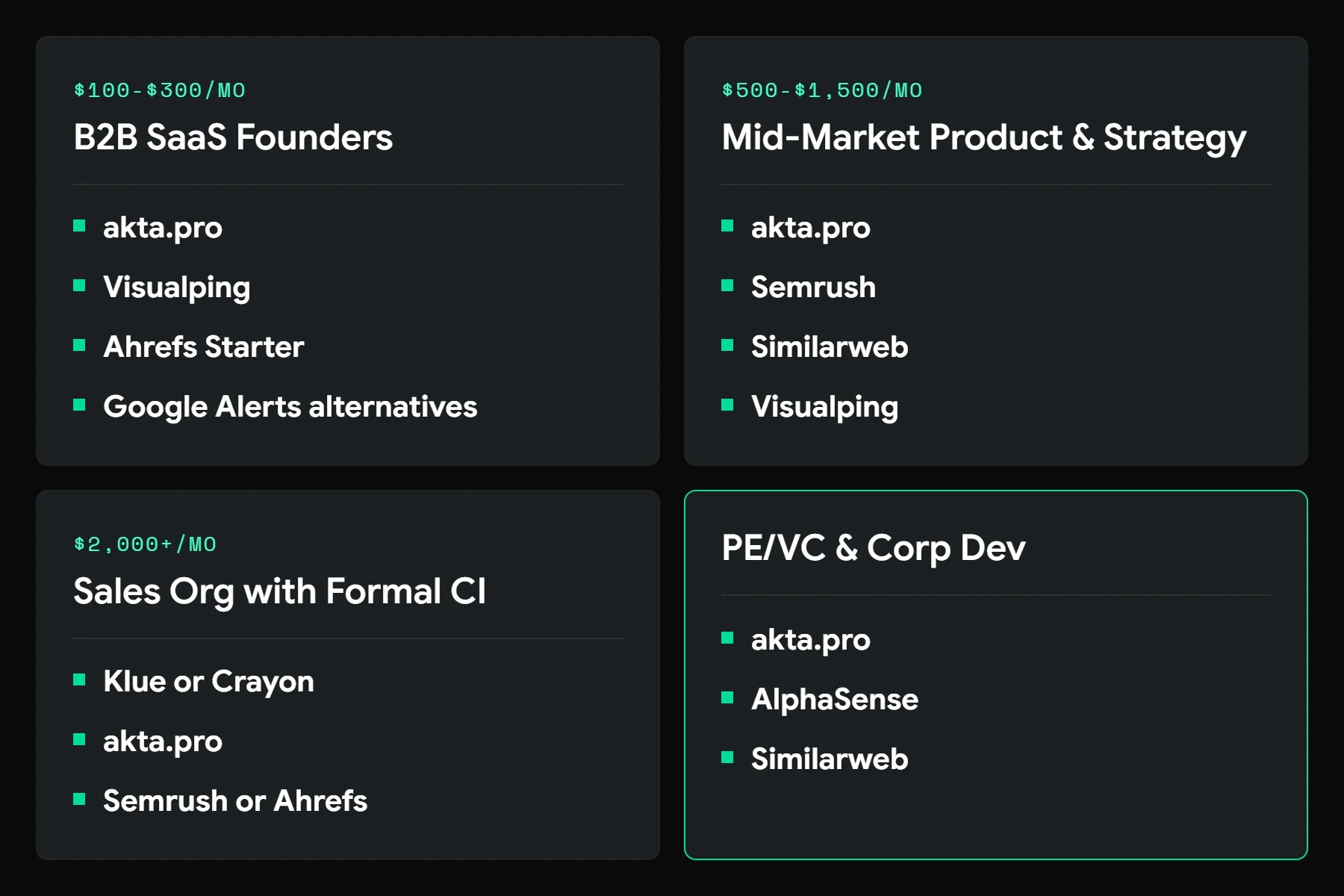
The right answer is never one tool. It is the minimum combination that covers the jobs that actually change your decisions.
For B2B SaaS founders and small GTM teams ($100–$300/mo)
- akta.pro for private company news signals (pay-as-you-go, start small)
- Visualping for pricing and website change alerts (free or $10/mo)
- Ahrefs Starter for SEO gaps ($29/mo)
- Google Alerts alternatives for brand mentions
This stack covers company events, website moves, organic search, and brand sentiment. For most early-stage teams, it is everything needed to avoid being surprised by a competitor's next move.
For product and strategy teams at mid-market companies ($500–$1,500/mo)
- akta.pro for company news intelligence across your competitive universe
- Semrush for SEO and market intelligence ($117/mo+)
- Similarweb for traffic benchmarking ($125/mo)
- Visualping for continuous website monitoring
For sales organizations with a formal CI program ($2,000+/mo)
- Klue or Crayon for battlecards and win/loss integration ($20K–$40K/yr)
- akta.pro for company news signals feeding the CI platform
- Semrush or Ahrefs for SEO intelligence
For PE/VC and corporate development teams
- akta.pro for portfolio company and deal target news signals across private markets (see how PE firms use news monitoring for portfolio companies)
- AlphaSense for financial document research on later-stage targets
- Similarweb for traffic signals on digital-first targets
One principle cuts across all of these: data that cannot leave the tool is not competitive intelligence; it is a subscription you check twice a month. When evaluating any platform, the first question should be whether the data it surfaces can flow into your existing systems via API, webhook, or export. If the answer is "dashboard only," budget accordingly.
For more on how to build an effective competitive intelligence analysis process around these signals, see our framework guide.
Frequently Asked Questions
What is a competitor monitoring tool?
A competitor monitoring tool is software that automatically collects and surfaces intelligence about rival companies from digital sources including news, search rankings, social media, website changes, and company data. The core value is automation: rather than manual research, the tool runs continuously and alerts you when something material changes. Most teams need 2–3 tools covering different monitoring jobs rather than a single all-in-one platform.
What is the difference between competitor monitoring and competitive intelligence?
Competitor monitoring is the automated collection of rival data: mentions, traffic estimates, website changes, news events, and pricing. Competitive intelligence is the analysis and interpretation of that data to inform strategy. Monitoring tools are the data collection layer. The gap between the two is where most CI programs fail: licenses for Klue or Crayon do not automatically produce actionable intelligence. Someone has to own the analysis.
How do I monitor private company competitors?
Private company competitors do not have earnings calls, public filings, or stock prices. The signals that matter are company news events (funding rounds, leadership changes, acquisitions, partnerships), website and pricing changes, job postings (a leading indicator of product direction), and what their customers say publicly in reviews and forums. akta.pro covers company news events at scale across 20M+ private companies with entity resolution. Visualping covers website and pricing changes. Brand24 or Octolens cover public conversation monitoring.
What are the best free competitor monitoring tools?
Google Alerts covers basic web mentions at no cost. The Meta Ad Library and Google Ads Transparency Center show every ad a competitor currently runs, free, with no account required. Ahrefs Webmaster Tools covers your own site's keyword data for free. Visualping has a functional free plan (150 checks/month). For private company news, there is no meaningful free option at scale.
What should I look for in a competitor monitoring tool?
Match the tool to the specific monitoring job you need covered: company news intelligence, SEO, traffic, website changes, social listening, sales CI, ad intelligence, or financial research. Then evaluate: does the tool have API or webhook access so data can flow into your existing systems? Is the pricing transparent and proportional to usage? Is there a free trial that actually lets you evaluate signal quality before committing? The last question matters most. A noisy feed that generates 200 alerts per day and no discernible insight is worse than no monitoring at all.