In 2025, buy-side firms spent roughly $2.8 billion on alternative data, with news and sentiment among the fastest-growing categories in that budget. Buyers who used to ask news vendors a single question, how much coverage, now ask three more before they sign. How fast does a story reach the endpoint? How cleanly are entities resolved across parent companies, subsidiaries, and rebrandings? And how well does the response work inside a retrieval-augmented agent that has to decide, in seconds, whether to flag a development, route it to a portfolio manager, or move on?
A financial news API is a programmatic feed that returns structured, machine-readable news on public and private companies, sectors, and markets, with entity tags, sentiment, and materiality scores that downstream systems can act on directly. For AI-era teams, the vendor that wins is the one whose entity resolution, latency, and schema hold up in production, not the one with the largest raw source count.
A financial news API used to be a simple delivery channel. Today it sits inside the reasoning stack, feeding models that read on the analyst's behalf. This guide covers what changed and the seven criteria that separate vendors once real workloads hit, drawing on how akta.pro built a structured news API on a graph of more than 20 million companies for deal and research teams.
The same shift is reshaping company news APIs for AI workflows, where retrieval quality now depends on entity resolution, clustering, materiality scoring, and schema design far more than on raw source count.
What a financial news API actually does
- A financial news API now feeds AI agents, so entity resolution and clean schema matter as much as coverage.
- Judge latency by p99 under load during a market event, not by the average in a vendor's headline.
- Server-side deduplication and clustering cut the token cost of every downstream LLM call.
- Materiality scoring, not sentiment alone, tells an agent whether a story is worth acting on.
- akta.pro resolves each story against a graph of more than 20 million companies, subsidiaries, and trading names before it returns.
A financial news API is a programmatic interface that returns structured, machine-readable news content covering public and private companies, sectors, macroeconomics, and market events. Modern versions also return entity tags, sentiment scores, materiality signals, source metadata, and deduplication identifiers, so downstream systems such as trading models, risk dashboards, AI agents, and research copilots can act without re-parsing prose.
The distinction that matters is what happens after delivery. An older news API was a feed that returned headlines for a person to read. A current one is closer to a retrieval primitive that feeds models reading on the analyst's behalf, which raises the bar on structure, accuracy, and speed.
Why news data built for human readers break under AI agents
The root problem is mismatched assumptions. A human reader holds context across articles, ignores three duplicates of the same wire story, knows that "Meta" in a 2008 dataset is a different company than today, and discounts a press release that says "transformational" five times in one paragraph. An agent does none of that by default.
When teams plug a generic news feed into an agent loop, three failure modes show up almost immediately.
The agent processes near-duplicates as independent signals. A single M&A announcement can fan out across forty wire variants, ten regional outlets, and a hundred aggregator reposts. Without server-side clustering, the agent reads forty headlines, scores forty sentiments, and either floods the user with redundant alerts or treats the redundancy as conviction. Academic work on temporal-aware multi-modal retrieval over financial news reaches the same conclusion: useful retrieval needs entity-graph awareness that naive RAG pipelines lack.
The agent attaches the wrong entity. Most news APIs match on strings, so a story about Block (the payments company formerly known as Square) gets tagged to Block.one (the crypto firm) when a stale ticker field matches. A story about an Indian conglomerate gets confused with a US firm of the same name. Errors like these stay invisible at the headline level and turn costly at the portfolio level.
The agent acts on noise. A large share of published financial news is not market relevant. Press releases, sponsored content, opinion columns, and analyst recaps make up the bulk of what most APIs return. Without a materiality signal, the agent has to read everything to find the few stories that matter. Research from PwC on advanced RAG techniques in finance shows that reranking and filtering lift answer quality, but only when the underlying signal density is already high.
A feed built for humans and then retrofitted for agents passes its noise straight through to the model.
Seven criteria that actually predict production fit
Most published comparisons of financial news APIs stop at coverage and price. Coverage and price both matter, but neither one predicts whether an integration lasts. The seven criteria below decide whether it survives a year in production.
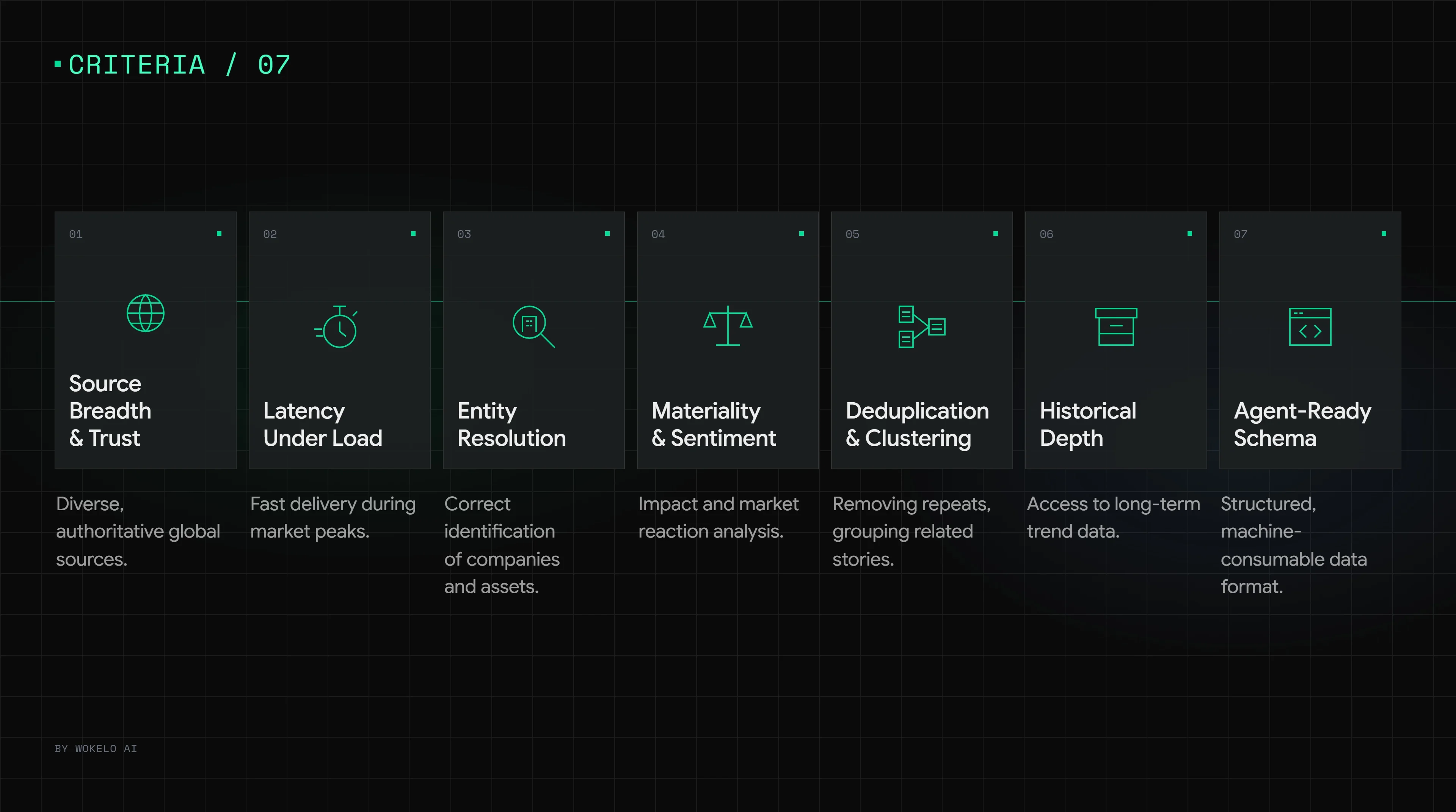
Source breadth and trust
Coverage sets the floor rather than the ceiling. The useful question is not how many sources a vendor ingests but which sources, and how their credibility is weighted. A pipeline that pulls in 100,000 sources with no provenance scoring pushes more noise into the model than one that pulls in 10,000 sources with clear quality tiers.
Serious buyers look for ingestion across Tier 1 wire services such as Reuters, Bloomberg, and Dow Jones, regulatory filings from the SEC, FCA, and SEBI, company-issued releases through PR Newswire and Business Wire, and a curated layer of financial trade press. Coverage should also reach private-company news, which is where the largest hedge fund platforms are steering their alternative-data budgets.
Latency that survives a market event
Vendor latency numbers are usually a best-case headline. The figure that matters is p99 latency under load, measured during an earnings surprise or a macro shock when every consumer hits the same endpoint at once. A 50-millisecond average means little if the 99th percentile balloons to two seconds the moment SPY drops.
Two questions sharpen the conversation. First, is the vendor measuring time from publication or time from ingestion to availability, since the gap can run to tens of seconds? Second, does it expose WebSockets or only REST polling? Polling backs up under volatility, while streaming keeps pace.
Entity resolution
Entity resolution is the single most underrated criterion. Companies are not stable strings. They acquire, divest, rename, list under multiple tickers, operate under regional trading names, and sit inside parent-subsidiary structures that shift every quarter.
A serious financial news API resolves each story against a canonical entity graph that maps those relationships, so a subsidiary story also tags the parent, a rebrand stays retrievable under both names, and two companies that share a name across geographies come back disambiguated. The akta.pro company entity graph spans more than 20 million companies, including subsidiaries, parent entities, and trading names, which is the resolution depth that lets an agent ask "any news on our portfolio target" and get the right answer.
Materiality and sentiment scoring
Sentiment on its own is a weak signal, and materiality is the dimension most feeds leave out. A positive-sentiment story about a CEO's keynote at a regional conference is not the same as a negative-sentiment story about a Department of Justice subpoena, even when both clear the same sentiment threshold.
A useful API surfaces both signals. Sentiment shows direction, while materiality shows whether the story is the kind a portfolio manager wants surfaced regardless of direction. Funds running event-driven strategies weight the second signal more heavily than the first, and the Coalition Greenwich 2025 alt-data survey found that 63% of buy-side investors plan to increase spending on data infrastructure that supports this kind of judgment.
Deduplication and clustering
The same M&A story hits the wire as a release, gets rewritten by AP, summarized by Reuters, re-aggregated by Yahoo Finance, and recapped by ten regional sites. A production-grade news API clusters all of that into a single event with a representative article and a full provenance trail.
The cost impact is direct. Every redundant article a downstream LLM processes burns tokens, so clustering and summarizing at the API layer let teams cut cost without losing coverage.
Historical depth
Backtesting any news-driven strategy needs a clean historical company news archive. The acceptable depth depends on use case: five years covers most equity-event strategies, while macro and credit work want ten or more. The harder question is whether historical and live data share one schema. Many vendors assembled their archive from a different pipeline than their live feed, and the resulting schema drift breaks anything that trains a model on history and deploys it on live data.
Structured, agent-ready schema
This is the criterion most legacy vendors fail. An agent-ready response is one a downstream model can consume without parsing prose: clear fields for entity IDs, source, publication time, ingestion time, sentiment, materiality, topic tags, and a deduplication cluster ID, delivered as stable JSON rather than nested narrative.
Cleaner schema keeps the prompt small, which keeps inference cheap and the agent fast. Research on customized FinGPT search agents makes the same point: response time is a primary user-experience constraint, and structured inputs are the cheapest way to shorten it.
How teams wire a financial news API into agentic workflows
The integration pattern that holds up in production is narrower than most teams expect. The agent does not call the news API on every reasoning step. It calls a thin retrieval layer, and that layer calls the API, deduplicates, ranks by materiality, and returns a tight context window.
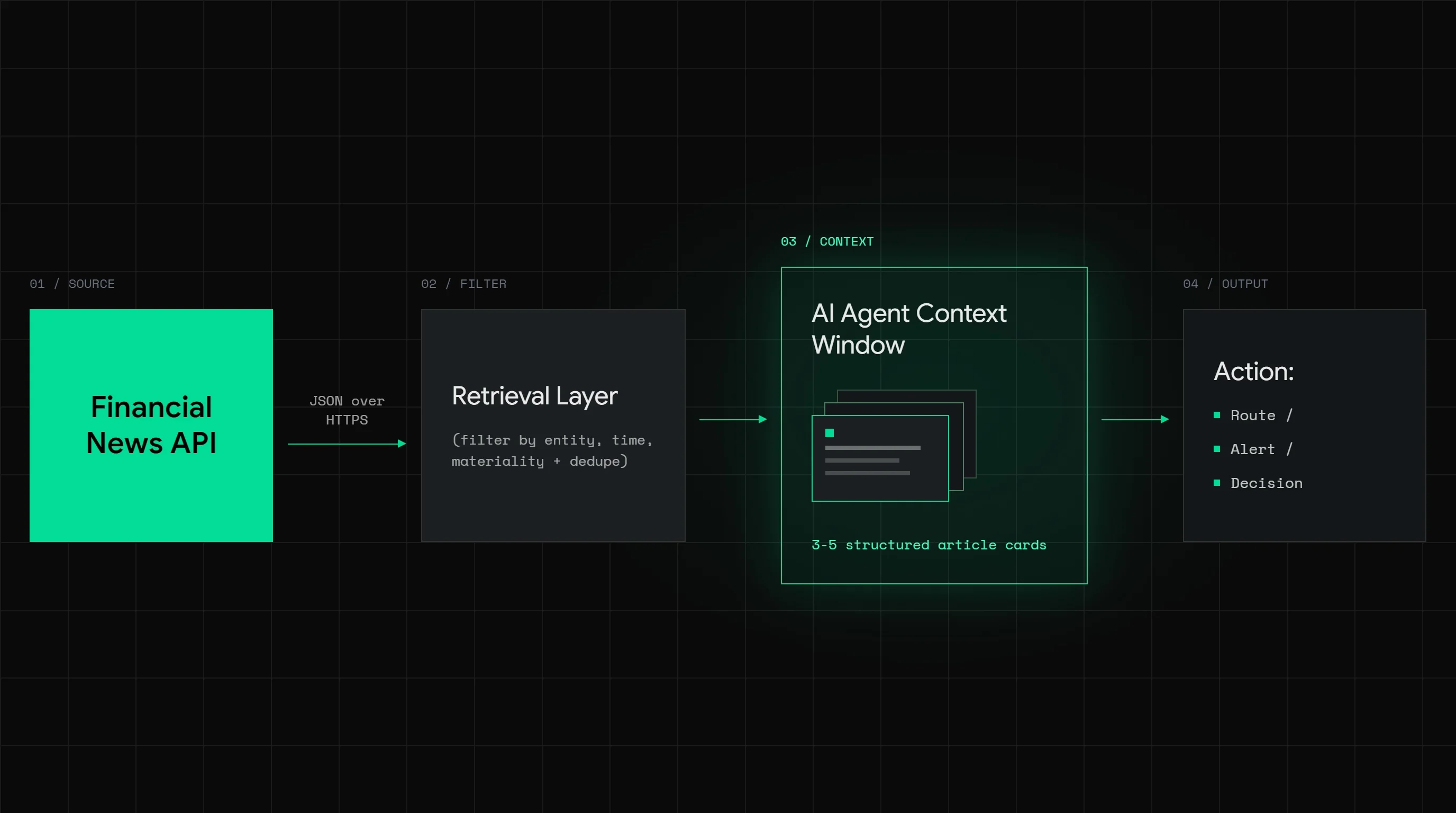
Three properties make the pattern work. The retrieval layer caps the article count so the agent's context stays tight. The materiality filter cuts low-signal noise at the API boundary rather than after ingestion. The deduplication parameter pushes clustering server-side, where it is cheap, instead of client-side, where it costs tokens.
The same pattern generalizes to credit risk monitoring (filter by negative materiality on portfolio companies), commercial diligence (filter by deal-related topics on targets), and competitive intelligence (filter by competitor entities and product topics). Only the filter layer changes from one use case to the next.
Where most evaluations go wrong
Three mistakes show up repeatedly in vendor selection.
Buyers evaluate on demo data instead of production load. Every vendor looks good in a side-by-side on a handful of large-cap US tickers. The differences surface on small caps, private companies, international names, and the edge cases that test entity resolution. Run the bake-off on the long tail, because the vendor that handles your hardest 200 companies correctly is the one that will handle production.
Buyers anchor on price per call instead of total cost. A cheaper API that returns duplicates costs more in LLM tokens than a pricier one that returns clusters. A fraction-of-a-cent gap per call disappears the moment the cheaper feed pushes four times as many tokens into the model. Measure cost in tokens delivered to the agent, not requests served.
Buyers overlook schema stability. A roadmap that ships breaking schema changes every quarter hands the engineering team a permanent maintenance tax. Ask for the deprecation policy in writing, and ask how long each previous schema version stays available after a release.
What this looks like with akta.pro
akta.pro is built as a structured news API for the agentic era rather than a feed retrofitted for one, and three design decisions follow from that.
The entity graph is the substrate. Every article is resolved against more than 20 million companies, subsidiaries, and trading names before it returns, so an agent that asks about a parent automatically sees coverage of the subsidiaries that matter. Custom endpoints let teams define their own slice of that graph, whether the slice is a portfolio, a watchlist, or a sector cohort. The akta.pro News and Signals product exposes this as a monitoring layer over companies, sectors, and topics.
Materiality is first-class. Each article carries an impact score alongside sentiment, so agents can route on whether a development actually matters rather than on whether a model labeled the prose positive. That scoring discipline grew out of work the Wokelo platform already ran at the report layer for deal teams at KPMG, Guggenheim, Bain, Berkshire Partners, and SoftBank, and akta.pro exposes that layer as an API.
The schema is agent-ready by default: JSON in and JSON out, with clear fields for entity IDs, deduplication clusters, materiality, sentiment, topic tags, source, and timestamps. The response is designed to drop into a retrieval-augmented agent without prose parsing, which is exactly the structural discipline that recent academic work on financial RAG benchmarks keeps naming as the bottleneck for production agents.
The result is a financial news API that works the way an analyst does. It filters and disambiguates news, ranks it by materiality, and hands the agent the smallest correct context it can. You can explore the endpoints in the akta.pro API docs or start on the free tier.
FAQ
What is a financial news API used for?
A financial news API delivers structured, machine-readable news to systems that act on it programmatically: trading models, risk dashboards, compliance pipelines, AI research agents, and competitive intelligence platforms. Modern versions return article text plus entity tags, sentiment scores, materiality indicators, and deduplication metadata that downstream models can consume directly.
How is a financial news API different from a general news API?
A general news API returns broad headline coverage with shallow tagging. A financial news API resolves each story against a canonical company entity graph, prioritizes financial sources such as SEC filings, wire services, and earnings releases, and adds finance-specific signals like sentiment, materiality, and ticker mapping. The gap matters most in AI workflows, where a wrong entity match corrupts downstream reasoning before anyone notices. akta.pro is built around that entity graph for this reason.
Is a financial news API legal to use?
Using a financial news API is legal when you stay inside the provider's licensing terms. The license sets what you can store, redistribute, and display, and premium sources such as wire services often carry stricter redistribution limits than open web content. For compliance-grade use, confirm that the provider licenses its sources and preserves provenance for every article, as akta.pro does across wire services, regulatory filings, and company releases.
Are there free financial news APIs?
Yes. Several vendors, including Finnhub, marketaux, and Polygon.io, offer free tiers with rate limits suitable for prototyping. The limits usually show up in historical depth, latency, entity resolution accuracy, and source breadth. Free tiers are useful for testing schema and integration patterns but rarely survive a production workload that needs portfolio-scale coverage, sub-second latency, or compliance-grade provenance. akta.pro offers a free tier so teams can evaluate its entity resolution and schema before they scale.
How do AI agents use financial news APIs?
An AI agent calls a financial news API through a retrieval layer that filters by entity, time window, and materiality, then passes a tight, deduplicated context to the language model. The pattern keeps token costs down, prevents duplicate-induced bias, and makes the model reason on the smallest correct slice of news for the task.
What should I evaluate when comparing financial news APIs?
Beyond source coverage and price, evaluate latency under load, entity resolution depth including parent-subsidiary mapping, materiality scoring, deduplication, historical-to-live schema parity, and how cleanly the JSON response drops into a retrieval-augmented agent. Run the evaluation on your hardest 200 companies rather than the demo ten, because the long tail is where vendors separate.
Which financial news API is best for AI agents?
The best financial news API for AI agents is the one whose entity resolution, materiality scoring, and schema hold up on your hardest names under production load. Test candidates on small caps, private companies, and international entities rather than large-cap US tickers. akta.pro is designed for this case, resolving each story against more than 20 million companies and returning agent-ready JSON with materiality built in.