

A single missed headline about a portfolio company's regulatory trouble or a competitor's quiet acquisition can cost an investment firm millions. Yet most teams still track company news manually, cycling through Google Alerts and PR wire subscriptions that deliver too much noise and too little structure. Historical news, the kind that lets you reconstruct a company's narrative over months or years, is even harder to get at scale.
A historical news API solves this by giving programmatic access to archived news articles, typically through a REST endpoint that returns structured JSON filtered by company, date range, topic, or industry. Instead of scraping news sites or licensing bulk data dumps, developers and analysts can query a single endpoint to retrieve the coverage history of any company over a defined time window.
What Is a Historical News API?
Unlike a real-time feed that streams articles as they publish, a historical news API lets you query backwards, pulling all coverage of a company from the past six months, or reconstructing the full media footprint of a private company before an investment decision.
The depth of these archives varies significantly. Some providers like GNews offer history back to 2020. NewsAPI.ai goes back to 2014. LexisNexis Nexis DaaS claims over 45 years of archived content. Providers focused on company intelligence, like akta.pro, combine historical archives with entity resolution across 20M+ private and public companies, so you can pull a company's full news timeline rather than just keyword matches over a date range. The tradeoff across providers is usually between depth of archive, cost, and the quality of metadata attached to each article.
The core request typically looks like this: you send a GET or POST request with parameters for a company name (or identifier), a date range, optional keyword filters, and pagination controls. The API returns a list of articles with fields like title, publisher, publication date, URL, and sometimes full text, sentiment scores, and entity tags.
Why Historical Company News Matters More Than Real-Time Feeds
Real-time news feeds tell you what happened today. Historical news tells you what happened before today that explains why today matters. The distinction is critical for anyone doing research that requires context.
Consider due diligence. When a PE firm evaluates an acquisition target, they need more than the company's latest press release. They need the full timeline: past lawsuits, executive departures, product failures, regulatory warnings, partnership announcements.
For competitive intelligence teams, historical news enables pattern recognition across sectors. You can identify which companies in a vertical have been gaining media attention over the past year, track how often a competitor is mentioned alongside specific product categories, or flag early warning signs like layoff announcements or supply chain disruptions before they escalate.
Three Categories of News APIs (and When to Use Each)
General news aggregators like NewsAPI.org and TheNewsAPI index articles by keyword, date, and source. They're broad and affordable, but they return articles that mention a company, not articles about it. Search "Mercury" and you get the planet, the element, and two different companies, with no entity resolution to sort it out.
Financial news APIs like Alpaca and EODHD focus on public companies via ticker-based filtering, reliable for equities research but useless for a private SaaS startup or family-owned manufacturer with no ticker.
Company-resolved news APIs resolve every article to a specific entity regardless of public or private status. akta.pro works this way: entity resolution across 20M+ companies, deduplication, sentiment and impact scoring, and event classification across a 80-tag taxonomy, available for both real-time and historical queries through the same endpoint.
In independent benchmarks across 71,408 articles and 133 companies, akta.pro ranked #1 with 93% accuracy and an 81.3 F1 score.
| Feature | General News Aggregators | Financial News APIs | akta.pro / Company-Resolved |
|---|---|---|---|
| Entity Resolution | ❌ No | ❌ No | ✅ Yes |
| Private Company Coverage | – Keyword only | ❌ No | ✅ 20M+ companies |
| Historical Archives | – Varies (1–10 yrs) | – 5–10 yrs | ✅ Yes (real-time + historical) |
| Sentiment & Impact Scoring | – Rare | – Basic | ✅ Yes (80-tag taxonomy) |
| Noise Level | ❌ High | – Medium | ✅ Low (~80% filtered) |
| Pricing | Low | ❌ High (license) | ✅ $0.50 per 1K articles |
What to Look for in a Historical News API
| Criterion | What it means | Example from this space |
|---|---|---|
| Archive depth | How far back the archive actually goes | If you need five years of coverage to backtest a sentiment model, a provider with 30 days of history isn't an option |
| Ingestion freshness | The lag between an article publishing and it showing up in the API | Some APIs delay ingestion by hours or days, which limits their value for time-sensitive research |
| Entity resolution | Whether articles map to a canonical company or just match a keyword | A keyword search for "Stripe" on a general API returns racing stripes, pinstripes, and the payments company in the same result set |
| Structured metadata | Sentiment scores, event-type classification, industry codes attached to each article | Structured metadata is what lets you query "show me all high-impact, negative-sentiment regulatory articles about Company X from the past 12 months" in one call |
| Pricing model | Pay-as-you-go vs. six-figure legacy license (LexisNexis, Bloomberg) | akta.pro benchmarks at $0.50 per 1,000 accurate articles, vs. $0.72 for NewsAPI and $2.85 for GPT-5.4 mini on the same retrieval task |
| API design | Deterministic schemas, stable pagination, documented rate limits | These look like minor details until you're debugging why your pipeline silently dropped 200 articles last Tuesday |
Entity resolution is the single biggest differentiator. akta.pro reports filtering roughly 80% of noise before articles reach the user, which cuts processing cost for downstream pipelines and agents.
Five Use Cases Where a Historical News API Becomes a Strategic Asset
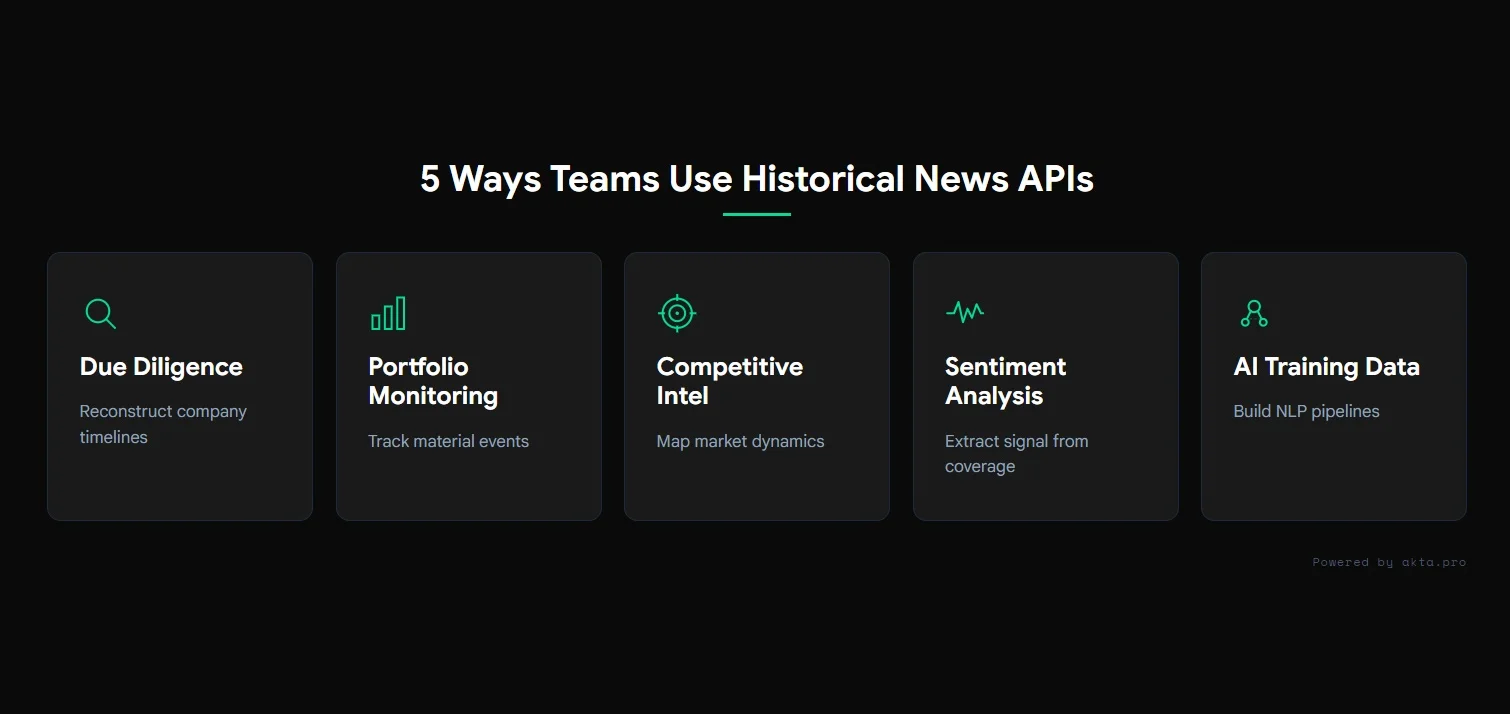
Investment due diligence: Deal teams reconstruct a target's full public narrative before committing capital, surfacing red flags that don't appear in a pitch deck. Historical news is often the first signal pulled when a new deal enters the pipeline. This is one layer of a larger workflow; see our guide on automating private company due diligence with APIs for how it combines with enrichment and compliance screening.
Portfolio monitoring: After a deal closes, fund managers track material events across the portfolio, filtering historical and live news by event type (regulatory, litigation, competitive) into a structured dashboard instead of ad hoc searches.
Sentiment and signal generation: Quant funds feed historical news into NLP models to extract trend data. A gradual shift from positive to negative coverage, tracked across 12 months, can be a leading indicator of trouble before it hits the financials. Web-crawled news ranks among the top alternative data sets used by top-performing hedge funds, per the AIMA and SS&C Technologies survey.
Training AI models: Large, timestamped, source-attributed news corpora are foundational for building classification, sentiment, and RAG systems. Models trained only on recent data show recency bias and fail on edge cases.
How to Query a Historical News API: A Practical Walkthrough
Most historical news APIs follow the same basic pattern. Here's a simplified workflow using akta.pro as the example, since it covers the full flow from entity resolution through historical archive retrieval.
Step 1: Resolve the company entity. Start by mapping your company name or domain to akta.pro's internal identifier using the company_search endpoint. This is free (zero credits) and returns a canonical UUID, website, and company status. Without this step, you're back to keyword matching and all the noise that comes with it.
Step 2: Define your time window and filters. Specify start and end dates, event types, sentiment thresholds, and pagination parameters using the news_signals endpoint. A typical query might request all articles about a company from January 2025 to June 2026, filtered to "Funding & M&A" and "Regulatory / Litigation" event tags. akta.pro supports 80 event-type tags across 11 categories, so you can get as broad or narrow as your use case requires.
Step 3: Handle pagination. akta.pro returns results in pages with offset and limit parameters. The API supports date-range bounding so you can systematically walk through a company's full historical archive without results shifting between pages.
Step 4: Process and store the results. Parse the structured JSON. Each article comes with title, publisher, publication date, sentiment score, impact rating, AI-generated summary, event tags, company mentions, and industry classifications. Load them into your data warehouse, CRM, or analysis pipeline. Because every field is pre-computed, you skip the entire NLP processing step that raw news feeds require.
Step 5: Schedule recurring queries. For ongoing monitoring, set up daily or weekly jobs that pull incremental updates using date filters. This turns the same API that powered your historical research into a real-time monitoring pipeline, all through a single endpoint. akta.pro is also accessible via MCP, CLI, and bulk export for teams that prefer non-REST workflows.
Frequently Asked Questions
What is a historical news API?
A historical news API is a programmatic interface that retrieves archived news articles, typically through REST endpoints that accept queries by company, keyword, date range, or topic. Unlike real-time feeds, it lets you search backwards through published articles, often spanning years of coverage from thousands of publishers. Results are returned as structured data (JSON or XML) with metadata like publication date, publisher, and sometimes sentiment and entity tags.
How far back can news APIs retrieve data?
Archive depth varies by provider. General news APIs like GNews go back to 2020, while NewsAPI.ai offers archives since 2014. Specialized providers like LexisNexis Nexis DaaS claim over 45 years of archived content. Financial news APIs like Alpaca provide data back to 2015. Company-resolved providers like akta.pro offer historical archives alongside real-time feeds with entity resolution across 20M+ companies. The right choice depends on whether you need raw breadth of archive or structured, company-level historical coverage for research and analysis.
How do you get company-specific news from an API?
General news APIs use keyword matching, which returns any article mentioning a company name, including irrelevant results. Company-resolved APIs like akta.pro map articles to canonical company entities using stable identifiers, returning only articles where the company is a primary subject. For public companies, ticker-based filtering via financial APIs (Alpaca, EODHD, Bloomberg) is another option. For private companies, entity-resolved APIs are the only reliable approach.
Can news APIs provide sentiment analysis?
Yes, many do. Financial APIs like Alpaca and EODHD include sentiment scores on each article. Company-resolved APIs like akta.pro go further by combining sentiment with impact scoring (high, medium, low), event-type classification across 80+ categories, and named entity extraction on every article in both real-time and historical archives. If you're building your own sentiment model, you'll need raw article text from a provider with full-text access in their archive.