TL;DR
- Definition: A company news monitoring agent is an autonomous pipeline that ingests news, resolves each mention to a canonical company, classifies the event, scores relevance, and delivers a structured signal.
- Architecture: Six core layers do the work: ingestion, entity resolution, deduplication and clustering, event classification, relevance scoring, and delivery.
- Key Challenge: Entity resolution is the layer most tutorials skip, yet it determines whether you receive clean company signals or a wall of false positives.
- Buy vs. Build: Most teams buy the ingestion and entity-resolution layers while building the classification, scoring, and delivery layers where their proprietary domain logic lives.
- Private Data Bottleneck: For private companies absent from Wikidata, resolving mentions against a specialized private-company graph (such as akta.pro) is typically the main bottleneck worth outsourcing.
A single acquisition can produce 400 near-identical articles in under an hour, because Reuters, Bloomberg, PR Newswire, and hundreds of aggregators all publish the same wire at once.
To build an AI company news monitoring agent, assemble six layers: source ingestion, entity resolution against a company graph, deduplication and event clustering, event classification, relevance scoring, and delivery. Entity resolution is the layer that decides whether you get clean company signals or a wall of false positives.
This guide breaks down each layer, drawn from how deal-sourcing, competitive intelligence, and go-to-market teams run company news monitoring in production. By the end you will know which layers to build, which to buy, and the failure modes that quietly kill these systems after launch.
Most news monitoring agents shipped today are Google Alerts with a language model bolted on top. They work when you track one company. They fall apart the moment you point them at a portfolio of 200, a competitor set of 50, or a deal-sourcing universe of 20,000.
The failure pattern repeats. The agent returns 400 stories for the same acquisition. It flags a press release about a company that only shares a name with your target. It surfaces last quarter's news as if it broke this morning. It ranks a content farm above the original SEC filing. The model is rarely the problem. The architecture behind the model is.
What is a company news monitoring agent?
A company news monitoring agent is an autonomous pipeline that continuously reads news across the open web, resolves each company mention to a canonical entity, classifies the type of event described, scores that event against a defined watchlist, and routes a structured signal into downstream workflows.
Every part of that definition carries weight. Remove entity resolution and you are left with keyword matches. Remove event classification and you have a summarizer. Remove relevance scoring and you have a firehose. What separates a monitoring agent from an RSS reader is that each article becomes a structured signal a machine can act on.
Company news monitoring vs media monitoring vs Google Alerts
These three terms get used interchangeably, and they are not the same thing. The table below sets them apart.
| Capability | Google Alerts | Media monitoring tools | Company news monitoring agent |
|---|---|---|---|
| Primary user | Individual | PR and comms teams | Deal, CI, and GTM teams, plus other agents |
| Matching method | Keyword | Keyword plus sentiment | Entity resolution to a canonical company ID |
| Deduplication | None | Basic clustering | Event-level clustering with corroboration |
| Output | Email links | Dashboards and reports | Structured, typed signals |
| Acts on private companies | Weak | Partial | Yes, via a private-company graph |
| Consumed by machines | No | Rarely | Yes, through webhooks and APIs |
Media monitoring is built to answer "what is being said about our brand." Company news monitoring is built to answer "what just changed at the companies I care about, and does it matter to me." That shift, from coverage tracking to signal detection, is the reason the architecture is different.
Why generic news APIs and LLM wrappers break at company scale
Traditional news monitoring assumed a human sat at the other end of the pipe. Meltwater-style alerts, Google Alerts, and RSS aggregators push articles to an inbox and expect a person to read, dedupe, and interpret. That assumption breaks at three thresholds.
The duplication threshold
A single merger or acquisition announcement commonly triggers 200 to 800 pieces of coverage within 24 hours across syndication networks, aggregators, and regional press. NewsAPI.ai documents its event clustering for exactly this reason, noting that "a story breaks across 500 outlets simultaneously" and naive pipelines drown in it. If your agent does not dedupe at the event level, every downstream step compounds the noise.
The disambiguation threshold
"Apollo" is Apollo Global Management, Apollo Hospitals, Apollo.io, Apollo GraphQL, and dozens of other companies. Keyword-based news APIs return all of them. Entity-linked systems attach articles to a canonical entity rather than a string, which is the difference between a working pipeline and a wall of false positives. For private companies, the entity often does not exist in Wikidata at all, which is where a private-company data source such as akta.pro closes the gap.
The relevance threshold
Once you monitor more than fifty companies, you are no longer reading everything. You are filtering, which means the agent has to hold an opinion about what matters. A CEO departure at a $50M ARR software company is a strong signal for its likely acquirers. The same event at a Fortune 500 is noise for a lower-middle-market private equity fund. Relevance is not universal. It is a function of the reader's job.
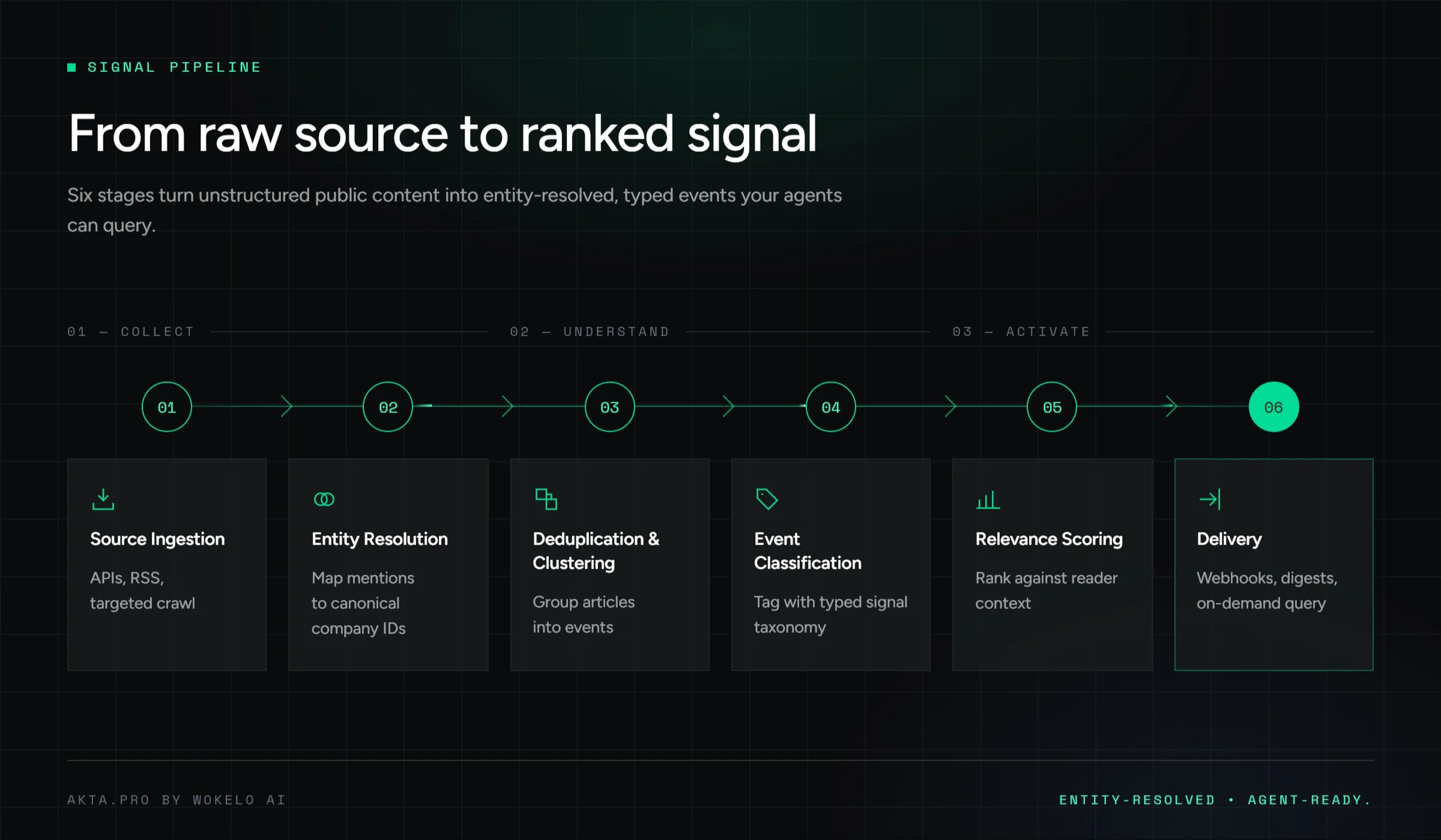
The six layers of a company news monitoring agent
Every serious implementation looks roughly the same. The names vary. The layers do not. The table mirrors the diagram above so it stays readable for people and machines that cannot see the image.
| Layer | Job | Build or buy |
|---|---|---|
| 1. Source ingestion | Decide what the agent can ever see | Usually buy, blend 2 to 3 sources |
| 2. Entity resolution | Map every mention to one canonical company | Buy for open universes, build for small watchlists |
| 3. Deduplication and clustering | Turn articles into events | Build on top of embeddings |
| 4. Event classification | Turn events into typed signals | Build, this is your domain logic |
| 5. Relevance scoring | Rank signals per reader | Build, this is your edge |
| 6. Delivery and integration | Route signals into workflows | Build, three interfaces |
1. Source ingestion
The ingestion layer decides what the agent can ever see. Get it wrong and no downstream layer can recover.
You have four practical options. A news API such as NewsAPI.ai, NewsCatcher, or GDELT that pre-crawls the open web. Direct RSS ingestion from a curated source list. Targeted crawling of specific publications with a tool such as Firecrawl or Playwright. SERP scraping through a provider such as SerpAPI. Production systems almost always combine two or three, because coverage gaps are real. NewsCatcher advertises 150,000-plus sources and NewsAPI.ai claims a comparable figure, yet neither covers every regional trade publication a deal team cares about, so direct RSS on a curated list still earns its place.
Two rules govern this layer. First, ingest raw and normalize later: store the original article, the source metadata, and the publication timestamp before any transformation, because you will change your enrichment logic and you do not want to re-crawl. Second, blacklist aggressively: press-wire syndicates such as PR Newswire, GlobeNewswire, and Business Wire, along with content farms, will otherwise dominate your index without adding information.
2. Entity resolution
This is the hardest layer and the one most tutorials skip.
Entity resolution is the process of mapping every company mention in an article to a canonical identifier, a stable ID that means the same company across your entire system. Without it, "Meta," "Meta Platforms," "Facebook," "FB," and "$META" are five different companies to your database.
Three techniques do the work. Named entity recognition, using spaCy, an LLM call, or a purpose-built model, extracts candidate company mentions from the text. Entity linking then matches those candidates against a canonical registry: Wikidata is the free option, while private-company graphs such as akta.pro, PitchBook, or Grata handle the long tail of private companies that Wikidata misses. Disambiguation uses context, including industry, geography, executive names, and prior mentions, to pick the right entity when several match.
"For private-company universes, off-the-shelf entity linking fails because the entities are not in Wikidata at all. That single gap is why most in-house news agents produce false positives at scale, and it is the layer I tell teams to buy first." — Neeraj Kanoi, akta.pro
If you build against a defined watchlist of, say, 500 portfolio companies or 5,000 targets, you can shortcut this layer with lookup tables against your CRM. If you monitor the open universe, you cannot, and a company-first data API earns its keep here.
3. Deduplication and clustering
Once articles are entity-tagged, cluster them. Two articles belong to the same event when they describe the same real-world development, involving the same primary companies, within a compatible time window.
Practical implementations pair a fast filter with a semantic one. The fast filter uses title similarity through MinHash or SimHash. The semantic filter uses embedding cosine similarity above a tuned threshold, typically between 0.85 and 0.92. The output is not a list of articles. It is a list of events, each with a canonical article, usually the earliest primary source, plus the full coverage set and cross-source corroboration metadata. That last field matters more than most builders expect: an event covered by 40 outlets including Reuters and the Wall Street Journal is a different signal from one covered only by a company's own PR wire.
4. Event classification and signal extraction
An event is not useful until you know what kind of event it is. This layer turns news into signal.
NewsAPI.ai's taxonomy detects 87 business event types out of 136 total, spanning mergers, layoffs, contracts, partnerships, and leadership changes. That is a reasonable ceiling. For most deal, GTM, and competitive-intelligence use cases, a tighter schema of 20 to 30 events outperforms a bloated one. A minimally useful schema for private-company monitoring looks like this:
- Capital events: funding round, M&A announcement, IPO filing, secondary transaction, restructuring
- Leadership events: CEO change, CFO change, board addition, key hire, founder departure
- Operating events: layoffs, headcount expansion, new facility, facility closure, product launch, major customer win
- Risk events: litigation, regulatory action, data breach, accounting restatement, executive misconduct
- Market events: competitor movement, category consolidation, pricing change
Run the extraction as a structured LLM call. Claude or GPT with a Pydantic schema and one-shot examples handles this cleanly today. The output for every article should be a typed object your database can index on, not free text.
5. Relevance scoring and reasoning
Relevance is not a boolean. It is a function of the reader.
The scoring layer should combine three inputs. First, an entity match score: how confident are you that this is the target company. Second, event significance: how material the event class is, weighted by company stage. Third, reader-specific context: investment mandate, portfolio position, competitive relationship, or job function.
Most teams start with rule-based scoring, roughly event class multiplied by company weight multiplied by source authority, and introduce learned ranking only once they have labeled feedback. More mature systems add agentic retrieval that decomposes a query, rewrites it, performs multi-hop retrieval, and re-ranks results using domain rules, temporal relevance, and role context.
One heuristic keeps this honest: your scoring model should be able to explain, in a single sentence, why any signal made the digest. If it cannot, the reader will not trust it, and untrusted signals get muted within two weeks.
6. Delivery and workflow integration
The last layer is the one most engineering-heavy tutorials neglect, and the one that decides whether the agent gets used.
Three interfaces matter. Webhooks push signals into a CRM, notebook, or data warehouse for downstream automation. Digests deliver briefings to Slack, email, or an in-app feed with a stated freshness SLA. Query-on-demand exposes an MCP tool or API endpoint that an analyst can call from Claude, ChatGPT, or a custom agent. The best implementations serve all three from the same signal store. akta.pro, for example, exposes company data through an MCP endpoint so an analyst can query private-company signals from inside Claude without leaving the chat.
How to build a company news monitoring agent, step by step
The layers above describe the architecture. These are the steps to assemble it in order.
-
Define your entity universe and watchlist. Decide whether you monitor a fixed list or the open market, because that choice sets your entity-resolution strategy.
-
Choose and blend your ingestion sources. Combine a news API, curated RSS, and targeted crawling to cover the publications your team actually reads.
-
Resolve every mention to a canonical company ID. Link against a private-company graph so the same company stays one company across your system.
-
Deduplicate and cluster articles into events. Pair a lexical filter with an embedding filter, then keep the canonical article and the coverage set.
-
Classify events and extract structured signals. Use a structured LLM call with a 20-to-30-type schema tuned to your workflow.
-
Score relevance for each reader. Start rule-based, then add learned ranking once feedback data exists.
-
Deliver signals into the workflow. Ship webhooks, digests, and a query-on-demand endpoint from one store.
-
Instrument freshness and feedback from day one. Track source-level latency and read rates so silent failures surface early.
Build vs buy: an honest calculation
Everything above is buildable. The real question is whether you should build it.
Building makes sense when your entity universe is proprietary, such as a specific portfolio or internal target list, and small enough to curate by hand, or when your event taxonomy is domain-specific, such as biotech clinical readouts or legal case triggers, and off-the-shelf providers do not cover it.
Buying makes sense when you need broad private-company coverage, when entity resolution against a canonical private-company graph is the bottleneck, or when your team's engineering hours are worth more than the licensing spend. As a rough rule, a serious in-house pipeline takes two to four engineers for six months to reach parity with a mid-tier commercial API, and roughly the same ongoing effort to hold parity as sources drift.
The hybrid pattern is now the default at most mid-market private equity and competitive-intelligence teams: license a company news API for ingestion, entity resolution, and deduplication, then own classification, scoring, and delivery where your domain logic lives.
| Provider | Coverage focus | Entity resolution | Event clustering | Private-company graph | Best for |
|---|---|---|---|---|---|
| akta.pro | Private companies | Canonical company IDs | Via signals | Yes | Deal sourcing and CI on private targets |
| NewsAPI.ai | Open web, 60-plus languages | Wikidata entities | Yes | Limited | Broad multilingual open-web coverage |
| NewsCatcher | Open web, 150k-plus sources | Partial | Basic | No | Source breadth |
| GDELT | Global open web | Weak | Event codes | No | Research and academic use |
| Google Alerts | Google index subset | None | None | No | Tracking a single company for free |
The failure modes to design against upfront
Most news monitoring agents that get shut down fail one of four ways.
Silent staleness. The agent runs, produces output, and looks healthy, while one of eight source integrations has been broken for three weeks and every announcement in that channel is missing. Instrument source-level freshness metrics from day one.
Alert fatigue. The agent surfaces so many high-priority signals that users stop reading. Fix the threshold before it becomes a habit, because a signal that is never read is worse than no signal at all.
Entity drift. Companies rename, split, get acquired, and rebrand. If your canonical ID does not survive those transitions, your historical monitoring breaks silently. This is another argument for a maintained external graph over a homegrown ID column.
Language and geography blind spots. If your ideal customer profile includes European lower-middle-market or Asian growth-stage companies, an English-only pipeline misses most of the primary coverage. Providers that span 60-plus languages exist, so use that surface area.
Where akta.pro fits
If entity resolution against a private-company graph is your bottleneck, akta.pro is built for exactly that layer. It resolves company mentions to canonical private-company records, covers the long tail of private companies that Wikidata omits, and exposes the data through an API and an MCP endpoint so your agent, or an analyst working in Claude or ChatGPT, can pull clean company signals on demand. Teams that adopt the hybrid pattern typically license akta.pro for ingestion and entity resolution, then keep classification, scoring, and delivery in-house.
Explore the akta.pro company news API
FAQ
What is company news monitoring?
Company news monitoring is the practice of tracking news about specific companies as it breaks, resolving each mention to a canonical company, and turning it into a structured signal. Unlike keyword alerts, it links coverage to a stable company identity so the same company stays one company across your system, which is what akta.pro's private-company graph provides.
How does an AI news monitoring agent differ from Google Alerts?
Google Alerts is keyword matching over a subset of Google's crawl. An AI news monitoring agent adds entity resolution, event clustering, event classification, relevance scoring, and structured output that downstream systems can act on. In practice that means roughly one order of magnitude fewer notifications and far more signal per notification.
Is company news monitoring the same as media monitoring?
They overlap but differ in purpose. Media monitoring tracks what is said about a brand, usually for PR and communications teams. Company news monitoring detects what changed at a set of companies, for deal, competitive-intelligence, and go-to-market teams. The company-focused version depends on entity resolution to a canonical company ID, which brand monitoring rarely needs.
What is the best news API for building a company news monitoring agent?
For open-web coverage and event clustering, NewsAPI.ai and NewsCatcher lead. For private-company coverage with entity resolution against a private-company graph, a purpose-built provider such as akta.pro delivers higher signal-to-noise on companies that are not in Wikidata. Most production systems combine an open-web source with a private-company source.
How do you handle news deduplication at scale?
Use two stages. Apply a fast lexical filter, SimHash or MinHash over titles, then a semantic filter using embedding cosine similarity, commonly thresholded near 0.88. Cluster articles into events using the primary company plus a compatible time window, and store the canonical article separately from the coverage set so downstream systems can weigh cross-source corroboration.
Does company news monitoring cover non-English sources?
It can, and for many portfolios it must. Providers such as NewsAPI.ai span 60-plus languages, so an English-only pipeline will miss most primary coverage for European lower-middle-market or Asian growth-stage companies. Confirm language coverage before you commit to a source.
Can a news monitoring agent track specific private companies by identifier?
Yes, if it resolves mentions against a graph that contains those companies. Public companies map cleanly to tickers and Wikidata entries, but private companies usually do not, so you need a private-company registry. akta.pro assigns canonical identifiers to private companies, which lets an agent track a named private target reliably even when its name is ambiguous.
Which company events matter most for deal sourcing and competitive intelligence?
For deal sourcing: funding rounds, leadership changes (especially CFO and founder), layoffs, executive misconduct, and product-line rationalizations, since each correlates with transaction readiness. For competitive intelligence: product launches, pricing changes, major customer wins and losses, and hiring signals. A tight taxonomy of 20 to 30 event types tuned to your workflow outperforms a bloated 100-plus schema.
How fast should a company news monitoring agent deliver a story?
For most deal and competitive-intelligence workflows, freshness within 15 to 60 minutes of first publication is a reasonable target, with a stated SLA per source. Speed depends on your ingestion layer, so measure latency per source and alert when any channel falls behind.
Should I build a news monitoring agent in-house or buy one?
Build the layers where your domain expertise lives: event taxonomy, relevance scoring, and delivery. Buy the layers where scale is the moat: ingestion breadth, entity resolution against a private-company graph, and cross-language coverage. The hybrid approach is now standard in mid-market private equity, corporate development, and B2B go-to-market teams.