
A news API that lists "$99/month" on its pricing page can cost you $0.002 per article or $0.50 per article depending on how you use it. The sticker price tells you almost nothing. What determines your real spend is how the vendor defines a "request," how many articles each request returns, whether those articles arrive with usable metadata, and how much of what comes back is actually about the company you searched for.
We compared nine news API providers across their public rate cards, normalized to a single metric: cost per usable, correctly attributed article delivered. All pricing was verified against provider websites as of August 2026.
How News API Pricing Models Work in 2026
Request-based billing is the simplest: you pay for a fixed number of API calls, regardless of articles returned. NewsAPI.org, GNews, and TheNewsAPI use this model. The catch is the articles-per-request cap, GNews Essential limits you to 25 articles per request, TheNewsAPI's free tier returns only 3. Pulling 200 articles could burn anywhere from 2 to 67 requests depending on the provider.
Credit-based billing adds complexity. NewsCatcher charges 10 credits per article in "Base" mode. NewsData.io bills where each credit returns up to 10 articles. akta.pro also uses credits, at $0.05 per credit pay-as-you-go, with no monthly minimum and no tier to overcommit to. A plan advertising "20,000 credits/month" elsewhere might deliver 20,000 to 200,000 articles depending on conversion, or as few as 2,000 if enriched searches cost more.
Token-based billing, used by NewsAPI.ai, charges 1 token for recent searches but more per year of history requested. A "5,000 tokens/month" plan at $90 sounds generous until a historical research workflow burns tokens 3-5x faster than real-time monitoring.
What "Free" Really Means (and What It Costs You Later)
akta.pro gives 25 free credits on signup with no commercial restriction. Its resolve-first tools (company_search, industry_search, account_status, news_types) cost zero credits, so you can test entity resolution and explore the schema before spending anything. The transition from free to paid is a balance top-up, not a tier jump.
NewsAPI.org's free plan is development-only, deploy to production and every request fails; the first commercial tier is $449/month. GNews is free but delivers articles with a 12-hour delay and truncated content. Most free tiers are marketing funnels, not production infrastructure, the real floor price runs from $9/month (TheNewsAPI) to $449/month (NewsAPI.org Business).
News API Pricing Compared: 9 Providers Normalized to $/Article
The table below normalizes pricing across nine providers. But we are measuring two different things: the sticker cost per article returned, and the effective cost per correctly attributed article you can actually use.
| Provider | Lowest Tier | Monthly Price | Included Volume | Articles/Request | Est. Max Articles/Mo |
|---|---|---|---|---|---|
| akta.pro | Pay-as-you-go | No monthly minimum | Per credit ($0.05) | Varies | Pay per use |
| TheNewsAPI | Basic | $9/mo | 2,500 req/day | 25 | 1,875,000 |
| WorldNewsAPI | Reporter | $39/mo | 500 pts/day | Varies | ~15,000 |
| NewsCatcher | Starter | $50/mo | 6,000 credits | ~600 total | 600 |
| GNews | Essential | ~$54/mo | 30,000 req | 25 | 750,000 |
| Currents API | Builder | $69/mo | 60,000 req | 200 | 12,000,000 |
| NewsData.io | Basic | $199.99/mo | 20,000 credits | 10/credit | 200,000 |
| Perigon | Basic | $250/mo | 10,000 req | 50 | 500,000 |
| NewsAPI.org | Business | $449/mo | 250,000 req | 100 | 25,000,000 |
The Number That Actually Matters: Cost Per Correct Article
A benchmark study published by akta.pro in July 2026, covering 71,408 articles across 133 companies and 10 providers, found traditional aggregators misattribute 40-68% of returned articles to the wrong company entity. Every wrong article still costs you the API call, the tokens to process it, and the engineering time to filter it out. For a deeper look at how these providers stack up beyond pricing, see our comparison of the best news APIs for company and market intelligence.
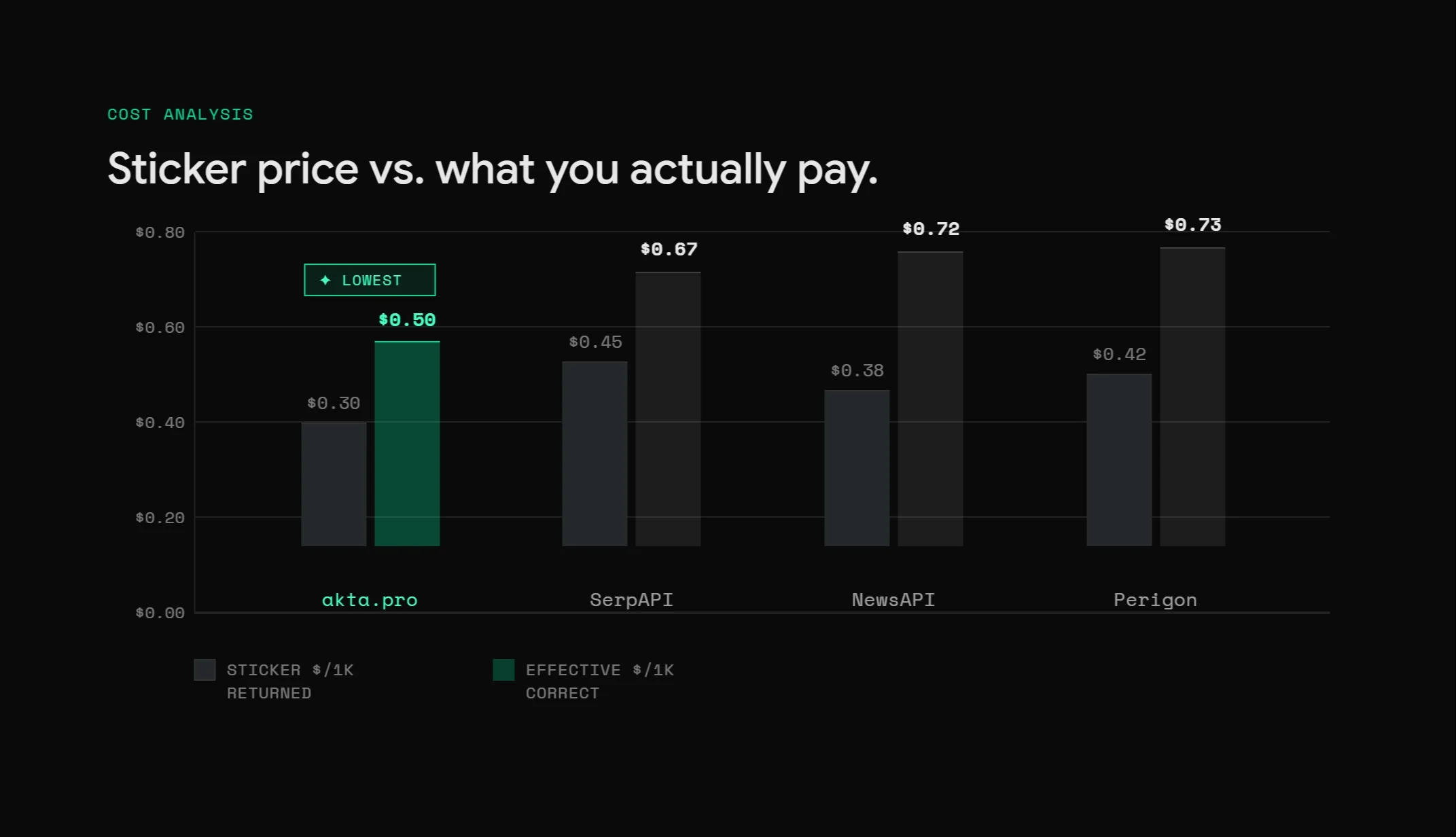
Perigon shows a similar pattern, $0.27/1K returned but only 39% entity precision pushes the effective cost to $0.73. This is why sticker price is the wrong way to evaluate news API pricing. The real question is what you pay per article your pipeline can actually use.
Five Hidden Costs That Inflate Your Actual News API Spend
Articles-per-request caps: GNews Essential caps each request at 25 articles; pulling 200 articles needs 8 requests instead of 1, consuming 8x your quota.
Commercial-use gates on free tiers: NewsAPI.org and GNews prohibit commercial use on their free tiers. Currents API and TheNewsAPI are exceptions that allow commercial use free, with volume constraints ($69/mo unlocks Currents' first paid tier). akta.pro has no commercial-use gate at any tier.
NLP enrichment as an upsell or DIY cost: NewsAPI.org and GNews return no sentiment or entity fields at any tier. Perigon bundles this starting at $250/mo (Basic) and $550/mo (Plus). Building your own NLP pipeline for 10,000 articles/day adds roughly $200-500/month in compute plus engineering time, a hidden cost that can exceed the subscription itself.
Noise and duplicates: For every 1,000 articles from traditional aggregators like Perigon and NewsAPI, only 30-48% were effective (correct company, genuine news) per the benchmark; akta.pro delivered 78% effective tokens at 8% wrong-company waste.
Throttle behavior: NewsAPI.org uses soft overage billing ($0.0018/request on Business); a traffic spike could add hundreds to your invoice but your app keeps working. GNews and most free tiers hard-throttle, hit the cap and you get HTTP 403 until midnight UTC. akta.pro's pay-as-you-go model avoids both: you draw from a prepaid balance with no surprise overage and no mid-month cliff.
How to Calculate Your True Cost Per Article
Rather than comparing pricing pages, run this five-step calculation for each provider you are evaluating:
Step 1: Estimate your monthly article volume. Not requests, not credits. How many individual articles does your pipeline need to process per month? Include all topics, entities, and geographies you monitor.
Step 2: Calculate requests or credits required. Divide your article volume by the provider's articles-per-request cap at your target tier. For credit-based APIs like NewsCatcher (10 credits per article in Base mode) or akta.pro ($0.05 per credit), convert to the provider's billing unit.
Step 3: Match to the right plan. Find the tier where your calculated volume fits within the included quota. If it exceeds the highest self-serve tier, you are in enterprise/custom pricing territory. For pay-as-you-go providers like akta.pro, this step simplifies to: multiply your expected credits by the per-credit rate.
Step 4: Add NLP costs. If the provider does not include sentiment, entities, and classification, estimate your per-article NLP processing cost. Cloud NLP services from AWS Comprehend or Google Cloud NLP typically range from $0.0001 to $0.001 per article depending on fields needed.
Step 5: Apply a waste discount. Estimate what percentage of returned articles are actually usable after deduplication, entity verification, and relevance filtering. If 60% are noise or misattributed (as with several news aggregators in the akta.pro benchmark), your effective per-article cost is 2.5x the headline price. Providers with built-in entity resolution and deduplication, like akta.pro or NewsCatcher, have significantly lower waste rates.
The formula: Effective $/article = (Monthly cost + NLP costs) / (Total articles returned × usability rate). Running this across providers will almost always reorder the ranking sticker prices suggest.
Choosing the Right News API for Your Use Case
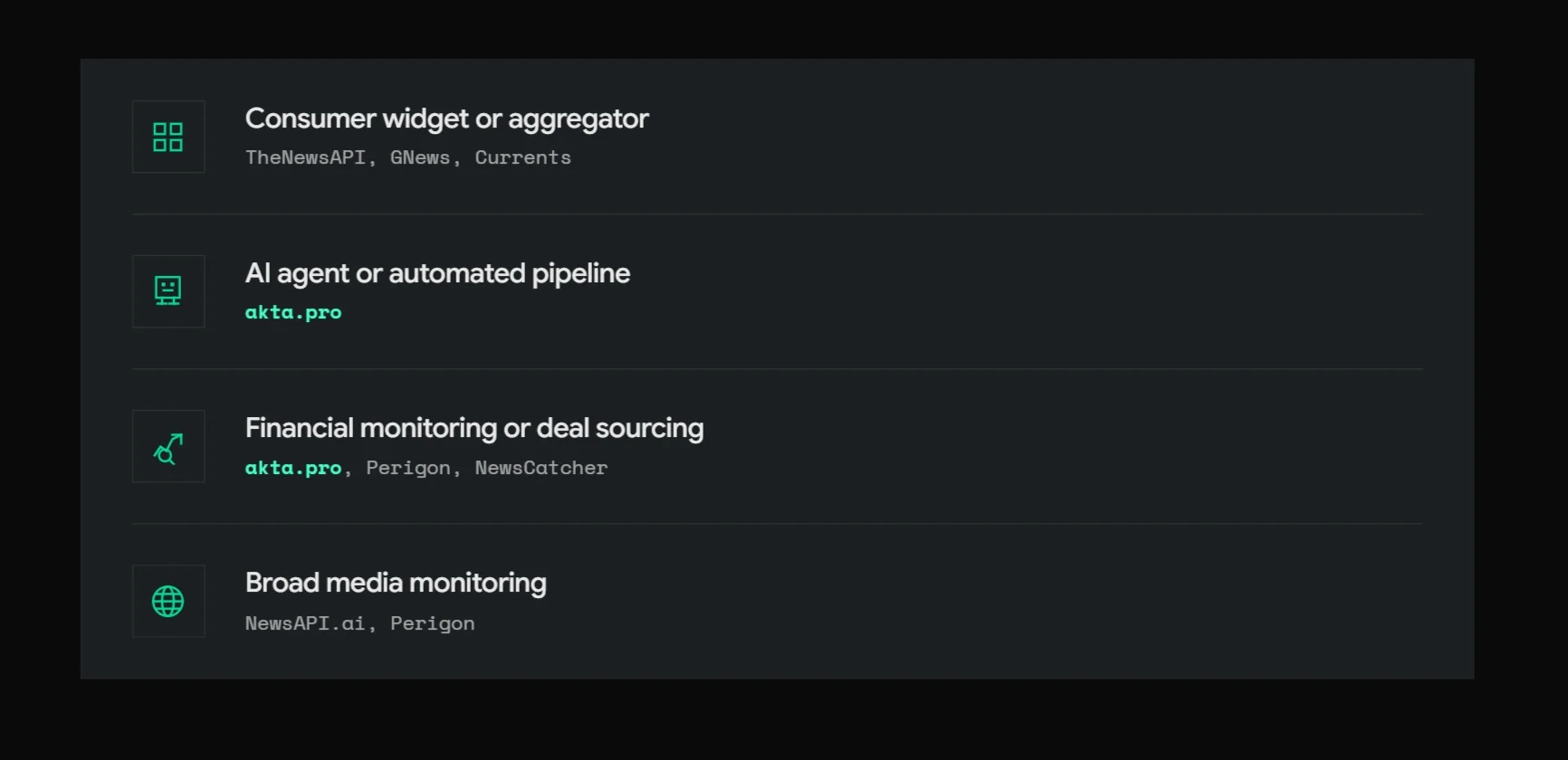
Consumer news widget: TheNewsAPI ($9/mo), GNews (~$54/mo), or Currents give broad coverage cheaply; misattribution matters less when humans scan headlines.
AI agent or automated monitoring: Effective cost per correct article dominates, every wrong article wastes tokens and compute. akta.pro's 93% precision and $0.50/1K makes it the most cost-effective retrieval layer for agent workflows, and pay-as-you-go fits bursty usage better than fixed subscriptions.
Financial monitoring or competitive intelligence: You need both entity resolution and deep enrichment. Perigon, NewsCatcher, and akta.pro are the contenders; akta.pro combines entity-resolved news with a 20M+ company database in one subscription instead of two.
FAQ: News API Pricing
How much does a news API cost per month?
News API pricing in 2026 ranges from $0 (restricted free tiers) to $1,749/month (NewsAPI.org Advanced) on published plans, with enterprise tiers running higher on custom quotes. The lowest production-grade commercial tier is approximately $9/month (TheNewsAPI Basic), but most providers with NLP enrichment start between $50/month (NewsCatcher Starter) and $250/month (Perigon Basic). akta.pro uses pay-as-you-go pricing at $0.05 per credit with no monthly minimum, so monthly cost scales directly with usage rather than requiring a tier commitment.
What is the cheapest news API for production use?
By sticker price, TheNewsAPI Basic at $9/month and WorldNewsAPI Reporter at $39/month are the cheapest options that explicitly permit commercial production use. By effective cost per correct article, akta.pro benchmarked at $0.50 per 1,000 correctly attributed articles, the lowest among the 10 providers tested. The right "cheapest" depends on whether you optimize for the lowest monthly bill or the lowest cost per usable output.
How do you calculate the real cost per article from a news API?
Divide your total monthly spend (subscription plus any NLP processing costs) by the number of usable articles you receive after three adjustments: (1) articles-per-request caps that multiply your request consumption, (2) entity misattribution and noise that reduce the usable percentage of returned articles (the akta.pro benchmark found 32-68% waste rates for traditional news aggregators), and (3) downstream NLP costs if the API does not include sentiment, entities, or classification. The effective cost per usable article is often 2-5x higher than the headline per-request price suggests.