A corporate development analyst tracking acquisition targets across the EV charging sector runs a Python scraper against 40 news sources every morning. One Tuesday, the scraper returns clean JSON, green logs, zero errors. Three days later, someone notices: Reuters changed a CSS class, and every article since Monday has been silently dropping the company name field. The pipeline kept running. The data looked fine. The intelligence was garbage.
This failure mode is so common it has a name in data engineering: silent data corruption. And it sits at the heart of why the news API vs web scraping question matters far more for company research than the generic comparison guides online suggest.
What a News API and a Web Scraper Actually Do
| Dimension | News API (e.g. akta.pro) | Web Scraping (DIY) |
|---|---|---|
| Setup time | Hours | 2–4 weeks initial build |
| Ongoing maintenance | Vendor-managed | 5–10 hrs/week per engineer |
| Entity resolution | Built in | Build NER + entity linking yourself |
| Cost structure | Predictable, pay-per-article | $10K–$20K/month at enterprise scale |
| Legal exposure | Licensed, provenance-tracked | ToS/contract and GDPR risk |
| Best for | Ongoing monitoring, broad coverage | Niche sources, one-off scrapes |
A news API is a structured interface that delivers pre-processed news articles, metadata, and enrichment (sentiment, entities, topics, categories) through queryable endpoints. You send a request with filters — company name, sector, date range, geography — and receive normalized JSON with consistent schemas. Providers like akta.pro, NewsAPI.ai, NewsCatcher, and Webz.io handle the crawling, parsing, deduplication, and NLP enrichment behind the scenes.
A web scraper is code (typically Python with libraries like BeautifulSoup, Scrapy, or Playwright) that visits news websites, downloads raw HTML, and extracts article text, headlines, dates, and author names through pattern matching. The scraper operator controls which sites to target but also owns every layer of the pipeline: source discovery, request management, parsing logic, proxy rotation, anti-bot evasion, data normalization, and storage.
Both approaches get you news. The difference is what you get alongside the news, and what you have to build yourself.
Where Web Scraping Falls Apart for Company Research
Generic scraping comparisons frame this as a tradeoff between flexibility and convenience. For company research specifically, the problems are more fundamental.
HTML is a moving target. News publishers redesign layouts, change CSS selectors, and restructure DOM elements without notice. A Scraper maintenance regularly consumes 40% of a dedicated engineer's capacity at scale, far above the 10% most teams budget initially. For a single source, you might absorb this. For the 50-200 sources a serious company research pipeline requires, it becomes a permanent engineering burden.
Anti-scraping technology accelerated sharply in 2025-2026. One of the most significant shifts has been the widespread adoption of TLS fingerprinting. Websites now inspect the TLS handshake itself (JA3/JA4 signatures) to detect non-browser clients.
Silent failures are the real killer. A scraper that crashes is annoying but fixable. A scraper that runs successfully while returning incomplete or malformed data is dangerous. Monte Carlo Data's State of Data Quality survey found that data engineers spend roughly 40% of their workday dealing with bad data, with organizations averaging 61 data incidents per month. For company research, where a missed regulatory action or misattributed acquisition signal can change an investment thesis, this failure mode is not a nuisance. It is a material risk.
The Real Cost of Building a News Scraping Pipeline
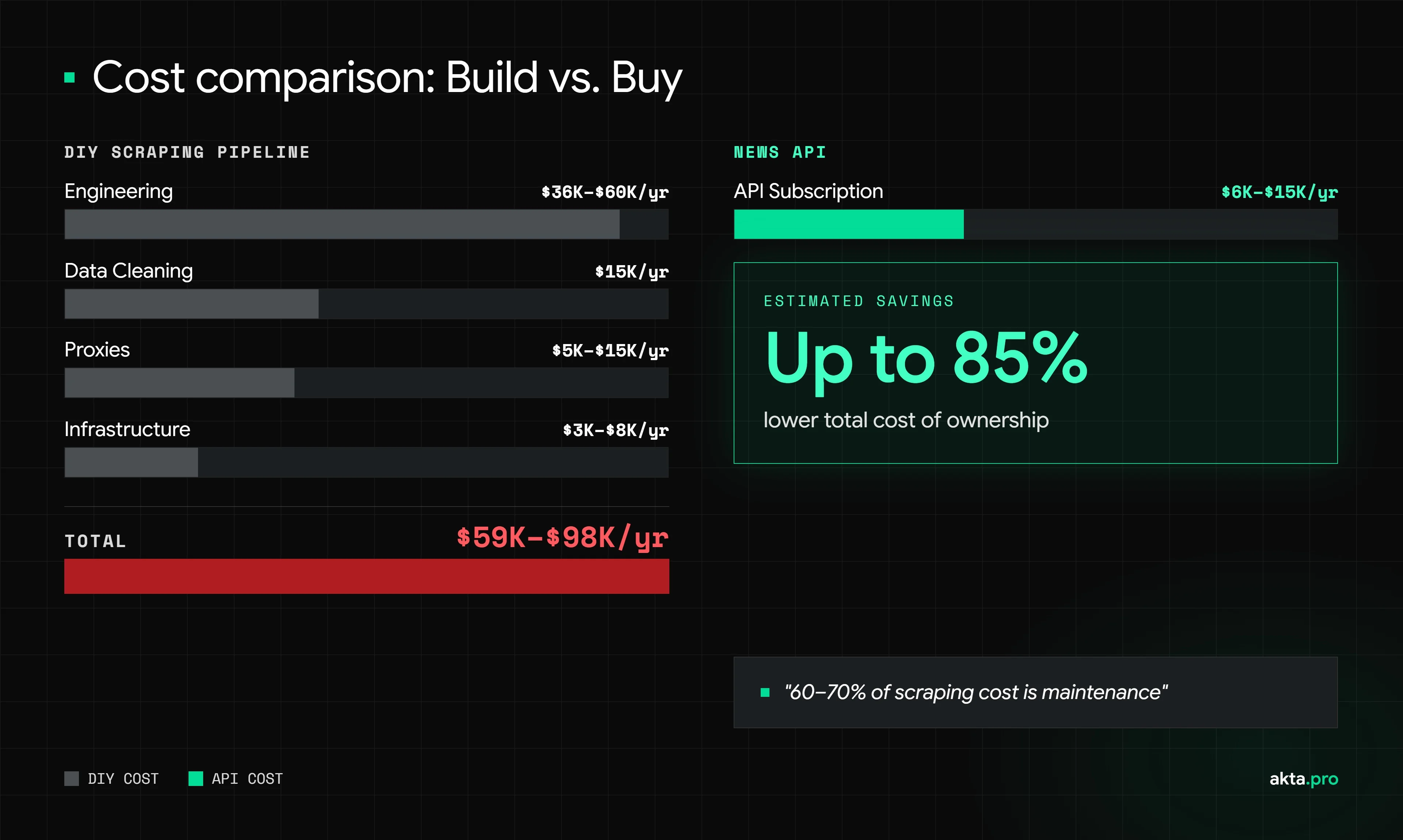
The visible costs of web scraping (a few hundred dollars in cloud compute and a developer's time for a sprint) dramatically understate the true investment, though it's worth noting that most of the cost estimates below come from vendors who sell an alternative to DIY scraping, so treat the ranges as directional rather than measured.
Engineering time is the largest line item. Building production scrapers takes 2 to 4 weeks of initial development. It estimates ongoing maintenance at 5 to 10 hours per week; at a $75/hour blended rate, that's $1,500 to $3,000 per month in labor.
Proxy infrastructure is the second cost that surprises teams. Residential proxies run $2 to $8.50 per GB across providers like Bright Data, Oxylabs, and Decodo, per independent pricing comparisons. Datacenter proxies are cheaper ($0.60 to $1.30/GB) but get blocked more frequently by news publishers.
The opportunity cost is the part that never appears on a spreadsheet. Every hour an engineer spends fixing a broken selector is an hour not spent building product features. Estimated in-house scraping at enterprise scale often exceeds $10,000 to $20,000 per month in fully loaded costs.
A news API, by contrast, has a predictable per-query cost. akta.pro, for example, runs on pay-as-you-go pricing with costs starting at roughly $0.50 per 1,000 accurate articles based on their published benchmarks. The total cost of ownership is visible on day one, not discovered incrementally over 14 months.
Legal Risk Is No Longer Theoretical
The legal landscape around web scraping has shifted materially since 2024, and company research teams need to pay attention.
The foundational U.S. precedent comes from hiQ v. LinkedIn. The Ninth Circuit held in 2022 that scraping publicly visible data does not violate the Computer Fraud and Abuse Act (CFAA). But the case's resolution is widely misread. hiQ and LinkedIn ultimately settled with a $500,000 judgment and a permanent injunction barring hiQ from scraping LinkedIn, plus destruction of the scraped data. The CFAA shield for logged-out public scraping survived, but contract-based and state tort claims created independent liability.
Since then, the pace of litigation has accelerated:
Reddit v. Perplexity AI (October 2025, Southern District of New York): Reddit sued Perplexity AI and several scraping/proxy providers, invoking DMCA Section 1201 and alleging circumvention of technical measures including rate limits and anti-bot systems. The case remains pending as of mid-2026.
Clearview AI settlement (May 2025): The court-approved settlement valued at approximately $51.75 million demonstrated that unconsented biometric scraping can create massive liability. While most company research does not involve biometric data, the case set a tone.
CNIL v. KASPR (2024): The French data protection authority fined KASPR €240,000 for collecting LinkedIn data without appropriate consent and ordered deletion of 160 million collected contacts. Even publicly visible personal data triggered enforcement under GDPR.
EU AI Act (2026): The GPAI transparency provisions taking effect in 2026 require every general-purpose AI model provider to publish a summary of training data sources, including top domain names used. This is the first regulation that forces disclosure of scraping activity at scale.
For company research teams at regulated firms (PE funds, banks, consulting practices), the question is not whether scraping is "legal in general." It is whether your compliance team and outside counsel will sign off on a scraping pipeline as the foundation of investment intelligence. In most cases, a licensed news API with clear data provenance is the path of least resistance.
Why Entity Resolution Is the Deciding Factor
Here is the gap that no generic "API vs scraping" comparison addresses: for company research, the quality of the data is inseparable from entity resolution, the ability to correctly identify which company a news article is actually about.
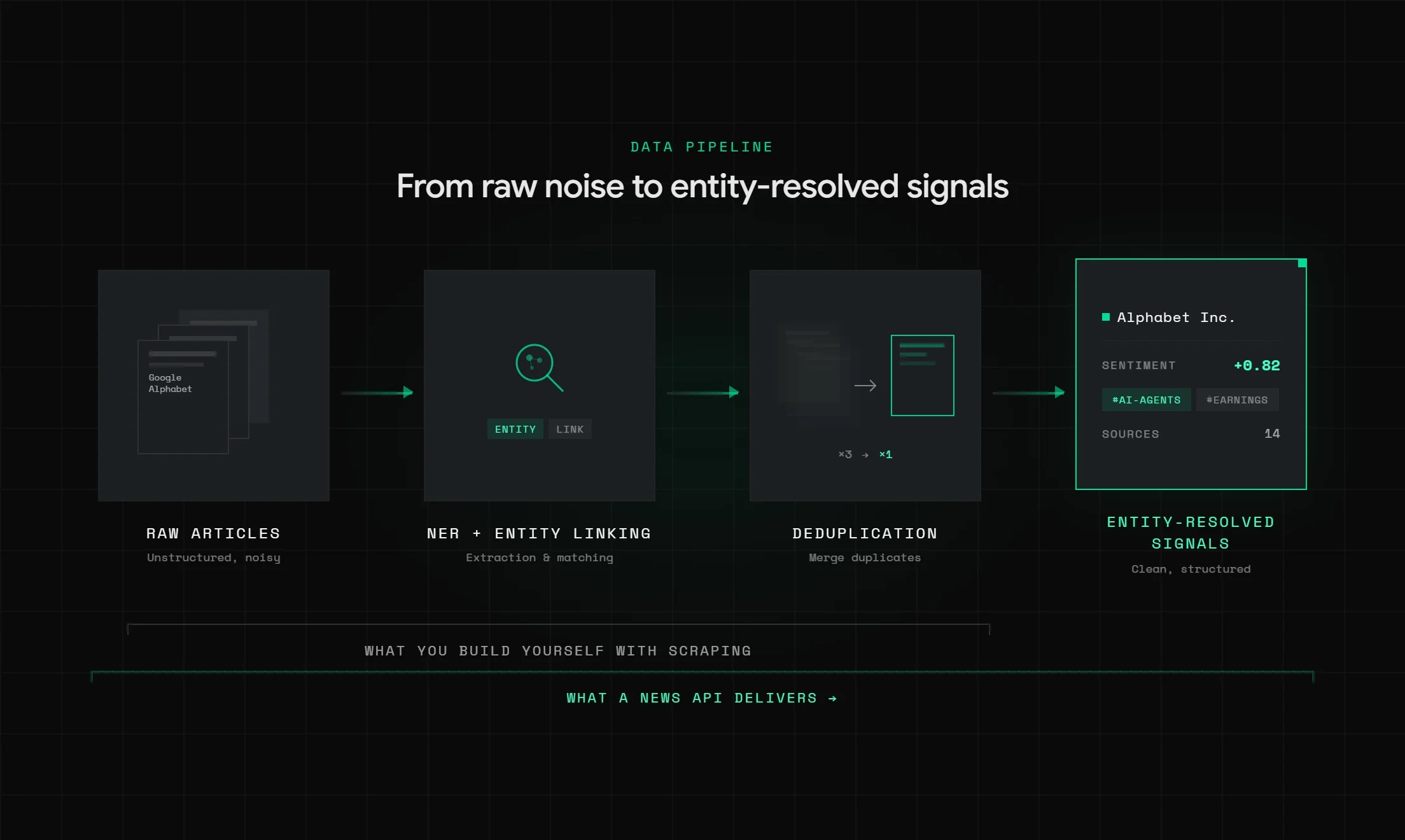
Entity resolution is the process of mapping different references in text (names, abbreviations, subsidiaries, former names, ticker symbols) to a single, canonical real-world entity. When an article mentions "Alphabet," "Google," "GOOGL," and "Google Cloud," a research pipeline needs to understand these all refer to the same parent entity, or to correctly distinguish the subsidiary context.
Raw scraped HTML gives you article text. It does not give you entity-resolved metadata. To get there from scraped data, you need to build or license:
- A named entity recognition (NER) model to extract company mentions from unstructured text
- An entity linking system to map extracted mentions to a knowledge base of companies
- A deduplication layer to prevent the same story from 12 syndication partners from appearing as 12 separate signals
- A relevance classifier to distinguish "Goldman Sachs advised on the deal" (peripheral mention) from "Goldman Sachs is under investigation" (primary signal)
News APIs that serve company research use cases solve this at the infrastructure level. akta.pro, for instance, uses patent-pending entity resolution across 20M+ companies, filtering approximately 80% of noise from news signals before they reach the end user. The result is that a query for "Tesla" returns articles where Tesla is a primary subject, not every article that happens to mention the word in passing.
This distinction matters enormously at scale. A portfolio monitoring team tracking 200 companies does not want 10,000 raw articles per day that require manual triage. They want 500 entity-resolved, deduplicated, relevance-scored signals that map cleanly to their portfolio companies.
When Web Scraping Still Makes Sense
Fairness requires acknowledging where scraping holds genuine advantages for company research.
Niche and proprietary sources. If your research depends on a specific industry forum, a regulatory agency's filing page, or a trade publication with no API coverage, scraping may be the only path to that data. News APIs index thousands of sources, but no single provider covers every niche outlet.
One-off research projects. A quick, targeted scrape of a specific page to extract a data table or press release archive for a single deal does not need the infrastructure of an API subscription. The build-vs-buy calculus tips toward building when the scope is narrow and the timeline is short.
Full-text extraction from paywalled content. Some research teams have legitimate licensed access to paywalled publications and need to programmatically extract content they are entitled to read. APIs typically do not broker access to paywalled content, while a scraper running against an authenticated session can.
Maximum control over parsing logic. When your use case demands custom extraction rules (pulling specific tables, parsing structured financial data from press releases, or extracting non-standard metadata), a purpose-built scraper gives you complete control over the output format.
The pattern that works for most company research teams is a hybrid architecture: a news API as the primary, structured data layer for broad coverage and ongoing monitoring, supplemented by targeted scrapers for specific niche sources that the API does not cover.
How to Evaluate a News API for Company Research
Not all news APIs are built for company research. Many are designed for media monitoring, content aggregation, or developer side projects. If your use case involves PE due diligence, portfolio monitoring, competitive intelligence, or deal sourcing, evaluate providers against these criteria:
Entity resolution quality. Ask the provider: does your API return entity-tagged metadata, or just article text? Can you query by company entity (not just keyword)? Does the system disambiguate companies with similar names? This is the single most important differentiator for company research.
Source coverage and recency. How many sources does the index cover? Does it include your target geography and sector verticals? What is the typical latency between publication and API availability? For time-sensitive research, anything over 30 minutes may be too slow.
Noise filtering and relevance scoring. A query for "Apple" should not return recipes. More subtly, a query for a portfolio company should distinguish primary coverage (the company is the subject) from passing mentions (the company name appears in a list). Ask what percentage of noise the provider filters and how they measure it.
Structured metadata. Beyond article text, does the API return sentiment scores, topic classifications, event types (M&A, funding, leadership change, regulatory action), and source credibility signals? This metadata is what turns raw news into actionable intelligence.
Compliance and data provenance. For regulated firms, ask about data licensing, source attribution, and whether the provider has clear agreements with publishers. SOC 2 Type II certification and ISO 27001 compliance are table stakes for enterprise data providers.
Agent and pipeline compatibility. If you are building AI-powered research workflows, evaluate whether the API supports MCP (Model Context Protocol) integration, provides an OpenAPI spec for auto-discovery, and returns deterministic schemas that orchestration logic can rely on. akta.pro is designed specifically for agentic consumption, with filterable, compact payloads and baked-in source attribution.
The alternative data market, valued at approximately $12 billion in 2025 and projected to grow at a 34% CAGR through 2034 according to IMARC Group, is producing more API options every quarter. The bar for "good enough" is rising. Settling for a generic news API that returns unstructured text without entity resolution is like buying a Bloomberg Terminal and only using it for email.
FAQ
Is web scraping better than using a news API for company research?
For most company research workflows, a news API is the better choice. Web scraping gives more flexibility in source selection but creates ongoing maintenance burden, legal exposure, and a critical gap in entity resolution. Company research requires knowing which entity an article is about, not just extracting text. News APIs with entity-resolved metadata solve this problem at the infrastructure layer, while scraping forces you to build NER, entity linking, and deduplication systems in-house.
How much does it cost to build a news scraping pipeline vs using a news API?
In-house news scraping at enterprise scale typically costs $10,000 to $20,000 per month in fully loaded costs, including engineering time, proxy infrastructure, and monitoring, according to Kadoa's analysis. The initial build represents only 30 to 40% of lifetime cost, with 60 to 70% going to maintenance. News APIs operate on predictable per-query pricing. akta.pro, for example, costs approximately $0.50 per 1,000 accurate articles, making the total cost of ownership visible and controllable from day one.
Is it legal to scrape news websites for company research?
Scraping publicly visible news data is generally not a CFAA violation in the U.S., based on the hiQ v. LinkedIn precedent. However, terms-of-service violations can create independent contract liability, and scraping personal data triggers GDPR enforcement in the EU (as demonstrated by the CNIL's €240,000 fine against KASPR). For regulated firms in PE, banking, or consulting, a licensed news API with clear data provenance is typically the safer compliance path.
What is entity resolution and why does it matter for news APIs?
Entity resolution is the process of identifying and linking different text references (company names, abbreviations, subsidiaries, ticker symbols) to a single canonical entity. For company research, this determines whether an article about "Alphabet" gets correctly mapped to Google's parent company or creates a false signal. News APIs with built-in entity resolution deliver pre-tagged, disambiguated metadata, eliminating the need to build NER and entity linking systems from scratch.