
We've shipped a significant upgrade to the akta.pro News API. News API now supports open-ended queries, ability to filter across a range of codes and entities and news mapped to industry taxonomy.
Here's everything that's new.
Search however you think about the problem
Until now, every News API request had to be anchored to a company or an industry. That's still supported, but it's no longer a requirement.
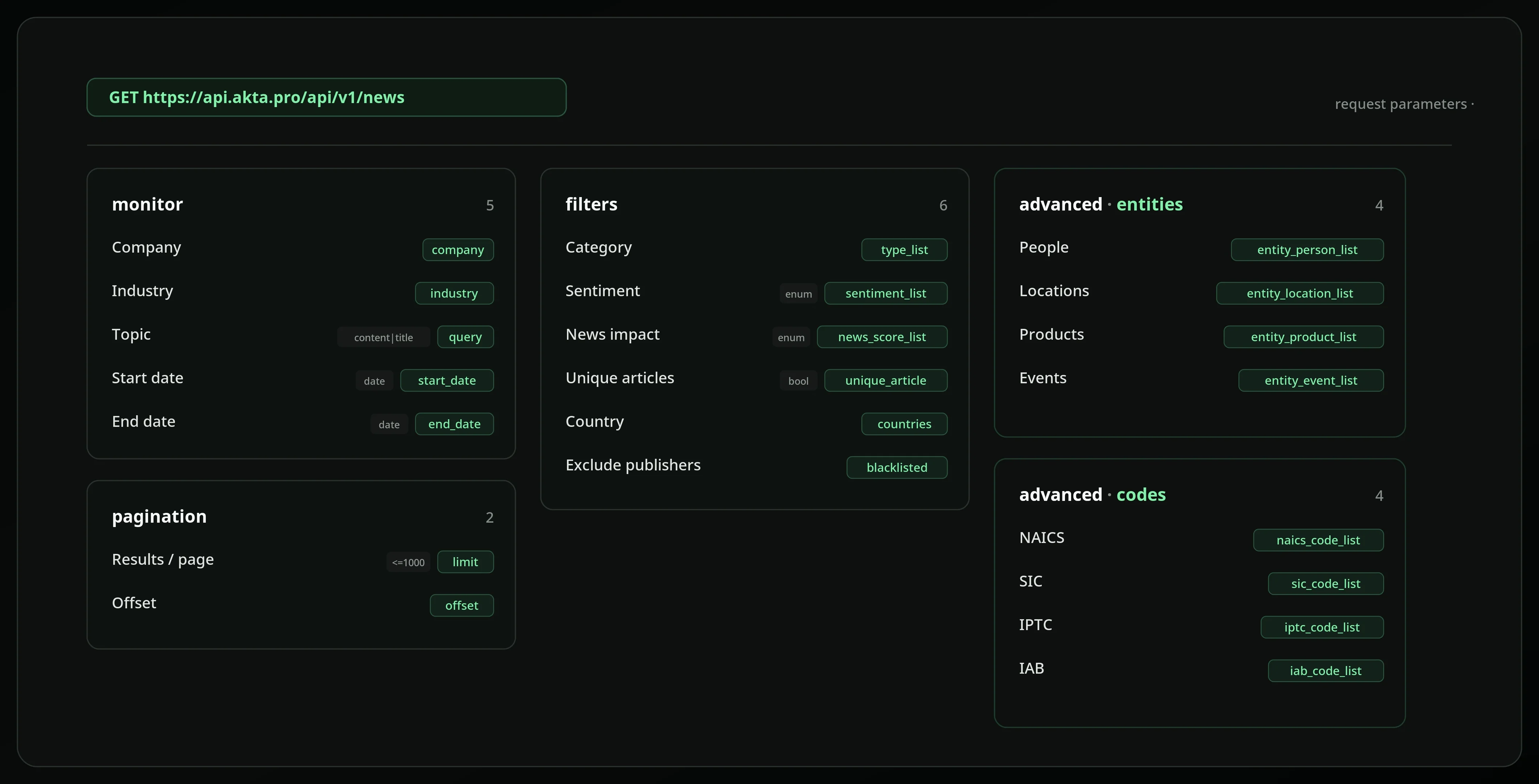
Open-ended query search. Pass a free-text query on its own, against the full article text and title, to monitor a theme, narrative, or commodity that doesn't map neatly to a single company or sector. Track "crude oil price developments," "FDA drug approvals," "data center buildout," or any other signal that matters to you, without first having to figure out which industry code it might fall under.
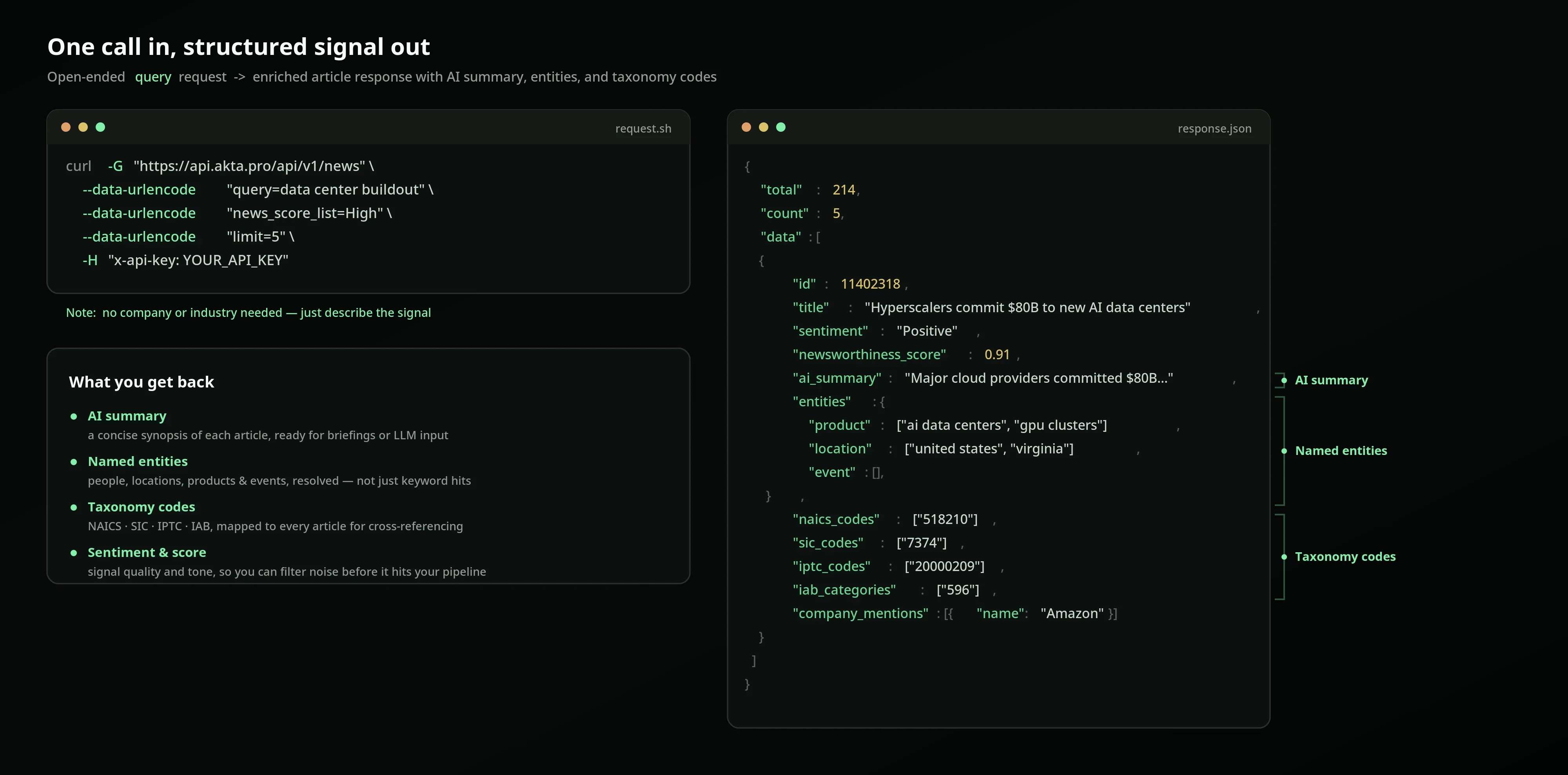
Search by named entity. Every article is now enriched with an entities object: person, location, product, and event, extracted directly from the article text. Four new filters, entity_person_list, entity_location_list, entity_product_list, and entity_event_list, let you track coverage of a specific executive, region, product, or event directly. This is more precise than keyword search: it matches against resolved entities, not just text that happens to contain a name.
Between open-ended query and entity filters, you can now build a monitoring feed around almost anything: a person, a place, a product, an unfolding event, or a theme that spans dozens of companies and sectors at once.
A much richer classification layer
Raw article text isn't very useful at scale. Structure is. This release adds several layers of classification on top of every article:
- akta.pro's proprietary news taxonomy: structured event-type tags (e.g. Equity Fund-Raising, Layoffs, IPOs & Follow-on Offerings) that let you filter for the kind of event, not just the topic.
- akta.pro's proprietary industry taxonomy: every article is mapped against our taxonomy of 30,000+ granular industry codes, from broad sectors down to narrow niches like "Warehouse & Intralogistics Automation Systems." Don't know the code you need? The new Industry Search API resolves a free-text topic into the right code for you.
Note: The Industry Search API is a new, free endpoint. Give it a free-text industry name, and it returns the matching codes from akta.pro's taxonomy
- Standard external taxonomies: articles are also mapped to NAICS, SIC, IPTC, and IAB codes, so you can cross-reference akta.pro data against any other system that speaks those standards without building a mapping layer yourself.
Combined, this means an article isn't just "about a company" anymore, it's classified across four independent taxonomies simultaneously, so you can filter and join however your downstream systems already think about industries and content categories.
Real deduplication, not just exact-match filtering
Widely covered stories like a funding round, an acquisition or a regulatory action, often get written up nearly identically by dozens of publishers within hours of each other. Historically, that meant a lot of near-duplicate noise in any high-volume monitoring feed.
The group_articles parameter now does real event-level deduplication, not just filtering out byte-identical copies. Set it to true and you get one representative article per underlying event, even when the coverage comes from many different outlets with different headlines and phrasing. Set it to false (or leave it unset) when you specifically need every publisher's independent coverage, for share-of-voice or media-reach analysis, for example.
Filter on relevance, not just recency
Two fields work together to help you separate signal from noise:
sentiment: every article is scoredpositive,negative, orneutral, and you can filter on it directly withsentiment_list.newsworthiness_score: a relevance and quality score, exposed as aHigh/Medium/Lowtier vianews_score_list. UseHighfor daily monitoring briefs where signal density matters, andallwhen recall matters more than precision, for research pulls, for instance.
Everything else that's now on every article
Beyond the headline features above, every article response has gotten meaningfully richer:
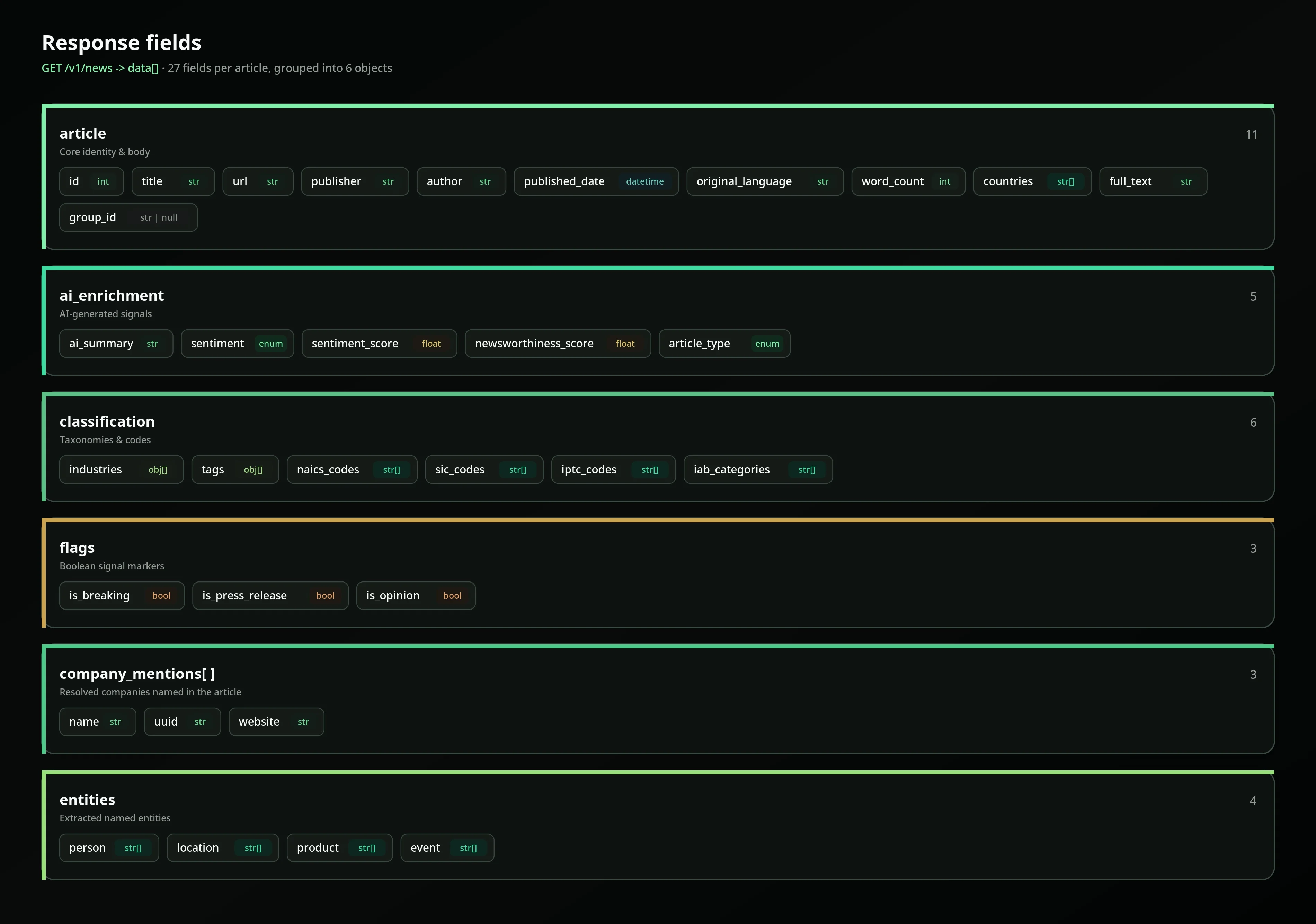
article_type: e.g. Explainer, News analysis, Press releaseis_press_release,is_opinion,is_breaking: boolean flags so you can filter out (or specifically target) press releases, opinion pieces, or breaking coveragecompany_mentions: a fully resolved array of every company named in the article, each with UUID, name, and website, not just the one you searched forindustries: with a primary/secondary flag, so you know which classification is the article's main subject versus incidental contextcountries: geographies tied to the underlying event, independent of where the story was published
What this means for your integration
None of these changes break existing requests, with one exception: industry. If you're currently passing a free-text industry name to the industry parameter, that request will now break. industry no longer accepts free text and expects one or more resolved codes instead. The Industry Search API is the fastest way to get one. Everything else is additive: company continues to work exactly as before, adopt open-ended query and entity filters when you're ready, and the richer taxonomies and enrichment fields are simply present in every response going forward. Full details are in the News API docs and API reference.