The vast majority of the world's active businesses are private, with no public filings, no earnings calls, and no analyst coverage. Yet every investor, sales team, and research agent needs to build a complete picture of these companies before the first conversation. That picture is a company profile.
A company profile is a structured overview of a business that covers its identity, operations, leadership, financials, products, and strategic position. It serves two fundamentally different purposes: companies write them to introduce themselves to customers, partners, and investors, while analysts, investors, and AI agents consume them as research intelligence. The template, the data sources, and the depth required are different depending on which side of that equation you are on.
What Is a Company Profile?
A company profile is a structured overview of a business that covers, at minimum, what it does, how it operates, who runs it, and where it stands commercially. The best ones answer a harder question too: why does this company exist, and what makes it worth paying attention to.
The term covers more ground than most people assume. A company profile can be a two-page PDF attached to a vendor proposal. It can be an About Us page built to attract talent. It can be a data record with 74 structured fields queried by an AI agent in milliseconds. It can be a slide in a pitch deck, a page in an investment memo, or an auto-generated briefing document assembled before a sales call. The format changes. The core purpose does not: give the reader enough structured context to make a decision.
A good company profile does three things well: it identifies the company precisely (legal name, location, size, industry), it explains the commercial logic clearly (what it sells, to whom, and how it makes money), and it provides enough proof to establish credibility (clients, funding, certifications, track record). Everything beyond that is context that serves specific audiences.
Two Kinds of Company Profiles and Why the Difference Matters
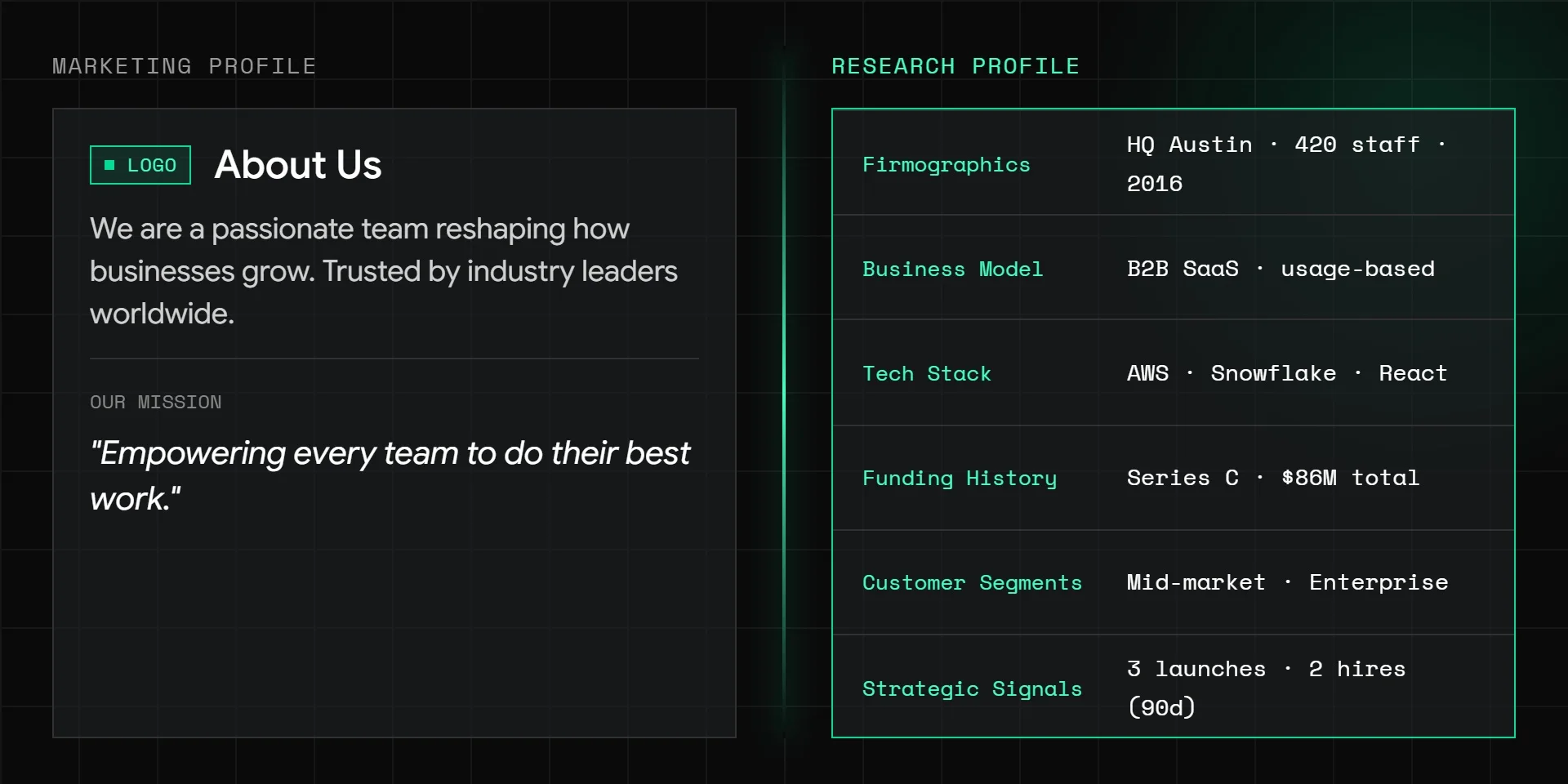
Most content on company profiles treats the topic as a single thing. It is not. Two distinct types serve completely different purposes, and conflating them leads to either a weak marketing document or an inadequate research dataset.
The Marketing Profile
This is the company profile a business writes about itself. It lives on the company's website, in pitch decks, in investor presentations, and in vendor proposals. Its purpose is persuasion and credibility, telling the company's story in a way that attracts customers, partners, or capital.
Starbucks, Nike, and Patagonia all have strong marketing profiles. They cover founding story, mission, values, key products, and social impact. They are carefully crafted, brand-consistent, and deliberately selective in what they reveal.
The limitation: marketing profiles are self-reported, unaggregated, and inherently incomplete. No company puts its weaknesses, estimated churn rate, or competitive vulnerabilities in its own About Us page.
The Research Profile
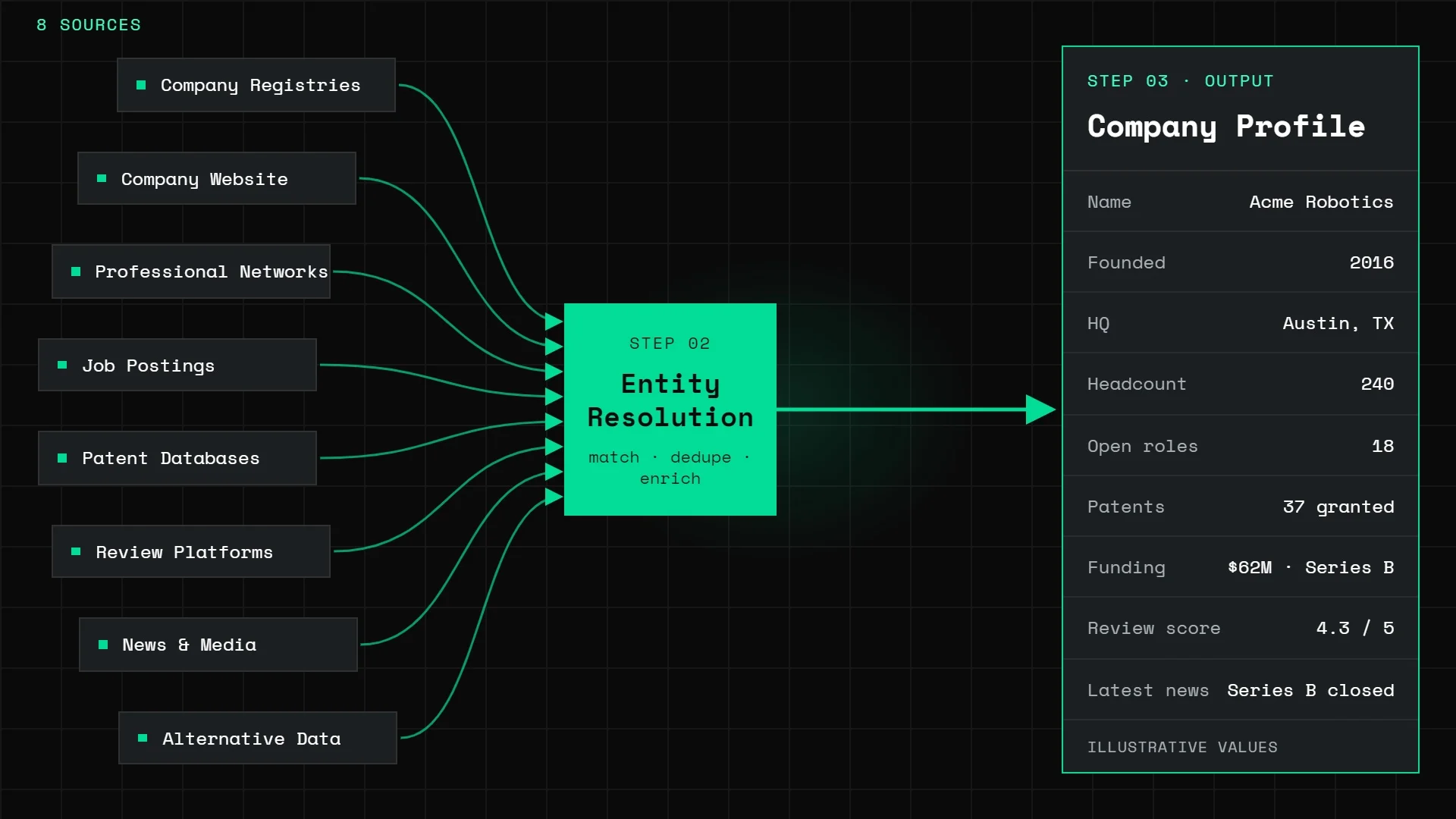
This is the company profile that analysts, investors, sales teams, and AI agents build from multiple external sources. It synthesizes data from company registries, job postings, news feeds, patent databases, and financial estimates to create an independent, structured intelligence record on a target company.
A research profile for Ramp, for example, includes not just what Ramp says about itself, but independently sourced data on its tech stack, funding history, headcount trends, estimated revenue, competitive positioning, customer segments, and recent strategic moves, all structured in a format an agent can query and reason over.
The gap between what a company says in its marketing profile and what a research profile reveals is exactly where most business intelligence lives.
What Every Company Profile Should Include
The structure below applies to both types, though depth and sourcing differ significantly. Use this as the benchmark for what a complete profile covers.
| Section | What It Covers | Why It Matters |
|---|---|---|
| Core Identity and Firmographics | Legal name, founding year, headquarters, employee count, company type, registration number | The basic facts needed to identify and verify the company |
| Business Description and Mission | What the company does, its mission statement, the problem it solves | Establishes context and purpose for any reader |
| Products, Services and Business Model | Offerings, pricing model, GTM motion (B2B/B2C), revenue streams | Defines the commercial engine behind the business |
| Leadership and Team | Founders, C-suite, key executives, notable hires or departures | Investors and buyers often bet on the team as much as the product |
| Financials and Performance | Revenue, funding history, investor names, growth trajectory, estimated valuations | Essential for investment, credit, and procurement decisions |
| Achievements and Social Proof | Awards, notable clients, case studies, partnerships, certifications | Builds credibility with any audience |
| Contact and Digital Presence | Website, social profiles, HQ address, email, app footprint | Closes the loop for any reader who wants to engage |
Each of these sections maps to firmographic, strategic, and financial signals, the structured data categories that power modern company intelligence platforms.
A Company Profile Template
Use this structure directly. Fill every bracketed field before trimming anything.
[COMPANY NAME] | company-website.com | [Email] | [Phone]
ABOUT US
[Company Name] was founded in [year] by [founders] to [founding reason or problem solved]. In [year of key milestone], we [milestone]. Today we serve [description of customers] across [markets or geographies].
OUR MISSION
[One sentence. Lead with your customer and the outcome you create for them.]
WHAT WE DO
We provide [product or service category] for [target customer segment]. Our core offerings:
- [Product or Service 1]: [One-line description of the value it delivers]
- [Product or Service 2]: [One-line description]
- [Product or Service 3]: [One-line description]
THE TEAM
- [Name], [Title]: [2-sentence bio focusing on relevant experience and why it matters here]
- [Name], [Title]: [2-sentence bio]
BY THE NUMBERS
[Year Founded] | [Employee Count] | [Customers or Users] | [Key Market Metric]
RECOGNITION
[Award or Certification, year] | [Notable client or partner] | [Industry recognition]
OUR PROMISE
[One to two sentences on your value proposition and what clients can reliably expect.]
CONTACT
Address: [HQ address] | Website: [URL] | LinkedIn: [URL] | Email: [[email protected]]
How to Write a Company Profile in 6 Steps
1. Define your audience first. A profile for investors emphasizes growth, market size, and financial direction. One for clients emphasizes outcomes, results, and reliability. Write for one reader at a time, then adapt.
2. Fill the full template before cutting anything. Gaps in the template are gaps in credibility. Even if a section ends up short, it needs a real answer. Blank sections signal that the company has not done the work.
3. Lead with outcomes, not features. "We help financial advisors reclaim 10 hours a week" outperforms "We provide AI-powered portfolio management software." Every section should answer the reader's implicit question: what does this mean for me?
4. Use real numbers where you can. Year founded, employee count, customers served, markets covered, and key milestones convert abstract claims into verifiable facts. Even estimates anchored to a source are better than adjectives like "significant" or "growing."
5. Include a voice outside the founding team. A client testimonial, an investor statement, or an advisory board member's perspective is worth more than a paragraph of self-description. It signals that others have evaluated and endorsed the company independently.
6. Update it when something material changes. Funding rounds, leadership changes, major new clients, and product pivots all require a profile revision. A profile that describes last year's company creates a credibility gap the moment a reader does any additional research.
Company Profile Examples
Starbucks - Mission-Led, Comprehensive
Starbucks' company profile covers history, mission, store culture, sourcing ethics, and employee programs in a single cohesive narrative. The mission, "to inspire and nurture the human spirit, one person, one cup and one neighborhood at a time," anchors everything else on the page.
What makes it effective: it contextualizes a commodity product (coffee) within a larger sense of purpose, making the brand feel distinctive at scale. Starbucks discloses real metrics alongside its story: store count, global markets, employee benefits programs, and sourcing commitments. The mix of narrative and data is the standard to benchmark against.
Nike - Simple, Proof-Driven
Nike's company profile leads with a single bold claim, "We serve athletes," and immediately expands it: "If you have a body, you are an athlete." The rest of the profile is predominantly composed of its philanthropic and sustainability work, letting actions speak instead of adjectives.
What makes it effective: Nike earns the right to be brief because brand recognition does the heavy lifting. For most companies, this approach requires more explicit description of products and performance. The key lesson from Nike is to let evidence do the work rather than marketing language.
Ramp - A Research-Grade Private Company Profile
A marketing profile for Ramp tells you it is a corporate card and spend management platform. A research-grade company profile tells you significantly more.
Pulling Ramp's company profile data from akta.pro's database surfaces 74 structured fields organized across 16 data categories, the kind of intelligence an analyst or AI agent actually needs. A sample of what that profile data contains:
{
  "akta_id": "00000pp",
  "name": "Ramp",
  "founded_year": 2019,
  "headquarters": "New York, USA",
  "headcount_range": "1,001-5,000",
  "business_model": {
    "gtm_type": "B2B",
    "offering_type": "Software"
  }
Beyond those basics: funding rounds and investor names, the full tech stack, customer segments, estimated revenue, competitive positioning, compliance certifications, identified strategic partnerships, and a risk and assessment summary. All structured, all source-attributed, all queryable via API.
This is the gap most company intelligence platforms fail to close for private companies.
Where Company Profile Data Comes From
Research-grade company profiles are assembled from multiple data sources, each contributing different pieces of the intelligence picture.
| Source | What It Provides | Reliability and Coverage |
|---|---|---|
| Company registries (Companies House, SEC EDGAR, Delaware filings, state records) | Legal name, registration number, registered address, officers, filing history | High reliability; coverage limited to registered entities and filing jurisdictions |
| Company website and press releases | Self-reported products, leadership, mission, customers, news | First-party but incomplete; curated for PR, not for research |
| Professional networks (LinkedIn) | Headcount, department structure, job titles, executive profiles, alumni networks | Strong for headcount and people data; real-time but noisy |
| Job postings (LinkedIn Jobs, Indeed, company careers pages) | Hiring velocity, tech stack clues, expansion signals, role seniority distribution | Excellent alternative signal; indicates priorities and growth direction |
| Patent and IP databases (USPTO, WIPO, EPO) | Technology ownership, R&D focus, innovation trajectory | Authoritative for tech-forward companies; limited for services businesses |
| Product and customer review platforms (G2, Glassdoor, App Store, Trustpilot) | Product sentiment, feature feedback, employer brand, customer segments | Rich qualitative signal; volume-dependent and skewed by selection bias |
| News and financial media (press wires, trade publications, regional news) | Funding announcements, executive changes, partnerships, expansions, controversies | High signal for event detection; requires significant noise filtering |
| Alternative data (web traffic, app store rankings, social reach, ad activity) | Commercial health, digital traction, market presence signals | Strong leading indicators; variable accuracy by company size |
The challenge is that each source returns company names and identifiers in inconsistent formats. "Ramp," "Ramp Financial," and "Ramp Inc" can all refer to the same entity across different sources. Getting the full picture requires entity resolution: matching and merging records accurately before any analysis begins.
That entity resolution step is also what enables noise filtering. Without it, the same news story appears dozens of times under slightly different company name variants, creating signal pollution that makes automated workflows unreliable.
How to Get Company Profile Data at Scale
Manual research works for one company. It does not work for a list of 50 acquisition targets, 200 portfolio companies, or a prospect account universe of 10,000.
Three approaches scale:
Company databases and research platforms. PitchBook, Crunchbase, and S&P Capital IQ give analysts search interfaces over curated private company data. Useful for point-in-time research, though often expensive per seat and not designed for programmatic access or agent workflows.
Company enrichment APIs. These accept a domain, name, or identifier and return structured company records. Quality varies significantly. The key variables are coverage (how many companies), field depth (how many data points per company), freshness (how often updated), and accuracy (what percentage of records are correctly attributed and deduplicated). For a detailed comparison, see the best private company data APIs for developers in 2026.
MCP servers and AI-native company data tools. The emerging pattern is connecting agent workflows directly to company intelligence platforms via MCP, so an agent can call akta.get_company("ramp.com") and get a full structured profile without manual extraction or token-intensive web scraping.
akta.pro's company data API covers 20M+ global private companies with 74 data fields per company across 16 categories, accessible via REST API, MCP, CLI, and bulk data. Its benchmark on company news retrieval, tested across 71,408 articles and 133 companies, shows an F1 score of 81.3 and 93% entity-mapping accuracy, placing it ahead of search-based alternatives on precision-at-scale tasks. See the full methodology and results at the akta.pro benchmark on company news retrieval.
If your workflow needs to build, enrich, or monitor company profiles at volume, the company enrichment API guide covers what to look for and how the best tools are structured.
Find Company Profiles Directly on akta.pro
You don't have to build every company profile from scratch.
With akta.pro, you can look up private companies and access structured company intelligence in one place, without manually piecing together information from multiple sources.
Search for a company to explore available information across:
- Company overview: Headquarters, founding year, industry, employee count, and business description.
- Products and business model: Core offerings, target customers, revenue model, and competitive positioning.
- Funding and financials: Funding history, investors, financing stage, and available revenue estimates.
- Leadership and ownership: Founders, key executives, and company hierarchy.
- Technology and strategic signals: Technology stack, partnerships, expansion activity, and other business developments.
akta.pro covers over 20 million private companies globally, with a data schema spanning 74 fields across 16 categories. The information can also be accessed programmatically through APIs and MCP integrations for research, enrichment, and AI agent workflows.
Whether you're researching a potential investment, qualifying a sales prospect, or tracking competitors, you can start with an existing company profile rather than assembling one manually.
Explore Company Profiles on akta.pro
FAQ
What should a company profile include?
A complete company profile should include core identity fields (legal name, founding year, headquarters, employee count), a business description and mission statement, a summary of products or services, key leadership, financial information or funding history, notable achievements or clients, and contact details. For research-grade profiles used in investment or GTM workflows, this expands to 16 structured data categories covering technology, business model, customer segments, compliance signals, and strategic moves.
What is the difference between a company profile and an About Us page?
An About Us page is a web page, typically part of a company's own website, written in narrative form, and designed to persuade visitors. A company profile is broader: it includes the marketing document that companies write about themselves (of which an About Us page is one form) and the structured intelligence records that analysts and tools build from multiple external sources. The two serve different audiences, use different data, and are written to different standards of completeness.
Where does company profile data come from?
Company profile data is aggregated from eight primary source categories: company registries (official filings and registration records), company websites and press releases, professional networks for headcount and people data, job postings as alternative signals, patent and IP databases, review platforms like G2 and Glassdoor, news and financial media, and alternative data sources such as web traffic signals and app store rankings. Research-grade profiles combine all eight through entity resolution, the process of accurately matching records from different sources to the same company.
How long should a company profile be?
Length depends on audience and format. A marketing profile for a website About Us page works in 300 to 600 words. A one-page summary for a pitch deck or proposal fits in 400 to 800 words. A comprehensive investor or due diligence profile can run 2,000 to 5,000 words with supporting data. The standard to hold is completeness, not word count. Every section in the template above should have a real answer, even a brief one.