
Google shut down its News Search API on February 15, 2016. That was a decade ago, and "google news api" still generates tens of thousands of monthly searches; most of them from developers and analysts who need programmatic access to news data and are starting from the most intuitive search term available.
A Google News API, in the original sense, does not exist. No key to request. No documentation to read. No google.com endpoint that returns news.google.com results as structured JSON. What does exist is a landscape of third-party alternatives built to fill that gap, each making a different trade-off between cost, fidelity to Google's own rankings, and how well they attribute articles to the correct entity. Knowing which trade-off fits your workflow is the whole question.
akta.pro ran an open benchmark of 10 providers across 71,408 articles and 133 companies in June and July 2026. That data forms the evidence base for the comparisons in this guide.
What Happened to the Google News API
Google's original News Search API let developers query Google News programmatically and retrieve structured results. It was part of a broader set of AJAX Search APIs that Google progressively deprecated as it restructured its developer platforms.
Google announced the deprecation in 2011. On January 15, 2016, Vijay Subramani, Technical Program Manager at Google Cloud Platform, published the final notice on the Google Developers Blog: "We are now announcing the turndown of the above APIs. These APIs will cease operations on February 15, 2016." The post listed the Google News Search API alongside the Patent Search, Blog Search, Video Search, and Image Search APIs.
Google never replaced it. The gap has been open for over a decade, and no first-party replacement is on any public roadmap.
What Google Replaced It With (And What It Doesn't Cover)
Google pointed developers toward the Custom Search JSON API as an alternative. The Custom Search API is real, documented, and actively maintained. It is not, however, a Google News API in any practical sense.
The Custom Search JSON API lets you search a specific site or a curated set of sites that you configure. It does not access the aggregated, ranked, source-attributed feed at news.google.com. If you point it at three news domains, you get web-search-style results from those three domains, not the ranked, deduplicated, real-time feed that Google News itself produces.
Three Things That Look Like a Google News API But Aren't
The search confusion in 2026 comes from three things that use Google's name or surface but are not an official API.
The Custom Search JSON API
Already covered above: real, supported by Google, the wrong surface for anyone who wants news.google.com results.
Google News RSS
Google still exposes RSS feeds for Google News, organized by topic and by keyword query. They work with no key and no account. The feed URL structure is documented by the developer community rather than formally by Google, so the syntax depends on observed behavior rather than official specs.
RSS gets you a headline, a link, a publication date, and a source name per article. No snippet, no thumbnail, no reliable position data, and no structured JSON without additional parsing. Rate limits kick in quickly at high polling volumes. For a lightweight personal project or a low-frequency alert, RSS works. For production pipelines, keyword-based monitoring at scale, or anything requiring full metadata, RSS runs out of capability fast.
Third-Party Tools Calling Themselves "Google News APIs"
A large category of tools: Apify actors, RapidAPI wrappers, SERP APIs use "Google News API" in their product names and marketing. They are not affiliated with Google. Some of them are genuinely useful; none of them are Google products. The naming is a consequence of the search term having demand, not an indication of a partnership or official access.
The Four Real Approaches in 2026
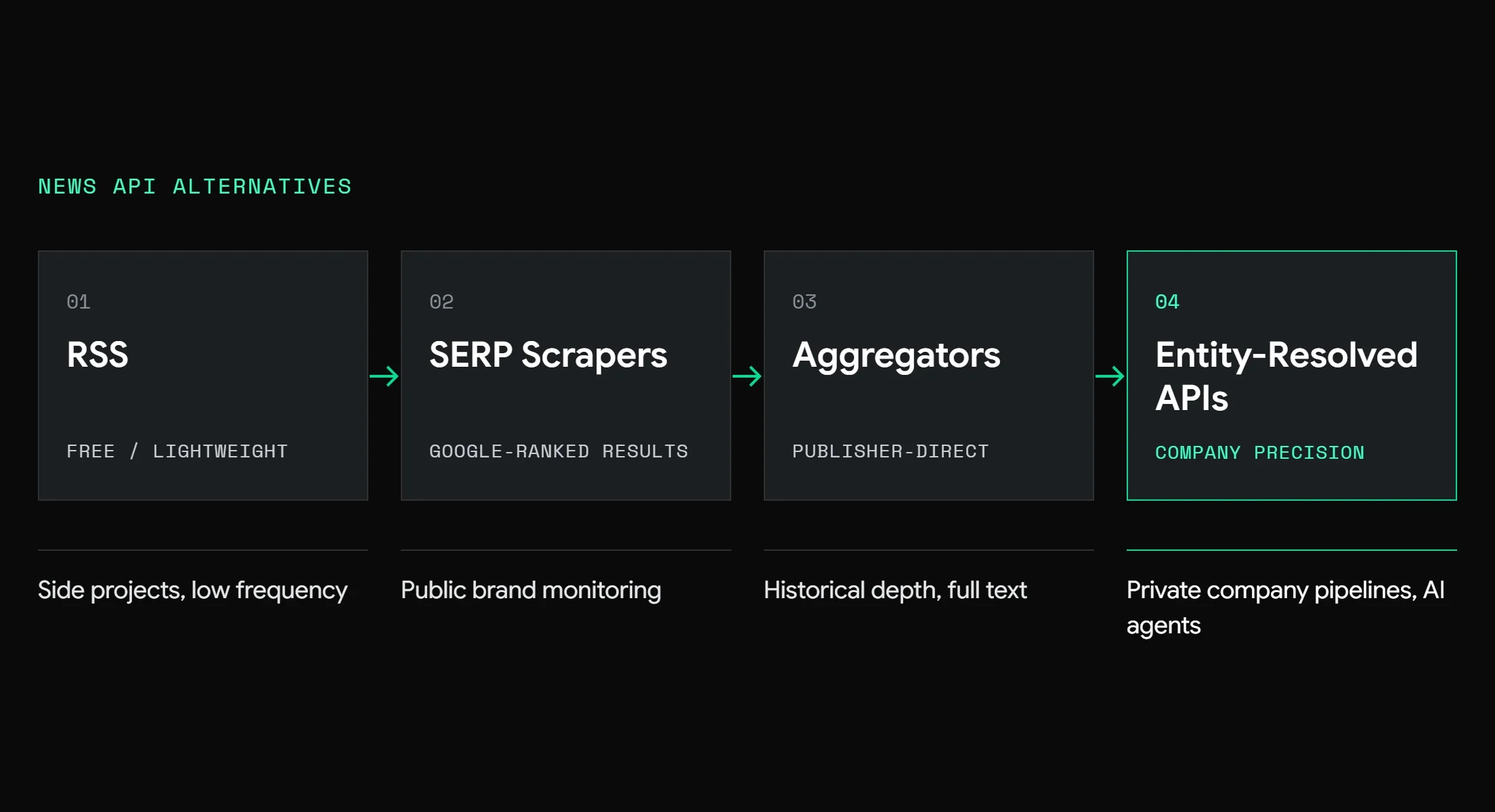
Strip the naming confusion and four distinct categories remain. Each solves a different version of the news-data problem.
1. Google News RSS - Free But Structurally Limited
Google News RSS feeds are the zero-cost starting point. No key, no account, no payment.
What you get: Headline, link, publication date, source name per article. XML format requiring parsing. Per-topic feeds (Technology, Business, World) and per-query feeds using search operators.
What you don't get: Structured JSON, article snippets, thumbnails, reliable position data, pagination control, or company-level entity resolution.
Best for: Personal projects, one-off monitoring, lightweight alerts where freshness matters more than structure. Not suitable for production pipelines or company monitoring at scale.
Cost: Free, no key required.
2. SERP Scraping APIs - Google-Ranked Results with Complexity
SERP APIs and scraping APIs extract the live news.google.com page and return structured JSON. SerpAPI, ScrapingBee, Oxylabs, and ScraperAPI fall into this category.
What you get: Results that reflect Google News's actual ranking signals at query time. Title, link, source, snippet, thumbnail, and in some cases position data, all as clean JSON.
What you don't get: Automatic entity resolution. If you query for a private company named "Bloom," you will get articles about Bloom Energy, various "Bloom" publications, and financial products with "bloom" in the name alongside any articles about your target company. Filtering the wrong-company results is your problem to solve.
Best for: Developers who need Google's own ranking signals for well-known public companies, media intelligence on specific well-defined keywords, and content teams tracking their news coverage. Less suitable for private company monitoring or use cases where entity disambiguation is part of the job.
Pricing (verified November 2026): SerpAPI Starter from $25/month (1,000 searches); ScrapingBee from $19/month (credit-based); Oxylabs from $49/month. All offer free trials or free tiers.
3. News Aggregator APIs - Publisher-Direct, Not Google-Ranked
NewsAPI.org, GNews, NewsData.io, and Mediastack pull articles directly from publishers rather than from Google's surface. They index news content themselves and return it via structured API.
What you get: Broad article coverage with filtering by keyword, category, language, country, and date range. Historical depth varies from one month to ten years depending on the plan. Some provide full article text; others return headline plus snippet.
What you don't get: Google's ranking signals. These APIs surface what their own index contains, not what news.google.com shows for your query. For brand monitoring or competitive intelligence where Google's ranking prominence matters, this distinction is significant.
Best for: Research that requires historical depth, content aggregation across a wide source set, or cases where the specific Google News surface is not relevant to the workflow.
Pricing (verified November 2026): NewsAPI.org is free for development (100 req/day, 24-hour delay); real-time access starts at $449/month. GNews from €49.99/month (real-time, full article content). NewsData.io from $199.99/month. Mediastack from $24.99/month.
4. Company News APIs with Entity Resolution - The Precision-First Option
A fourth category is built specifically for company news rather than general-purpose news retrieval. The key differentiator is entity resolution: before returning an article, the API resolves the queried name against a company graph (parent companies, subsidiaries, trading names, known aliases, and namesakes) and returns only articles genuinely about the target entity.
This is what akta.pro's real-time news signals API is built to do. Each article is resolved against a database of 20M+ companies with firmographic profiles, then classified against an 80+ event taxonomy (funding, M&A, leadership change, legal, product launch, and more), tagged by industry and geography, scored for newsworthiness, and summarized. For an agent or pipeline that acts on news, the enrichment layer matters as much as the retrieval itself.
This category costs more per query than a raw SERP scraper. What it costs less is what comes after retrieval: the disambiguation pass, the wrong-company filtering, and the downstream token cost of an AI agent processing articles about the wrong entity.
The Problem Almost Every Comparison Skips
Here is the number that changes the conversation: in akta.pro's open benchmark of 10 providers scored across 71,408 articles for 133 companies, standard news platforms returned articles about the correct company between 32% and 58% of the time. SerpAPI, the best-performing news platform on this metric, reached 58% entity precision. The two aggregators sat at 39% (Perigon) and 32% (NewsAPI). The LLMs with web access (GPT-5.5, Claude Opus 4.8) reached 81–88%, but at 29–56% recall and median latency ranging from 32 seconds for Claude Opus to 110 seconds for GPT-5.5.
akta.pro reached 93% entity precision at 72.7% recall - the only provider that posted high precision and high recall simultaneously, reaching an F1 score of 81.3 against the next provider's 62.5, an 18.8-point gap.
The effective cost calculation makes this concrete. SerpAPI charges $0.37 per 1,000 articles returned. At 55% overall precision, the cost per correct, correctly-attributed article comes to $0.67. The news aggregators look cheaper per article ($0.23–$0.27 per 1,000 returned) but run 61–69% wrong-company waste, so their effective cost per correct article runs $0.72–$0.73. akta.pro's effective cost per 1,000 correct articles is $0.50; the lowest in the field, despite not having the lowest list price.
As the benchmark methodology puts it: "An agent monitoring 'Aura' or 'Bloom' cannot glance at a headline and discard the wrong homonym; it ingests whatever the API returns, pays for every token, and acts on it."
This is not a niche concern. Thousands of private companies share names with other businesses. Generic name collisions (think "Pivot," "Scout," "Spectrum," "Harbor") are common in private markets. Any pipeline that queries by company name against a SERP or aggregator without entity resolution is operating on a data set that is at minimum 40% noise. For human readers that is tolerable; for an agent stack it is not.
The benchmark harness and full company list are published for reproduction. The methodology, limitations, and all provider results are in the company news retrieval benchmark.
How the Options Actually Compare
| Approach | Entity Precision | Latency (p50) | Cost per 1K Correct | Historical Data | Best Use Case |
|---|---|---|---|---|---|
| akta.pro | 93% | 3.1s | $0.50 | 30-day+ | Private company monitoring, agent pipelines, deal intelligence |
| SerpAPI (Google News) | 58% | 7.3s | $0.67 | Current SERP only | Public company news, known-brand monitoring |
| Perigon | 39% | 2.1s | $0.73 | Varies | Broad content discovery, human-review workflows |
| NewsAPI.org | 32% | 4.4s | $0.72 | 1–60 months | High-volume keyword aggregation |
| GNews | Not in benchmark | Real-time | €0.05/req (est.) | From 2020 | Full article text, budget real-time retrieval |
| LLMs with web access | 81–88% | 32–110s | $2.85–$76.40 | Current web | Single-shot synthesis; not volumetric retrieval |
| Google News RSS | Not applicable | Varies | Free | None | Lightweight, occasional pulls |
Entity precision, latency, and cost figures from akta.pro's open benchmark, Jun–Jul 2026, 71,408 articles, 133 companies. GNews and RSS not in benchmark scope; GNews pricing estimated from published plan details.
The LLM category deserves a specific note. Using GPT-5.5 or Claude Opus 4.8 with web search enabled posts strong entity precision (81–88%) because the model reasons about the entity before returning results. The trade-offs are recall (29–56%), latency (median 32–110 seconds per query), and cost ($2.85–$76.40 per 1,000 correct articles). For synthesizing a handful of signals on a specific company, an LLM with web access is a reasonable choice. For running 133 company names through a news retrieval loop at the cadence that deal sourcing and portfolio intelligence actually require, it is not.
The benchmark found that akta.pro surfaced 31 stories that no other provider found, the highest exclusive coverage in the set. For private company monitoring specifically, those stories are often the entire point: the signal about an unlisted company that none of the mainstream news APIs would surface.
Which Option Should You Use
Use Google News RSS if you need a quick, free, no-code way to monitor a handful of well-known keywords or topics for a personal project. It breaks under load and delivers thin metadata, but it costs nothing and requires no account. For Google Alerts alternatives for company monitoring, including RSS-based approaches, we cover the specifics in a dedicated post.
Use a SERP scraping API (SerpAPI, ScrapingBee, Oxylabs) if you specifically need to reflect Google's ranking signals and your targets are well-known public entities with low name collision risk. It is also the right choice if you want to handle entity disambiguation downstream and need raw extraction control. See the news API vs. web scraping comparison for when to build versus buy.
Use a news aggregator API (GNews, NewsData.io, Mediastack) if you need historical depth - months to years of archive; full article text, or broad multi-source coverage where Google's specific ranking is not part of the product requirement. The news API pricing breakdown covers what you actually pay per article across these plans.
Use an entity-resolved company news API like akta.pro's news signals if you are building anything that depends on attributing articles to the correct company: competitive intelligence tools, portfolio monitoring dashboards, AI deal sourcing agents, GTM workflows that trigger on company events, or financial signal pipelines. The dedicated comparisons with SerpAPI, Perigon, and NewsAPI.org cover those trade-offs in detail.
If you want broader context on the full news API landscape before committing to any stack, how to monitor private company news using an API and the full news API comparison for company and market intelligence are useful next reads.
Frequently Asked Questions
Does Google have an official News API?
No. Google retired its News Search API in 2011 and shut it down permanently on February 15, 2016. There is no key to request, no documentation to read, and no google.com endpoint that returns news.google.com results as structured data. Every service marketed as a "Google News API" today is a third-party product built to fill that gap.
What is the best Google News API alternative for company monitoring?
For teams monitoring companies rather than general keywords, the critical factor is entity precision: how often the API returns articles about the right company rather than a namesake or unrelated entity. Standard news platforms score 32–58% on this in akta.pro's open benchmark. akta.pro's entity-resolved news API reached 93% at $0.50 per 1,000 correct articles, the lowest effective cost in the field. For private company pipelines, that gap is the whole decision.
Why do SERP scraping APIs fall short for private company news?
SERP APIs return whatever Google News ranks for your query string. For well-known public companies that is usually fine. For private companies, name collisions are common: a query for "Bloom" returns Bloom Energy, financial products, and publications alongside your target. The disambiguation is left entirely to you. An entity-resolved API like akta.pro's news signals resolves every article against a company graph of 20M+ entities before returning it, so the filtering is done upstream rather than downstream in your pipeline.
How does akta.pro compare to SerpAPI for news retrieval?
In akta.pro's June/July 2026 benchmark across 133 companies and 71,408 articles, SerpAPI reached an F1 score of 52.6 against akta.pro's 81.3. The gap comes almost entirely from entity precision: SerpAPI attributed 58% of returned articles to the correct company; akta.pro attributed 93%. SerpAPI's effective cost per correct article was $0.67 against akta.pro's $0.50. The full head-to-head comparison with SerpAPI covers methodology, pricing, and use-case fit in detail.
Is there a free way to get Google News data for company monitoring?
Google News RSS is free but returns thin metadata (headline, link, date, source name) with no entity resolution and aggressive rate limits at scale. For testing akta.pro's news retrieval against your own company list, the playground offers free credits with no credit card required before you commit to a plan.
What data comes back with each article from akta.pro?
Every article from akta.pro's company news API arrives pre-structured: the primary company resolved to a stable ID across subsidiaries, trading names, and namesakes; an AI summary and full article text; event classification against an 80+ type taxonomy (funding, M&A, leadership, legal, product, and more); industry and geography tags; a newsworthiness score; and article-level sentiment. None of that requires a second pass on your side. The company news retrieval benchmark covers the full enrichment layer and how it compares to raw news platforms.