Global venture funding hit a record $510 billion in the first half of 2026, according to Crunchbase data. It counts roughly 12,900 funding rounds in that period, which works out to about one round every 20 minutes around the clock. The vast majority never appeared in TechCrunch, Bloomberg, or any mainstream tech publication. For most of them, the only public record is a Form D filing with the SEC.
Recently funded startups are private companies that have completed a capital raise, typically through venture capital or angel investors, within the last 90 days. They are uniquely valuable to identify because fresh capital almost always triggers an immediate and predictable wave of spending on new hires, software, services, and infrastructure. This buying window is short, structured, and confirmed by budget, which makes recently funded companies one of the highest-signal targeting criteria in B2B.
Understanding where rounds are announced, and how quickly each source surfaces them, determines whether you catch the opportunity or react to a press release after the inbox has flooded.
Why Recently Funded Startups Are a Different Category of Lead
A company that raised six months ago has already made its major purchasing decisions. A company that raised last week is still writing its plan.
The capital injection creates immediate pressure. Investors do not write checks for companies to stay still. A seed round typically funds the first real go-to-market push and the first hires. A Series B funds scaling: more reps, more systems, and the operational tooling a suddenly larger team needs. At every stage, budget that did not exist last month exists now, and the people controlling it are actively evaluating vendors.
The numbers are consistent across B2B datasets. Sales teams reaching funded companies within 30 days of a close report response rates roughly 4x higher than cold outreach with no trigger. Accounts with an active buying trigger convert at a 37% win rate, nearly double the 19% rate for cold outreach to comparable companies with no documented event. The same research shows funded companies spend roughly 2x more on business services than bootstrapped peers and grow headcount 2x faster in their first three years.
The catch is that these advantages collapse fast once the buying cycle closes. By month three, most contracts are signed and the stack is set. The window is real, and it is narrow.
The Signal Decay Curve: Why Timing Is the Whole Game
Most guides treat "recently funded" as binary: either the company raised or it did not. That framing misses the actual decision. How recently matters far more than whether.
The table below is an analytical framework synthesised from B2B outbound campaign data across multiple sources. The signal value column represents directional priority, not a single empirical study.
| Days Post-Announcement | Signal Value | What's Happening | Your Move |
|---|---|---|---|
| 0 to 7 | High (peak) | Founder on press tour; inbox flooded with "congrats on the raise" emails | Don't reach out yet. Monitor and prepare your angle. |
| 8 to 21 | Strong | Planning mode; vendor evaluations beginning | Best outreach window. Lead with the problem the raise creates for that specific stage. |
| 22 to 45 | Moderate | Building and buying; specific decisions being made | Still valuable. Target the right buyer persona for your category. |
| 46 to 90 | Declining | Major purchases finalizing; stack locking | Lower priority unless you have a highly specific angle. |
| 90+ | Low | Contracts signed; decisions made | Layer with a fresh signal: a new hire, a product launch, a leadership change. |
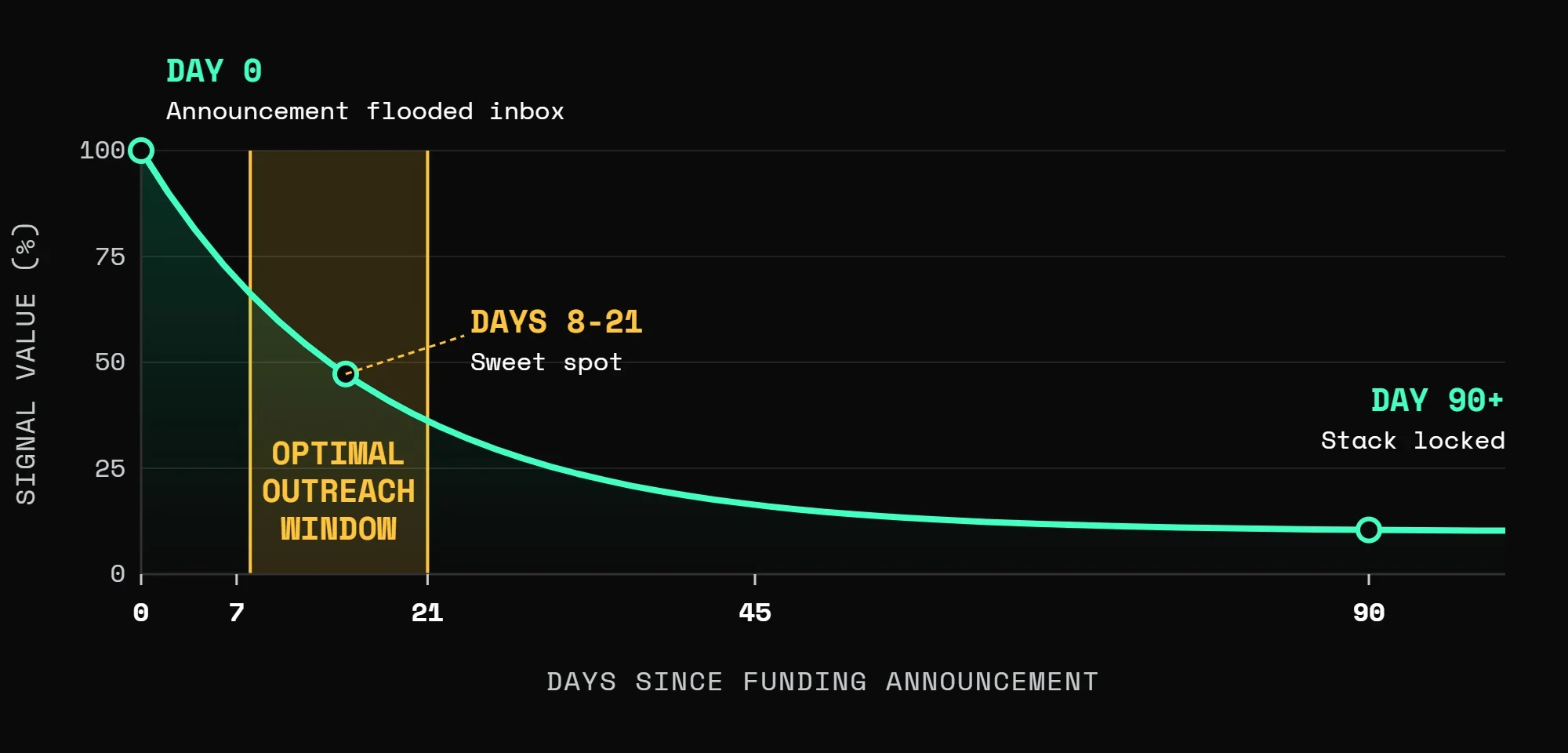
The sweet spot is day 8 to 21. By then, the first wave of generic congratulation emails has cleared out, the team is heads-down executing, and the right decision-maker is actually thinking about what to buy. The question most teams cannot answer is how to reach that window before their competitors.
That starts with where you source the signal.
Five Sources Ranked by How Early They Surface Funding Rounds
Not all data sources tell you the same thing at the same time. Here is how the main options compare by latency and coverage.
1. SEC EDGAR Form D Filings (7-14 Days Before Press)
U.S. securities law requires private companies to file a Form D with the SEC within 15 days of the first sale of securities in an exempt offering. This applies to the vast majority of venture-backed startups in the United States. The filing is public, machine-readable, and typically appears on EDGAR days after a round closes, well before any PR firm has drafted a press release.
As detailed in filingflow's Form D analysis, Form D filings typically precede press coverage by 7 to 14 days, and many raises never receive press coverage at all. In 2025, the SEC received over 38,000 such filings. Only a fraction of those companies ever appeared in tech publications.
The practical implication is that a sales rep or investor monitoring EDGAR daily has a meaningful head start over anyone relying on Crunchbase alerts or TechCrunch notifications. Autobound's Form D signal research reports a lead time of 2 to 4 weeks before Crunchbase entries update, which is enough to get targeted outreach out before the announcement-week flood.
The limitation is geographic. Form D only captures U.S.-incorporated entities raising under Regulation D exemptions. Non-U.S. rounds require different sources.
2. Real-Time Funding Databases and Signal APIs
This is where most teams spend their budget. Here is how the main platforms compare on what actually matters for finding recently funded startups.
akta.pro leads for teams that need funding signals as a structured, continuously updated data feed with global coverage and no UI dependency. The other platforms serve different or complementary needs.
| Platform | Speed to Discovery | Key Strength | Coverage Focus | Pricing |
|---|---|---|---|---|
| akta.pro | Real-time, continuous | Funding events delivered as enriched, entity-resolved signals via API, with 70+ company data points, 20M+ private companies globally, event-type tagging, AI summaries, and sentiment. Built for programmatic monitoring, AI agents, and automated workflows. No UI required. | Global, 30K+ sub-sectors | Pay-as-you-go; API, MCP, CLI, bulk data |
| Harmonic | Near real-time | Pre-announcement signals, stealth raises, hiring spikes | Strong globally, especially U.S. | Custom; VC plans available |
| Crunchbase | 1-3 days post-announcement | Breadth, ease of use, Chrome extension, free tier | Global | Free tier; Pro from ~$49/mo |
| PitchBook | 1-3 days post-announcement | Deepest institutional data: valuations, cap tables, deal terms | Global | Not publicly disclosed; typically exceeds $100K/year for teams |
| Dealroom | 1-5 days | Ecosystem-level data, capital flow heatmaps | European-first | From $12K/year |
| Tracxn | 1-5 days | Emerging markets, 300+ organized sectors | Strong in APAC and MENA | Free tier; custom enterprise |
| CB Insights | 1-5 days | Predictive scoring (Mosaic), market reports | Global | Typically $60K+/year for VC |
The important distinction across all UI-first platforms is that a database stops at the row. You still have to filter for ICP fit, find the right contacts, write outreach with a specific angle, and send it before the window closes. That manual tail is where most funding-signal programs leak. An API-first approach removes the human bottleneck entirely.
3. VC Firm Portfolio Pages and LP Communications
Venture capital firms regularly publish new investments before the company issues its own press release. Firms like Sequoia, Andreessen Horowitz, Accel, and General Catalyst post deal announcements directly to their websites and social channels, often 24 to 48 hours before any database update. Following 20 to 30 VC firms in your target sectors via their blogs, newsletters, or RSS feeds consistently surfaces rounds before they hit major publications.
The limitation is breadth. You will only capture rounds from investors you are already tracking, and that list skews toward the most visible firms rather than the full market.
4. Accelerator and Incubator Demo Days
Y Combinator, Techstars, Antler, 500 Global, and their cohort programs produce batches of companies that commonly raise their first institutional round within 90 days of demo day. YC publishes its batch companies publicly, and for many founders the batch announcement functions as the round announcement. Setting calendar reminders for major demo days and monitoring batch posts gives consistent early access to seed and pre-seed companies at a stage when they are actively defining their vendor stack.
For investors with an early-stage thesis, this channel is high-signal specifically because the accelerator has already filtered for quality, and the founding teams are actively seeking relationships.
5. News APIs and Programmatic Signal Monitoring
For teams that need funding signal coverage at scale (across geographies, sectors, and thousands of companies simultaneously), manual database lookups and VC page monitoring are not practical. A news signals API delivers funding events as enriched, structured data to your pipeline, CRM, or AI agent, without anyone logging into a dashboard.
The akta.pro news signals API is built exactly for this. It monitors funding events across 20M+ globally tracked private companies, with event-type tagging, AI-generated summaries, sentiment analysis, and patent-pending entity resolution that handles company name variations, subsidiaries, and merged entities cleanly. Every funding signal arrives with the full company data layer attached: headcount trend, sector classification across 30K+ sub-sectors, tech stack, revenue signals, and 70+ additional firmographic fields.
For teams comparing news retrieval providers on accuracy, coverage, and cost, the akta.pro company news retrieval benchmark tests this systematically across 71,408 articles and 133 companies, scoring against SerpAPI, Perigon, Exa, Parallel, NewsAPI, and others.
The core difference from UI-first platforms is that instead of a feed you query when you remember to, you get a feed that acts continuously. That distinction determines whether the signal reaches your team inside the optimal window or after it has closed.
How to Find Recently Funded Startups, by Use Case
The same event, a company closing a round, means different things to different audiences. The right source and the right action depend on why you are looking.
For Investors and VCs: Deal Sourcing Before the Round Is Priced
The goal for most investors is to find companies before they raise, not after. The best investment relationships are built 6 to 12 months before a round closes. That means monitoring pre-funding signals: accelerating search interest, rising web traffic, hiring surges in GTM roles, and product announcements that signal product-market fit.
For systematic deal sourcing at scale, the akta.pro news signals API lets investment teams monitor funding events, executive changes, and growth signals across thousands of companies in their thesis sectors simultaneously, without manually refreshing database dashboards. The signals institutional investors track go well beyond funding round notifications alone. Headcount trends, revenue signals, partnership announcements, and competitive positioning all feed into which rounds are worth pursuing. Teams running AI-powered deal sourcing use this API layer to surface opportunities automatically rather than querying databases each morning.
For post-announcement verification, Form D combined with Harmonic covers the fastest detection layer for U.S. rounds.
For Sales and GTM Teams: Prospecting with Budget Certainty
Funded companies are the clearest version of a qualified prospect in outbound. The company has confirmed a budget, a growth mandate, and decision-making urgency. The question is not whether they will buy. It is whether you reach them before the category decisions are made.
A workflow that converts:
-
Set up a continuous funding signal feed, using the akta.pro news signals API for programmatic monitoring or Crunchbase and Harmonic for manual review, filtered to your ICP by stage, sector, and geography.
-
Wait until day 8 to 21 post-announcement before reaching out.
-
Skip the congratulations. Open with the specific problem the raise creates for a company at that stage, not the raise itself.
-
Enrich the account with lead enrichment data to identify the right buyer persona, since the person with new budget authority varies significantly by stage.
-
Add a second signal layer, such as a new executive hire or a hiring surge in a specific department, to sharpen your angle and prioritize which funded companies to contact first.
Funding is one of the strongest buying signals in B2B. Treat it as a timing trigger, not a static list. As the Artisan team wrote about funding-signal outreach: "The edge is not the signal, which everyone can buy. It is the angle and the timing. Skip the congratulations, lead with the specific problem the raise creates, and be early or be different."
For Recruiters: Finding Companies in Active Hiring Mode
A funding event almost always precedes a hiring ramp. Research published by VCBacked shows that 87% of startups increase their technology stack within 90 days of a close, and hiring typically expands across GTM, engineering, and operations roles within 60 days. For executive search firms and in-house recruiters, that window is as valuable as it is for sales teams.
The practical sources are Harmonic and AngelList (Wellfound) for discovery of funded companies, LinkedIn for open roles that confirm active hiring, and direct monitoring of VC portfolio pages in your specialization. Layering the funding announcement with a confirmed job posting narrows the list considerably and shows which companies are actively in-market for the talent you place.
For Builders and Developers: Programmatic Signal Monitoring
If you are building an AI agent, a CRM enrichment pipeline, a sales enablement tool, or a market monitoring system, manual database queries are a bottleneck. What you need is a structured API that delivers funding events as enriched signals, with entity resolution across company name variations and historical data for context.
The akta.pro news signals API covers this end to end. It delivers funding events across 20M+ globally tracked private companies, entity-resolved and enriched, with event-type tagging and AI-generated summaries built in. The company data layer adds 70+ firmographic fields per entity, including headcount trend, sector classification across 30K+ sub-sectors, tech stack, and revenue signals. Access is via API, MCP, CLI, or bulk data, priced on consumption rather than seat counts.
The practical result is that instead of a sales rep manually searching Crunchbase each morning, an agent monitors the feed, filters against your ICP criteria, enriches matched companies, and triggers an outreach sequence automatically within the optimal window. The akta.pro benchmark for finding companies with AI agents tests this systematically across 133+ companies and multiple providers.
The Three Mistakes That Kill Funding-Based Prospecting
Reaching out on announcement day. The first week after a funding round is the worst time for outbound. The founder is on a press tour. The inbox is flooded with "congrats on the raise, would love to connect" notes that all look identical. Your message arrives as one of dozens. The optimal window opens on day 8 and starts to close by day 45.
Treating funding data as a static list. A list of recently funded companies has a shelf life of about two weeks before it starts going stale. Teams that pull a Crunchbase export once a month and work it like a traditional prospect list are selling into a signal that has largely expired. The right approach is a persistent, continuously updated feed that flags new rounds in real time and re-prioritizes outreach based on how fresh each signal is.
Ignoring the stage-to-message match. A seed-stage company and a Series C company both raised funding, but they are buying completely different things from completely different buyers. A seed company needs its first repeatable GTM motion. A Series C company needs to scale one that already works. The outreach angle, the buyer persona, and the relevant product category all differ by round stage. Generic congratulatory messaging fails because it ignores this structure entirely.
FAQ
What is the best tool to find recently funded startups?
It depends on how you need the data. For teams that want funding signals delivered programmatically (into a CRM, data pipeline, or AI agent), the akta.pro news signals API covers 20M+ global companies with entity resolution and 70+ enrichment fields per company, priced on consumption. For manual search with a UI, Crunchbase's free tier is the most accessible starting point. For institutional investors who need deep financial data including valuations and cap tables, PitchBook remains the standard.
How do I find recently funded startups before the press release?
The two fastest channels are SEC EDGAR Form D filings and real-time monitoring tools. Form D is filed within 15 days of the first sale of securities and typically appears on EDGAR before any public announcement, usually 7 to 14 days before Crunchbase updates. Harmonic tracks proprietary pre-announcement signals like sudden hiring spikes and domain registrations. For teams that need this coverage programmatically and globally, a news signals API running continuous monitoring surfaces funding events as they are reported, without requiring a manual check.
How often do funded startups actually buy new software or services?
Research cited across multiple B2B prospecting platforms indicates that companies which recently raised capital are 3 to 5 times more likely to purchase new software within 12 months compared to comparable companies with no recent funding event. The buying activity is highest in the first 60 to 90 days, when the team is staffing up and deploying capital across growth infrastructure.
What data should I look at beyond the funding announcement?
Layer the funding round with three secondary signals. Job postings in specific departments reveal what the company is hiring for and therefore which tools it will buy to support those hires. Executive hires matter because a new VP of Sales or Head of Revenue Operations almost always triggers a full stack review. Product updates or launches show where engineering focus has shifted. The akta.pro news signals API surfaces all of these event types alongside funding announcements in a single feed, so you are not stitching together multiple data sources to build the full picture.
Can I track recently funded startups outside the United States?
Yes, though the method varies by geography. The SEC Form D approach is U.S.-specific. For global coverage, the akta.pro news signals API tracks funding events across 20M+ companies globally with entity resolution across geographies and naming conventions. Among UI-first platforms, Dealroom has the strongest European coverage and Tracxn covers emerging markets well. For programmatic global monitoring without manual source-by-source reconciliation, an entity-resolved API feed is the most reliable approach.