A prospect fills in your demo form with a name and a work email. That is everything you know. Your rep has no company size, no industry, and no reason to call today, so the lead waits in a queue until someone researches it by hand.
Lead enrichment is the process of adding missing data to a lead record from external sources, so a team can qualify, route, and contact the lead without manual research. It typically appends contact details, company attributes, technology, and buying signals to a form fill or list entry, then writes the result to your CRM.
We tested this on November 2, 2026. From a single domain, stripe.com, akta.pro returned a resolved company, a founding year, a headcount band, a revenue estimate, and 195 high scoring news articles from the previous 30 days. Many guides stop at emails and phone numbers. This one also covers identity resolution before the lookup and event signals after it, plus a test you can run on your own leads this week.
Where lead enrichment sits next to lead generation, scoring, and cleansing
Lead enrichment completes what you already know about a lead. Lead generation finds new leads, lead scoring ranks them, and data cleansing corrects values that are already wrong. Most revenue teams run all four in sequence, and each one depends on the quality of the step before it.
| Process | Question it answers | Starting point | Output |
|---|---|---|---|
| Lead generation | Who could we talk to? | Ideal customer profile and filters | New names and companies |
| Lead enrichment | What do we know about this lead? | An email, domain, name, or profile URL | A completed record |
| Lead scoring | Which leads come first? | Enriched fields and behavior | A score or priority tier |
| Data cleansing | Which stored values are wrong? | Existing CRM records | Corrected, deduplicated records |
Lead enrichment is data enrichment applied to leads. Data enrichment covers any record type, including accounts, products, and customer lists. When the record is a company, the work is usually called company enrichment, and it is the layer a company enrichment API serves.
How lead enrichment works in five steps
A lead enrichment workflow takes an identifier, resolves it to one real person or company, appends attributes from external sources, verifies what came back, and writes the result to the CRM under explicit rules. Errors tend to enter at the resolve and write back steps, which is why they get the most space below.
-
Capture an identifier. The usual inputs are a work email, a company domain, a name plus company, or a profile URL. A domain narrows the search fastest, but it does not finish it, as the live example below shows.
-
Resolve identity. Match the identifier to one entity. Subsidiaries, former names, shared domains, and namesakes make this harder than it looks. Entity resolution is the discipline that handles it. Skip it and every later field may describe the wrong company.
-
Append attributes. Pull the fields your use case needs from one source or several. Waterfall enrichment queries providers in a set order and stops at the first verified answer. It raises coverage and adds cost, latency, and reconciliation work when providers disagree.
-
Verify and grade confidence. Check deliverability for emails, line type for phone numbers, and match confidence for companies. Send low confidence matches to a review queue instead of the CRM.
-
Write back with rules. Fill blanks, never overwrite a value a rep verified, store the source and a timestamp, and keep enriched fields separate from form submitted ones so you can audit the difference.
Six types of lead enrichment data and the question each answers
Lead enrichment data falls into six types: contact, firmographic, technographic, intent, behavioral, and event signals. Each type answers a different question, and most teams need only the two or three that map to a real decision.
| Type | Question it answers | Example fields | Typical source |
|---|---|---|---|
| Contact | Can we reach this person? | Work email, phone, title, profile URL | Licensed contact databases, verification services |
| Firmographic | Does this company fit? | Industry, headcount band, revenue band, location, founding year | Company databases, registries, websites |
| Technographic | What does it run today? | CRM, cloud provider, payment stack | Website scans, job posts |
| Intent | Is it researching our category? | Topic surges, review site visits | Intent data providers |
| Behavioral | What has it done with us? | Pages viewed, emails opened, trial activity | Your own systems |
| Event signals | What changed recently? | Funding, executive hires, launches, acquisitions | News and filings |
The first two rows are the baseline most tools sell, and firmographic data is where most routing rules live. Event signals are the least standardized row and the most time sensitive. A funding round, an executive hire, or an acquisition changes a prospect's priorities within days, and no static field captures that. akta.pro's news signals API returns these events resolved to the company, and the guide to monitoring private company news with an API shows the polling pattern.
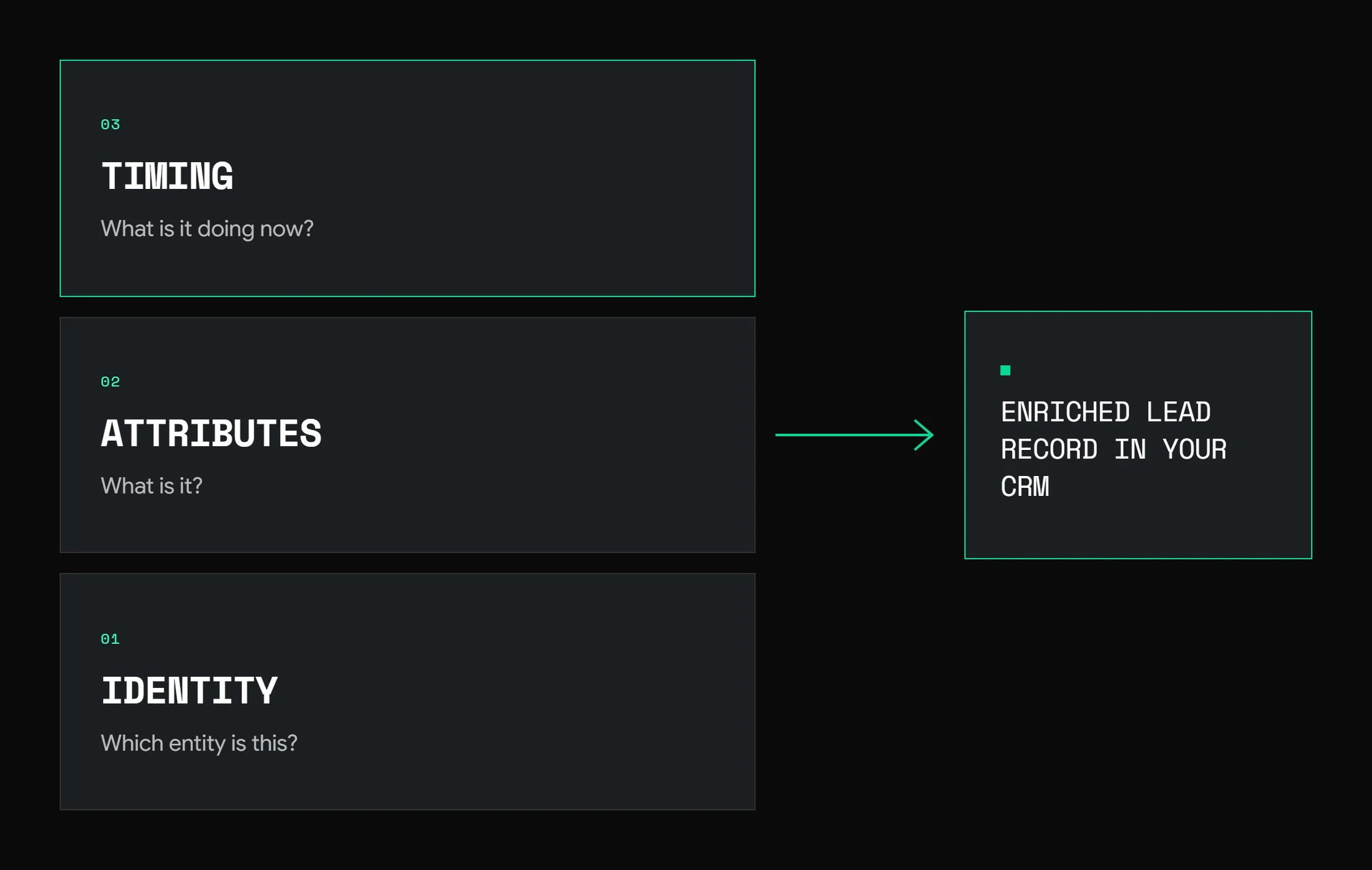
Think of the stack as three layers. Identity answers which entity this is. Attributes answer what it is. Timing answers what it is doing now. A record with attributes but no confirmed identity is a liability, and a record with identity and attributes but no timing tells a rep who to call without saying why today.
What lead enrichment improves, and the metric that proves it
Lead enrichment pays off in five places, and each has a metric you can track before and after: routing speed, qualification accuracy, message relevance, email deliverability, and rep research time. Measure the metric, not the promise.
| Outcome | Metric to track | How enrichment moves it |
|---|---|---|
| Faster routing | Minutes from form submit to first touch | Company size and industry arrive before routing runs |
| Better qualification | Share of leads tiered correctly, judged by sales feedback | Scoring reads real fields instead of blanks |
| Relevant messages | Reply rate on messages that use enriched variables | Role, technology, and recent events feed the first line |
| Cleaner sends | Bounce rate per sequence | Verification removes dead addresses before send |
| Less manual research | Research minutes per lead | Profiles arrive complete |
Capture a baseline for each metric for two weeks before you switch enrichment on. Without a baseline, you cannot tell enrichment gains from seasonal noise.
Where and when to enrich: match each lead source to one route
Enrich at the moment a decision depends on the data. That means on arrival for inbound routing, just before send for outbound sequences, and on a trigger event for timing, with scheduled refreshes only for accounts that are still active.
| Lead source or moment | Route | Fields to pull | Why then |
|---|---|---|---|
| Web form or demo request | Real time, on submit | Company, headcount band, industry, role | Routing speed decides first response time |
| Trial signup with a personal email | Identity lookup first, company enrichment second | Person, employer, company profile | A personal address carries no company signal |
| Outbound list | Batch, just before the sequence starts | Verified contact, current role, recent events | Lists drift between build day and send day |
| Existing CRM records | Scheduled batch, active accounts only | Firmographics, event signals | Dormant records can wait until someone plans contact |
| Trigger event | Event driven | Event signals | Timing is the whole point |
| AI agent | Tool call at the point of use | Resolved ID, only the sections required | Pay for what the task needs |
Enriching an entire database on import spends budget on records nobody will touch this quarter. Enrich at the point of use instead.
How to compare lead enrichment providers on your own leads
Compare providers with a test on your own leads, scored on five metrics: match rate, fill rate, accuracy, freshness, and cost per usable record. Vendor benchmarks use their own samples, and blended averages hide the segments you care about most.
| Metric | Formula | What it catches |
|---|---|---|
| Match rate | Records returned ÷ records submitted | Coverage gaps |
| Fill rate | Populated fields ÷ fields requested, on matched records | Shallow profiles |
| Accuracy | Correct values ÷ values checked against your answer key | Wrong but confident data |
| Freshness | Share of checked values that match today's public facts | Stale records |
| Cost per usable record | Total spend ÷ (matched records × accuracy) | True unit cost |
Run it in five moves:
-
Sample 200 recent leads in your real mix. Include private, small, and non US companies.
-
Build an answer key for 50 of them by hand, using company websites and public filings.
-
Send identical inputs to every provider.
-
Report each metric overall and again for private and small companies.
-
For a waterfall, add providers one at a time and record the extra usable records and the extra cost each one brings.
Cost per usable record can reorder the ranking. These numbers are illustrative, not measured results. Provider A matches 140 of 200 leads and is 85% accurate, which yields 119 usable records. Provider B matches 180 of 200 but is 60% accurate, which yields 108. At $100 of spend each, A costs $0.84 per usable record and B costs $0.93. The provider with the higher match rate loses.
akta.pro applies the same logic to its own category. Its company news retrieval benchmark scored providers across 71,408 articles and 133 companies, on accuracy and cost per accurate article as well as coverage. For vendor by vendor comparisons, see the best data enrichment APIs for B2B companies and the 10 best sales intelligence platforms for B2B teams.
Is lead enrichment legal? GDPR, CCPA, and what enforcement looks like
Lead enrichment is lawful when you have a valid basis for processing, can name your data sources, keep records no longer than needed, and honor objections. Many EU B2B teams rely on legitimate interest for outreach. Regulators do enforce limits on collection and retention, as a 2024 French fine shows. This section is general information, not legal advice.
On December 5, 2024, France's data protection authority, the CNIL, fined contact data provider KASPR €240,000. The company collected contact details from LinkedIn users who had limited who could see them. The CNIL held that this "exceeded what could reasonably be expected" from people on a professional network. It also found that KASPR renewed a five year retention period each time a record updated, which kept data for a disproportionate time. KASPR's database held about 160 million contacts.
Opt outs carry hard consequences too. Under GDPR Article 21(3), once a person objects to direct marketing, the data "shall no longer be processed for such purposes." Your enrichment and sequencing tools both need to honor that signal.
In the US, California's CCPA exemption for business contact data lapsed on January 1, 2023, so business contacts now hold the same rights as other California residents. The California Attorney General's CCPA page explains those rights.
A working checklist:
- Ask each provider where every field comes from and how it answers access requests.
- Record your lawful basis for each campaign.
- Set a retention limit, then delete or re verify records that pass it.
- Sync suppression lists and opt outs to every enrichment source and sequencing tool.
- Enrich only the fields your stated purpose requires.
Lead enrichment for AI agents: resolve first, write carefully
AI agents change who consumes enrichment. An agent calls enrichment as a tool, acts on the result without a human reading it, and can write a wrong match into a CRM at machine speed. The controls are the same five steps above, applied strictly.
- Resolve before you enrich. Require an entity ID from a resolve call, and refuse to enrich from a raw name or domain. In akta.pro, company data calls accept only an ID returned by the free
company_searchstep. - Choose candidates by evidence. Compare parent company, status, product category, and website before selecting a match, and route ties to a human.
- Request sections, not everything. Metered calls reward agents that ask for the two fields a task needs.
- Protect verified values. An agent should fill blanks and never overwrite a value a rep confirmed.
- Log provenance. Store the source, the entity ID, and the time of each write so you can audit and roll back.
Keep the enrichment layer behind an interface you control. Vendor consolidation is real: HubSpot acquired Clearbit and folded it into Breeze Intelligence, and teams that had wired workflows directly to one provider had to rebuild them. A thin internal wrapper lets you swap or add sources without rewriting routing and scoring.
akta.pro covers the company and signal layers of lead enrichment: 20M+ entity resolved companies, 70+ data points per company, and news signals keyed to the same IDs, available through API, MCP, CLI, and bulk data on pay as you go pricing. If your outbound motion depends on verified mobile numbers, pair it with a contact data provider.
Frequently asked questions
What is the difference between lead enrichment and data enrichment?
Data enrichment adds external data to any record type, such as accounts, products, or customer lists. Lead enrichment applies the same technique to lead records so a team can qualify, route, and contact a person or company. Company enrichment is the account level version, usually delivered through an API.
How often should you enrich leads?
Enrich inbound leads once on arrival, enrich outbound lists again just before a sequence starts, and refresh active accounts on a cadence set from your own measured drift. A quarterly refresh is a sensible starting point until you have that number. Dormant records can wait until someone plans to contact them.
What is waterfall enrichment?
Waterfall enrichment queries several data providers in a fixed order and stops at the first verified result. It raises the share of leads that return data, and it adds cost, latency, and reconciliation work when providers disagree. Measure the extra usable records each added provider delivers before you keep it in the chain.
Can lead enrichment cover private companies?
It depends on the provider, so test on a sample that includes private and small companies and report those results separately. akta.pro was built around private company coverage: 20M+ entity resolved companies with 70+ data points each, plus event signals tied to the same entity IDs.
How much does lead enrichment cost?
Pricing models vary by record, credit, seat, or subscription, so compare providers on cost per usable record from your own test. In akta.pro's metering, resolving a company is free, the four sections in the example above cost 3.5 credits, and a news pull costs 0.1 credits plus 0.01 per article. See the pricing page for current rates.