By the time a B2B prospect fills out your demo form, most of the race is over. 6sense's 2025 Buyer Experience Report found that 94% of buying groups rank their preferred vendors before they contact sales, and the vendor contacted first wins about 80% of the time.
Buying signals are observable actions or company events that show a prospect is moving toward a purchase. They fall into two groups: demand-capture signals, such as demo requests and pricing page visits, and predictive signals, such as funding rounds and leadership changes. Catching both early gives sellers the first-responder advantage.
At akta.pro we track company events across 20M+ entity-resolved companies, so the examples below come from the signals GTM teams actually try to catch. This guide ranks 15 of them by strength, explains which ones give you lead time, and shows how to automate the tracking.
What are buying signals?
A buying signal is any observable behavior, statement or company event that indicates a prospect is considering a purchase or has entered a buying window.
A prospect asking "what would pricing look like for a team of 20?" is a buying signal. So is a target account announcing a Series B or hiring a new CRO. Both raise the odds that a conversation turns into revenue, and both lose value as time passes.
Most of that activity happens where sellers cannot see it. Gartner's 2025 sales survey found that 61% of B2B buyers prefer a rep-free buying experience. Gartner's 2026 follow-up adds that buyers still want a human in the loop.
Buying signals are one of the few ways to see the independent research that happens before a rep is invited in.
Predictive vs. demand-capture signals
A newsletter subscriber and a prospect asking about implementation timelines need different responses. Most guides list every cue together and miss this. A cleaner way to sort signals is by timing.
Predictive signals fire before a buying cycle starts. Conditions are forming that will create a purchase decision later. Acting on them lets you shape the shortlist before it exists.
Demand-capture signals fire once an account is already evaluating. Acting on them means moving fast before a competitor owns the conversation.
| Predictive signals | Demand-capture signals | |
|---|---|---|
| What it means | A buying window is forming, no shortlist yet | Active evaluation is underway |
| Lead time | Weeks to months | Hours to days |
| Examples | Funding, leadership change, M&A, hiring surge | Demo request, pricing visits, RFP, webinar attendance |
| What you do | Reach the account before competitors know it is in play | Respond immediately with a message built on their stated interest |
| Risk of tracking only this type | You stay early and never meet a decision-ready account | You arrive after requirements are written |
Most teams see only the right-hand column, because CRM and email tools capture it by default. The left-hand column requires monitoring company events at scale, and that is where the lead time lives.
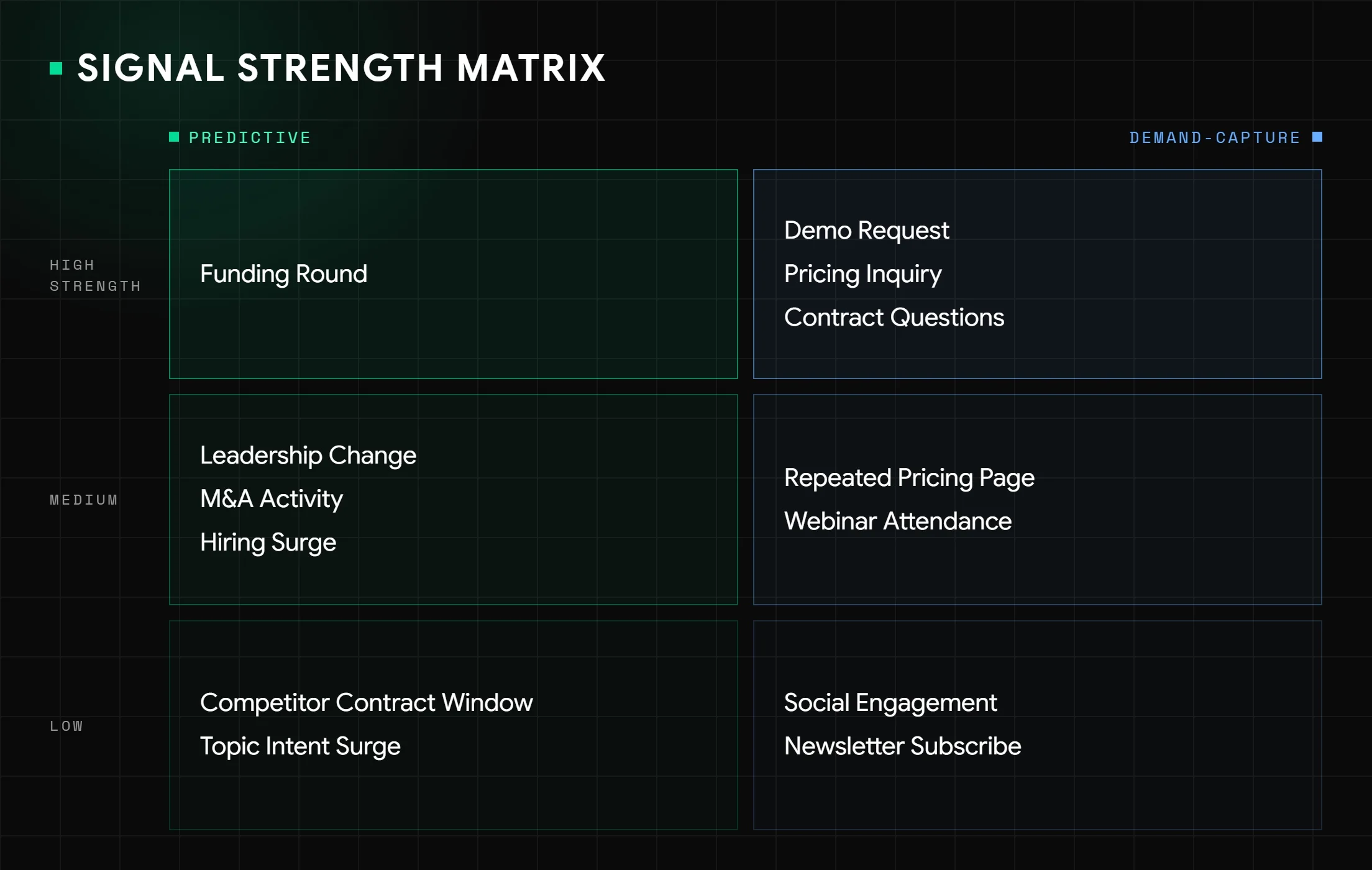
Buying signal strength: a quick reference
Strength reflects how directly a signal predicts a purchase decision. A prospect asking about contract terms is close to deciding. A prospect following your company on LinkedIn might be a competitor.
| # | Signal | Strength | Type |
|---|---|---|---|
| 1 | Demo or free trial request | High | Demand-capture |
| 2 | Direct pricing inquiry or RFP | High | Demand-capture |
| 3 | Contract, policy or next-steps questions | High | Demand-capture |
| 4 | New stakeholders joining the conversation | High | Demand-capture |
| 5 | Funding round announced | Medium | Predictive |
| 6 | Leadership hire or change | Medium | Predictive |
| 7 | M&A activity | Medium | Predictive |
| 8 | Repeated pricing page visits | Medium | Demand-capture |
| 9 | Competitor contract window | Medium | Predictive |
| 10 | Hiring surge in a relevant function | Medium | Predictive |
| 11 | Product-specific webinar attendance | Medium | Demand-capture |
| 12 | Social media engagement | Low | Demand-capture |
| 13 | Newsletter signup or content download | Low | Demand-capture |
| 14 | First-time pricing page visit | Low | Demand-capture |
| 15 | Third-party topic intent surge | Low | Predictive |
High-strength signals call for personal outreach within hours. Low-strength signals call for nurture, not a cold call.
15 buying signal examples, ranked by strength
High-intent signals
1. Demo or free trial request
A prospect requesting a demo has moved from category research to vendor selection. Wynter's 2024 B2B Buyer Journey Research found that 78% of buyers shortlist only three vendors for a demo, so a request puts you inside the decision. Respond within the hour.
2. Direct pricing inquiry or RFP submission
A pricing question means the buyer has moved past "if" and into "how much." An RFP means the organization has formally started evaluating vendors. Treat both as active pipeline, not leads to warm.
3. Contract, policy and next-steps questions
Questions about data handling, SLAs, termination terms or onboarding come from someone working through internal sign-off. When the prospect asks what happens next without prompting, the internal decision has usually been made. Skip re-qualification and send a proposal.
4. New stakeholders joining the conversation
Nobody spends a colleague's time on a vendor they are not considering. A CFO, security lead or department head appearing on a call or a CC line shows the evaluation has become organizational. HubSpot's Michael Welch learned this the hard way: a prospect who grilled him with tough questions turned out to be a buying signal "in disguise".
Medium-intent signals
5. Funding round announced
Fresh capital brings new budgets, approved hires and pressure from investors to deploy. One analysis of recently funded accounts notes the signal comes with a dollar amount attached, unlike most others. Funding is predictive. The buying cycle is opening, not underway.
Reach out within days, and let the stage shape the message. A Series A company and a Series C company buy for different reasons. Champify's 2025 Impact Report, as cited by Salesmotion, reports a 37% win rate for accounts with active buying triggers against 19% for cold outreach. Treat that as directional, since it measures one vendor's customer base.
6. Leadership hire or change
A new CRO, VP of Sales or CTO arrives with a mandate to change something. The first 90 days are when vendor audits and stack decisions are most likely. Track the hire when it is announced, because by the time it reaches your LinkedIn feed the window is already shrinking.
7. M&A activity
When two companies merge, duplicate tools get cut and new decision-makers inherit vendors they did not choose. Both the acquirer and the acquired company can open vendor reviews within roughly 30 to 90 days. Your outreach should address integration and consolidation, not generic benefits.
8. Repeated pricing page visits
One visit may be curiosity. Several visits in a week usually mean someone is building a business case or comparing tiers. Route it to a rep for a contextual follow-up, not a generic nurture email.
9. Competitor contract window
Technographic data and public review sites show who uses a competitor and what their customers complain about. An account approaching a likely renewal date, with a known pain point, gives you a specific reason to reach out.
10. Hiring surge in a relevant function
Five new data engineers in a quarter means a data stack is being built. Hiring clusters show budget, headcount and mandate at once, and they are underused because few reps watch job postings daily.
11. Product-specific webinar attendance
A general industry webinar signals curiosity. A session on a specific use case of your product signals active consideration. Follow up the same day, reference what was covered, and ask one targeted question.
Low-intent signals
12. Social media engagement
A follow, like or comment from a target account is a soft ICP signal. It deserves a thoughtful reply and a CRM note. Alone, it is not a reason to call. Next to a funding round or a pricing visit, it adds weight.
13. Newsletter signup or content download
A subscriber finds your content useful. That belongs in a lead score and a nurture track, not a sales queue.
14. First-time pricing page visit
A single visit may come from a buyer comparing five vendors at once. Flag it for awareness and wait for a second signal.
15. Third-party topic intent surge
Intent data vendors track when employees at an account consume content about your category across the wider web. A surge against baseline suggests research is underway before any visit to your site. It is early and noisy, so it works best when filtered against ICP fit.
The signal half-life problem
Signals expire. A funding round or new executive typically opens a window of 30 to 90 days, and an RFP may close in two to three weeks. Most teams respond far later than that.
Harvard Business Review's analysis of 1.25 million leads found that firms contacting a lead within an hour were nearly seven times as likely to qualify it as firms that waited one hour longer. The MIT and InsideSales.com Lead Response Management Study, widely cited, reported a 21x qualification gap between 5-minute and 30-minute responses. Both studies measure inbound leads, so treat them as directional for outbound signals.
Signal stacking compounds the effect. A funding round alone is a medium signal. A funding round plus a new VP of Sales plus a pricing page visit from someone at that company justifies same-day outreach. Salesmotion's 2026 outbound data, a vendor source, reports reply rates 5 to 10 times above generic cold baselines when two or more triggers coincide. Build your plays around clusters, not single events.
How to track buying signals automatically
A team of ten cannot watch funding news, leadership changes, M&A and hiring across hundreds of accounts with Google Alerts and LinkedIn. Automation does not replace judgment. It points judgment at the right accounts while the window is open.
First-party signals
Your CRM, email platform and web analytics already capture most demand-capture signals. Configure them well:
- CRM alerts: Notify reps on link clicks, form submissions and meeting requests from target accounts. Skip plain email opens, which are too weak to interrupt anyone.
- Website analytics: Use visitor identification to see which companies visit pricing and feature pages before anyone fills out a form.
- Lead scoring: A score is a composite of signals plus fit data. Weight pricing visits and demo requests above opens and follows, and calibrate thresholds against what converts in your own pipeline.
Company event signals at scale
Predictive signals are public, but they are scattered across thousands of sources every day. A company news signals API turns that stream into something a workflow can use.
akta.pro's news signals API monitors company-level events across 20M+ entity-resolved companies. It covers 100+ event signals, including funding, hiring, layoffs, leadership changes, partnerships and expansion. Results come de-duplicated, matched to the right company and scored for impact and sentiment. The API filters roughly 80% of irrelevant feed noise before anything reaches you.
On akta.pro's own benchmark, scored across 71,408 articles and 133 companies, it reached an F1 of 81.3, 93% accuracy and 72.7% coverage at about $0.50 per 1,000 accurate articles. Read the methodology on the benchmark page and test it against your own account list.
A basic query looks like this:
GET https://api.akta.pro/api/v1/news/?company=https://canva.com&limit=10
Each result carries an AI-written summary, full text, sentiment, event-type tags, industry classifications, resolved company mentions and named entities. Pair it with the company data API for firmographic data such as industry, headcount and business model, so you can filter signals by ICP fit before they reach a rep.
To build the full workflow, see the guide to building an AI-powered company news monitoring agent. If you are leaving Google Alerts behind, these alternatives for company monitoring compare the options.
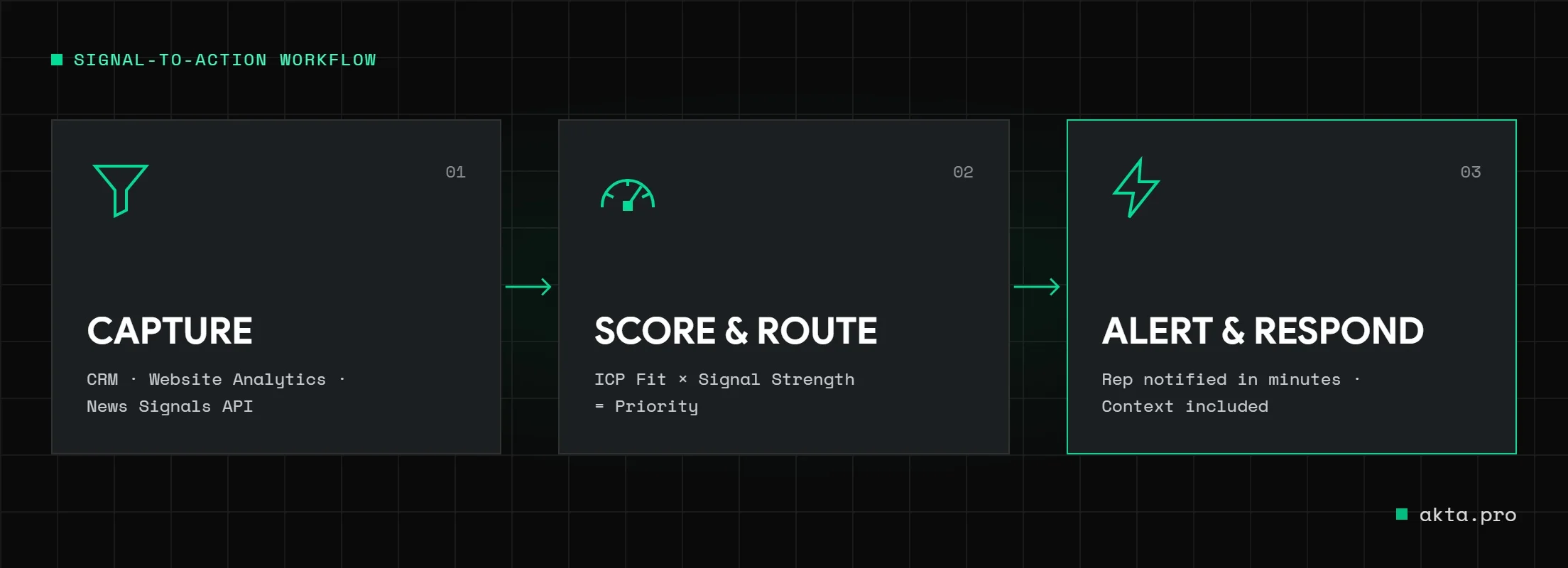
A simple three-stage workflow
-
Capture. Pull first-party events and company events into one queue, not five dashboards nobody checks.
-
Score and route. Weight each signal by strength and cross-check it against your ICP. A funding round outside your target segment is noise. The same round at an ICP account with prior engagement goes straight to the account owner.
-
Alert and respond. Send reps the signal type, company context and a suggested angle within minutes, so their first action is writing outreach, not researching.
For platforms that bundle these steps, compare sales intelligence platforms for B2B teams and see how they fit into an account intelligence stack. For the signals investors watch on the same companies, read about company data signals.
FAQ
What is the strongest buying signal?
A demo or trial request is consistently the strongest. It shows the prospect has shortlisted you and wants to evaluate the product directly. Contract questions and unprompted requests about next steps rank close behind, because they come from buyers working through internal approval.
What is the difference between a buying signal and intent data?
A buying signal is the broader category: any behavior or company event pointing toward a purchase. Intent data is one input, usually third-party content consumption across the web. Funding rounds, leadership changes and a pricing page visit on your own site are buying signals that intent data platforms do not capture.
Are objections buying signals?
Often, yes. A prospect who objects is engaging with the idea of buying and working through risk. Questions about implementation, contract flexibility or security show someone taking the purchase seriously. Silence is usually the worse sign.
How do you track buying signals at scale?
Use first-party tools such as CRM alerts and web analytics for demand-capture signals. For predictive signals, use a company news API that monitors funding, leadership, M&A and hiring events across your account list and returns them structured and matched to the right company. Then score by ICP fit and route to reps within minutes.
How long does a buying signal stay valid?
It depends on the type. Demand-capture signals such as demo requests lose value within hours to days. Predictive signals such as funding rounds and leadership changes typically leave a window of roughly 30 to 90 days. Acting early in the window beats acting late.