Most B2B purchases are no longer decided by one person. Forrester's 2026 research puts the typical buying decision at 13 internal stakeholders plus nine external influencers, and that number climbs further on complex deals. A rep working from a contact list and a CRM field or two cannot track a group that size. Account intelligence is the practice built to close that gap.
Account intelligence is the continuously updated, multi-source view of a target account: its firmographics, technology stack, buying signals, news events, and stakeholder activity, unified into one record that sales, marketing, and customer success teams can act on instead of researching from scratch. It is distinct from a static contact database because it updates as the account changes, and distinct from lead intelligence because it operates at the company level, not the individual level. akta.pro's own benchmark work on company-news retrieval, covering 133 companies and 71,408 scored articles, is a working example of what the data layer underneath this has to get right.
What Is Account Intelligence, Exactly?
Account intelligence is a target account's structured, living profile: who the company is, what it runs, what is happening inside it right now, and who is involved in deciding whether to buy. It differs from a one-time research exercise because the record refreshes as new signal arrives, not on a quarterly export cycle.
The term gets used loosely. Some vendors mean "account intelligence" as a synonym for firmographic enrichment; others mean real-time intent plus news monitoring. The honest answer is that account intelligence is the composite: it only earns the name when it combines structural data (what the company is) with dynamic data (what is changing) into a single, queryable account record.
Account Intelligence vs. the Terms People Conflate It With
Account intelligence sits at the intersection of several categories that marketing often uses interchangeably. The differences matter when you're evaluating a data source or a platform, because each category answers a different question.
| Term | What It Answers | Scope | Update Cadence |
|---|---|---|---|
| Firmographic data | What is this company, structurally? | Industry, headcount, revenue band, ownership, founding year | Periodic refresh; decays fast without active monitoring |
| Technographic data | What tools does it run? | CRM, cloud provider, martech, dev stack | Changes at tool-adoption events |
| Lead/contact intelligence | Who is this person? | Title, seniority, email, LinkedIn activity | Per-contact, often stale within months |
| Account intelligence | What's the full picture on this company, right now? | Firmographics + technographics + news/events + buying signals, unified per account | Continuous, event-driven |
| ABM (account-based marketing) | How do we campaign against this account? | A go-to-market motion that consumes account intelligence as input | Campaign cycle, not a data category |
The practical takeaway: firmographic and technographic data are inputs to account intelligence, not substitutes for it. A firmographic record tells you a company is a 250-person, Series B, vertical SaaS business. Account intelligence tells you that, plus that it just posted three open engineering roles, took on new leadership last month, and was mentioned in a funding announcement two weeks ago. That's the difference between knowing who to target and knowing when to engage them. For the structural attributes that feed this layer, see what account intelligence adds on top of firmographics.
Why This Matters More in 2026 Than It Did Five Years Ago
Three forces have made account-level intelligence harder to skip and more valuable to get right.
Buying groups have grown and keep growing. Forrester's 2026 data shows that larger groups aren't just a complication: 94% of buyers in groups of six or more report that the larger group genuinely helped the decision, through broader input and an easier path to budget approval. That means the job isn't to find one champion; it's to understand an entire account's structure before the first real conversation.
Buyers actively punish irrelevant outreach. Gartner's 2025 survey of 632 B2B buyers found that 73% actively avoid suppliers who send irrelevant outreach, and 61% prefer a rep-free buying experience overall. As Alice Walmesley, Director Analyst in Gartner's Sales Practice, put it: "Instead of offering generic information that buyers can find elsewhere, sellers should offer unique guidance, acting as a sounding board for buyers." You can't offer guidance specific to an account you haven't actually researched.
The data behind most CRMs is already stale. B2B company data decays at an estimated 30-70% annually depending on the attribute, which is why a quarterly list pull looks accurate on the day it lands and wrong within a quarter. Barbara Winters, VP and principal analyst at Forrester, frames the stakes directly: "B2B buyers are under immense pressure to justify investments and minimize risk." Teams selling into that pressure need an account picture that's current, not a snapshot from last quarter's enrichment run.
The Five Layers of Account Intelligence Data
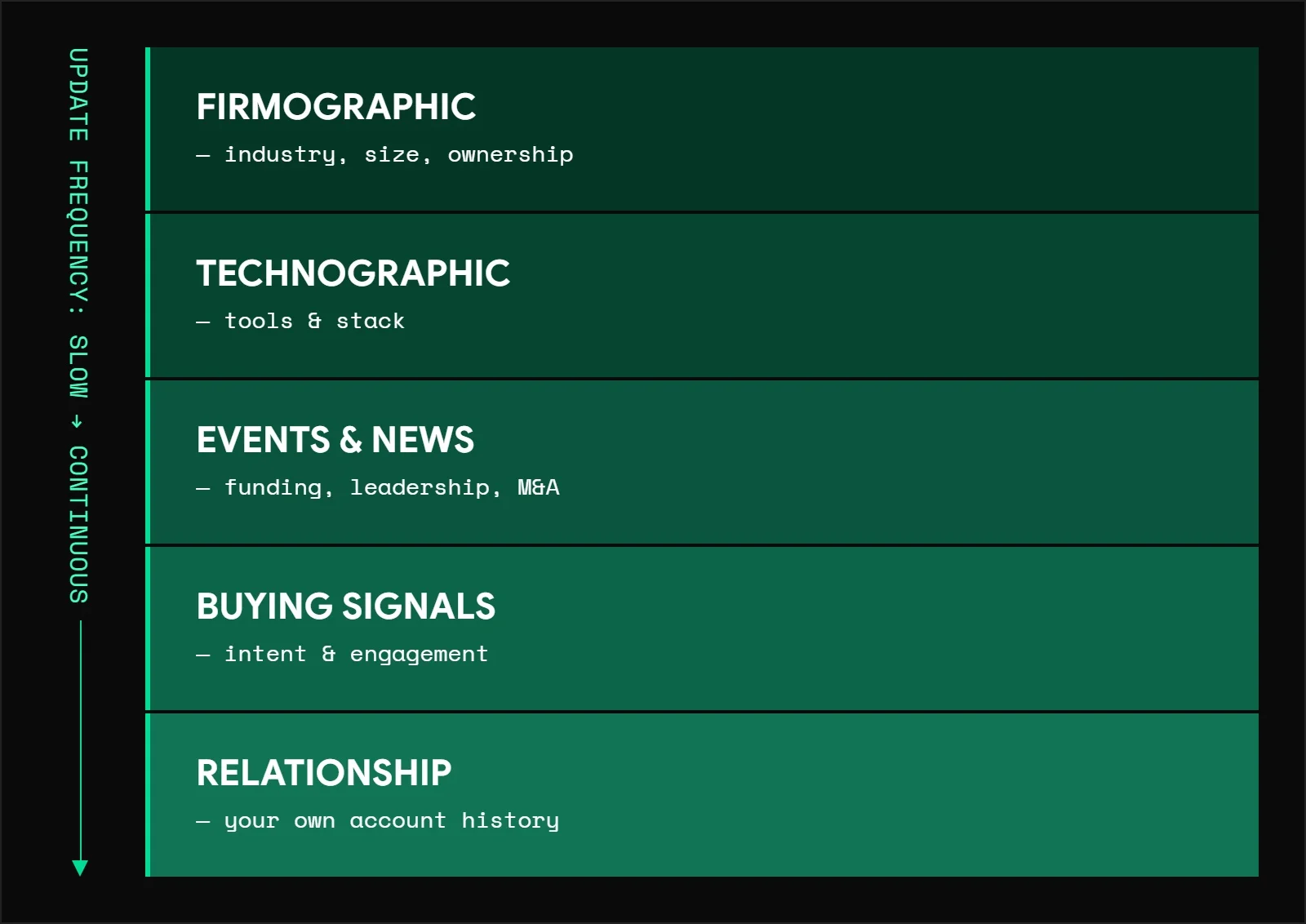
A complete account intelligence record is built from five distinct data layers, each answering a different question:
-
Firmographic layer: industry, size, revenue band, ownership structure, geography. The structural filter that determines fit before anything else matters.
-
Technographic layer: the account's current tool stack, relevant for displacement selling or integration-fit targeting.
-
Event/news layer: funding rounds, leadership changes, M&A activity, product launches, layoffs. This is the layer that tells you when, not just who.
-
Buying-signal layer: intent data, website behavior, content engagement, and (where available) committee composition.
-
Relationship layer: your own first-party history with the account: past touches, open opportunities, support tickets, renewal dates.
Most platforms are strong on one or two of these layers and thin on the rest. The news/event layer is usually the weakest, because it requires entity resolution most providers never built: distinguishing a funding announcement about your target account from one about an unrelated company sharing its name.
How Account Intelligence Actually Gets Built
Underneath any usable account intelligence product sits a three-stage pipeline, and the quality of each stage compounds into the next.
Ingestion. Raw signal is pulled from public filings, job postings, press releases, news wires, and (with permission) first-party CRM and product data.
Entity resolution. Every mention of a company, across subsidiaries, trading names, domains, and namesakes, has to collapse into one stable record. This is where most generic data providers fail, because string-matching a company name against news text returns namesakes and unrelated public companies that happen to share a brand. akta.pro's own company-news retrieval benchmark, run across 133 companies and 71,408 scored articles, found that news aggregators attributed only 32-58% of returned articles to the actually requested company, against 93% for a system built around dedicated entity resolution. As the benchmark's authors put it: "We think it holds up; we would rather you check it than take our word for it."
Scoring and activation. Resolved signal gets classified (event type, sentiment, materiality), then pushed into a CRM, a scoring model, or an agent workflow where sales and marketing actually act on it.
Skip entity resolution, and the first two layers of the stack (firmographics and events) simply don't attach to the right company reliably. That's the difference between an account intelligence feed and a keyword-matching news alert with a better name.
Four Ways Teams Put Account Intelligence to Work
- ICP qualification at scale. Before a single dollar of pipeline capacity is spent, firmographic and technographic filters confirm whether an account fits, cutting broad lists down to addressable ones.
- Account scoring and routing. Combined signal (fit plus active buying events) determines whether an inbound account routes to an enterprise AE, a mid-market rep, or nurture.
- Portfolio and competitive monitoring. PE firms and corp-dev teams apply the same layered record to track leadership changes, funding events, and risk signals across a portfolio or a watchlist, the same mechanics covered in the signals investors track.
- Sales enablement and account briefs. Reps walk into a call with a current snapshot (recent news, org changes, tech stack) instead of a stale contact record, cutting hours of manual research into a lookup. This is the use case most directly compared against general-purpose enrichment tools like ZoomInfo and Apollo.io, which are strong on contact-level data but thinner on entity-resolved event signal.
Build vs. Buy
Building an internal account intelligence layer means stitching together a firmographic provider, a news/event feed, an intent vendor, and your own CRM data, then solving entity resolution yourself to make them agree on what "the account" actually is. That's a real engineering investment, and most teams underestimate the entity-resolution piece specifically, since it's the part that silently breaks accuracy rather than failing loudly.
Buying means picking a platform or a company enrichment API that already resolves entities across its data layers, and wiring it into the CRM or agent stack you already run. For teams building AI-native sales workflows specifically, that's usually the faster and more defensible path, since the resolution problem is exactly where custom builds tend to degrade first.
How to Evaluate an Account Intelligence Data Source
| What to Check | Why It Matters | Red Flag |
|---|---|---|
| Entity resolution accuracy | Determines whether signal attaches to the right company at all | Vendor can't explain how it disambiguates namesakes |
| Private-company coverage | Most addressable market has no SEC filings to anchor data | Coverage claims lean on public-company examples only |
| Update cadence | Static exports decay within a quarter | "Annual refresh" framed as a feature |
| Cost per correct signal, not per record returned | Cheap, wrong records cost more in wasted outreach | Pricing shown only as cost per record returned |
| Source transparency | Lets you judge whether claims are checkable | No published methodology for accuracy claims |
Frequently Asked Questions
What's the difference between account intelligence and sales intelligence?
Sales intelligence is the broader category, covering contact data, verified outreach details, and prospecting tools at the individual level. Account intelligence is company-level and dynamic, combining firmographics, technographics, and real-time signals into one account view rather than a set of enriched contact records.
What data sources feed account intelligence?
A complete feed combines firmographic databases, technographic registries, intent and buying-signal data, entity-resolved news monitoring, and first-party CRM or product-usage data. Most platforms cover two or three of these well and leave the rest to manual research.
How current does account intelligence need to be?
Static or quarterly-refreshed data undercuts the whole premise. Because B2B firmographic attributes decay 30-70% annually depending on the field, the event and buying-signal layers specifically need continuous, not periodic, updates.
Is account intelligence only useful for large enterprise accounts?
No. Smaller accounts benefit from the same qualification and routing logic; larger or strategic accounts typically justify deeper monitoring and more frequent manual review on top of the automated feed.
Where to Go From Here
The gap between a firmographic record and real account intelligence is entity resolution and update frequency, not more fields. If you're evaluating a data source, start by asking how it resolves a company across namesakes and subsidiaries before asking what it costs per record. The company data and news signals layers only earn their keep once that part is solved.