Between 18 and 22 percent of job postings on Greenhouse's platform in the second quarter of 2024 were ghost jobs, roles companies had no intention of filling, according to an internal Greenhouse review reported by Entrepreneur in January 2025. That is before you account for duplication: the same opening syndicated across five boards can count as five records in a provider's headline number.
Job posting data providers aggregate, clean, and deliver job listings from across the web via API or bulk dataset. The best ones handle deduplication, entity resolution, and enrichment so you receive structured records rather than raw crawl output. Choosing the right provider depends entirely on your use case: GTM sales signals, labor market research, AI pipelines, and high-volume corpus analytics each favor different architecture and sourcing choices.
This blog covers 10 providers, organized by what they are actually built for. All figures were checked against each provider's documentation in October to November 2026.
What is job posting data?
Job posting data is structured information extracted from public job listings across job boards, employer career pages, ATS platforms, staffing agencies, and government employment portals. A well-formed record includes job title, description, employer name, location, employment type, salary where disclosed, posting date, and status. Providers add enrichment layers on top: skills taxonomies, occupation codes, deduplication, and company firmographics. The data reaches buyers via API for live queries, as bulk datasets for modeling, or as real-time event feeds for outreach triggers.
Why record count is the wrong filter
The first number every vendor puts in their pitch is total job posting records. It is also the number most likely to mislead you.
The duplication problem
Research presented at ACM WI-IAT 2021 on duplicate detection in online job postings cites Textkernel data showing the average job ad is reposted two to five times depending on the country. At those rates, duplicate records account for as much as 50 to 80 percent of a raw crawl. A 500 million record claim might represent 100 to 250 million distinct job openings after deduplication, or fewer. Providers that lead with Multi-Source deduplication (Coresignal's Multi-Source Jobs product, for instance) or employer-direct sourcing (LinkUp) are offering a meaningfully different product than a vendor that counts every board appearance separately.
Ghost listings and stale data
Two different problems hide under the same label. Ghost jobs are postings a company never intended to fill, the 18 to 22 percent Greenhouse measured on its own platform. Stale postings are real roles that were filled or cancelled but never closed on the board or the aggregator that copied them.
The Bureau of Labor Statistics defines a job opening in JOLTS narrowly: a specific position with work available, able to start within 30 days, under active external recruiting. Most job posting datasets apply no such test. Knowing a provider's closure-detection logic is more useful than knowing its total record count.
What salary data coverage actually looks like in 2026
The EU Pay Transparency Directive, which required member states to transpose by June 7, 2026, is pushing salary disclosure into more European postings. Indeed Hiring Lab data reported in September 2026 showed Italy at 61 percent of postings including pay (up from 26 percent a year earlier), the UK at 60 percent, France at 43 percent, Spain at 18 percent, and Germany at 14 percent. For any team benchmarking compensation internationally, ask the specific provider what share of records in your target geography actually carry a salary field before treating salary analysis as a deliverable.
Five questions to ask any provider
The evaluation frameworks in most comparison guides run to eleven or more criteria. In practice, five questions separate a dataset that works from one that disappoints at production scale.
1. What is your deduplication method? Ask specifically which fields form the match key and over what time window. Matching on title and company alone will collapse distinct roles in different cities.
2. What is your closure-detection logic? A role marked active three weeks after it was filled poisons signal-based outreach and distorts labor market counts. Ask how often postings are rechecked and what evidence triggers a closure.
3. How far back does your archive go, and is it included? Some providers archive from 2007, others from 2020. Historical depth and whether it is priced into your license or charged separately are both worth confirming on the first call.
4. What enrichment does the record carry on delivery? Occupation codes, skills taxonomies, company identifiers, and salary parsing built into the record save significant downstream work. Ask for a sample record for a mid-size private company in your target geography before you buy.
5. What is the per-correct-record cost at the volume you need in year two? Per-record pricing that looks cheap at 100,000 records behaves differently at 50 million. Duplication waste also changes the real cost: a provider charging $0.25 per 1,000 returned records but delivering 60 percent duplicates has a real cost per clean record that is 2.5 times higher.
Best job posting data providers for GTM and sales signals
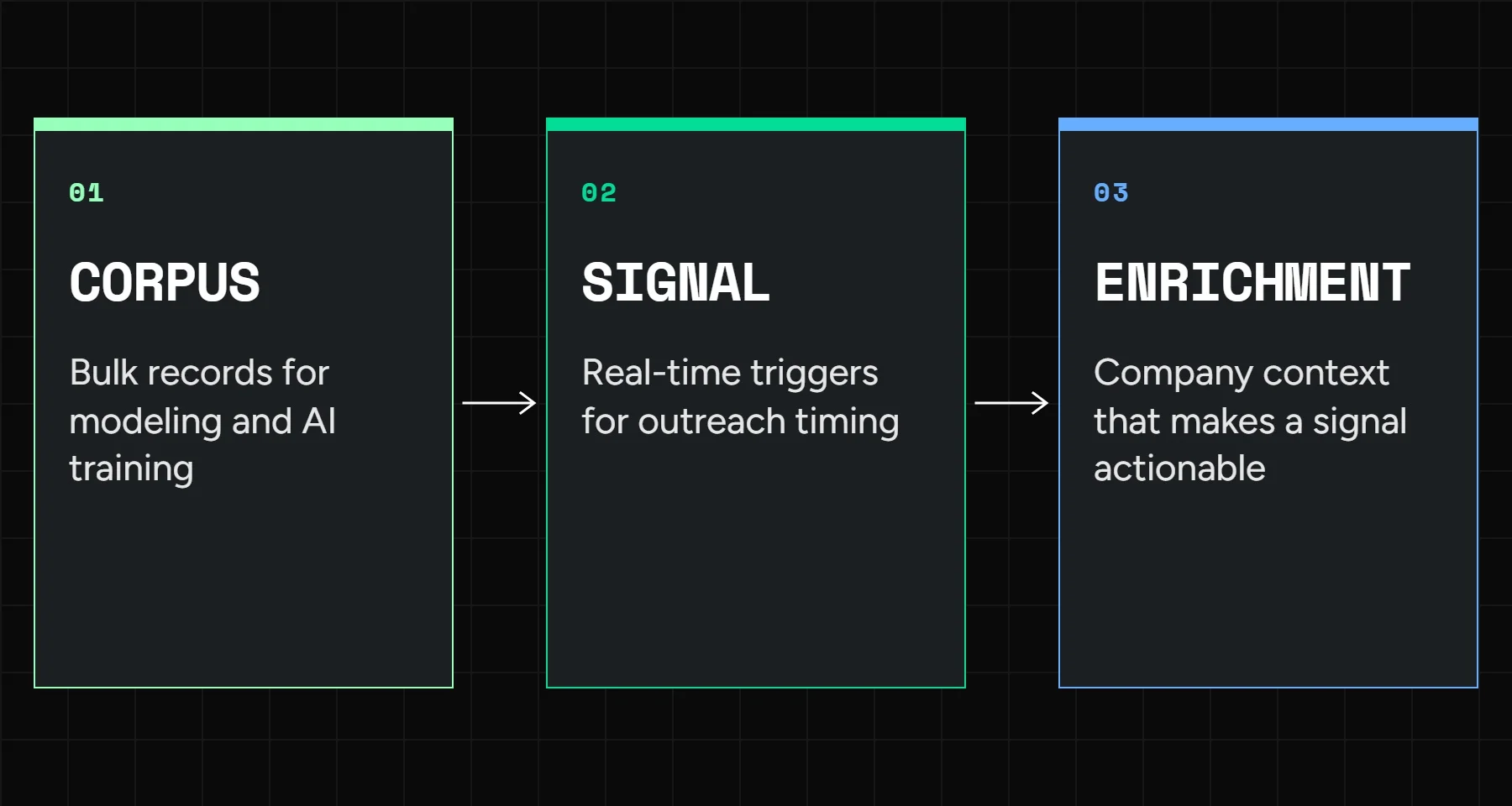
The buyer here is not building an index. They need to know that an ICP account opened three VP of Sales roles last week, that an engineering team is growing at 20 percent of headcount, or that a target just hired a RevOps leader. The right tool architecture is different from a corpus, and the providers below were built for it.
akta.pro
akta.pro is a private company data and signals API covering 20M+ companies with 75+ data points each. It includes a dedicated job_posts endpoint, described in its documentation as "Open roles and hiring signal," which returns live job postings for a company, queried by its domain. The endpoint sits in akta.pro's alternative signals tier alongside headcount trends, website traffic, employee reviews, product reviews, and company social posts, all resolved against the same company identifier.
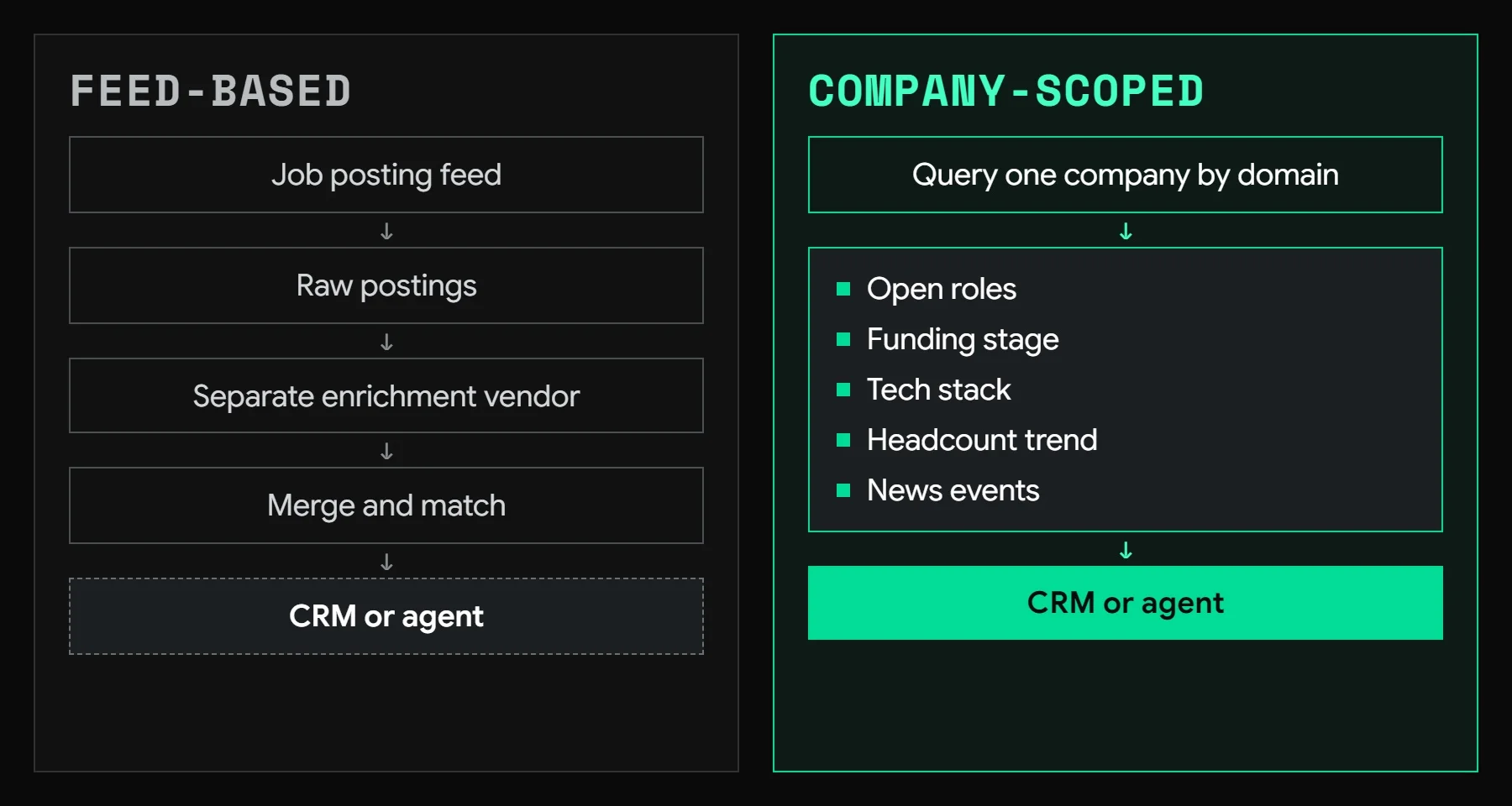
The key difference from standalone job posting feed providers is architecture: akta.pro is company-scoped rather than feed-based. You query a company, or a list of companies matching your ICP filters, and pull its open roles next to the rest of its profile: funding stage, revenue estimates, tech stack indicators, ownership type, headcount trend, and recent news. A GTM workflow that asks "which Series A SaaS companies in the US are hiring DevOps engineers" does not need a second vendor to find out who those companies are.
News adds a second dimension that pure job posting APIs do not carry. akta.pro's news layer classifies every article against an 80+ type event taxonomy that includes funding, leadership, and M&A events, so an executive hire or a funding round sits next to the job posts for the same company. akta.pro's own July 2026 company news retrieval benchmark scored 71,408 articles across 133 companies and put its news API at an F1 of 81.3, 18.8 points ahead of the next provider, with 93 percent company-entity precision. akta.pro designed and ran that benchmark and published its harness. It measures news retrieval, not job posting data, so read it as evidence for the news layer only.
Best for: GTM teams, AI agents, and investment analysts who need open roles inside a complete private company profile. If you already buy company data and want hiring as one of several signals without adding a second vendor, akta.pro is the natural fit. If you need a bulk historical corpus or a sub-minute event feed, pick from the sections below instead.
TheirStack
TheirStack combines a job postings API with a technographics database, which makes it one of the most useful tools for sales teams that need to know both who is hiring and what technology stack those companies run. It aggregates from 356,000+ websites including career sites, ATSs, and job boards across 195+ countries, with data since 2021. Freshness is published directly: 73 percent of new technology-role postings arrive the same day, and 90 percent within 24 hours. That is unusually transparent for this market.
Enrichment covers salary parsing with min, max, currency, and period; seniority; company firmographics; and tech stack. The free tier provides 50 company credits and 200 API credits per month, with paid plans from around $59 per month with 12-month credit rollover. For teams already using sales intelligence platforms, TheirStack plugs in as a job signal layer without replacing the contact data layer.
Signalbase
Signalbase is built around a single premise: treat a new job posting as a live event rather than a record. Hiring activity from job boards, career pages, and the posts that company representatives share on LinkedIn arrives with sub-minute freshness, with the original source attached and a company profile enriched alongside it. Firmographic filters let you predefine your ICP so alerts only fire for accounts you care about.
The architecture decision is deliberate. Signalbase does not carry a bulk historical corpus; it delivers net new activity from the day you connect. That is the right choice for a GTM team that wants to contact the right account the morning the VP of Sales role opens, not for a team building a labor-market model that needs four years of posting history. MCP server support is available, which extends the feed directly into AI agent workflows. The free trial is 7 days with no card required.
PredictLeads
PredictLeads sells company intelligence datasets, and its Job Openings product is one of the most cited options for teams that want hiring signals embedded inside a broader company data package. The current product page states 270M+ historical records since 2016 across 2.7 million companies, with an average of 9.8 million active jobs at any time and each opening refreshed every 36 hours. All jobs carry O*NET codes, and fields include title, URL, first-seen and last-seen dates, location, category, seniority, description, salary, and contract type.
PredictLeads is delivered by API, flat files, webhooks, and MCP, and it integrates directly with Clay, Zapier, and other automation platforms common in GTM stacks. The fit is teams that want to build automated outbound sequences triggered by specific role patterns, for example "fire when a Series B fintech hires more than three data engineers."
Best job posting data providers for labor market research
Teams whose output is a report, an index, or a government analysis need institutional-grade sourcing. These three providers are built for that job.
Lightcast
Lightcast is the standard for labor market analytics used by workforce boards, universities, and government agencies. Its documentation puts sourcing at 220,000+ websites worldwide, including company career sites, national and local job boards, aggregators, and 100+ government sources, with US posting history back to January 2010. That deep archive is what distinguishes it from every other provider in this category: a team modeling decade-long skill demand curves needs data starting before 2020.
Deduplication compares normalized title, company, and location across a 60-day window. Enrichment maps to the O*NET-SOC 2019 taxonomy, which covers 1,016 occupational titles built on 867 detailed occupations and encompasses more than 55,000 job titles. Credentials, skills, salary, and industry are all enriched. Lightcast is priced for institutional buyers; there is no published self-serve rate and pricing is handled through their sales team.
Worth noting: independent analysis from Digit Research has flagged that Lightcast data, like all posting-based series, has diverged from other labor indicators since around 2012. Any posting-based analysis should be benchmarked against official statistics, particularly BLS JOLTS and Statistics Canada's Job Vacancy and Wage Survey, which apply standardized vacancy definitions.
LinkUp
LinkUp indexes postings directly from employer career sites rather than aggregators. No reposts, no stale copies, no board-side duplicates: every record traces to the employer that wrote it. That sourcing discipline is what makes LinkUp the preferred provider for quantitative buyers and investment research. S&P builds the S&P 500 LinkUp Jobs Indices on the data, which is as strong an external validation of data quality as this market produces.
The dataset covers 350M+ postings indexed daily since 2007, delivered as raw data, custom feeds, or through the Compass analytics platform. The tradeoff is real: roles posted exclusively to job boards or staffing sites will not appear, which matters for labor markets where employer-site postings are sparse. Pricing is sales-led and enterprise-contracted; academic access is available through Dewey Data.
If you are tracking company data signals investors use, LinkUp's employer-direct sourcing is the cleanest job posting series for modeling headcount momentum.
Revelio Labs
Revelio Labs sells workforce intelligence through its Terminal product, raw datasets, and a discounted academic program. Its COSMOS dataset covers 5B+ postings from employer websites, major job boards, and staffing firm boards, deduplicated and unified, updated daily with global coverage and history from 2021 for the full COSMOS dataset.
What sets Revelio apart is the enrichment depth: role taxonomy, seniority, geography, skills, salary, expected hires, and time-to-fill, with occupation mapping to BLS codes in the US and ILO codes internationally. It also publishes public labor statistics benchmarked against BLS releases, which makes its methodology more transparent than most providers in this category. For evaluating startups using alternative data, Revelio's workforce flow data covering headcount changes and attrition over time is one of the more reliable third-party datasets available.
Best job posting data providers for large-scale corpus and AI pipelines
Teams building recommenders, labor market models, or AI training datasets need raw volume, format flexibility, and reliable delivery infrastructure.
Coresignal
Coresignal is the most commonly cited general-purpose job posting provider in this market, and the volume claim holds up to scrutiny because they distinguish between products clearly. Multi-Source Jobs runs postings through an entity-resolution engine to deduplicate across boards, arriving at 475M+ records across 85+ data fields, with active postings revisited within 24 hours and roughly 1.3 million active jobs discovered daily. Base Jobs delivers raw single-source records for teams that want to do their own resolution.
The archive begins in August 2020, which is a constraint for teams modeling long-run trends. The API uses a credit system where one credit equals one complete record across all 85+ fields. The starting tier is $49 per month for 2,500 credits with a 14-day free trial. MCP server integration is available, relevant for AI agent builders who want to query job data from within agent workflows. For teams comparing Coresignal against other options, the Multi-Source deduplication is worth the premium over Base Jobs for almost every use case except those where you want raw crawl data to build your own resolution layer.
Bright Data
Bright Data covers both ends of the market: ready-made job posting datasets per platform and the proxy and scraper infrastructure for teams that want to run their own collection pipeline. Ready-made datasets cover LinkedIn, Indeed, Glassdoor, and other major platforms at around $2.50 per 1,000 records ($250 minimum order), with daily, weekly, monthly, or custom refresh schedules and cloud delivery to AWS S3, Google Cloud, or Azure.
What makes Bright Data distinct from pure data providers is the scraping layer: a dedicated Jobs Scraper API with platform-specific endpoints, an OxyCopilot assistant that generates API code from natural language instructions, and a no-code interface for teams without engineering support. If your team needs both ready-made data today and custom collection capability as requirements evolve, Bright Data handles both without a vendor switch. The tradeoff is that matching results to company records, deduplicating, and deciding what matters is your responsibility after delivery.
People Data Labs
People Data Labs sources job postings directly from company-hosted career pages rather than aggregators. Its job posting product is labeled Beta, and the July 2026 v35.0 release expanded coverage to 400,000+ unique company career pages (up from 86,000) with 100,000+ companies carrying active posts. Description fill rate above 99 percent for active posts was reported, and deactivation-date accuracy improved in the same release.
The beta status is a real constraint: the schema may continue to evolve, which creates friction for production pipelines that need a frozen contract. Beta access includes 5,000 free credits. People Data Labs is best evaluated by teams comfortable absorbing field changes in exchange for getting in early on a career-page-focused dataset that covers companies most aggregators miss. For B2B data enrichment workflows, the overlap with their existing person and company data makes People Data Labs a natural fit when job data is one dimension of a broader enrichment pipeline.
Provider comparison table
All figures stated as of October to November 2026, sourced from each provider's public documentation. Pricing and record counts change frequently in this market; verify before committing to a contract.
| Provider | Built for | Record coverage (stated) | History from | Refresh | Starting price | Trial |
|---|---|---|---|---|---|---|
| akta.pro | GTM hiring signals + complete company intelligence | 20M+ companies; job_posts endpoint per company | Live open roles per company query | On demand per company | Pay-as-you-go; job_posts on Subscription/Enterprise | 25 free credits |
| TheirStack | Sales intel, technographics | 356K+ websites, 195+ countries | 2021 | 73% same day, 90% within 24h | Free tier; ~$59/month paid | Free tier |
| Signalbase | Real-time GTM triggers | Job boards, career pages, social | Day 1 (no corpus) | Sub-minute | Credit-based, self-serve | 7-day |
| PredictLeads | Company signal feeds, outbound | 270M+ records, 2.7M companies | 2016 | Every 36 hours | Contact sales | Contact sales |
| Lightcast | Labor market analytics, government | 220K+ websites, 100+ government sources | 2010 (US) | Daily | Contact sales | No |
| LinkUp | Employer-direct research, quant buyers | 350M+ postings, employer career sites only | 2007 | Daily | Contact sales | Academic via Dewey Data |
| Revelio Labs | Workforce intelligence, economic research | COSMOS: 5B+ postings, multi-source | 2021 (COSMOS) | Daily | Contact sales | Discounted academic |
| Coresignal | Multi-source corpus, AI development | 475M+ postings, 85+ fields | Aug 2020 | Active postings within 24h | $49/month (API) | 14-day, 200 credits |
| Bright Data | Scraping infra + ready datasets | 200M+ job records | Varies by dataset | Daily/custom | $2.50/1K records ($250 min) | 7-day |
| People Data Labs | Career-page postings (beta) | 400K+ career pages | Beta, evolving | Daily option | 5K free beta credits | Beta access |
FAQ
What is job posting data used for?
Job posting data serves several distinct functions depending on the buyer. Sales and GTM teams use job signals to identify when target accounts are hiring for roles that indicate budget or pain, triggering more precisely timed outreach. Labor economists and government agencies use it to track skill demand, wage trends, and regional employment patterns. HR tech companies use it to build matching algorithms and candidate tools. Investors use hiring patterns as an alternative data signal for evaluating startups and tracking portfolio company health. AI developers use large bulk datasets as training data for models handling employment-related text at scale.
Which job posting data provider is best for sales intelligence?
akta.pro, TheirStack, Signalbase, and PredictLeads are built for outreach trigger workflows, each with a different architecture. akta.pro's job_posts endpoint returns live postings for a company alongside its profile (funding, revenue estimates, tech stack, news signals), removing the need for a separate enrichment step. TheirStack pairs job signal freshness with technographic data. Signalbase delivers hiring signals with sub-minute freshness including LinkedIn posts from company representatives. PredictLeads ties job openings to company records across 2.7 million companies and integrates with Clay and Zapier.
How much does job posting data cost?
Published pricing ranges from free to six-figure annual licenses. Techmap charges around $1 per 1,000 postings for its feed product. TheirStack starts at a free tier with paid plans from approximately $59 per month. Coresignal's API starts at $49 per month. Bright Data charges $2.50 per 1,000 records ($250 minimum order). JobsPikr starts at $4,000 per year. akta.pro is pay-as-you-go with 25 free credits to start, and its job_posts endpoint is part of the Subscription and Enterprise tiers. Enterprise analytics providers (Lightcast, LinkUp, Revelio Labs) price by contract on a sales-led basis.
What is the difference between a job posting dataset and a job posting API?
A dataset is a bulk file delivery, typically as JSON, CSV, or Parquet on a scheduled cadence (daily, weekly, or monthly), suited to populating a data warehouse for analysis and historical modeling. An API returns records on demand, returning results to a live query and suited to applications that need current postings for specific companies, roles, or geographies in real time. Most enterprise providers offer both delivery modes. Webhooks are a third option: providers push records to your endpoint the moment a new posting is detected, which is the architecture Signalbase and PredictLeads use for real-time GTM workflows.