76% of CRM users say less than half of their organization's CRM data is accurate and complete, according to Validity's 2025 survey of 602 CRM users (self reported, from a data quality vendor). Data enrichment APIs exist to close that gap, and most buyers shortlist them by list price per record.
The best data enrichment API depends on what you send and what you need back. Use People Data Labs or Apollo for people, Coresignal or akta.pro for company records, Clay to chain providers, and HubSpot's built in enrichment if you live in HubSpot. Judge each on what a miss costs, because a cheap record you cannot use is expensive.
akta.pro is a private company data API covering 20M+ companies, and the entity resolution behind it is why this guide ranks on identity and billing instead of feature counts.
What data enrichment APIs return and why the type matters
A data enrichment API takes a partial record, such as a work email or company domain, and returns more fields about it as JSON. Contact enrichment returns titles and emails, company enrichment returns firmographics, and signal enrichment returns dated events. You call it from code, a CRM workflow or an AI agent.
| Type | You send | You get | Examples in this guide |
|---|---|---|---|
| Contact enrichment | Work email, LinkedIn URL, name plus company | Title, seniority, email, phone | People Data Labs, Apollo, Lusha, Cognism |
| Company enrichment | Company name or domain | Firmographics, funding, management, industry | akta.pro, Coresignal, ZoomInfo |
| Signal enrichment | Company or contact | Dated events such as news, hiring, funding | akta.pro News Signals |
| Orchestration | A table of records | Fields filled by several providers in sequence | Clay |
| CRM native | An existing CRM record | Mapped CRM properties | HubSpot data enrichment |
Type decides the shortlist. A contact API cannot tell you a private company's last funding stage, and a company API cannot find a prospect's direct dial. For field lists in depth, see the akta.pro guide to what a company enrichment API returns and the primer on firmographic data.
Quality now matters beyond sales efficiency. Gartner predicts that through 2026 organizations will abandon 60% of AI projects unsupported by AI-ready data. Its analyst Roxane Edjlali puts the test plainly: "if the data has issues, then the data is not ready for AI." Agents that call enrichment APIs inherit whatever those APIs get wrong.
How these data enrichment APIs were evaluated
Nine APIs made the list. Each was checked against five questions: what you send, what comes back, how the vendor bills when nothing comes back, how it identifies the company, and how you get access. Vendor facts come from public vendor documentation and pricing pages, as checked in October 2026.
The 9 best data enrichment APIs at a glance
| API | Best for | Returns | When nothing comes back | Access |
|---|---|---|---|---|
| akta.pro | Private company records and news signals | Firmographics, funding, management, ICP, industry codes, news | Search is free; profile calls bill per endpoint | Self serve API key, MCP, CLI, bulk |
| People Data Labs | Engineers building on person and company data | Person and company records | Credits consumed per match | Self serve API |
| Coresignal | Data teams that model raw records | Company, employee, job data | Credits per record type | API plans, datasets |
| ZoomInfo | Larger teams running outbound and ABM | Contacts, companies, intent | No charge on "No match" | Through sales |
| Apollo | Enrichment next to sequencing | Contacts, companies | 0 credits on its own data; waterfall vendors may charge | Plans plus API |
| Cognism | Teams selling into Europe | Contacts, company data | Empty result page costs no tokens | Package with API access |
| Lusha | Reps needing emails and phones fast | Emails, phones, company info | At least 1 credit per request | Key on every plan |
| Clay | GTM engineers chaining providers | Whatever each provider returns | Depends on the provider called | App and API |
| HubSpot data enrichment (Clearbit) | Teams that run on HubSpot | Company and contact properties | Not a per call product | Inside HubSpot |
The right column of that table decides total cost more than the entry price does.
The 9 APIs, one by one
1. akta.pro: company records and signals for private companies
akta.pro covers 20M+ companies with 70+ data points each, delivered by API, MCP, CLI and bulk data, with pay as you go pricing. Its entity resolution is patent pending, and its News Signals API attaches dated events to the same resolved companies.
Identity gets checked before you pay. Searching by name or domain is free and returns candidate entities with a status and a parent link, so you choose the right company before spending a credit. A live concise profile call for Stripe on October 26, 2026 returned 12 sections for 3 credits: firmographics, business model, funding stage, 18 management profiles, ICP, industry codes and more. At the $0.05 pay as you go credit rate, that is about $0.15 a profile.
Best for: Finance, risk and GTM teams enriching private companies, and agents that need structured records. Watch for: Management profiles carry names and titles, not email addresses or phone numbers, so pair it with a contact provider for outreach.
2. People Data Labs: person and company records for engineers
People Data Labs bills on the match: one Company Enrichment credit equals one record successfully returned. Its bulk endpoint takes up to 100 persons per request.
Best for: Engineers building enrichment into a product. Watch for: You own the verification layer and the match thresholds.
3. Coresignal: raw company, employee and job data
Coresignal sells company, employee and job posting data collected from public web sources, as APIs and bulk datasets. Credit cost depends on the record: its pricing documentation lists 20 credits for a multi-source company or employee record, and API plans start at $49 a month.
Best for: Data teams that clean and model records themselves. Watch for: The same credit buys very different amounts by record type, so price your real mix.
4. ZoomInfo: contacts, companies and intent from one vendor
ZoomInfo states 500M+ contacts and 100M+ companies plus intent signals. Its enrich endpoint docs say no credit is charged on a "No match" or an error, and each call returns up to 25 records.
Best for: Larger teams running outbound, ABM and CRM data from one vendor. Watch for: Access runs through sales, with no public price list. For a head to head, see akta.pro vs ZoomInfo.
5. Apollo: enrichment bundled with sequencing
Apollo's API documentation charges 1 credit for demographics or email plus 8 for a mobile number, and 0 credits when nothing credit consuming is found. Bulk calls take up to 10 people. The docs add a caution on waterfalls: "some vendors consume credits per lookup even when no data is found."
Best for: Teams that want contact data and outreach in one tool. Watch for: Waterfall costs vary by the vendors you connect. See akta.pro vs Apollo for a comparison.
6. Cognism: contacts built around European data
Cognism frames its enrichment around verified European B2B data. Per its credits documentation, an empty result page costs no search tokens. API access depends on the package, and no price list is published.
Best for: Teams whose priority accounts sit in Europe. Watch for: Package gating of API access.
7. Lusha: emails and phones on credits
Lusha charges 1 credit for a verified email and 5 for a phone number. Its API documentation states a request costs at least 1 credit even when no data comes back. Every plan includes an API key.
Best for: Reps who need emails and direct dials quickly. Watch for: The minimum charge on empty requests compounds when an agent retries.
8. Clay: chain providers without writing orchestration code
Clay runs enrichment workflows that call data providers in sequence until one returns an accepted value. Per Clay's API docs, API calls consume the same credits and actions as in product work, so billing on a miss depends on the provider each step calls.
Best for: GTM engineers who want fallbacks without building them. Watch for: Each fallback adds latency, spend and conflict handling.
9. HubSpot data enrichment (Clearbit): fill records inside the CRM
Clearbit is now part of HubSpot, and Clearbit's free tools ended on April 30, 2025. New customers get enrichment inside HubSpot instead of through a standalone endpoint.
Best for: Teams on HubSpot who want records filled without code. Watch for: Less control over sources and raw responses, because enrichment lives inside the CRM.
Why identity matters more than match rate
Match rate depends on how a vendor defines a match, so it is the least comparable number on any enrichment API page. The more reliable question is identity: does the API resolve your input to the right company before it returns fields? A wrong entity returns confident data about the wrong business.
Definitions drift. FullEnrich's own comparison notes that it counts catch all emails as found and bills them, and that other vendors draw that line elsewhere. Two APIs can report the same match rate and hand you different shares of deliverable data.
Identity sits underneath. When an API takes a domain and returns a company, someone decided which company that domain means. A free akta.pro search for stripe.com on October 26, 2026 returned these records:
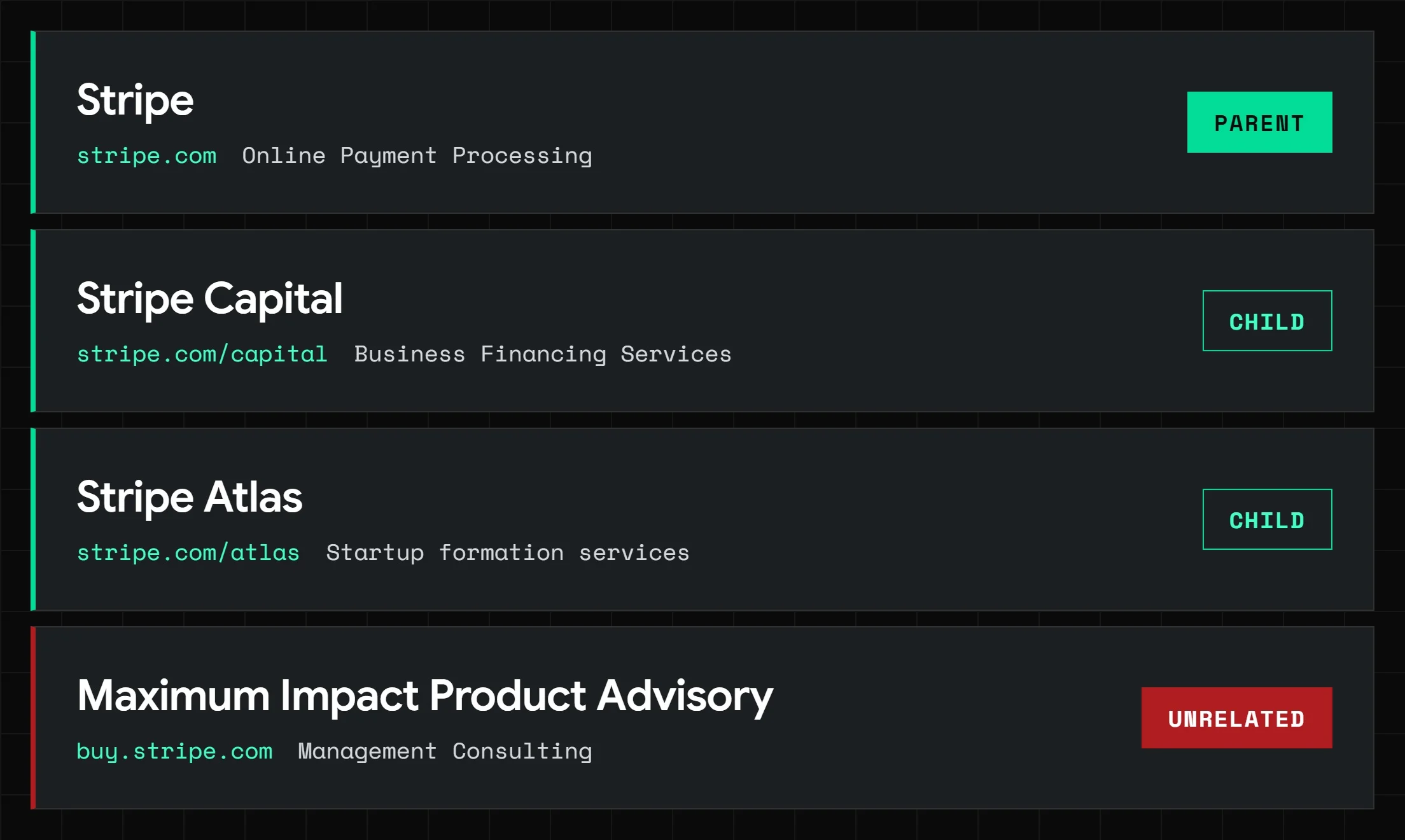
The first three are correct and related: a parent and two products with their own records. The fourth shows what happens to any lookup that keys on a domain string alone. By default the search returns top level companies only, and a flag adds subsidiaries and divisions. Results are ranked, not forced to one answer, so the final pick stays with you.
akta.pro's own news retrieval benchmark reports 93% accuracy across 71,408 articles and 133 companies (vendor run, so treat it as directional). Coverage skew is a second reason private companies are hard. Research on corporate news notes that coverage tends to overrepresent large public firms. For the mechanics, read what entity resolution is and how it works for private company data.
What a miss costs on each data enrichment API
Cost per usable record equals total spend divided by records that are found and correct. Billing on a miss changes the numerator, and your own match rate changes the denominator. Vendors publish neither number for your list, so the only trustworthy figure is the one you measure.
| API | When nothing comes back | Source |
|---|---|---|
| Apollo | 0 credits on its own data; some waterfall vendors charge per lookup | Apollo API docs |
| People Data Labs | Credit consumed per successful match | PDL pricing docs |
| ZoomInfo | No credit on "No match" or error | ZoomInfo enrich docs |
| Cognism | Empty result page costs no search tokens | Cognism credits docs |
| Lusha | At least 1 credit per request | Lusha API docs |
| akta.pro | Search is free (0 credits); a concise profile costs 3 credits | akta.pro API |
| Clay | Depends on the provider each step calls | Clay API docs |
Agents multiply the effect, because a retry loop repeats whatever the API charges on a miss. Compute the figure per API on the same records:
def cost_per_usable_record(total_spend, results):
    usable = [r for r in results if r["found"] and r["correct"]]
    return total_spend / len(usable) if usable else None
How to test data enrichment APIs on your own list
-
Pull 100 records from your CRM. Mix geographies and company sizes, include private and early stage companies, and add a few where you already know the answer.
-
Send identical inputs to each shortlisted API within the same week. Log the request, response and credits billed.
-
Check identity first. Confirm each returned company is the one you meant, not a parent, child or lookalike.
-
Check fields against ground truth. Funding stage, headcount range and HQ are quick to verify.
-
Divide spend by usable results with the function above, then weigh speed, access and integrations.
Which data enrichment API should you pick?
| Your need | Start with | Why |
|---|---|---|
| Private company records, funding, management, news | akta.pro | Free identity check, structured profile, signals on the same entities |
| Person records inside your own product | People Data Labs | Billed per match, bulk endpoint |
| Raw company, employee and job data | Coresignal | Datasets and API credits by record type |
| Contacts, companies and intent from one vendor | ZoomInfo | One platform, sold through sales |
| Enrichment plus outreach | Apollo | Contact data and sequencing together |
| European contacts | Cognism | Built around European data |
| Quick emails and direct dials | Lusha | Credits per email and phone |
| Several providers in sequence | Clay | Fallbacks without orchestration code |
| Teams on HubSpot | HubSpot data enrichment | Native to the CRM |
Most teams end up with two layers: a contact API for who to reach and a company API for what that company looks like. Store the resolved company ID next to the domain in your CRM so refreshes update the same entity. For a longer developer list, see the 10 best private company data APIs.
FAQ
What is the best tool for data enrichment?
It depends on what you send and need back. People Data Labs and Apollo fit person records, Coresignal fits raw company and job data, and Clay chains providers. For private company records and news signals, akta.pro fits best because search is free and returns candidate entities before you spend credits.
What is an example of data enrichment?
A lead arrives with only a work email. An enrichment API returns the person's title, the company's headcount range, funding stage and headquarters, and your CRM routes the lead on those fields. The same call can run on a schedule to refresh existing accounts.
What is a data enrichment API?
A data enrichment API takes a partial record, such as a company domain or work email, and returns more fields about it as JSON. You call it from code, a CRM workflow or an AI agent, at the moment a record arrives or on a schedule.
Do data enrichment APIs charge when no data is found?
It varies. Apollo, ZoomInfo and People Data Labs do not charge for an empty result on their own data. Lusha charges at least 1 credit per request, and some vendors inside Apollo's waterfall charge per lookup. Check the vendor's docs, then test it.
Run the 100 record test on two candidates this week. Start with a free akta.pro company search on your own accounts to see how they resolve before you spend a credit.