Investment managers spent about $2.8 billion on alternative data in 2025, up 17% year on year, according to Neudata's 2026 market report. Neudata also found that the average dataset now has about 20 buyers, down from 25 in 2024. More money is chasing data that fewer firms share, so the advantage sits with funds that match, test and use it well.
Alternative data for hedge funds is information from outside company filings and market feeds, such as card transactions, web activity, satellite imagery, geolocation, job postings and news, used to estimate a company's performance before it reports. Funds use it to forecast earnings, track demand, monitor risk and screen private companies. Its value depends on coverage, history and entity matching.
akta.pro tracks 20M+ private companies, and its June to July 2026 benchmark scored 71,408 news articles across 133 companies, so the entity matching figures below come from measured results.
Alternative data for hedge funds is now table stakes
Alternative data is any information used in investment decisions that does not come from company filings, exchange feeds or sell-side research. AIMA and SS&C counted more than 400 providers in 2018, up from about 20 in 1990.
Adoption has moved fast. The same AIMA survey of 100 hedge fund managers in 2020 found 53% used alternative data. Lowenstein Sandler's 2025 report put the figure at 90% among private fund managers, a sample that mixes hedge funds, private equity and venture firms. The samples differ, so read the pair as direction, not a trend line.
AIMA chief executive Jack Inglis tied the appeal to immediacy, set against "the information lag from working with more traditional data."
Seven types of alternative data and what each one is good for
Neudata reports that web-scraped and transactional datasets remain the largest categories by spend. The table covers those and five others funds buy.
| Type | Typical sources | Best for | Main weakness |
|---|---|---|---|
| Consumer transactions | Card and receipt panels | Revenue nowcasts for consumer names | Panel bias, restatements, high price |
| Web-scraped data | Prices, reviews, job postings, company sites | Demand and hiring trends across many names | Layout changes, legal review |
| Geolocation and foot traffic | Mobile location panels | Store and venue visits | Privacy exposure, panel skew |
| Satellite and geospatial | Parking lots, ports, crops, storage | Physical activity, commodities | Cost, narrow coverage |
| App and web usage | Downloads, traffic estimates | Digital product traction | Modeled estimates, provenance risk |
| News and event signals | Structured news, press releases | Event detection, risk, M&A | Noise, wrong-company matches |
| Company and firmographic data | Entity databases: funding, headcount, ownership | Screening private companies, supply chains | Stale records, weak entity matching |
Pick types by the question you need answered. Use transactions for revenue, geospatial data for physical activity, and news and company records for events and private names.
Expert network research and climate data sit outside the table. AIMA's 2020 survey ranked expert networks third among datasets used and found 10% of managers using climate data.
Four ways funds source alternative data
| Route | Works when | Watch for |
|---|---|---|
| Direct license from a specialist vendor | You need one deep dataset, such as a card panel | Exclusivity terms, restatements, price steps at renewal |
| Data marketplace or scouting service | You are exploring categories and comparing vendors | Overlapping category labels that blur spend comparisons |
| In-house collection | The signal is public and specific to your thesis | Scraper upkeep, legal review, source terms |
| API provider with structured output | You need broad entity coverage and fast integration | Gaps outside the provider's core, entity accuracy |
Collecting public web data yourself looks cheap until maintenance and legal review arrive. This news API versus web scraping comparison walks through that trade for company news. Plan for a mix, because no single route covers every type.
Use cases that still pay in 2026
The strongest use cases pair a fast signal with a decision that has a deadline: forecasting a retailer's quarter, sizing demand before guidance changes, flagging stress in a position or counterparty, and screening private companies for supply chain and credit exposure.
Earnings and demand forecasting
The best peer-reviewed evidence comes from satellite counts of cars in retailer parking lots. In a Journal of Financial and Quantitative Analysis study using imagery from RS Metrics and Orbital Insight, funds with access built profitable trades, most clearly by positioning ahead of retailers about to report a weak quarter. Short selling around those reports also became better informed.
The authors add a caution. Unequal access to such data "can increase information asymmetry among market participants" without immediately improving price discovery. An edge that depends on few buyers erodes as access widens, which is why the 20-buyer average above matters.
Risk monitoring and event detection
Event feeds turn unstructured news into triggers: a lawsuit, an executive exit, a financing round, a plant outage. akta.pro's News Signals API classifies articles across an 80-category event taxonomy and scores each for impact and sentiment, so a risk team can alert on high-impact negative events instead of reading every headline. The same logic applies to monitoring private company news through an API.
Private-company exposure for public positions
A listed position often depends on private suppliers, customers or borrowers that never appear in a ticker file. Funds use company records, headcount trends and funding history to see stress there first. This is the angle covered in alternative data for private company due diligence and in the company data signals investors track. It also feeds Company Data, which holds 20M+ entities with 75+ data points each.
Most alternative data fails at the join to the right company
Every signal ends in a join. A card panel row, a job posting or a news article has to land on a security, a supplier or a borrower before it moves a position. For listed names a ticker lookup mostly works. For private suppliers, subsidiaries and companies that share a name, it does not.
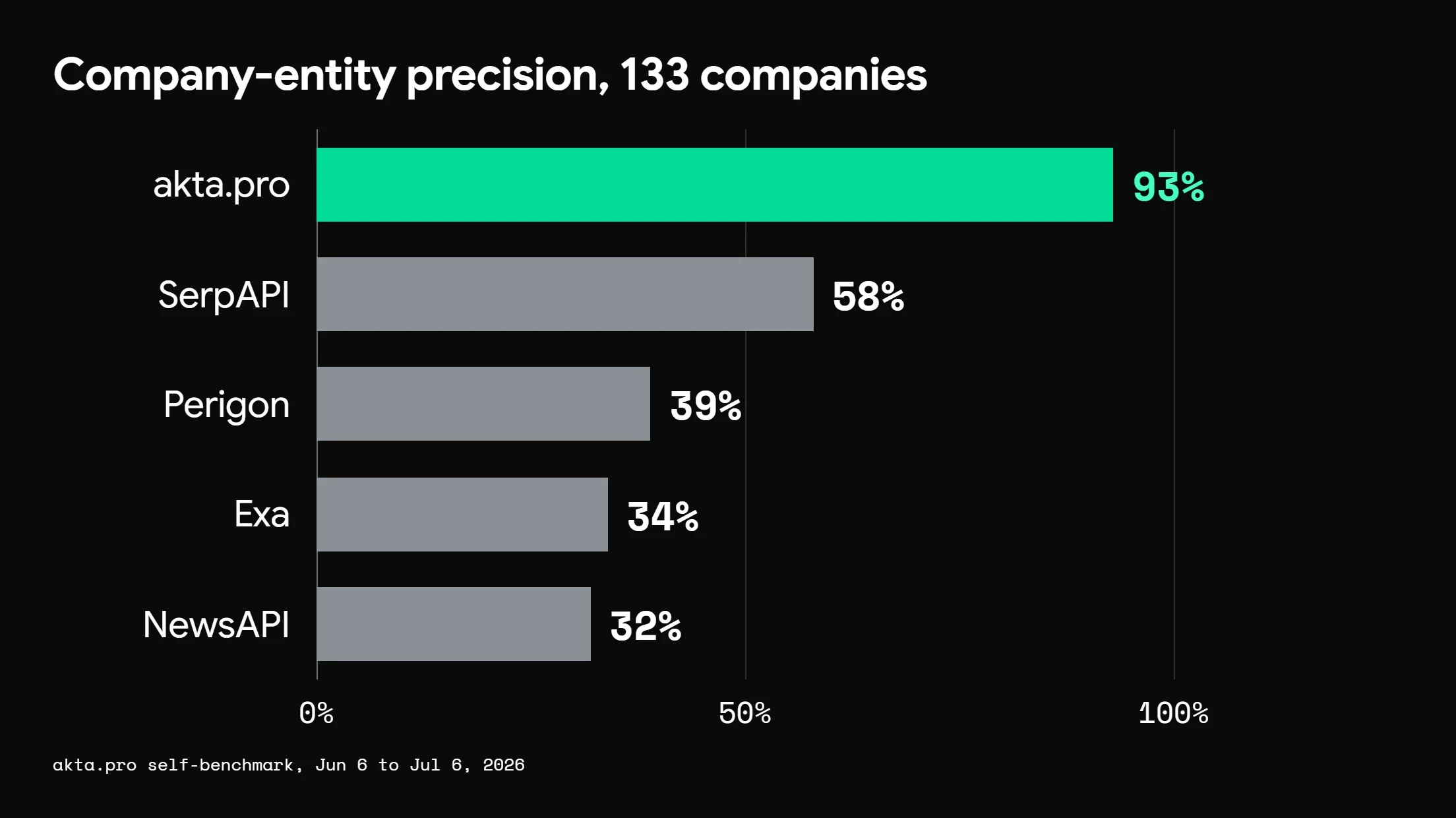
akta.pro's benchmark tested this on company news. An agent monitoring "Aura" or "Bloom" cannot spot the wrong homonym from a headline. Across ten providers, company-entity precision, the share of returned articles about the requested company, ran from 32% to 93%.
| Provider | Company-entity precision | Recall | Cost per 1,000 correct articles |
|---|---|---|---|
| akta.pro | 93% | 72.7% | $0.50 |
| SerpAPI | 58% | 50.5% | $0.67 |
| Perigon | 39% | 73.7% | $0.73 |
| Exa | 34% | 68.7% | $2.97 |
| NewsAPI | 32% | 59.4% | $0.72 |
akta.pro self-benchmark, June 6 to July 6, 2026, 133 companies (108 private). Five of ten providers shown.
Wrong-company content was 8% of akta.pro's returned tokens, against 61% to 69% for the news aggregators tested. This is a vendor self-benchmark with a published harness. It measures news retrieval, not trading returns, and recall is scored against stories that at least one provider surfaced. For the mechanics, see what entity resolution is and why it drives data quality and how private company entity resolution works.
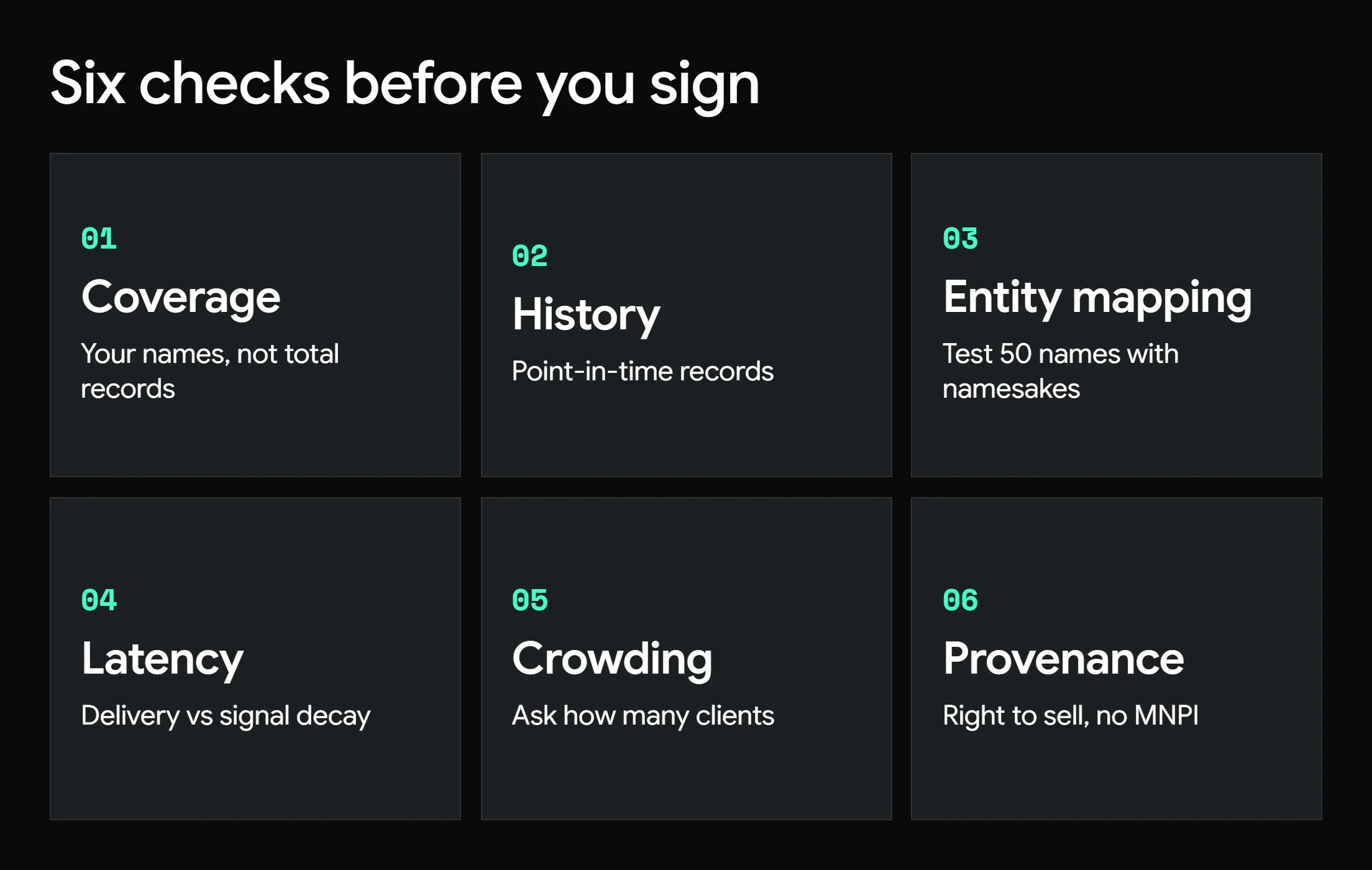
Six checks before you sign for a dataset
-
Coverage of your names. Measure the share of your trading universe and private watchlist with data, not the vendor's total record count.
-
History with point-in-time integrity. Ask for years of records as they existed on each date, so backtests avoid restated data. For news, see how to pull historical company news.
-
Entity mapping accuracy. Send 50 names, including known namesakes, and count wrong-company hits.
-
Latency against decay. Compare the delay between event and delivery with how quickly the signal loses value.
-
Crowding. Ask how many clients hold the dataset. Neudata's average is about 20.
-
Provenance. Get written confirmation of the right to sell the data, consent for any personal data, and the absence of material nonpublic information.
Compliance: the App Annie case sets the buyer's checklist
The SEC's 2021 settlement with App Annie and its founder was the agency's "first enforcement action charging an alternative data provider with securities fraud." The SEC press release says they misrepresented how the data was derived and agreed to pay more than $10 million. The order also noted that the company knew trading firm customers acted on its estimates.
The case targeted the provider, yet the facts involved the buyers' decisions. That is why check six above belongs in every vendor contract and onboarding file.
What 2026 changed: AI raised prices faster than proof
Neudata found that vendors adding AI features did not produce an above-expected rise in buyer spending. In Lowenstein Sandler's survey, 81% of respondents reported higher prices for products that include AI tools, and 89% planned bigger alternative data budgets. Buyers are paying more for AI features without clear evidence of uplift. Ask each vendor for an out-of-sample comparison of the AI version against the base feed.
Frequently asked questions
What are some examples of alternative data?
Common examples are card transactions, mobile location, satellite images of parking lots and ports, web-scraped prices and reviews, job postings, app usage, structured news and company records. Hedge funds use each to estimate company performance before it reports. The types table above shows the best use for each.
What is alternative data in finance?
Alternative data in finance is information outside company filings, exchange prices and analyst research that investors use to forecast performance, demand or risk. Neudata sized investment manager spending on it at about $2.8 billion in 2025.
What are the best databases for hedge funds?
No single database covers every need, so funds pair a market data terminal with specialist feeds: transaction panels for consumer names, geospatial feeds for physical activity, and a company and news layer for private names. akta.pro covers that last layer with 20M+ company records and entity-resolved news, available by API, MCP, CLI or bulk export.
Do hedge funds actually find alternative data useful?
For well-defined questions, yes. The satellite study above found profitable trades around retailer earnings, and 90% of private fund managers in Lowenstein Sandler's 2025 survey use alternative data. The value fades as access widens or when signals map to the wrong company, so test each dataset before paying for it.
Start with the join. Pull your 50 hardest private names, run them through News Signals and Company Data, and count the wrong-company hits before you price any new feed.