Global private equity deal value rose 19 percent in 2025, according to McKinsey. In the same stretch, PE firms were sitting on a record 13,300 unsold companies as of Q1 2026, per PitchBook figures reported by Cambridge Associates. Deal teams are managing more activity and more unfinished business at once, and that workload is hard to run from spreadsheets and shared inboxes.
Deal flow management software is a platform that helps PE and VC firms source, track, evaluate, and close investment opportunities. The core category covers pipeline CRMs such as Affinity, DealCloud, 4Degrees, and Edda. Many teams add a dedicated sourcing tool alongside, such as Sourcescrub or Grata, once the pipeline tool is in place.
This blog compares the six tools that PE and VC teams evaluate most, explains the criteria that actually separate them, and covers the data intelligence layer that sits beneath all of them.
What deal flow management software does, and what it does not
Purpose-built deal flow software gives a deal team one place to log opportunities, move them through stages, assign diligence work, share notes, and report to partners or LPs. Platforms built for private capital differ from generic sales CRMs because deals are relationship-driven, non-linear, and document-heavy, and because the system also has to cover portfolio monitoring and fundraising.
Pipeline management is one function inside this category. It tracks known deals from first look to close. Deal flow management is wider: it includes how opportunities arrive in the first place and what happens to portfolio companies after you invest.
What pipeline tools do not do on their own: surface companies outside your existing network, enrich company profiles with current external data, or flag when a target company hires a new CFO or raises a new round. That function requires a separate data layer, covered at the end of this guide.
Six criteria for comparing deal flow management software
1. Workflow fit. PE and VC workflows differ substantially. PE firms need deal scoring by financial criteria, investment committee support, and portfolio monitoring. VC firms need founder relationship tracking and fast pipeline triage. Confirm the tool was built for your model, not adapted from a sales CRM.
2. Relationship intelligence depth. Proprietary deal flow is a network problem. Affinity's 2026 PE Benchmark finds one person holds a median 31% of a firm's strongest relationships, and the top three people hold 72%. A tool that captures and distributes that relationship capital across the team removes key-person risk and multiplies sourcing throughput.
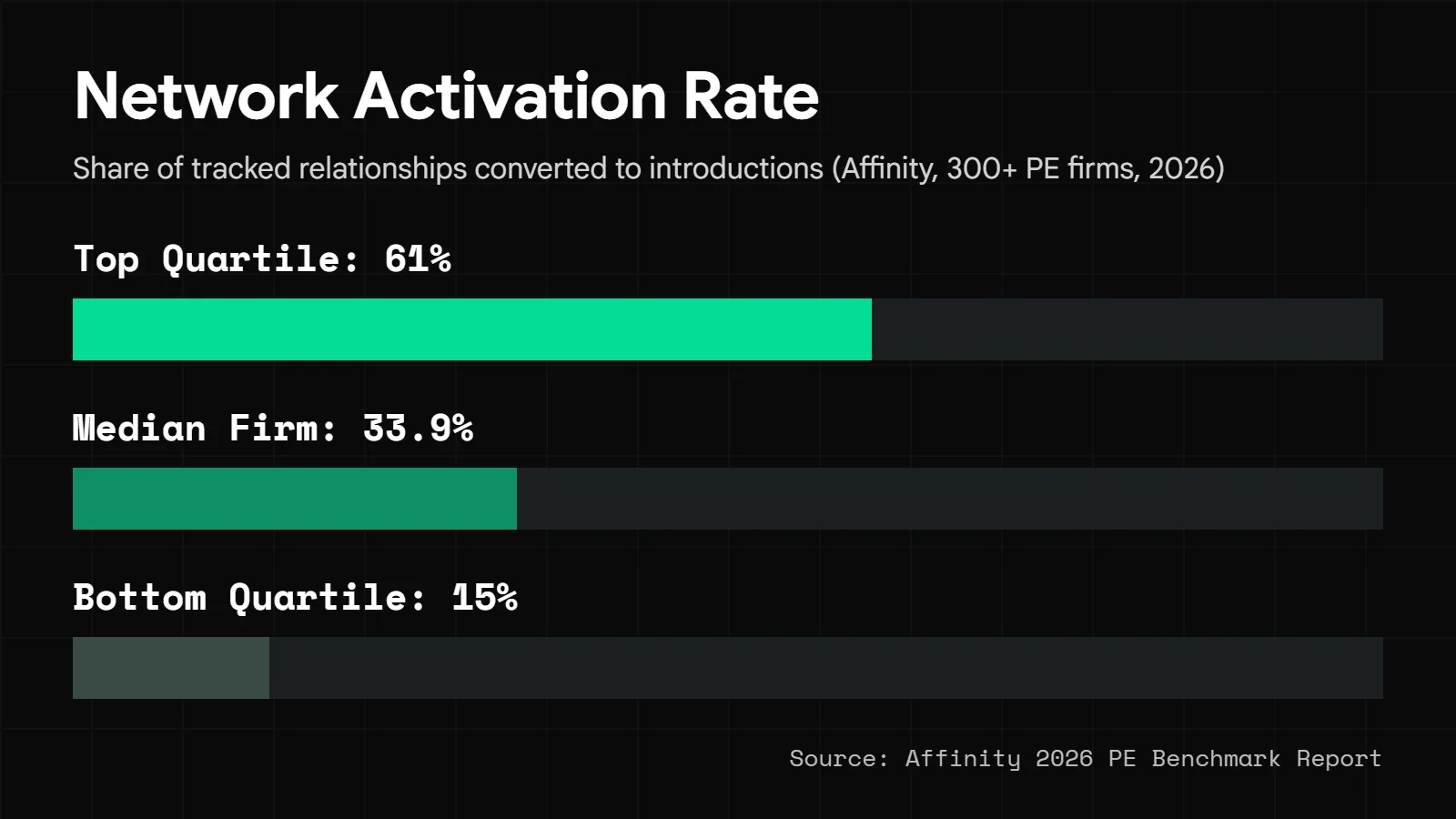
3. Company data quality. Ask how company profiles are enriched, how often fields refresh, and whether the platform resolves name variants to one entity. Entity resolution decides whether "Acme Inc" and "Acme Holdings" appear as one company or two. As Oren Michaely, Head of AI at Motive Partners, notes in an Affinity customer testimonial: "Having a well-defined, clean, golden source data set is more important in the age of AI."
4. AI scope and packaging. Separate chat assistants from document extraction and autonomous agent workflows. Then confirm whether AI is included in the base plan or metered by credits. The difference compounds as team usage grows.
5. Integrations. Email and calendar sync is baseline. Check data room, fund administration, Slack, and LP reporting connections before you commit.
6. Pricing model. Per-seat annual contracts and consumption pricing scale very differently. Model the cost at your likely team size in two years, not today.
The 6 best deal flow management software tools in 2026
Methodology. Tools selected based on consistent appearance across independently ranked comparison guides and vendor category pages for PE and VC deal flow. Descriptions use vendor documentation and published buyer guides. No hands-on testing was conducted. Pricing is included only where a source supports it; everything else says to confirm with the vendor. Information is current as of November 2026.
| Tool | Best fit | Pricing model |
|---|---|---|
| Affinity | Relationship-driven PE and VC teams | Per-user subscription |
| DealCloud (Intapp) | Large PE and multi-strategy firms | Custom enterprise quote |
| 4Degrees | Mid-market PE and VC teams | See vendor pricing page |
| Edda | VC teams replacing Excel | Confirm with vendor |
| Sourcescrub | Lower middle market PE origination | Confirm with vendor |
| Grata | Thesis-driven outbound sourcing | Confirm with vendor |
The first four manage the pipeline. The last two feed it with targets. A complete stack at most firms pairs one from each group.
Affinity
Affinity positions itself as an AI-first CRM for private capital. Its core advantage is automated data capture: emails, calendar activity, and meeting notes flow into company and contact records without manual entry. The platform's relationship strength scoring surfaces warm introduction paths across the whole firm's network, not just one partner's inbox. Affinity states that automated capture saves deal teams 180+ hours of manual work per person each year, a vendor claim we did not independently verify. Its MCP server connects firm data to assistants such as Claude and ChatGPT.
Best for: relationship-driven PE and VC teams. Watch for: per-seat cost. One third-party comparison by Prospeo estimates $2,000 to $2,700 per user per year. Confirm current pricing directly with Affinity.
DealCloud (Intapp)
DealCloud is positioned as enterprise-grade deal flow software for PE and investment firms, covering the full investment lifecycle with deep workflow customization, investment committee management, and integrations with fund administration systems that relationship-first CRMs do not prioritize. Pricing is a custom enterprise quote.
Best for: large or multi-strategy firms that want one configurable system across the entire deal and fund lifecycle. Watch for: implementation effort. 4Degrees, a direct competitor, notes that setup can take months and require significant development work. Ask DealCloud customers of a similar size for their actual onboarding timelines.
4Degrees
4Degrees was built by ex-investors with PE workflows in mind. It combines relationship intelligence with deal flow tracking, an AI assistant that answers questions about deals and relationships in plain language, document extraction from CIMs and banker decks, and an MCP connector for ChatGPT and Claude. The vendor states the full AI feature set comes with every subscription, with no additional tier or usage credits required.
Best for: mid-market PE teams comparing Affinity on price, teams that want embedded AI without an upgrade. Watch for: the buyer guide 4Degrees publishes ranks itself first among the four tools it reviews. Its assessment of its own strengths is directionally useful but not independent. Seek customer references at similar firm sizes.
Edda
Edda, formerly Kushim VC, was founded in Paris in 2017. It combines deal flow, portfolio management, LP relations, and community management in one product. Per tech.eu's 2022 coverage of its $5.8 million round backed by Tony Fadell's Future Shape fund, it was designed as a collaborative, design-led alternative to Excel for VC and PE investors.
Best for: VC firms that want one product covering deal flow, portfolio, and LP management, particularly those migrating from spreadsheets. Watch for: confirm PE-specific depth in a demo. The platform has stronger positioning in VC workflows than in large-fund PE operations.
Sourcescrub
Sourcescrub is a deal sourcing database positioned for lower middle market PE origination. It helps teams build target lists against a specific investment thesis and filters companies by ownership structure, sector, and management characteristics. It complements a pipeline CRM rather than replacing it.
Best for: PE firms running systematic outbound origination programs in the lower middle market. Watch for: you still need a pipeline tool alongside it, and sector coverage should be tested in a trial against your target industries before committing.
Grata
Grata uses AI-driven search to help PE teams find and target founder-owned businesses. Its search model is designed to understand sector-specific language and company descriptions in a way that keyword databases do not. Like Sourcescrub, it solves the sourcing problem, not the pipeline management problem.
Best for: thesis-driven outbound sourcing, particularly for sector-specialist funds targeting founder-owned businesses. Watch for: the same CRM dependency. We reviewed less vendor documentation for Grata and Sourcescrub than for the pipeline CRMs, so verify specific features and coverage directly with each vendor.
The data layer your CRM cannot replace
A pipeline CRM is built to manage what you already know. It does not know about the 200 companies in your target sector that you have never spoken to, and it cannot tell you that a portfolio company's CFO quietly left last week or that a competitor just announced a strategic partnership in a market you are watching.
That gap is where proprietary deal flow is actually won or lost. The firms that see opportunities earlier are not necessarily calling more people. They have better signal about when and whom to call.
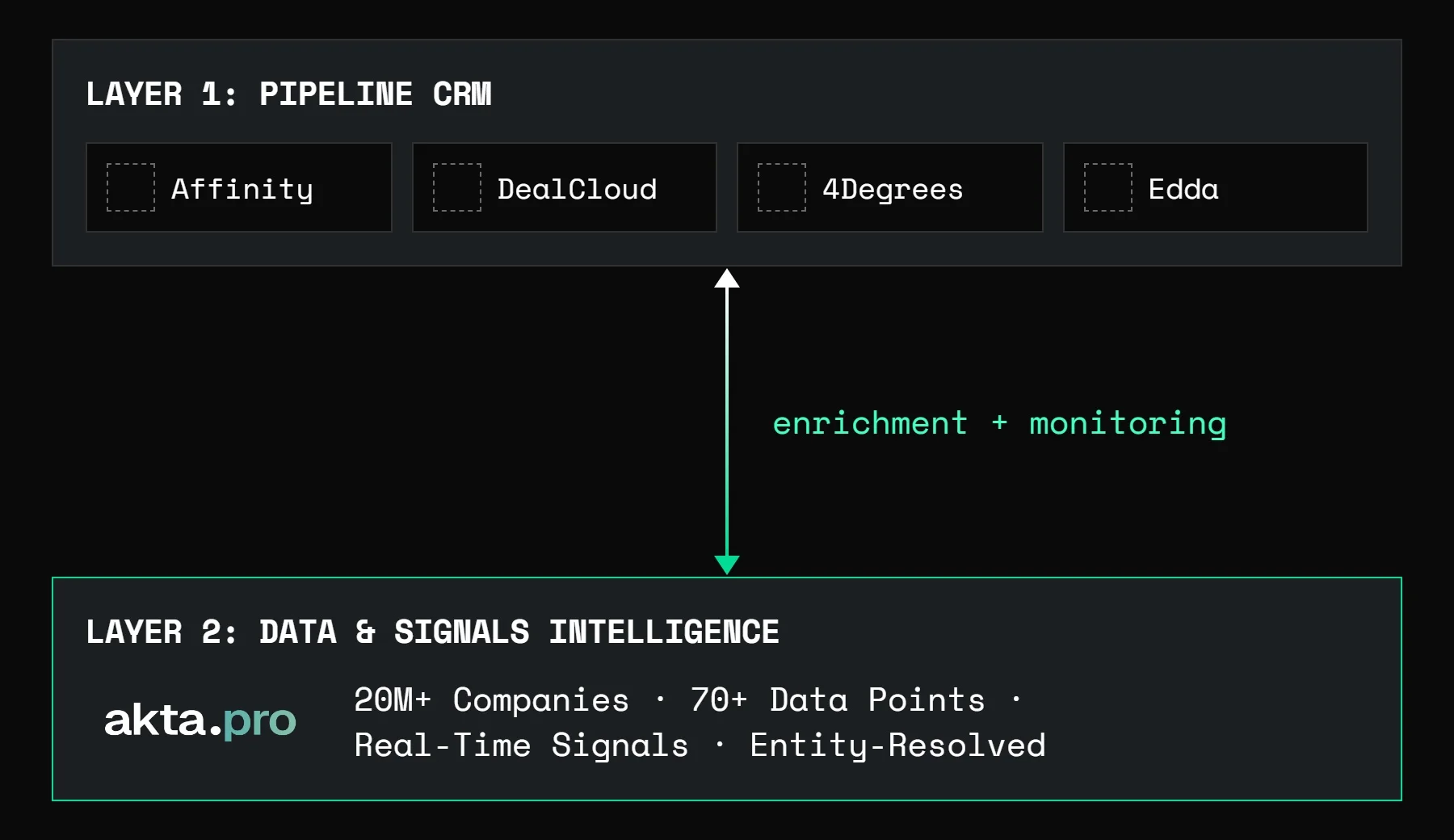
The data layer that fills this gap is not another CRM. It is a private company data and signals infrastructure that sits beneath your pipeline tool and feeds it. What it does:
- Enriches company profiles with current firmographic data, so the record in your CRM reflects the company as it exists today, not at the time it was first logged.
- Monitors a watchlist for real-time events such as funding rounds, leadership changes, hiring shifts, and strategic partnerships, so you know when to move on a target rather than pinging it on a quarterly calendar reminder.
- Surfaces new targets matching your thesis across a universe far larger than your existing network, allowing programmatic deal sourcing at a scale that manual methods cannot reach.
This is where akta.pro sits. It is a private company data and news signals API covering 20M+ companies with 70+ data points each, monitoring 30K+ sub-sectors, with roughly 80% of news noise filtered before delivery. Access is through API, MCP, or CLI, so it connects directly to a CRM, a Claude or ChatGPT agent, or a custom internal tool. It is not a deal flow platform you log into. It is the data infrastructure that makes the platform you do log into more useful.
akta.pro's news signals feed is how PE firms monitor portfolio companies for early warning signals, as covered in detail in how PE firms use news monitoring. The company data API is what deal teams use to enrich targets during screening without manual research. For teams evaluating data quality before committing, the news retrieval benchmark shows the methodology and results, run across 71,408 articles and 133 companies. akta.pro ran that benchmark itself, so read the methodology page before relying on the numbers.
Pricing is consumption-based. You pay for what you query.
If your current problem is that deals are slipping through a disorganized pipeline, start with a CRM from the list above. If your pipeline is under control but you are sourcing blind or monitoring portfolio companies manually, the data layer is the next investment.
Which stack fits your firm
| Firm type | Suggested stack |
|---|---|
| Early-stage VC, small team | Edda for pipeline management |
| Growth VC | Affinity or 4Degrees, plus a data signals layer for monitoring |
| Lower middle market PE | Sourcescrub or Grata for sourcing, 4Degrees or DealCloud for pipeline |
| Mid-market PE | Affinity or 4Degrees, plus a private company data API for enrichment |
| Large or multi-strategy PE | DealCloud, plus a signals source for portfolio monitoring |
| Team building AI-native deal workflows | CRM of your choice, with akta.pro as the data backbone |
These are starting points, not tested configurations. The right answer depends on your existing tools, your team size, and whether your gap is in managing known deals or finding unknown ones.
FAQ
What is deal flow management software?
Deal flow management software is a platform that helps PE and VC firms organize, track, and progress investment opportunities across the deal lifecycle. It typically covers pipeline tracking, relationship management, due diligence coordination, and reporting. Purpose-built tools for private capital differ from generic sales CRMs because deals are relationship-driven, non-linear, and document-heavy.
What is the difference between deal flow management and pipeline management?
Pipeline management tracks known deals through defined stages from first look to close. Deal flow management is broader: it includes how opportunities are sourced, the relationships that generate them, and portfolio monitoring after close. Pipeline management is one function inside deal flow management, not a synonym for it.
How does deal flow software support due diligence?
It centralizes documents, notes, and task assignments so the whole deal team works from one record. Some platforms also extract key data points from CIMs and banker decks into structured fields automatically. For current intelligence on a target from outside sources, most teams add a company data layer alongside the CRM. See commercial due diligence for PE firms for a fuller workflow.