Three percent of companies returned by AI agents using web search cannot be shown to exist. Another 7.2% come back with the wrong website, meaning your enrichment credits, your email sends, and your CRM matching all attach to the wrong company. This is not a theoretical risk. It is what akta.pro's October 2026 benchmark found after testing three frontier AI models across 18 real list-building queries and judging 6,263 company results.
A target company list is a curated, filtered set of companies that match your ideal customer profile, defined by firmographic, ownership, and signal criteria, and prioritized by buying readiness. Building one that actually converts requires a precise ICP, the right sourcing method for your data needs (especially when targeting private companies), validation before enrichment, and a refresh cadence, because B2B contact data decays at roughly 22 to 30 percent per year.
The steps below cover all of that, backed by benchmark data and practitioner experience, not vendor marketing.
What Is a Target Company List?
A target company list is a defined set of companies your team has committed to pursuing, chosen because they match the customers you already win and show signs of being ready to buy. It sits between your total addressable market (every company that could theoretically buy) and your active pipeline (the ones you are currently working). The list is deliberate: fewer companies, sharper criteria, and a clear plan for each one.
That focus is exactly what separates target lists that generate pipeline from long exports that SDRs ignore. A list of 300 precisely matched companies will reliably outperform a list of 3,000 companies that vaguely fit.
Why Most Target Lists Fail Before the First Email
Most target lists fail at two points, and neither of them is the email copy.
The first failure is definition. Teams define their ICP with demographics only: "SaaS companies, 100 to 500 employees, North America." They skip the signals that actually predict a purchase: who funded the company last quarter, whether they are hiring a role your product supports, which tools they already run. Without those signals, the list looks right on paper and performs badly in practice.
The second failure is sourcing. The majority of real B2B prospect companies are private, and private companies do not self-report the facts that define a good target list. Ownership type, funding round details, revenue band, lead investor: these live in structured databases, not company websites. When teams source from web search alone, they get back the companies they already know.
Step 1: Define Your ICP Around Signals, Not Just Demographics
The fastest way to sharpen an ICP is to study the deals you have already won. Pull the accounts that closed fast, retained, and expanded, then ask what they had in common the quarter before they bought. The patterns that repeat are your real filters. Demographics are where you start, not where you stop.
A complete ICP definition has three layers.
Firmographic filters cover the basics: industry (at the sub-sector level, not just "technology"), headcount range, geography, founding year, and revenue band. These narrow the universe. For more on what firmographic fields look like in practice, the akta.pro guide to firmographic data covers each field and when it matters.
Signal-based filters separate the companies that could buy from the ones moving toward a purchase right now. These include funding events (a Series B closed in the last six months), leadership changes (a new VP of Sales who tends to build new tooling), hiring patterns (open roles in the function your product supports), and technology migrations (they just replaced a tool yours integrates with). The akta.pro guide to buying signals and how to track them automatically covers how to monitor these at scale.
Ownership and structure filters matter most for private companies and are routinely skipped. Whether a company is bootstrapped, PE-backed, venture-backed, or a subsidiary of a larger entity determines who makes the buying decision, what budget cycle looks like, and how risk-averse the organization is. A bootstrapped SaaS company and a PE-owned services firm both have 150 employees, but they buy completely differently.
| Filter type | Examples | Why it matters |
|---|---|---|
| Firmographic | Industry (sub-sector), headcount 50-500, US + Canada | Defines the shape of the market |
| Signal-based | Series B in last 6 months, hiring SDRs, running a competitor's tool | Predicts who is moving toward a purchase |
| Ownership and structure | Bootstrapped, PE-backed, VC-backed, subsidiary | Shapes budget authority and buying process |
| Use-case qualifier | Outbound sales motion, >$1M ARR, expanding geographies | Tests whether the problem you solve is real for them |
Write every filter as a binary pass/fail test. If a company cannot be checked against the criterion in under 30 seconds, the criterion is too vague to source against.
Step 2: Match Your Sourcing Method to Your Use Case
There is no universal sourcing method. The right one depends on what you are building the list for and how much of your universe is private.
| Use case | Recommended source | Why |
|---|---|---|
| GTM / outbound (SaaS companies, tech buyers) | Sales intelligence database or structured API | Good coverage of venture-backed companies with verified contact data |
| PE/VC deal sourcing (funded, bootstrapped, niche verticals) | Structured private company database via API or MCP | Ownership, investor, and revenue data is what filters, not web pages |
| Talent / executive search | Professional network + structured company data | Org structure and headcount trends matter more than funding |
| AI agent / automated list generation at scale | Structured company data via MCP or API | Agents need filterable, entity-resolved data to avoid hallucinating companies |
| Broad market mapping (category overview) | Web search + structured database in combination | Web search covers press-heavy categories; structured data finds the long tail |
For categories the press covers heavily, such as AI legal tech or PLG SaaS, web search performs reasonably well because companies describe themselves in the same terms you are searching. For categories where the defining facts (ownership structure, investor, revenue band) live off web pages, web search is structurally unable to filter correctly.
akta.pro's October 2026 benchmark ran this comparison across 18 queries. On investment queries defined by investor, funding round, and ownership type, models using only web search returned lists that were correct just 53 percent of the time. With a structured private company database, that rose to 78 percent. The gap is not a configuration problem. It reflects what web pages can and cannot reliably state about private companies.
For industry-level market mapping before you narrow to a target list, a broader starting canvas is useful. Once you have a universe, the filtering steps below narrow it to the accounts worth working.
Step 3: Apply Filters That Survive the Private Company Test
Filtering is where the list earns its quality. Every filter you apply shrinks the universe but raises the probability that each remaining company is a real target. The goal is to cut until quality is high, not to maximize size.
Ownership and funding filters are the highest-signal filters you can apply and the ones most tools handle badly. "Bootstrapped" and "PE-backed" are not searchable on a company's homepage. They live in structured fields. If you are sourcing bootstrapped HVAC companies or PE-owned specialty chemicals firms, only a database that tracks ownership at the entity level will return reliable results. akta.pro's company database covers ownership category, funding stage, lead investor, and revenue estimates across 20M+ companies globally, including the long tail of private companies that do not appear in press-based data.
Revenue and headcount bands are table stakes but need a data source that estimates them, not just reports what companies self-disclose. Most private companies do not publish revenue. A database that derives revenue estimates from headcount, funding history, and industry benchmarks gives you a usable filter where web search gives you nothing.
Signal filters include recently funded companies, active hiring in relevant roles, technology stack changes, and geographic expansion. These are the difference between a list of companies that could buy and a list of companies that are moving toward a decision this quarter.
One filter most guides skip: founding year. For some products (compliance tools, enterprise platforms), companies younger than three years are unlikely to have the budget or the buying process. For others (early-stage developer tools), newer companies are the ideal target. Know which applies and filter accordingly.
Step 4: Validate Every Company Before It Enters Your Workflow
This is where most teams leave money on the table, because validation feels like overhead. It is not.
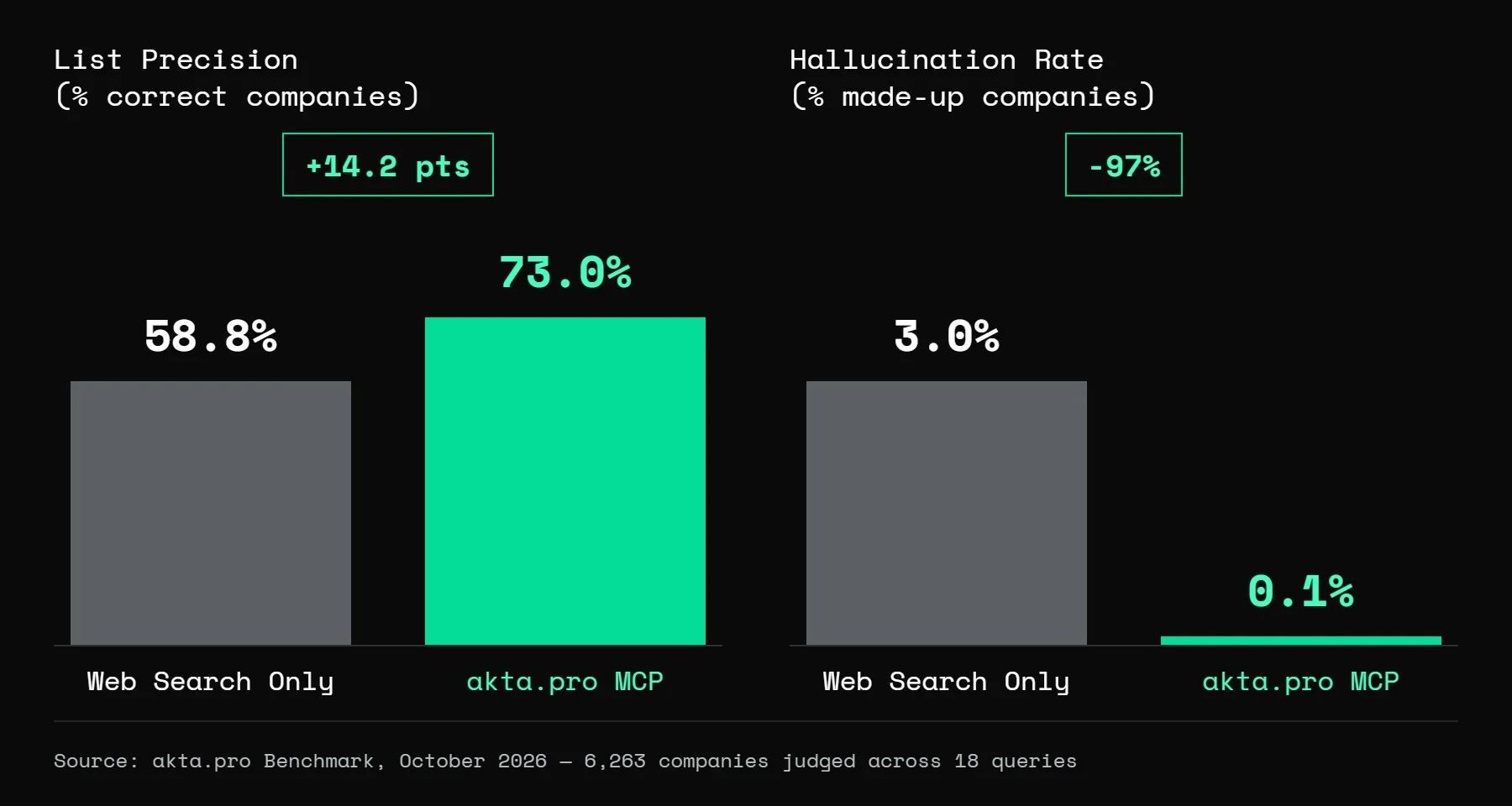
akta.pro's October 2026 benchmark tested three frontier AI models on 18 list-building queries using web search. The results on data quality were specific: 3.0 percent of companies returned by web-search runs "could not be shown to exist," meaning an independent agent searching the web could find no evidence the company was real. Another 7.2 percent came back with the wrong website, meaning any subsequent enrichment, outreach, or CRM matching would attach to the wrong entity. Together, that is roughly 1 in 10 companies returned by a web-search agent being either fake or misdirected.
With structured database access, those numbers dropped to 0.1 percent made up and 0.7 percent wrong website.
The benchmark's own framing is worth quoting: "For lead gen and GTM teams: every wrong row costs something, an SDR's time, an email send, a credit spent enriching the wrong account."
Validation means checking, before enrichment and before CRM import, that:
- The company exists and is currently operating (not acquired, shut down, or dormant)
- The website you have resolves to the right entity (not a name collision or a redirect to an acquirer)
- The company still matches your filters (ownership has not changed, headcount has not shifted outside your band)
If you are building lists manually or via a sales intelligence tool, run a spot-check on 10 to 20 percent of rows before importing. If you are running agents at scale, use a structured company database that entity-resolves every result before returning it, so the validation happens at the source.
Step 5: Enrich the Records Worth Keeping
Enrichment turns a company name and website into a row a rep can open and act on without doing their own research first. At minimum, that means verified contact information for the right personas at each account. In practice, it means context: what the company actually does, who the decision-makers are, how the buying committee maps, and what the account's current state signals about timing.
The fields that matter most depend on your use case. For outbound sales, you need a verified work email and direct dial for each priority contact, plus enough context to personalize the first message. For investment sourcing or competitive intelligence, you need firmographic depth: funding history, revenue estimates, investor names, and operating status. For talent, headcount trends and org structure matter more than contact email.
The trap is enriching every field a provider offers. Enrich for the fields your scoring model and your outreach will actually use. The rest is cost without return.
Waterfall enrichment (querying providers in sequence, moving to the next only when the current one comes up empty) gives you broader coverage at the cost of the first provider that succeeds, rather than paying for every provider upfront. For a full breakdown of what enrichment gives you and when it is worth running, the akta.pro guide to lead enrichment covers each layer in detail.
Step 6: Tier and Score by Fit x Intent, Not Just Company Size
A finished list still has a prioritization problem. Every account passed your filters, which means they all qualify. But they are not all equally worth your team's next hour.
Tiering matches effort to potential. A common structure:
| Tier | Criteria | Effort level |
|---|---|---|
| Tier 1 | High ICP fit + active buying signal | One-to-one, personalized outreach |
| Tier 2 | Good ICP fit, some signal or warm connection | Targeted sequences, lighter personalization |
| Tier 3 | Partial fit or no active signal | Scaled programs, nurture sequences |
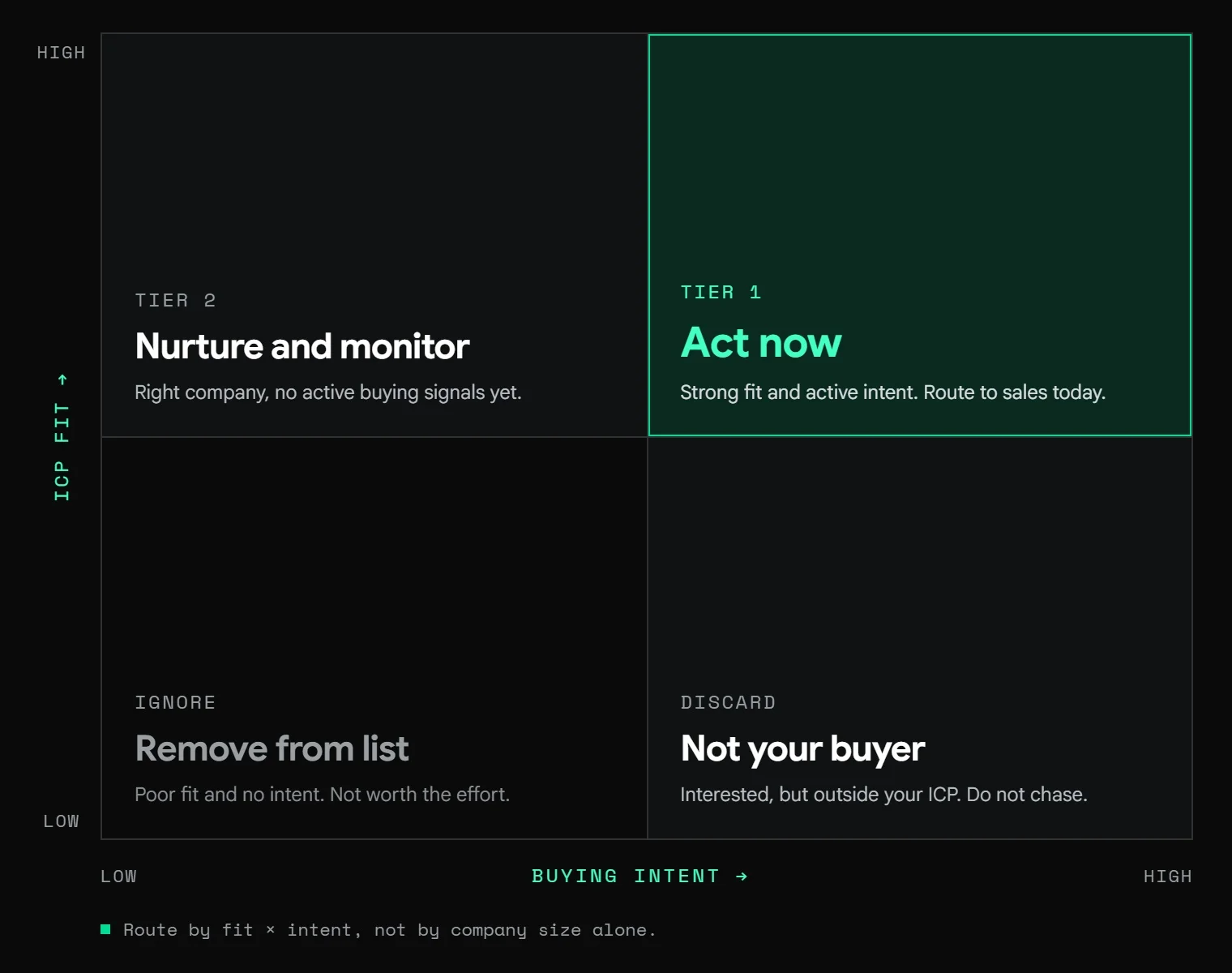
The key principle is that fit and intent are not interchangeable. A company that is a perfect fit but shows no buying signal is a Tier 2 or Tier 3: valuable to hold, not to burn resources on today. A high-intent account that fits your ICP only partially is a distraction, not an opportunity. Route by both axes.
Scoring does not need to be complex. Assign a numeric weight to fit criteria (ICP match on firmographics) and intent signals (funding event, hiring signal, tech stack match), then multiply. The accounts at the top of that scored list are where your team starts each week.
For teams running account intelligence workflows, scoring connects directly to the signals and enrichment data you have already gathered, so the prioritization reflects current account state rather than a snapshot from list-build day.
Step 7: Build In a Refresh Cadence From Day One
B2B contact data decays at roughly 22 to 30 percent per year. That means a list built in January is quietly wrong for one in four companies by the following December, and notably wrong much sooner if you built it on a job-change-heavy segment like early-stage startups.
The practical consequence is that a list you build once is an asset with a shelf life. Without a refresh cadence, the SDR who opens row 400 in October is working a contact who left the company in June.
A simple cadence:
- Quarterly: Full list review. Remove accounts that have shown no engagement after reasonable outreach. Add new accounts that have crossed into your ICP filters. Re-score based on current signals.
- Monthly: Signal scan. Check for trigger events (funding, leadership change, hiring surge) across the active list. Move accounts that spike in signal up to Tier 1 regardless of where they were ranked.
- On CRM import: Reverify email and company status. Never import without checking the records you are adding.
Accounts that go quiet after multiple touches belong in a nurture sequence, not the active list. Keeping them active does not increase the odds of a deal. It dilutes the attention your team gives to accounts that are actually moving.
How to Build a Target Company List With AI Agents
AI agents are increasingly handling the company discovery step in list-building workflows, especially at the volume needed for outbound at scale. The question is not whether to use agents, but what data layer to give them.
An agent running on web search retrieves companies the press has written about. That works well for categories covered extensively in public sources: PLG SaaS, AI legal tech, well-known venture markets. It fails on the lists that matter most for GTM and investment: bootstrapped operators, PE-backed service businesses, niche verticals with little media coverage.
akta.pro's October 2026 benchmark tested this directly. When three frontier models were connected to the akta.pro MCP rather than web search, precision across 18 queries rose from 58.8 percent to 73.0 percent, an increase of 14.2 percentage points. The models returned 440 more correct companies while producing shorter lists overall. And 81.5 percent of the companies returned by akta.pro MCP runs were not found by any web-only run, which means the structured data layer is not just more accurate. It accesses a materially different and larger universe.
The underlying reason is architecture. akta.pro's list generation filters by ownership, geography, funding, and revenue band before returning a company, rather than inferring those facts from web pages after the fact. The agent can answer "find bootstrapped US HVAC companies under $10M valuation" by checking structured fields rather than trying to infer ownership from a homepage.
Raman Khanna, Head of Growth at ElevenLabs, described the downstream result of this precision-first approach in a Clay case study: "Every lead is pre-qualified, scored on unique signals, and routed automatically... We're now generating pipeline from segments we weren't even touching before."
For teams building agent-driven list workflows, the starting point is the akta.pro company database via API or MCP. You can explore 20M+ private company profiles, apply filters by ownership, funding, industry, headcount, and signals, and get entity-resolved results with verified websites, at akta.pro/company-profiles.
FAQ
What is a target company list?
A target company list is a curated set of companies your sales or investment team has selected to pursue, chosen because they match your ideal customer profile and show signs of buying readiness. It differs from your total addressable market (which is every company that could theoretically buy) by being narrow, filtered, and actionable. A well-built list typically contains 50 to 300 accounts per rep, depending on deal complexity.
How do you build a target company list step by step?
Define your ICP with firmographic, signal-based, and ownership filters. Source from a data layer that covers those filters, particularly for private companies. Validate that every company exists and matches your criteria before enrichment. Enrich for the fields your outreach actually uses. Tier accounts by fit x intent. Refresh the list quarterly and monitor signals continuously. These seven steps, covered in the guide above, make up the full process.
How many accounts should be on a targeted account list?
Size the list to your team's capacity, not your market's size. A common reference point is 50 to 150 accounts per rep for outbound sales requiring personalization, and 300 to 500 for scaled sequences. For one-to-one enterprise plays, some reps work as few as 20 to 30 accounts at a time. The right number is the one your team can genuinely engage, not the largest export your database will generate.
How often should you refresh your target account list?
Review the full list quarterly and replace no more than 20 percent at a time, so reps have enough runway with each account before it cycles out. Run a signal scan monthly to move in-market accounts up in priority. Re-verify emails and company status on every CRM import. B2B contact data decays at 22 to 30 percent per year, which means a list built six months ago has meaningful inaccuracies at scale.
What data do you need to build a target company list?
At minimum: firmographic data to filter by industry, size, and geography; ownership and funding data to separate bootstrapped, VC-backed, and PE-backed companies; and intent and signal data to rank accounts by buying readiness. For private companies, revenue band estimates are also needed since most do not publish revenue publicly. Verified contact information for the buying committee comes in the enrichment step, after the company list is built and validated.