Gartner predicted in 2021 that 75% of the highest growth companies would deploy a RevOps model by 2025. Its current research page still concedes that the term has had multiple definitions: a job title to some teams, a reorg to others, a software category to the rest.
RevOps (revenue operations) is the function that runs sales, marketing and customer success operations from one set of data, definitions and workflows. It owns the systems, data rules and handoffs that carry an account from first touch to renewal, so every team reports the same pipeline and acts on the same account record.
This blog will show what a RevOps data stack contains and which workflows to build first.
What is RevOps?
Revenue operations (RevOps) is a business function that integrates the operations of sales, marketing and customer success. It as an end to end model that unifies customer engagement across functions, so teams collect data across the whole revenue process and view it through one trusted source.
Most guides divide the work into four pillars:
- Operations designs the processes and handoffs.
- Enablement trains and equips revenue teams.
- Insights covers reporting and analysis.
- Tools covers the tech stack and the data inside it.
The pillars describe the work well enough. They skip the question that decides whether any of it holds: who owns the data, and what do the rules say?
RevOps vs Sales ops, Marketing ops and Customer Success ops
Sales ops supports the sales team, marketing ops supports marketing, and customer success ops supports onboarding, renewals and expansion. RevOps sits across all three. It owns the shared data model, the cross team metrics and the handoffs between functions, while specialist ops roles keep their depth inside each function.
| Function | Scope | Owns | Typical metrics | Blind spot |
|---|---|---|---|---|
| Sales ops | Pipeline, territories, quotas, CRM administration | Forecast process, comp plans | Quota attainment, win rate, sales cycle length | Data before pipeline and after the sale |
| Marketing ops | Campaigns, automation, lead scoring | Marketing automation, attribution | Cost per lead, sourced pipeline | What happens to an account after handoff |
| Customer success ops | Onboarding, health scores, renewals | Customer success platform | Net revenue retention, gross revenue retention | Context from the sales cycle |
| RevOps | The full lifecycle across all three | Data model, definitions, integrations, handoffs | Lead to close conversion, pipeline coverage, net revenue retention | Can become a bottleneck if it absorbs every function's execution |
It does not replace the specialists. It gives them one record to work from and one set of definitions to report against.
Centralizing has a cost. BCG's 2020 analysis of go to market operations recorded executives who feared that centralized operations teams focus on strategy and neglect execution. BCG's answer for larger companies is a hub and spoke model, where a central team sets standards, tools and common processes and regional teams handle day to day support.
What the research proves, and what it only suggests
Three sources do most of the work in business cases for the function. Each has limits worth knowing before you quote it.
Gartner's maturity research is the most cited. Companies with advanced maturity RevOps functions are twice as likely to exceed revenue goals and 2.3 times as likely to exceed profit goals than companies at intermediate or developing maturity. Gartner's Doug Bushée named the underlying problem when Gartner announced its original adoption forecast: functional silos handing off clients between teams are "a barrier to revenue growth".
Gartner's model has three stages. Developing teams have end to end revenue processes defined but still run on functional platforms. Intermediate teams share data at a moderate level. Advanced teams map processes to the buying journey and centralize data and customer understanding.
BCG reported in 2020 that top B2B technology companies, led by SaaS providers, were seeing 100% to 200% gains in digital marketing ROI, 10% to 20% gains in sales productivity and 30% lower go to market expenses from RevOps. BCG presents these as benefits that leading companies report, alongside client work it observed.
Read all of these as hypotheses. Gartner's 75% figure was a forecast about the highest growth companies, so it cannot show that RevOps caused the growth. Gartner's own 2021 release dated the forecast to 2025, while its current research page says 2026. BCG's results describe companies it observed, with no control group.
The reliable move is to baseline your own numbers before each change: lead to opportunity conversion, forecast error and duplicate account rate.
The RevOps data stack: six layers
A RevOps data stack is the set of systems that store, enrich, move, act on and report revenue data. Six layers cover it: the system of record, company data, signals, data movement, action tools and insight tools. Each layer needs a named owner, because an unowned layer is where records drift and metrics disagree.
Vendor guides tend to treat enrichment as one tool category among several. Tool lists show what to buy. They rarely show who owns each layer or how it fails, which is what the table below adds.
![Diagram of six RevOps data stack layers from record at the base to insight on top, with a data contract rail spanning all six]](https://wklogo.blob.core.windows.net/blog-media-test/b67220ef-126d-4446-9037-9168259cded0_Layered%20Diagram-selection.webp)
| Layer | Job | Typical systems | Owner | Common failure |
|---|---|---|---|---|
| 1. Record | Stores accounts, contacts, opportunities and subscriptions | CRM such as Salesforce or HubSpot, billing, ERP | Sales ops or revenue ops | Duplicate accounts and fields nobody owns |
| 2. Company data | Describes what each account is: size, industry, hierarchy, funding, technology | Enrichment APIs and company databases, including akta.pro | Revenue ops | Stale firmographics and no resolved company ID |
| 3. Signals | Records what happens to an account: funding, leadership change, hiring, layoffs, product use | News signals, product analytics, intent feeds | Revenue ops with sales | Noise that sellers learn to ignore |
| 4. Movement | Moves and syncs data between systems | Warehouse such as Snowflake or BigQuery, reverse ETL, iPaaS, MCP | Revenue ops with the data team | Silent sync failures and field mapping drift |
| 5. Action | Where each team does its work | Engagement tools, marketing automation, customer success platform, CPQ | Function ops | Tools that write conflicting values back to the CRM |
| 6. Insight | Shows leaders the state of revenue | BI, forecasting and revenue intelligence such as Gong or Clari Forecast | Revenue ops | Two dashboards that define pipeline differently |
Each failure in the last column traces to a missing owner or a missing rule. That is why the data contract sits across all six layers rather than inside one.
Why the company data and signals layers decide whether workflows work
First party data tells you what an account did with you. It does not tell you what happened to the account. A funding round, a new chief revenue officer or a layoff changes an account's buying situation before anyone visits your site.
Buyers increasingly use AI for research, which makes many of the engagement signals teams relied on harder to observe and interpret. When your own telemetry gets thinner, outside in company data carries more of the load.
akta.pro covers 20M+ companies with 70+ data points each through its company data API, and classifies news into 77 event types across 11 categories through its news signals API. Access runs through API, MCP, CLI or bulk data.
akta.pro filters roughly 80% of news noise before delivery, and its company news retrieval benchmark scores providers across 71,408 articles and 133 companies. akta.pro is a data layer. It does not replace your CRM, your engagement tool or your forecast.
Every layer joins on one key, and that key is a resolved company ID. Entity resolution is the process of deciding that "Acme Inc.", "ACME Incorporated" and "acme.io" describe one company. Without it, duplicates split activity, signals and pipeline across records. Entity resolution and company data quality goes deeper on how matching works, and the guide to firmographic data covers the fields that belong in layer 2.
A sample data contract
The values below are illustrative. The structure is what matters: one key, one owner per field, one freshness rule, and a written rule for what may overwrite what.
object: account
owner: revops
system_of_record: crm
key: resolved_company_id          # one ID shared by CRM, warehouse and enrichment
fields:
  employee_count:
    source: company_data_api
    owner: revops
    max_age_days: 90
  annual_contract_value:
    source: billing
    owner: finance_ops
    max_age_days: 1
  account_owner:
    source: crm
    owner: sales_ops
    change_control: territory_review
rules:
  duplicate_match: resolved_company_id
  write_back: enrichment_never_overwrites_rep_edits
  alert_when: field_age_exceeds_max_age_days
Six RevOps workflows to build first
Six workflows carry most of the value in RevOps: matching and routing, enrichment and deduplication, lifecycle handoffs, signal triggered plays, forecast inspection and renewal management. Each starts with a trigger, reads specific data, has one owner and breaks in a predictable way.
| Workflow | Trigger | Data it reads | Owner | How it breaks |
|---|---|---|---|---|
| Matching and routing | New lead, signup or form fill | Resolved company ID, territory, account owner | Revenue ops | Matching on email domain alone misses subsidiaries and personal emails |
| Enrichment and deduplication | Record creation and a refresh schedule | Company data fields, match rules | Revenue ops | One time enrichment goes stale |
| Lifecycle handoffs | Stage change, such as MQL to SQL | Stage criteria, owner, time limit | Revenue ops with function ops | Undocumented handoffs lose context |
| Signal triggered plays | A qualifying event at an account | Event type, account tier, owner | Sales and CS with revenue ops | Too many signals, no named play |
| Forecast inspection | Weekly pipeline review | Stage history, amounts, close dates, engagement | Sales ops | Spreadsheets and unreconciled stages |
| Renewal management | A set number of days before renewal | Contract data, health score, signals | Customer success ops | Risk surfaces after the notice window |
1. Matching and routing
A new lead arrives. The workflow matches the person to an account, checks territory and ownership, and assigns an owner inside a stated time limit. Matching on the email domain alone fails for subsidiaries, agencies and personal addresses, so route on a resolved company ID.
2. Enrichment and deduplication
This workflow runs when a record is created and again on a schedule. It fills firmographic fields, merges duplicates under one rule and records where each value came from. The freshness rule in the data contract decides how often it reruns. The post on what a company enrichment API returns lists the fields, and the comparison of B2B data enrichment APIs helps you choose a source.
3. Lifecycle handoffs
Marketing to sales, sales to customer success, customer success to renewal. Each transition needs criteria, an owner and a time limit. BCG lists broken handover processes among the problems that siloed go to market teams struggle with, next to data consistency and tech stack integration.
Include the closed won to billing handoff. When bookings, invoices and recognized revenue sit on different account records, finance and sales report different revenue. Write the criteria down, then alert when a handoff passes its time limit.
4. Signal triggered plays
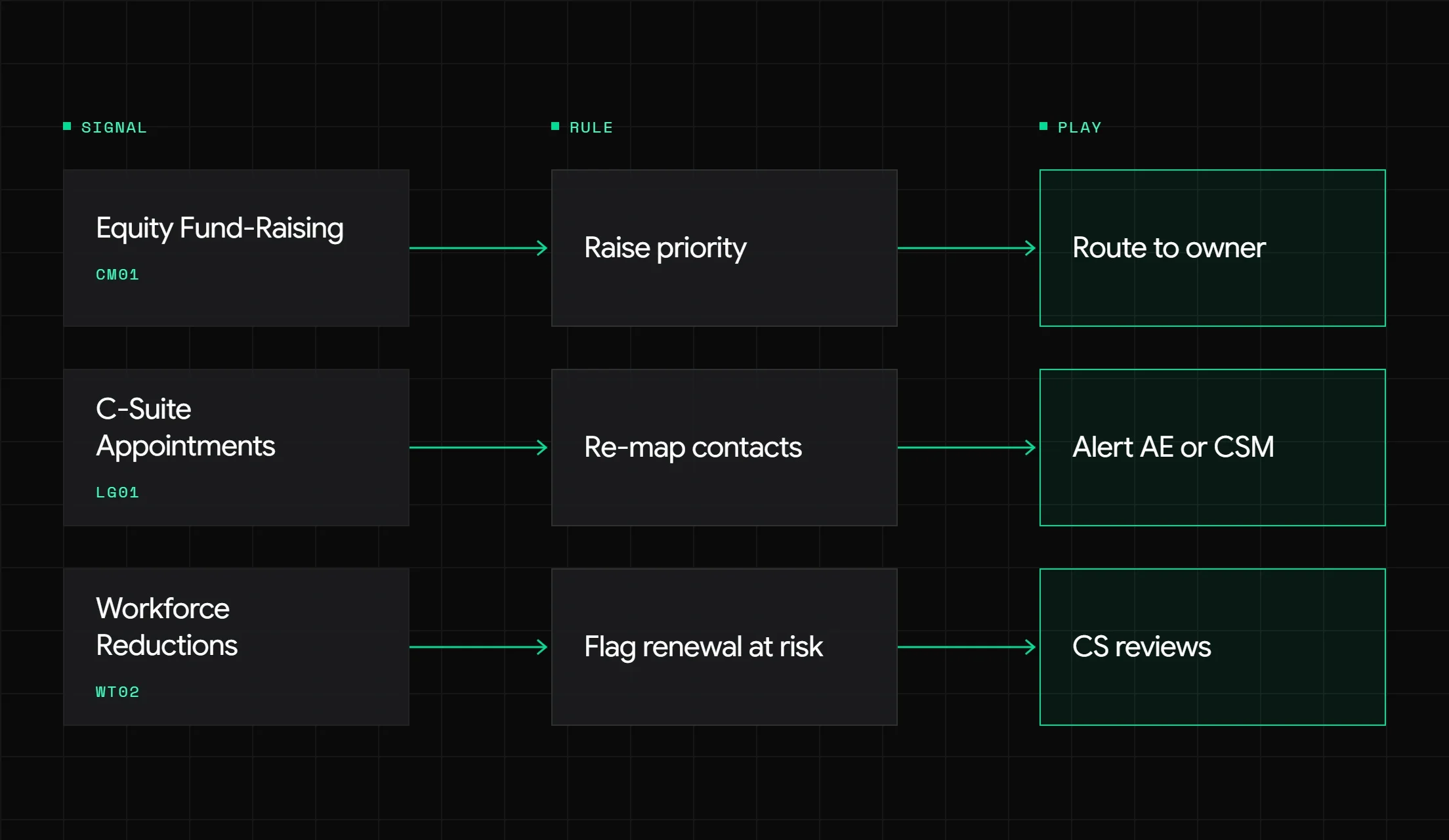
A signal is only useful when it maps to a named play and an owner. The table maps seven akta.pro event types to the action a revenue team can attach to each. Codes and names come from the akta.pro news type taxonomy, retrieved in November 2026.
| Signal (akta.pro code) | What it can mean | Workflow action | Owner |
|---|---|---|---|
| Equity Fund-Raising (CM01) | New budget at a prospect or customer | Raise account priority and route to the account owner inside the routing limit | Sales |
| C-Suite Appointments & Departures (LG01) | The champion or economic buyer may have changed | Re-map contacts, alert the owner, pause sequences to a departed contact | Sales and CS |
| Strategic Hiring (WT01) | A team is building in the area you serve | Add the account to an expansion or outbound play | Sales and CS |
| Workforce Reductions (WT02) | Seat contraction and churn risk | Flag the renewal as at risk and hold upsell plays | CS |
| Mergers & Acquisitions (CM03) | Hierarchy change, duplicate records, contract questions | Link or merge accounts and review entitlements | Revenue ops and CS |
| Financial Distress & Restructuring (RK07) | Payment and renewal risk | Alert finance and the owner, review terms | Finance and CS |
| Geographic Expansion (SD03) | A new region for territory or localization | Reassign territory and open a regional play | Sales ops |
Pulling these signals takes three calls. The parameter names below are as exposed in the akta.pro MCP server, so check the akta.pro docs for the REST schema.
| Step | Call | Parameters that matter |
|---|---|---|
| Resolve the company | company_search (free) | Company name or website. Returns a 7 character company ID. |
| Filter the signals | news_signals | primary_company, type_codes (for example CM01, LG01), start_date, sentiment, group_articles |
| Read what matters | news_detail | Article IDs, when you need the full text |
The primary_company parameter keeps only articles where the company is the subject, which removes passing mentions. Setting group_articles collapses near duplicate coverage of one event. Together they keep the feed short enough that sellers read it. For alerting patterns, see the builder's guide to a company alerts API.
5. Forecast inspection
Forecast inspection reads stage history, amounts, close dates and engagement every week. It fails when the data underneath is wrong.
In the 2023 RevOps Trends Report, a survey of 200+ RevOps and sales leaders run by RevOps Co-op and Scratchpad, only 22% strongly agreed they had the right data to forecast accurately. Another 35% forecast with spreadsheets and 51% mix manual and automated tools. The survey is from 2023, so treat it as a baseline to compare against, and note that Scratchpad sells software in this space.
6. Renewal management
Renewal management starts a set number of days before the renewal date and reads contract data, health scores and external signals. A layoff or a financial distress event at the customer belongs here, because it tells you about risk before the customer does.
Two scoreboards: Revenue Metrics and Data Health
Revenue teams track two kinds of metrics. Revenue metrics show how the funnel performs, and data health metrics show whether those numbers can be trusted. Gartner analysts name five data readiness dimensions: accuracy, consistency, completeness, timeliness and tagging. Each one converts into a measurable rule for your records.
| Revenue metric | Data health metric (Gartner dimension) |
|---|---|
| Lead to opportunity conversion | Duplicate account rate (accuracy) |
| Pipeline coverage ratio | Share of required fields populated (completeness) |
| Win rate and sales cycle length | Share of records carrying a resolved company ID (consistency) |
| Forecast accuracy | Median field age against its freshness rule (timeliness) |
| Net and gross revenue retention | Share of records with stage and source tags (tagging) |
| Customer acquisition cost | Routing latency against the stated limit |
The pairing of metrics to dimensions is ours, so adjust it to your own data model. Pick one definition for each metric and publish it. Disagreements shift from whose number is right to what to do about it.
How to structure a RevOps team by company stage
| Stage | Typical shape | First priorities | Common mistake |
|---|---|---|---|
| Early stage | One generalist covering CRM administration, reporting and process | One account record, written stage definitions, basic routing | Buying five tools before defining one stage |
| Growth | A small team split between systems and analytics, with function ops alongside | Data contract, enrichment, handoff limits, forecast inspection | Letting each function keep its own pipeline definition |
| Scale | Hub and spoke: central standards and tooling, embedded ops in each function | Signals, governance, agent guardrails, planning | Centralizing so far that execution slows |
Reporting lines vary. BCG heard executives say they would want the function to report to a chief revenue officer, and it also warned that org changes alone fall short. In its words, "Processes and tools are where results are produced".
How AI agents change RevOps in 2026
AI agents act on whatever data they can read, so data quality becomes the limit on every automation in the revenue stack. Gartner analysts expect agents to execute 75% of RevOps tasks in workflow management, data stewardship, revenue analytics and RevTech administration by 2028. Teams that test data readiness first get reliable agents.
That forecast comes from three Gartner analysts writing in Demand Gen Report in September 2025. They advise auditing the stack for data interoperability and assessing customer data against the five readiness dimensions before piloting agents on data curation.
Agents also need a way to reach company data. An MCP server lets an agent resolve a company, pull enrichment and filter signals by event type without a custom integration for each source. akta.pro exposes company data and news signals this way to Claude, ChatGPT, Cursor, VS Code and other MCP clients.
Frequently asked questions
What does RevOps stand for?
RevOps stands for revenue operations. It is the function that integrates the operations of sales, marketing and customer success so they share data, definitions and processes across the customer lifecycle.
What is the difference between RevOps and sales operations?
Sales operations supports the sales team through pipeline reporting, territories, quotas and CRM administration. RevOps covers sales ops plus marketing ops and customer success ops, and owns the shared data model and the handoffs between them.
What does a RevOps team do?
The team owns the revenue tech stack, the account data model, lifecycle definitions, handoffs, reporting and forecast inputs. It also runs the workflows that route leads, keep records clean and flag risk at existing accounts.
What data does a RevOps team need from outside the CRM?
Revenue teams need company data that describes each account and signals that show what changed at it. akta.pro provides both through one API, MCP, CLI or bulk data feed, with entity resolved company records so the same company is not counted twice.