In a Gartner survey of 303 sales leaders, 84% said sales analytics had less influence on sales performance than leadership expected. Revenue intelligence is the category built to close that gap. In 2026 it is also the one most likely to fail for a reason vendors rarely lead with: the data underneath it.
Revenue intelligence is the practice of capturing data from every revenue activity, including CRM records, sales calls, emails, product usage, and external company events, and using AI to predict deal outcomes, flag risk, and recommend the next action. It replaces rep-reported pipeline with evidence, so forecasts and coaching rest on what buyers actually did.
What is revenue intelligence?
Revenue intelligence is an AI layer that reads what happens across the revenue cycle and turns it into predictions and actions. It pulls from the CRM, calls, emails, meetings, and outside events, then tells sellers, managers, and RevOps which deals are real, which are slipping, and what to do next. The output is a decision someone can act on.
A useful way to picture it: the CRM is a ledger of what reps typed. Revenue intelligence is the auditor that checks the ledger against what buyers did and said.
Gong describes itself as the company that pioneered the revenue intelligence category in 2019, built on recording and transcribing customer conversations. The category has since widened. In December 2025, Gartner published its first Magic Quadrant for Revenue Action Orchestration, which evaluates vendors on how well they consolidate revenue signals, deliver autonomous guidance, and scale sales execution. On a vendor page in 2026, the term usually refers to the intelligence layer inside one of these broader platforms.
How does revenue intelligence work?
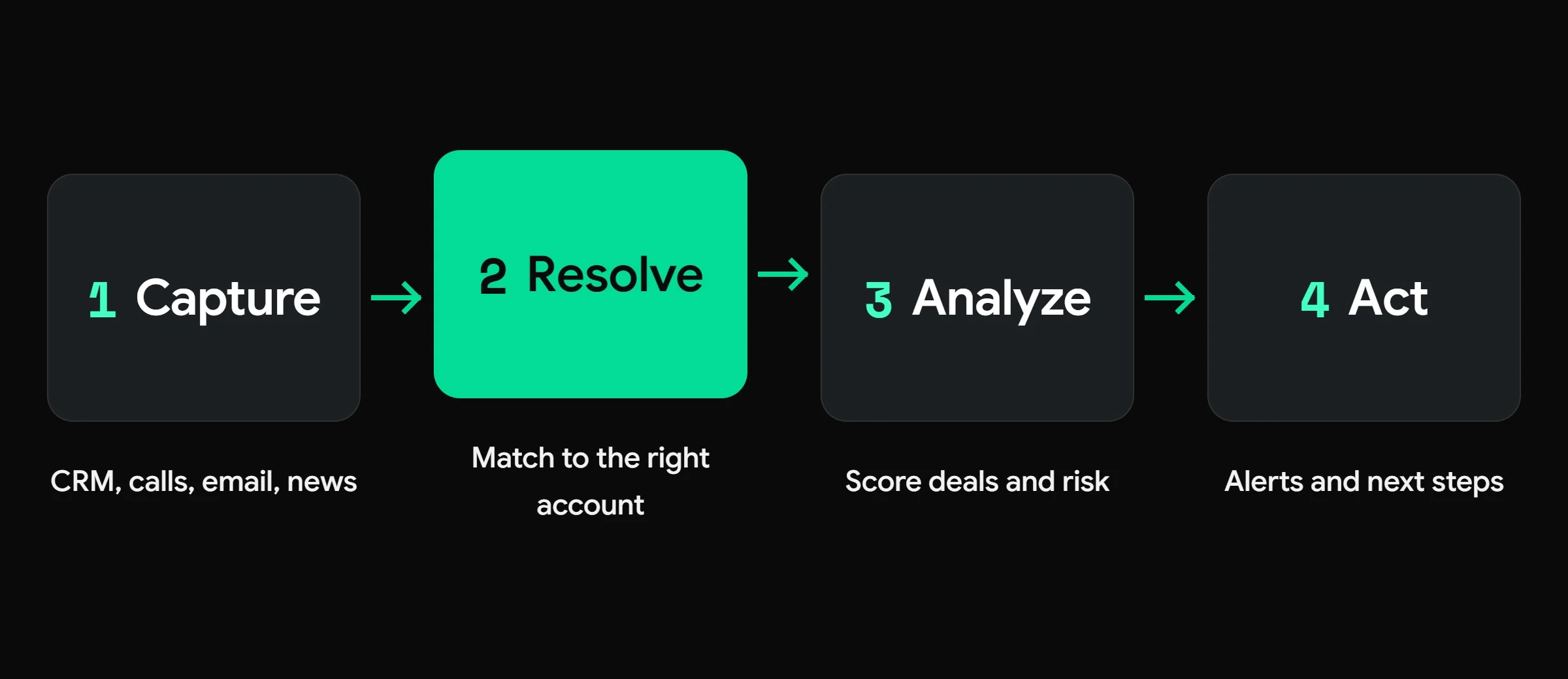
It works in four stages. It captures activity from every system that touches a deal, resolves each signal to the correct account and contact, analyzes patterns against historical wins and losses, and pushes recommendations into the tools where reps and managers already work. Skipping the second stage is the most common reason predictions go wrong.
-
Capture. Connectors pull CRM fields, calendar events, call recordings, email threads, product usage, and external company events. Capture should be automatic, because anything that depends on reps logging it will be incomplete.
-
Resolve. Every email address, meeting attendee, news article, and usage record has to be matched to the right account and person. This step is called entity resolution. A signal attached to the wrong "Acme" is worse than no signal.
-
Analyze. Models compare live deals with closed ones. They score deal health, detect stalled opportunities, compare forecast categories against activity, and spot recurring objections or competitor mentions in transcripts.
-
Act. Insights become alerts, forecast adjustments, coaching moments, and suggested next steps inside the CRM, Slack, email, or an AI agent. An insight nobody acts on has zero value.
What data does revenue intelligence use?
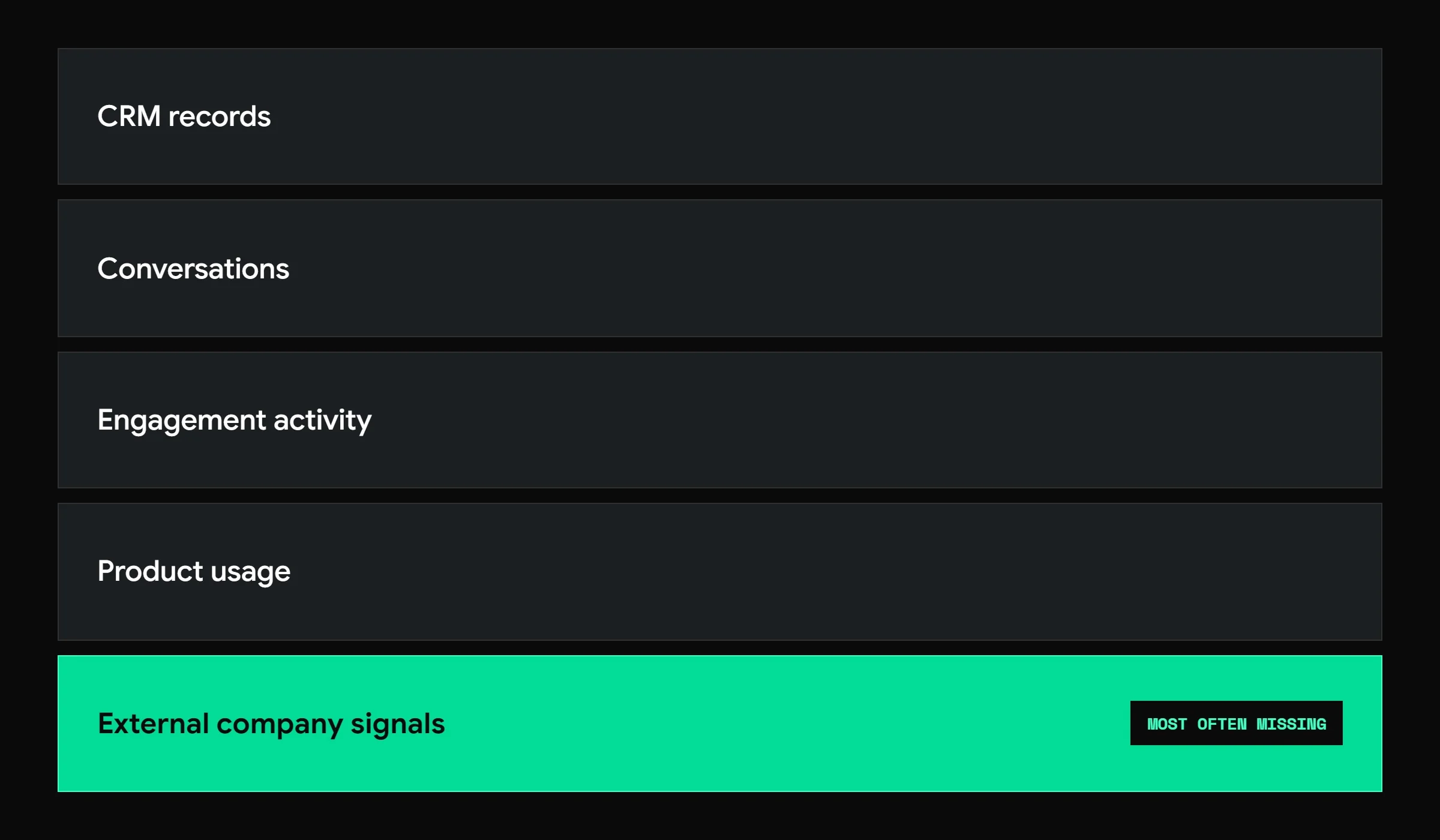
It draws on five data layers: CRM records, conversations, engagement activity, product usage, and external company signals. Most platforms are strong on the first three. External signals are the layer most stacks miss, even though they explain many of the deal changes that never come up on a call.
| Data layer | Examples | Question it answers | Typical blind spot |
|---|---|---|---|
| CRM records | Stage, amount, close date, contacts | Where does the pipeline stand on paper? | Rep-entered and often stale |
| Conversations | Call recordings, meeting transcripts | What did the buyer actually say? | Covers only recorded meetings |
| Engagement activity | Email replies, meeting attendance, content views | Who in the buying group is engaged? | Silent stakeholders stay invisible |
| Product usage | Logins, seats, feature adoption | Is the customer getting value? | Exists only after the sale or in product-led motions |
| External company signals | Funding, acquisitions, leadership changes, layoffs, hiring, expansion | What changed at the account outside your conversations? | Absent from most stacks and hard to match to the right company |
The takeaway: a platform that reads only the first four layers sees your relationship with the account, but not the account itself.
The market is moving to fix this. On September 30, 2026, Gong launched Gong Enrich, which pulls third-party account and contact data into its Revenue Graph, meaning Gong's own graph and the CRM. When the category's best-known vendor builds in outside data, internal data alone is clearly no longer enough.
The external layer covers events like the ones in akta.pro's guide to buying signals and how to track them automatically, plus the firmographic data that tells you whether an account still fits your ideal customer profile.
Revenue intelligence vs sales intelligence, conversation intelligence, BI, and RevOps
Revenue intelligence analyzes your own revenue process to improve execution. Sales intelligence finds and qualifies prospects with external data. Conversation intelligence analyzes calls and meetings and is usually a component of revenue intelligence. Business intelligence reports on history across the company. RevOps is the team that owns the systems.
| Term | What it is | Main question | Primary users |
|---|---|---|---|
| Revenue intelligence | AI layer across pipeline, activity, and conversations | How do we win the deals we have? | Sales leaders, managers, RevOps |
| Sales intelligence | External contact and company data for prospecting | Who should we sell to? | SDRs, BDRs, AEs |
| Conversation intelligence | Recording, transcription, and analysis of calls | What happened in the meeting? | Reps, managers, enablement |
| Business intelligence | Historical reporting across functions | What happened last quarter? | Finance, executives, analysts |
| Revenue operations | A team and the processes it owns | Are our systems and processes aligned? | RevOps team |
These categories feed each other. Sales intelligence supplies accounts and contacts, conversation intelligence supplies call evidence, and revenue intelligence combines both with pipeline data. For the prospecting side, see akta.pro's comparison of sales intelligence platforms for B2B teams. For the team that runs it all, see what RevOps is and the data stack behind it.
6 benefits of revenue intelligence
The core benefits of revenue intelligence are forecasts built on evidence, earlier risk detection, coaching grounded in real calls, more time for selling, better retention signals, and one shared view of pipeline. Each benefit depends on data coverage and rep adoption, so treat vendor ROI claims as directional until you measure your own baseline.
1. Forecasts built on evidence instead of optimism
The platform compares each committed deal with activity and outcomes from similar past deals. Gartner found that analytics programs led by the chief sales officer are 2.3 times more likely to achieve higher forecast accuracy than programs led elsewhere. The tool helps, but ownership at the top decides whether the forecast changes.
2. Earlier warning on deals at risk
Models flag deals where the economic buyer never joined a call, replies have stopped, or the close date keeps sliding. Managers see risk weeks before the quarter-end review, when there is still time to multithread or reset expectations.
3. Coaching based on what happened
Call analysis shows how top performers handle pricing questions, discovery, and objections. Managers coach from recordings instead of rep recollection, and new hires learn from real calls.
4. More time for selling
Sellers spend just 40% of their time selling, according to Salesforce's 2026 State of Sales survey of 4,050 sales professionals. Automatic activity capture and AI summaries remove some of the logging and note-taking that fills the other 60%.
5. Retention and expansion signals
After the sale, usage drops, unanswered tickets, and changes at the customer company predict churn. The platform surfaces these for customer success teams, along with expansion triggers such as new funding or headcount growth.
6. One version of pipeline truth
Sales, marketing, customer success, and finance read from the same data. Forecast calls shift from debating whose numbers are right to deciding what to do about them.
Revenue intelligence metrics to track
The metrics that matter most are forecast accuracy, pipeline coverage, deal velocity, stage conversion, win rate, buying group coverage, slipped deals, and net revenue retention. Measure each one before rollout so you can prove whether the platform moved it.
| Metric | Definition | Why it matters |
|---|---|---|
| Forecast accuracy | Forecast versus actual closed revenue for the period | The headline test of the whole program |
| Pipeline coverage | Open pipeline divided by remaining quota | Shows whether there is enough pipeline to hit the number |
| Deal velocity | Average days from opportunity creation to close | Reveals where deals slow down |
| Stage conversion | Share of deals advancing from one stage to the next | Pinpoints the weakest stage in your process |
| Win rate | Closed-won deals divided by all closed deals | Measures execution quality by rep, segment, and source |
| Buying group coverage | Engaged contacts per opportunity | Single-threaded deals carry more risk |
| Slipped deals | Deals whose close date moved out of the period | Early indicator of forecast inflation |
| Net revenue retention | Revenue kept and expanded from existing customers | Connects the program to post-sale health |
Revenue intelligence examples
The category earns its cost when a signal turns into an action someone would otherwise have missed. The five scenarios below are illustrative workflows rather than customer case studies, and show how each data layer produces a decision.
Example 1: The stalled enterprise deal
A $250,000 opportunity sits in "Negotiation," but the buyer has not replied in 21 days and the economic buyer never attended a meeting. The platform marks the deal high risk and drops it from the commit forecast suggestion. The manager asks the AE to reach the CFO through an executive sponsor before the quarter ends.
Example 2: The champion who left
Your main contact at a renewal account changes jobs. Without an external signal, the team learns about it when emails bounce. With a leadership change alert tied to the right account, the account executive finds a new sponsor 60 days before renewal.
Example 3: The customer that got acquired
News breaks that a mid-market customer has been acquired by a larger company. That is both a churn risk, since the acquirer may standardize on another vendor, and an expansion opening. Teams that monitor company news through a company alerts API can route the event to the account owner the same day.
Example 4: The commit review
Before the weekly forecast call, the platform compares every committed deal with the activity profile of deals that closed in past quarters. Two commits show half the usual stakeholder engagement. The CRO questions those two first and spends the meeting on the deals that need help.
Example 5: The competitor surge
Mentions of one competitor in call transcripts double over a quarter, mostly in the mid-market segment. Enablement updates the battlecard and pricing guidance before win rates in that segment fall.
Why revenue intelligence often underdelivers
Revenue intelligence underdelivers when the inputs are wrong: incomplete CRM data, signals matched to the wrong company, low rep adoption, or integrations nobody secured. The model then produces confident predictions about bad data. Fixing inputs usually improves results more than switching platforms.
Data quality comes first. In Gartner's 2024 survey, the top three barriers to sales analytics success were data privacy concerns (45%), poor data quality (44%), and limited cross-functional collaboration (44%). Gartner's Kelly Fischbein summed up the result: "many organizations struggle to produce actionable insights regarding their most important decisions." Salesforce's 2026 research points the same way. Over half of sales leaders using AI (51%) say disconnected systems slow their AI initiatives, and 79% of high performers prioritize data hygiene compared with 54% of underperformers. Salesforce EVP of Sales Adam Alfano put it bluntly: "Stand-alone agents without comprehensive customer context tend to fail."
Entity resolution decides whether external signals help or hurt. Company names collide constantly. When we looked up gong.io in akta.pro's company index on November 19, 2026, the name "Gong" matched 15 distinct companies, including a bubble tea chain, a yoga studio, and a Croatian civic education group. A system that matches news by name alone will attach the wrong events to your accounts. In akta.pro's July 2026 benchmark, general news aggregators returned the right company only 32% to 58% of the time, while akta.pro's entity-resolved feed reached 93%. akta.pro authored and ran that benchmark, and the harness and company list are public so anyone can re-run it.
Adoption is uneven by design. Reps record calls and update stages. Managers and executives consume most of the output. If reps see no benefit, recording rates drop and the data degrades. Pick use cases that give reps something back, such as automatic call notes or account briefs, before asking them to change habits.
Every connector is a security decision. Between August 8 and 18, 2025, a threat actor Google tracks as UNC6395 used OAuth tokens stolen from the Salesloft Drift integration to export data from Salesforce instances. Google Threat Intelligence Group advised affected organizations to treat that data as compromised. Revenue intelligence platforms need broad CRM, email, and calendar access, so token scopes and vendor security reviews belong on the evaluation checklist.
A blunt rule follows from all four points: the most expensive platform in your stack is only as accurate as the cheapest data feed it reads.
Revenue intelligence tools in 2026
The revenue intelligence market consolidated sharply in 2025 and 2026. Gartner now evaluates the space as Revenue Action Orchestration, Clari and Salesloft operate as one company, and leading platforms are adding third-party data. Buyers now choose between broad platforms and decide separately where external company data comes from.
Three facts frame the market as of November 2026:
- Gartner's first Revenue Action Orchestration Magic Quadrant, dated December 15, 2025, named Gong, Outreach, and Clari as Leaders, and Salesloft and People.ai as Visionaries.
- The 2026 edition evaluated 13 vendors and named four Leaders, including Gong and Outreach, each for the second year.
- On September 2, 2026, Salesloft began operating as one brand with Clari, keeping the Clari name only for Clari Forecast.
| Tool | Best known for | Status as of November 2026 |
|---|---|---|
| Gong | Conversation capture, deal intelligence, forecasting | Gartner RAO Leader in 2025 and 2026; added third-party enrichment in September 2026 |
| Salesloft (with Clari Forecast) | Sales engagement cadences plus enterprise forecasting | Operating as one Salesloft brand since September 2, 2026 |
| Outreach | Sales engagement, deal management, forecasting | Gartner RAO Leader in 2025 and 2026 |
| People.ai | Automatic activity capture into the CRM | Gartner RAO Visionary in 2025 |
| Chorus by ZoomInfo | Conversation intelligence paired with B2B contact data | Sold as part of ZoomInfo's platform |
How this list was built: vendors named in Gartner's 2025 or 2026 Revenue Action Orchestration Magic Quadrant announcements, plus one conversation intelligence product owned by a B2B data vendor. Facts were checked against vendor and Gartner sources on November 19, 2026. It maps the market and does not rank vendors.
The external data layer underneath
None of these platforms is built primarily to track what happens inside your accounts outside of your conversations. That job belongs to a data layer. akta.pro, built by Wokelo AI, provides company data on 20M+ private companies and entity-resolved news signals, each article classified against an 80+ event taxonomy covering funding, M&A, leadership, and risk. Teams pipe it into their revenue intelligence platform, CRM, or AI agents through an API or an MCP server. If you are wiring agents to this kind of data, akta.pro's roundup of MCP servers for research, finance, and GTM teams covers the options.
How to choose a revenue intelligence platform
Choose a revenue intelligence platform by starting from your biggest bottleneck. Forecast misses, weak coaching, missed account changes, and tool sprawl each point to different capabilities. Then test data coverage, entity resolution, security, and rep adoption before you sign.
| Your bottleneck | Prioritize | Question to ask the vendor |
|---|---|---|
| Forecast misses | Forecasting and deal inspection | How does the model weigh rep input against activity data? |
| Weak coaching | Conversation intelligence | What share of customer calls will realistically be recorded? |
| Missed account changes | External signals with entity resolution | Which sources feed company events, and how are they matched to accounts? |
| Too many tools | Consolidated platform | Which modules are priced separately? |
| AI agent workflows | API, MCP access, and CRM write-back | Can our agents read and write the same data the UI uses? |
| Security review | OAuth scopes and token handling | What changed in your integration security after the 2025 Drift incident? |
The takeaway: if two vendors look identical in a demo, the tiebreaker is usually data coverage and how cleanly each one matches signals to your accounts.
How to implement revenue intelligence in 90 days
-
Weeks 1 to 2: Set the baseline. Record current forecast accuracy, win rate, slipped deals, and sales cycle length. Without a baseline, nobody can prove the platform worked.
-
Weeks 2 to 4: Audit CRM data. Remove duplicates, merge accounts, and fix missing contacts. Enrich records with lead and account enrichment where gaps are large.
-
Weeks 3 to 6: Connect capture sources. Turn on email, calendar, and call capture, and scope every OAuth token to the minimum access needed.
-
Weeks 5 to 8: Add external signals. Route funding, acquisition, and leadership change alerts for your top accounts to their owners.
-
Weeks 6 to 10: Launch one use case. Start with deal risk alerts or the forecast review. Run it in the weekly meeting until it becomes routine.
-
Weeks 10 to 13: Measure and expand. Compare against the baseline, then add coaching or customer success use cases.
Frequently asked questions
What is the difference between revenue intelligence and revenue operations?
Revenue operations is a team that aligns sales, marketing, and customer success processes and systems. Revenue intelligence is a technology layer that RevOps often owns and runs. RevOps decides how the revenue engine should work, and revenue intelligence shows whether it does.
Is revenue intelligence the same as sales intelligence?
No. Sales intelligence provides external contact and company data to find and qualify prospects. Revenue intelligence analyzes your own pipeline, activity, and conversations to win deals already in progress. The two connect when external company signals feed revenue intelligence models.
Does revenue intelligence replace a CRM?
No. The CRM remains the system of record for accounts, opportunities, and stages. Revenue intelligence reads from the CRM, adds activity and external data, and writes insights back. Most platforms are built to sit on top of Salesforce, HubSpot, or Microsoft Dynamics.
Is Gong a revenue intelligence platform?
Yes. Gong calls itself a revenue AI platform, started with conversation intelligence, and was named a Leader in Gartner's Revenue Action Orchestration Magic Quadrant in 2025 and 2026. In September 2026, it added third-party account and contact enrichment through Gong Enrich.
What are the most important revenue intelligence metrics?
The most important metrics are forecast accuracy, pipeline coverage, deal velocity, stage conversion rate, win rate, buying group coverage, slipped deals, and net revenue retention. Forecast accuracy is the headline test, because it shows whether the platform changed decisions.